Trauma researchers continue community-driven work to disrupt poverty in Edgecombe (EducationNC)

Carey Sipp Carey Sipp 3/29/185:16 PM

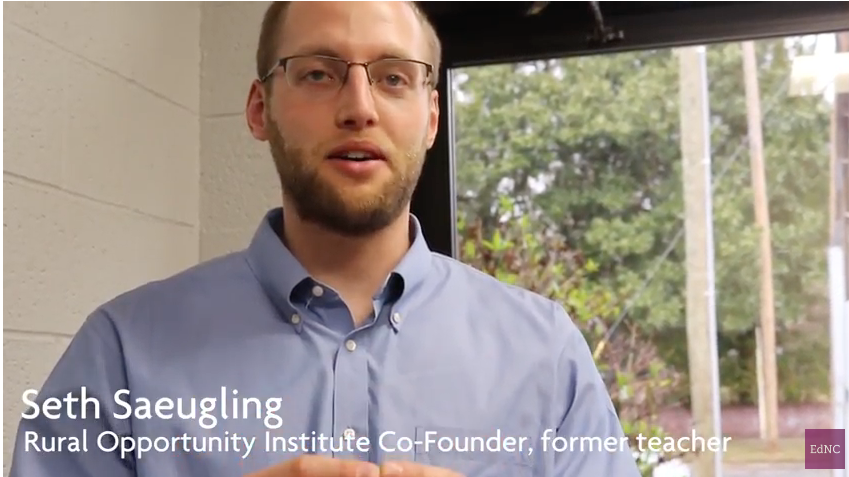
For months, Rural Opportunity Institute co-founders Seth Saeugling and Vichi Jagannathan have gathered Tarboro community members, interviewed families and leaders, and analyzed research around intergenerational trauma in a Pattillo Middle School office. 

“Where we’re headed is to really identify where is the leverage?” Saeugling said. “What’s the North Star and how can we all start rowing in the same direction when it comes to trauma and trying to provide healing opportunities?”

On Tuesday, healthcare providers, pastors, education leaders, and other Tarboro residents met to dissect a map of the largest issues in their community. 

Seth Video Shot

Karen Grattan, CEO and co-founder of Engaging Inquiry, led the group through “systems thinking” practices that allow analyzation of a larger system before focusing in on one solution. Groups of three or four community members took one “leverage point” and identified what is already happening in the community and how those resources can be used to shift negative patterns of trauma.

For more of EducationNC reporter Liz Bell’s continuing coverage of this story on community-based efforts to disrupt multigenerational trauma, please click here.

To see her video report and interview with Seth Saeugling and community members, please click here.

Attachments

Hide

Images (1)

Seth Video Shot

Carey Smith Sipp

carey.pacescommunites@gmail.com

❤️ 1

Closer Look: The Plight of Asylum-Seekers in the U.S.; Immigration and Trauma; Archdeacon Juan Sandoval; And More [Station WABE: A Closer Look]

Carey Sipp Carey Sipp 6/30/182:55 PM

(L-R) Janet Cox, PhD, ACEs Connection member and Atlanta psychologist, Rose Holmes, host of A Closer Look, and Carey Sipp, SE Community Facilitator for ACEs Connection.

This week I was a guest on A Closer Look, a news show hosted by journalist Rose Holmes on WABE, the National Public Radio (NPR) affiliate in Atlanta, GA. Psychologist Janet Cox, PhD, joined me on the second segment of the show. We talked about the impact of trauma on children who are separated from their parents, and the impact of trauma on the parents themselves. We were preceded by asylum seekers, and heard the harrowing story of a young mother desperate to leave her country for fear of losing her life, and the life of her child, at the hand of a gang that was angry with her for giving water to a police officer. Dr. Cox and I were followed by Archdeacon Juan Sandoval of the Episcopal Diocese of Atlanta, who spoke of the role of the church as families are separated at the U.S. border.

1:00:53 | Play story Add to My List

Monday on “Closer Look with Rose Scott”:

Today’s special edition of “Closer Look” focuses on the experience of asylum-seekers and the local response to U.S. immigration policies.

  • 0:00: President Donald Trump last week signed an executive order meant to end the separation of families at the border by detaining parents and children together for an indefinite period. But many say that it’s not enough. Now, a number of Georgia-based immigrant and minority advocacy groups are planning a “Families Belong Together” rally in Atlanta on Saturday, June 30. One of the major organizing forces behind the rally is the Georgia Alliance for Social Justice, which worked on Atlanta’s March for Our Lives earlier this year and grew into existence from Atlanta’s local Women’s March in 2017. We speak with Executive Director Janel Green about the rally, the intended messaging, and possible solutions.
  • 7:50: Our special edition of Closer Look continues as we hear the personal stories of those who sought – and were granted – asylum here in the U.S. We’re joined by Estrella and Erika, two of asylum-seekers here in Atlanta. We’re also joined by Shirley Zambrano, associate attorney with Kuck and Baxter Immigration Partners, and Sarah Owings, owner and attorney at Owings Immigration Law.
  • 29:23: What kinds of trauma can children experience when they are abruptly separated from their parents? We’ll ask Dr. Janet Cox, a clinical psychologist, and Carey Sipp, the southeast regional community facilitator at ACEs Connection Network, a social network helping communities accelerate the global science movement to prevent trauma and adverse childhood experiences (ACEs), heal trauma, and build resilience.
  • 42:33: Archdeacon Juan Sandoval, who leads the Episcopal Diocese of Atlanta’s immigration support programs, talks about how this issue places America at the intersection of compassion and politics.

Closer Look is hosted by Rose Holmes produced by Candace Wheeler, Emilia Brock and Trevor Young. To hear the broadcast, click here.

Carey Smith Sipp

carey.pacescommunites@gmail.com

Tags: Janet Cox, PhDAtlanta Diocese of the Episcopal ChurchRose HolmesEpiscopal ChurchImmigrationChildhood traumaBorder

Views: 581

Some 350 Florida Leaders Expected to Attend Think Tank with Dr. Vincent Felitti, Co-Principal Investigator of the ACE Study

Carey Sipp Carey Sipp 8/5/1811:49 AM

Leaders from across the Sunshine State will take part in a “Think Tank” in Naples, FL, on Monday, August 6, to help create a more trauma-informed Florida. The estimated 350 attendees will include policy makers and community teams made up of school superintendents, law enforcement officers, judges, hospital administrators, mayors, PTA presidents, child welfare experts, mental health and substance abuse treatment providers, philanthropists, university researchers, state agency heads, and faith-based leaders. 

Hosted by Florida State University’s Center for Prevention, the Think Tank features Dr. Vincent Felitti, who was principal investigator with Dr. Robert Anda of the CDC-Kaiser Permanente Adverse Childhood Experiences (ACE) Study. The study of 17,337 mostly white, middle-class and college-educated Kaiser patients in San Diego, asked participants 10 questions about abuse, neglect and family dysfunction, including violence, drug or alcohol addiction, divorce or separation, mental illness, or having someone in the immediate household jailed. The number of these “adverse childhood experiences” became known as a person’s ACE score.

ACEs science became a public health phenomenon over the past 20 years because it proves the relationship between adverse childhood experiences and the increased likelihood of cancer, heart disease, mental illness, drug or alcohol addictions, criminality, and more,” Felitti said.

The study found that almost two-thirds of those questioned had at least one ACE. The higher the score, the higher the risk of consequences. For example, people with four or more ACEs have a 700 percent increased risk of alcoholism, and a 1200 percent increased risk of attempted suicide. (Got Your ACE Score?)

ACEs are not limited to the original 10 in the ACE Study. Subsequent ACE surveys include other types of childhood adversity, such as: racism, sexism, bullying, witnessing violence outside the home, and living in an unsafe neighborhoods, to name just a few. 

The ACE Study is one part of ACEs science, which also includes:

  1. Brain science (neurobiology of toxic stress) — how toxic stress caused by ACEs damages the function and structure of kids’ developing brains.
  2. Health consequences — how toxic stress caused by ACEs affects short- and long-term health, and can impact every part of the body, leading to autoimmune diseases, such as arthritis, as well as heart disease, breast cancer, lung cancer, etc.
  3. Historical and generational trauma (epigenetic consequences of toxic stress) — how toxic stress caused by ACEs can alter how our DNA functions, and how that can be passed on from generation to generation.
  4. Resilience research and practice — Building on the knowledge that the brain is plastic and the body wants to heal, this part of ACEs science includes evidence-based practice, as well as practice-based evidence by people, organizations and communities that are integrating trauma-informed and resilience-building practices. This ranges from looking at how the brain of a teen with a high ACE score can be healed with cognitive behavior therapy, to how schools can integrate trauma-informed and resilience-building practices that result in an increase in students’ scores, test grades and graduation rates.


A study by the Florida Department of Juvenile Justice found that early adversity increased delinquency. While at the same time all youths involved with the agency had at least one ACE,  the study showed that half had experienced four or more ACEs.

Subsequent studies also found that resiliency or protective factors, such as having a caring adult in one’s life, could buffer the negative impact of ACEs. 

“Our work as judges, teachers, doctors, therapists, officers and community leaders must be infused with an understanding of ACEs and trauma.  We can end the cycle of abuse, addiction, jail and chronic illness for this generation and the next, one individual at a time,” said Judge Lynn Tepper, whose court became a nationally ranked trauma-informed court as a result of ACEs science. It was Tepper who invited Felitti to Florida to lead the Think Tank.

Dr. Mimi Graham, the director of the FSU Center for Prevention, who spearheaded the event, said the idea is to create statewide momentum to build Florida’s trauma initiatives into a collective effort that can reduce some of the state’s most intractable problems. 

Concurrent with the Think Tank, the FSU Center for Prevention is releasing a book, Creating a Trauma Informed State – A Showcase of Florida’s Cutting Edge Trauma Initiatives, which features 50 innovations from many of the attendees at the event. Those initiatives include programs such as trauma-informed courts and schools, partnerships between sheriffs and doctors, classes in yoga in women’s jails, ACE screenings in pediatric clinics, resiliency efforts for college students, and pet therapies to help traumatized kids.

Thanks to the Charles & Margery Barancik Foundation, each of the attendees will receive a copy of the book. A PDF of the book is attached to this post.  

The book is designed to help other communities see the benefits of cross-sector teams working together to prevent trauma, heal trauma, and build resilience, Graham said. This collection of actual ‘boots-on-the-ground’ programs that are in various stages of implementation in Florida is the first collection of its kind.

“We believe that many of Florida’s most costly, intractable social problems, including our opioid and substance abuse crisis, our growing public health costs, tragic school failures, and the multigenerational cycle of families into our criminal justice and child welfare systems, can be decreased by addressing early trauma,” Graham said.

Supreme Court Justice Barbara Pariente said, “Our courts see the effects of trauma every day, most importantly in cases involving children and families from dependency to delinquency to dissolution of marriage to domestic violence. Our ability to view the children and families with a trauma-informed lens, especially for the youngest and most vulnerable children, can help to change the trajectory of that child and family’ lives.” 

“Our vision is that through Dr. Felitti’s inspiration, our Think Tank and showcase of Florida’s trauma initiatives will create statewide momentum for replication and expansion of trauma work to achieve collective impact,” Graham said.

Details: Felitti Think Tank:  Creating A Trauma-Informed State

Monday August 6, 2018 1:30-6:00 pm. Naples Grande Beach Resort, Orchid Ballroom. 475 Seagate Drive, Naples FL 34103

For live streaming of the event, go to: https://tinyurl.com/ya5mh3ga

To download Creating a Trauma Informed State — A Showcase of Florida’s Cutting-Edge Trauma Initiatives, go to: http://www.floridatrauma.org

For further information, contact: Mimi Graham, FSU Center for Prevention & Early Intervention Policy (mgraham@fsu.edu) or cell: 850-922-1302. 

Attachments

Hide

Files (2)

Creating a Trauma Informed State_.pdf

ChadwickChapter10 .pdf

Carey Smith Sipp

carey.pacescommunites@gmail.com

❤️ 5

Views: 1,231

Add Comment

Carey SippCarey SippFormats 

javascript:””

Comments (4) 

Newest · Oldest · Popular

Lynn TepperLynn TepperMember

Thank you Dr. Mimi Graham for pulling all of this together. Dr. Vincent Felitti, how can we ever thank you for what you have been doing to transform the lives of those impacted by trauma and Adverse Childhood Experiences. Jane  Stevens, this ACEsConnection is an endless resource. Thank you. and Thank you Carey Sipp for posting this. 


❤️ 1

Lisa FrederiksenLisa FrederiksenMember

Carey S. Sipp (ACEsConnection Staff) posted:

Download the booklet with the link above. It is one of the resources.  It is beautiful, inspiring, and a game plan for programs that can be adopted in other communities. 

Hi Carey – I just skimmed through a portion of this — here’s a shocking fact: “According to the American Academy of Pediatrics, the average pediatrician will see 2-4 children each day with an ACE Score of 4+.” I’m downloading it, now – thanks!!


❤️ 1

Carey SippCarey SippFormer Volunteer Co-Director, PACEs Connection Revitalization

Yes Lisa! It’s great that we could attend part of it via webcast! I would love to have been there.

Download the booklet with the link above. It is one of the resources.  It is beautiful, inspiring, and a game plan for programs that can be adopted in other communities. 


❤️ 1

Lisa FrederiksenLisa FrederiksenMember

What an incredible opportunity to attend this event!


❤️ 2

Think Tank and Showcase of Florida’s Trauma Initiatives Begins Showing Collective Impact of Using Trauma Informed Lens

Carey Sipp Carey Sipp 8/8/187:15 PM

Dr. Vincent Felitti is shown with Dr. Mimi Graham, who spearheaded the event (center) Dr. Celeste Phillips, Florida’s Surgeon General, and Kelly Romanoff, Director of the Barancik Foundation, which underwrote expenses for the Think Tank and printing of the booklet, Creating a Trauma Informed State – A Showcase of Florida’s Cutting Edge Trauma Initiatives, for each attendee. 

Many of the more than 560 leaders from around Florida who attended Monday’s Trauma Informed Florida Think Tank – 350 in person and 266 joining via  webcast – are already asking event organizers when the next event such as this will be held.

“We had a great mix of state agency folks and local community folks, as well as great diversity from systems,” said Dr. Mimi Graham, the director of the Florida State University Center for Prevention and Policy.

Graham, who, with others from FSU, spearheaded the event, said many attendees made great effort to come, as Naples, the site of the Think Tank, is at the bottom tip of Florida. 

“The Sheriff from Pensacola drove 10 hours down and back each way. We had a committed group. Workgroups were super focused and enthusiastic,” she added.

Dr. Vincent Felitti, co-principle investigator with Dr. Robert Anda, of the Adverse Childhood Experiences (ACE) Study, was the keynote speaker for the event, which also included the attendees who joined his audience via webcast. 

Among those joining online was Sharon Miller, a Florida Guardian ad Litem (GAL), who had not heard Filetti speak before. She said of the experience, “This was mind boggling! So insightful and just so consice in amalgamating the adverse childhood experiences into charts in a way that made perfect sense. And the interviews!! So powerful.”

Miller, who works at the Kearney Center, which provides temporary emergency shelter and housing-focused services in Tallahassee, said she is “aware of how adults (with high ACE scores) have suffered growing up, but now I realize that having multiple ACE experiences just exponentially multiplies the trauma that they are trying to escape. They are just children in adult bodies desperately dealing with these memories.”

As a GAL for a family of four children coming from “unspeakable abuse and abandonment,” Miller said she has a new appreciation for “how bravely” people with whom she volunteers are handling their lives.

Graham said she and others leading the event were thrilled with Dr. Felitti’s presentation and the standing ovation he received, as well as with the lively question and answer session following, and the day’s closing talk by Supreme Court Justice Barbara Pariente, one of the hosts for the event.

“Our courts see the effects of trauma every day, most importantly in cases involving children and families, from dependency to delinquency to dissolution of marriage to domestic violence. Our ability to view the children and families with a trauma informed lens, especially for the youngest and most vulnerable children, can help change the trajectory of that child and families’ lives,” Justice Pariente has said.

Concurrent with the Think Tank, the FSU Center for Prevention released a book, Creating a Trauma Informed State – A Showcase of Florida’s Cutting Edge Trauma Initiatives, which features 50 innovations from many of the attendees at the event. Initiatives featured programs such as trauma informed courts and schools, partnerships between sheriffs and doctors teaming up to address trauma, classes in yoga in women’s jails, ACEs screenings in pediatric clinics, resiliency efforts for college students, and pet therapies to help traumatized kids.

 Thanks to the Charles & Margery Barancik Foundation, each of the attendees received a copy of the booklet. (Available here.)

 “Everyone loved the booklet. Attendees who had submitted descriptions of their programs were so excited to see their program showcased. We had all those whose programs were featured to stand up and take a bow,” said Graham.

 “The book is designed to help other communities see the benefits occurring when cross-sector teams come together to prevent trauma, heal trauma, and build resilience. We believe that many of Florida’s most costly, intractable social problems, including our opioid and substance abuse crisis, our growing public health costs, tragic school failures, and the multigenerational cycle of families into our criminal justice and child welfare systems, can be decreased by addressing early trauma,” Graham said.

 “Our vision is that through Dr. Felitti’s inspiration, our Think Tank and showcase of Florida’s trauma initiatives will continue our statewide momentum to replicate and expand trauma work to achieve collective impact,” Graham added.

Thanks to the Charles & Margery Barancik Foundation for generously sponsoring this Think Tank and underwriting the printing of this Showcase of Florida’s Cutting- Edge Trauma Initiatives; and to the Florida State University College of Medicine, Center for Child Stress & Health in Immokalee, FSU Center for Prevention & Early Intervention Policy, the Governor’s Office of Adoption & Child Protection, Florida’s Children & Youth Cabinet, and the Naples Children & Education Foundation.

Showcase of Florida’s Cutting Edge Trauma Initiativeswww.floridatrauma.org

For further information, contact:   Mimi Graham, FSU Center for Prevention & Early Intervention Policy (mgraham@fsu.edu) or office (850-922-1302).

To download the Creating a Trauma Informed State – A Showcase of Florida’s Cutting Edge Trauma Initiatives – please click here

Carey Smith Sipp

carey.pacescommunites@gmail.com

❤️ 2

Views: 584

Add Comment

Carey SippCarey SippFormats 

javascript:””

Comments (3) 

Newest · Oldest · Popular

Carey SippCarey SippFormer Volunteer Co-Director, PACEs Connection Revitalization

Cissy and Karen – Thank you all for letting me know the upload of the booklet didn’t actually upload! I have linked copy in the article to the PDF online, and it is also available here.


❤️ 1

Christine Cissy WhiteChristine Cissy WhiteIt’s not trauma-informed unless it’s informed by trauma survivors.

Carey:
It’s SO exciting to hear about this amazing event. WOW! 

I can’t see that the handbook was attached. How can that be referenced because it sounds incredible??? 

Cissy


❤️ 1

Karen ClemmerKaren ClemmerMember

Incredible!  I can’t wait to learn more about 50 innovative efforts to Create a Trauma Informed State – A Showcase of Florida’s Cutting Edge Trauma Initiatives!  
Best quote – “This was mind boggling! So insightful and just so concise in amalgamating the adverse childhood experiences into charts in a way that made perfect sense. And the interviews!! So powerful.”


❤️ 2

“Moving from Understanding to Implementing Trauma-Responsive Services” — Takeaways from SAMSHA Forum in Johnson City, TN

Carey Sipp Carey Sipp 9/10/182:16 PM

Speakers and guests at the SAMSHA Forum included (l-r) Mary Rolando of the Department of Children’s Services; Chrissy Haslam, First Lady of Tennessee; Dr. Joan Gillece, SAMSHA Center for Trauma Informed Care; Dr. Andi Clements, East Tennessee State University; Becky Haas, Johnson City Police Department; Carey Sipp, ACEs Connection, and Robin Crumley, Boys & Girls Club of Johnson City/Washington County.

It was easy to be both inspired and a bit overwhelmed at the Substance Abuse and Mental Health Services Administration (SAMSHA) forum hosted by Johnson City, TN, and Northeast Tennessee ACEs Connection last week. 

Amazing work is being done in Johnson City by more than 30 organizations that have come together under the leadership of Becky Haas of the Johnson City Police Department and Dr. Andi Clements of East Tennessee State University to create this growing system of care. Just keeping track of the number of programs (31) — and imagining the amount of time, talent, and treasure going into this effort to help the area become a Trauma-Informed Care Community — is a bit overwhelming, in the best of ways.

Below are just a few of the quotes and takeaways from the day-long seminar, which featured more than 20 speakers, and was almost balletic in how beautifully one portion of the program flowed into the next; how each speaker’s comments supported those of the prior speaker, setting the stage for the next.

“We all want to decrease crime. We want to see people who need health and human services get those services, and it’s all interconnected. Leadership is very important — to have a commitment and a passion for wanting to see your community survive,” said Stephanie McCladdie, SAMSHA regional administrator for Alabama, Florida, Georgia, Kentucky, Mississippi, North Carolina, South Carolina, and Tennessee.

“If you prevent things, you don’t have to fix them,” said McCladdie. “We have a lot of talented people sitting in our prison system. We have to look at how we can prevent trauma.”

“Include the voice of people you are serving, ” said Dr. Joan Gillece of the National Center for Trauma Informed Care. She talked about the need to have peer support immediately available for people receiving Narcan, the drug given to revive and save people who have overdosed on opioids.

To help people heal, and help prevent childhood trauma, “We must switch from control to comfort,” said Gillece. Working with women prisoners, she said, “there was overwhelming trauma.” Using a strengths-based approach, to see what people are doing right instead of what they are doing ‘wrong’, and going to comforting people first, instead of trying to control them, is what works, said Gillece.

“You don’t have to be a therapist to be therapeutic,” she said, in talking about the importance of having trauma survivors support other trauma survivors. “We must see people as more than their trauma. Up to 75% of women in substance abuse treatment report trauma histories. There is meaning in behavior.”

Oftentimes, “trauma survivors push people away rather than be vulnerable,” according to Gillece.

Quoting SAMSHA research, Becky Haas of the Johnson City Police Department added, “The number one reason for homelessness is trauma.”

“In beginning this work, I filled a notebook with trauma-informed practices being done in other places, it mostly came through ACEs Connection,” said Haas.

“Our towns are burning, and we must sound the alarm,” said Haas when speaking about trauma, the impact of trauma on drug abuse, homelessness, and gangs. “If I knew I had the ability to prevent cancer, and I did nothing, I couldn’t live with myself. Preventing trauma is the same thing. We can create a trauma-informed community that helps prevent trauma. Why give out Band Aids when we can do some healing?”

“Imprisonment has not reduced Tennessee’s drug problems. The cause of drug addiction isn’t drug addicts,” said Dr. Andi Clements of East Tennessee State University, who partners with Haas in working toward making Johnson City a trauma informed community. “If you are looking to self-medicate, you will self-medicate.”

“People (with addiction problems) must be heard,” said Clements. Ninety-two percent of homeless mothers report severe trauma histories.”

“Don’t ever underestimate the impact you can have on the life of a child,” said Robin Crumley, President and CEO of the Boys & Girls Club of Johnson City/Washington County. This club has a trauma-informed care room, where children can go to feel safe. “We can’t help everyone can help someone,” she added.

“We know children are stressed, distracted, and strained by toxic stress. ACEs science and the trauma-informed communities work being done here could help every one of our state’s problems,” said Crissy Haslam, First Lady of Tennessee.

“My husband and I are so proud of Johnson City, Tennessee, and how it is a model for the rest of the state, as we work to make Tennessee the best place to live and work and raise a family,” said Haslam. 

“A lot of states are working toward becoming trauma-informed; Tennessee is on the forefront,” she added. 

Attachments

Hide

Images (5)

mceclip0
mceclip1
mceclip2
mceclip3
mceclip4

Carey Smith Sipp

carey.pacescommunites@gmail.com

❤️ 5

Views: 1,241

Add Comment

Carey SippCarey SippFormats 

javascript:””

Comments (3) 

Newest · Oldest · Popular

Peter ChiavettaPeter ChiavettaMember

Jane Stevens (ACEs Connection staff) posted:

Does Care 7 use the ACE survey as you do, Peter?

I was told the  Care 7 counselors use the ACE survey, but I don’t know to what extent.

My first day on the job, I interview a man that I felt had a medical problem. So, as he drank his Jack & Coke in an insulated 32 oz sippy cup (It’s hot in Tempe), I asked him “You don’t have to answer my question. But did you have a rough childhood?” His reply was “Just consider me as the hated red headed step child. My father beat me often and one time I couldn’t get out of bed for 3 days.”  I told him that his medical condition and as I looked as his beverage cup, were two conditions from his childhood. With a real surprised look he said you’re kidding. I replied “no”. On be-known to me I met his two grand children earlier. I would describe them of a condition I call Darkness Behind The Eyes. It doesn’t take much of a peripheral lens to see the need that is out there.

I didn’t have my handouts the first day. Be sure I had them the rest of my stay.

Jane, You should contact them and see if they will share their Ace survey from 9th graders. 20% scored having a family member being incarcerated. The other %s on most questions were higher than the original 1986 ACE Survey.


Jane StevensJane StevensPublisher, ACEsTooHigh; founder, PACEs Connection

Does Care 7 use the ACE survey as you do, Peter?


Peter ChiavettaPeter ChiavettaMember

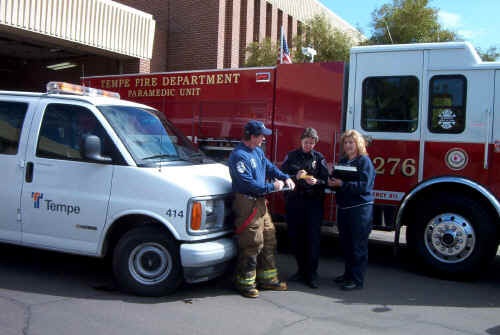
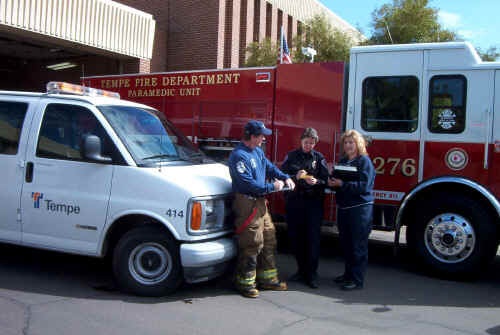
This Spring I was invited to shadow Care 7 community trauma mitigation team in Tempe, AZ. The team is on call 24-7, responding to 5 call per day on average, and serves a population of 180,000. My first day was a residential fire which displaced the physical and cognitive impaired home owner. The team member and I worked with the fire department to retrieve mail so that we could determine the insurance home owner policy and initiate the coverage for temporary housing. We also provided peripheral mitigation for children and families that could not get back to their homes until the fire was out. Day four the team included a victim advocate, a team member and myself. The team provided legal advocacy, emotional first aid and transportation to a proper medical facility. The client was transgender, post rape and suicidal.  

Care 7 is another great tool communities could use in the mitigation and prevention of trauma in people’s every day lives.

Attachments

Hide

Images (1)

Care 7: Care 7 Tempe, AZ


Hurricane Florence first responders receive free trauma/resilience training

Carey Sipp Carey Sipp 9/27/184:23 PM

In a webinar offered this morning by Elaine Miller Karas, executive director of the Trauma Resource Institute in Claremont, CA, leaders from several North Carolina ACEs Connection communities affected by flooding and other damage by Hurricane Florence learned more about trauma response and how to better help their communities find resilience.

Karas, who was delivering her Community Resiliency Model (CRM) training at Duke University in Durham, NC, offered the free training and provided materials for the 70-minute webinar, available to watch now by clicking here. 

 A major takeaway from the webinar is the importance of helping traumatized people find their “resilient zone.” 

 “Your resilient zone is that state of wellbeing in mind, body, and spirit when one is able to handle the stresses of life,” Karas said. She discussed the importance of using resiliency skills in the face of climate change, as well as ways to help people access positive thoughts, recognition of their and others’ strengths, and things to be grateful for in the face of natural and other disasters. For Karas, the thought of her two-year-old granddaughter helps to calm her nervous system so she can be present and focused.

 “When you’re in your resilient zone you can better take care of yourself and your family, help rebuild the community. You’re more open to the ways of creating better communities to meet challenges from the past, present, and future.”

About 40 people joined the webinar, and asked questions about how employers can better support workers still traumatized by the flooding, as well as how to help caregivers care for themselves.

 “It was valuable for our team to take the time to reflect together in the trauma our community is experiencing,” said Mebane Boyd, resiliency task force coordinator in New Hanover County, NC.

 Boyd, who is also the New Hanover County North Carolina ACEs Connection website community manager, added that she appreciated the insights into the fact her community is currently in the “honeymoon period” of disaster response.

 “We have had so many helping hands and experienced such generosity, and we need to figure out how now to work and prepare for the response for the long haul,” she said.

 Jenny Cooper, project director for Benchmarks’ Partnering for Excellence (PFE), an alliance of nationally accredited agencies providing care for children and adults and families in North Carolina, provided technical support by hosting the webinar, and added perspective as a professional trained in CRM.

“A ‘community’ can be defined as a feeling of fellowship with others, and community is exactly what we experienced this morning. We put aside our busy schedules and learned how we can help friends, family, neighbors, clients and coworkers who experienced tremendous loss and upset. Now that we have more knowledge, thanks to this introduction to CRM, we can think about next steps through a trauma-informed lens,” said Cooper, who is also a community manager for her organization’s ACEs Connection website, Benchmarks’ PFE of North Carolina.

Karas provided access to the materials she shared: the slide presentation and a three-page handout, THE BASIC SKILLS-The Community Resiliency Model® Wellness Skills. Cooper provided access to the webinar, which can replayed by clicking here

Attachments

Hide

Files (2)

6. BASIC THREE AFTER HUMAN MADE DISASTER.doc

CRM Introduction Hurricane (1).pdf

Carey Smith Sipp

carey.pacescommunites@gmail.com

Finding Resilience in the Midst of Hurricane Florence

Carey Sipp Carey Sipp 10/4/187:09 PM

Avis and her brother, Bruce, have seen some hard knocks in their lives. 

At 60, she’s his sole caretaker. She’s taught school, worked as a receptionist, always worked, or wanted to work.

Since she started caring for her brother, full-time work has seemed hard to find. 

He was born with autism 51 years ago.

They share her little house in Pamlico County, North Carolina, where she now hopes to be called in to substitute teach, and he looks forward to her home cooked meals. 

Their lives revolve around family, friends, and church. She plays the piano for Sunday services and writes articles for the congregation’s paper.

A car accident some years ago left her terrified of driving. But in the last six months or so, she’s gotten her courage up and driven alone several times, most recently to the school where she just started getting called in again to help out in the after-school program. This is a good thing, as it could ultimately lead to more work as a substitute teacher. Avis is hopeful.

When her cousin called to say that Hurricane Florence meant she needed to evacuate her home, Avis dutifully packed up her brother and herself.

I can imagine her humming a hymn as she put a few things in suitcases for the two of them. I can imagine that she was praying hard as she drove to the community college where she would have to leave her old van, and feeling nervous as she and Bruce boarded the bus that would take them to the high school gymnasium where they would ride out the storm.

Avis stays in the moment. 

Even though she knew her house could be gone by the end of this “storm of a lifetime,” Avis got onto the bus and made sure Bruce was okay before she looked around at her fellow travelers. Her gaze caught that of an older white woman. 

Their smiling at each other gave Avis a little peace. When they arrived at the school and introduced themselves to each other, their collective nervousness seemed to calm down a bit. 

Avis learned her new friend’s name was Mary. And then she went about getting Bruce settled in. 

Avis has some big faith. 

Avis believes in a higher power who loves her deeply. It is a relationship that gets played out in how she is grateful for being able to do things for and at her church. How grateful she is for little things such as finding a vegetarian recipe Bruce likes. Or being paid to play the piano on Sundays, which is something she loves to do whether she is paid or not. Though being paid sure helps out with expenses.

Once they settled into the gym, the waiting began. To be evacuated to a school gymnasium a couple of days before a storm hits is a good news/bad news situation. The good news is you have a place to stay that should be safe. The bad news is that when the storm ends and it’s time to go home, there may not be a home to go home to.

Avis knew she had to put her fears aside. Not only for her own sake, but for Bruce. Bruce laughs when Avis laughs. Bruce gets nervous when his older sister gets nervous. For the sake of Bruce and herself, Avis wanted to stay calm and add to the gratitude and serenity; not compound the stress, fear, and confusion. She prayed for the “courage to change the things she could.”

Hours after they’d settled into the gym and eaten a simple dinner, Avis headed to her cot. She’d checked to see that Bruce had taken his meds and was comfortable. As she lay in the strange bed in the strange place with the strange noises, Avis saw Mary approach her.

“Avis, would you like for me to tuck you in?” Mary asked.

Mary, a white woman Avis figured to be in her mid-eighties.
Avis, a black woman who’d recently turned 60.
Two women who’d experienced the Jim Crow south in what Avis hoped were its worst moments.
One woman who likely went to whites-only schools.
One woman who knew the sting of being called names when schools were integrated, and she was forced to go where she didn’t always feel welcome. 

In fact, as she lay in her cot, Avis was remembering what it felt like to be a black girl in assemblies in a gym that looked a lot like this one. 

For now, though, Avis and Mary and all the others in the gym were safe and sound and dry.

Avis and Mary held each other’s gaze for a few seconds before Avis said, “Yes. I would very much like for you to tuck me in.”

This bedtime conversation became a little ritual for the two women over the next four nights where they would sleep a few cots apart from each other in that big gym protecting them from the wind, rain, and thunder. The thunder and lightening would evoke fear; the wind and rain would leave some with the loss of loved ones, pets, property, a way of life.

A couple of weeks after the storm passed, Avis recalled some of what had happened to her, and remembered being grateful that she’d been evacuated. The old van she drove was fine. She’d driven it home to find her house in good shape, for the most part. Aside from needing to make lots of long calls about roof and air conditioning repairs, it looked as though life was getting back to normal.

When asked to focus for a minute though, on the most memorable aspect of those five nights away from home, Avis paused. And then talked about Mary.

“I don’t know her last name. I have no idea how to be in touch with her. I just know that it was a comfort to me every night when she asked if she could tuck me in,” said Avis.

“I’d like to think it helped her sleep better, too.”

Carey Smith Sipp

carey.pacescommunites@gmail.com
Finding Resilience in the Midst of Hurricane Florence

Carey Sipp Carey Sipp 10/4/187:09 PM

Avis and her brother, Bruce, have seen some hard knocks in their lives. 

At 60, she’s his sole caretaker. She’s taught school, worked as a receptionist, always worked, or wanted to work.

Since she started caring for her brother, full-time work has seemed hard to find. 

He was born with autism 51 years ago.

They share her little house in Pamlico County, North Carolina, where she now hopes to be called in to substitute teach, and he looks forward to her home cooked meals. 

Their lives revolve around family, friends, and church. She plays the piano for Sunday services and writes articles for the congregation’s paper.

A car accident some years ago left her terrified of driving. But in the last six months or so, she’s gotten her courage up and driven alone several times, most recently to the school where she just started getting called in again to help out in the after-school program. This is a good thing, as it could ultimately lead to more work as a substitute teacher. Avis is hopeful.

When her cousin called to say that Hurricane Florence meant she needed to evacuate her home, Avis dutifully packed up her brother and herself.

I can imagine her humming a hymn as she put a few things in suitcases for the two of them. I can imagine that she was praying hard as she drove to the community college where she would have to leave her old van, and feeling nervous as she and Bruce boarded the bus that would take them to the high school gymnasium where they would ride out the storm.

Avis stays in the moment. 

Even though she knew her house could be gone by the end of this “storm of a lifetime,” Avis got onto the bus and made sure Bruce was okay before she looked around at her fellow travelers. Her gaze caught that of an older white woman. 

Their smiling at each other gave Avis a little peace. When they arrived at the school and introduced themselves to each other, their collective nervousness seemed to calm down a bit. 

Avis learned her new friend’s name was Mary. And then she went about getting Bruce settled in. 

Avis has some big faith. 

Avis believes in a higher power who loves her deeply. It is a relationship that gets played out in how she is grateful for being able to do things for and at her church. How grateful she is for little things such as finding a vegetarian recipe Bruce likes. Or being paid to play the piano on Sundays, which is something she loves to do whether she is paid or not. Though being paid sure helps out with expenses.

Once they settled into the gym, the waiting began. To be evacuated to a school gymnasium a couple of days before a storm hits is a good news/bad news situation. The good news is you have a place to stay that should be safe. The bad news is that when the storm ends and it’s time to go home, there may not be a home to go home to.

Avis knew she had to put her fears aside. Not only for her own sake, but for Bruce. Bruce laughs when Avis laughs. Bruce gets nervous when his older sister gets nervous. For the sake of Bruce and herself, Avis wanted to stay calm and add to the gratitude and serenity; not compound the stress, fear, and confusion. She prayed for the “courage to change the things she could.”

Hours after they’d settled into the gym and eaten a simple dinner, Avis headed to her cot. She’d checked to see that Bruce had taken his meds and was comfortable. As she lay in the strange bed in the strange place with the strange noises, Avis saw Mary approach her.

“Avis, would you like for me to tuck you in?” Mary asked.

Mary, a white woman Avis figured to be in her mid-eighties.
Avis, a black woman who’d recently turned 60.
Two women who’d experienced the Jim Crow south in what Avis hoped were its worst moments.
One woman who likely went to whites-only schools.
One woman who knew the sting of being called names when schools were integrated, and she was forced to go where she didn’t always feel welcome. 

In fact, as she lay in her cot, Avis was remembering what it felt like to be a black girl in assemblies in a gym that looked a lot like this one. 

For now, though, Avis and Mary and all the others in the gym were safe and sound and dry.

Avis and Mary held each other’s gaze for a few seconds before Avis said, “Yes. I would very much like for you to tuck me in.”

This bedtime conversation became a little ritual for the two women over the next four nights where they would sleep a few cots apart from each other in that big gym protecting them from the wind, rain, and thunder. The thunder and lightening would evoke fear; the wind and rain would leave some with the loss of loved ones, pets, property, a way of life.

A couple of weeks after the storm passed, Avis recalled some of what had happened to her, and remembered being grateful that she’d been evacuated. The old van she drove was fine. She’d driven it home to find her house in good shape, for the most part. Aside from needing to make lots of long calls about roof and air conditioning repairs, it looked as though life was getting back to normal.

When asked to focus for a minute though, on the most memorable aspect of those five nights away from home, Avis paused. And then talked about Mary.

“I don’t know her last name. I have no idea how to be in touch with her. I just know that it was a comfort to me every night when she asked if she could tuck me in,” said Avis.

“I’d like to think it helped her sleep better, too.”

Carey Smith Sipp

carey.pacescommunites@gmail.com
2018 National ACEs Conference: Morning Movement Session

Carey Sipp Carey Sipp 10/17/1810:40 AM

Friend and trauma-aware health and fitness coach Renee McLaughlin created this 20-minute light stretching and brain-body connecting workout for ACEs Conference 2018 attendees. We shared it this morning in a session hosted by ACEs Connection.

Click to join Renee in a series of moves to get your day off to a relaxed but “woke” start, or to wake up anytime you’re feeling stressed or foggy. 

That Renee says, “you can’t build strength in tense muscles” makes me think of why these moves would be great for kids, too, as it’s hard for kids to learn when they are tense and not connected to their bodies. 

You can do this little workout in regular clothing and with bare feet or flat shoes. It’s not too strenuous and you probably won’t get sweaty.  

Doing this with friends and family will help regulate your “collective central nervous system.”

 Please feel free to share this post with friends and to save it so you can do it again, and to find more videos by Renee McLaughlin on YouTube. 

Here’s the link to share: https://youtu.be/XxpBM5JhZFc

 Have a great day, ACEs Connections! 

❤️ 4

Views: 509

Add Comment

Carey SippCarey SippFormats 

javascript:””

Comments (2) 

Newest · Oldest · Popular

Gail KennedyGail KennedyMember

So sorry I missed the event but i was be at the event but what a great morning wake up!  Thank you so much for recording this, Renee and next time we need to have you there in person!


❤️ 1

Christine Cissy WhiteChristine Cissy WhiteIt’s not trauma-informed unless it’s informed by trauma survivors.

This was fun and encouraging. Thanks for arranging this, Carey and Renee for generously making and sharing this video. 


❤️ 1

Back To Top

Hurricane Michael trauma response: Free Community Response Model webinar for Florida tomorrow

Carey Sipp Carey Sipp 11/1/1812:51 PM

Members of Florida’s health, mental health, child-serving agencies, faith-based communities, law enforcement groups and others are invited to attend a free webinar tomorrow morning at 9 a.m. EST on trauma response and how to better help communities find resilience following natural disasters. You can register for the webinar now by clicking on this link

Elaine Miller Karas, executive director of the Trauma Resource Institute in Claremont, CA, will lead the webinar. It will be recorded and available for later viewing via ACEsConnection and the ACEs Connection community websites Florida ACEs ConnectionPeace4the Big Bend ACEs Connection and Peace4Tarpon ACEs Connection.

Karas recently held a similar support webinar for North Carolina communities affected by Hurricane Florence. Attendees from the North Carolina webinar said a major takeaway from their learning was “the importance of helping traumatized people find their ‘resilient zone’.”

Karas will discuss the importance of using resiliency skills in the face of climate change, as well as ways to help people access positive thoughts, recognition of their and others’ strengths, and things to be grateful for in the face of natural and other disasters. As an example, for Karas, the thought of her two-year-old granddaughter helps to calm her nervous system so she can be present and focused. 

“When you’re in your resilient zone you can better take care of yourself and your family, help rebuild the community. You’re more open to the ways of creating better communities to meet challenges from the past, present, and future.”

About 40 people joined the NC webinar, and asked questions about how employers can better support workers still traumatized by the flooding, as well as how to help caregivers care for themselves.

“It was valuable for our team to take the time to reflect together in the trauma our community is experiencing,” said Mebane Boyd, resiliency task force coordinator in New Hanover County, NC.

Boyd, who is also the New Hanover County North Carolina ACEs Connection website community manager, added that she appreciated the insights into the fact her community was in the “honeymoon period” of disaster response.

“We have had so many helping hands and experienced such generosity, and we need to figure out how now to work and prepare for the response for the long haul,” she said.

Jennifer Travieso, community manager of Florida ACES Connection and Peace4the Big Bend ACEs Connection communities, is coordinating tomorrow’s webinar.

Attachments

Hide

Files (2)

BASIC THREE HANDOUT FOR ACES CONFERENCE.pdf

CRM Introduction WEBINAR FLORIDA.ppt

Carey Smith Sipp

carey.pacescommunites@gmail.com

“Cracked Up” interview with Darrell Hammond and Michelle Esrick on CNN

Carey Sipp Carey Sipp 11/16/185:51 PM

The film “Cracked Up,” produced and directed by Michelle Esrick, documents the pain and agony behind the jokes and smiles. Darrell Hammond, the comedian made famous by his Bill Clinton impersonation, talks to CNN’s John Vause about years of self harm, drug and alcohol abuse and the memories of child trauma which were repressed for decades.

Here are articles about the documentary:

A private screening of a work-in-progress unveils the personal struggles of SNL veteran and comedian Darrell Hammond [ACEsConnection]

Former SNL cast member Darrell Hammond talks childhood trauma on the Hill [washingtonpost.com]

Cracked Up [PsychologyToday.com]

Views: 780