Stacey Breitmann, trauma survivor, mom, military wife, neurofeedback advocate and coach.
“I want to see as many troubled families and individuals as possible – especially people such as I, who have experienced multiple Adverse Childhood Experiences (ACEs) – have access to neurofeedback. It has changed my life by changing my brain. I grew up in a horrific situation, never able to trust being safe. Stress would take me back to that childhood place of feeling terrified. Neurofeedback helped me become more rational, as my brain was trained to function with less stress. Now that I am not in constant panic, I can see the parts of our lives that are not going the way we want them to go and can look at these challenges with clarity and openness instead of fear and blame, shame, or guilt,” says Stacey Breitmann, trauma survivor, mom, military wife, and neurofeedback advocate.
For the Breitmann family in North Georgia, the last few years have been intensely stressful. Todd, a Lt. Col. in the Air Force for 24 years, retired in 2012, and fell into depression and anxiety when his military career came to an end. In an attempt to change the mood by changing the focus and location, the family bought a farm, sold it, tried life in a Winnebago for a couple of years while homeschooling their daughters on the road. Finally, when they settled in North Georgia in 2016, family stresses and Todd’s depression became so crippling that he became suicidal. Residential treatment seemed to be the best option.
In Todd’s absence, his wife Stacey did what good military wives do: She ran the household – as the mom and the dad. But the stress of being left behind this time were life-threatening for her too. Her fears that Todd might take his life during treatment drove Stacey beyond depression into being suicidal, too.
To read the rest of this post by Carey Sipp, ACEs Connection SE Regional Community Facilitator, click here.
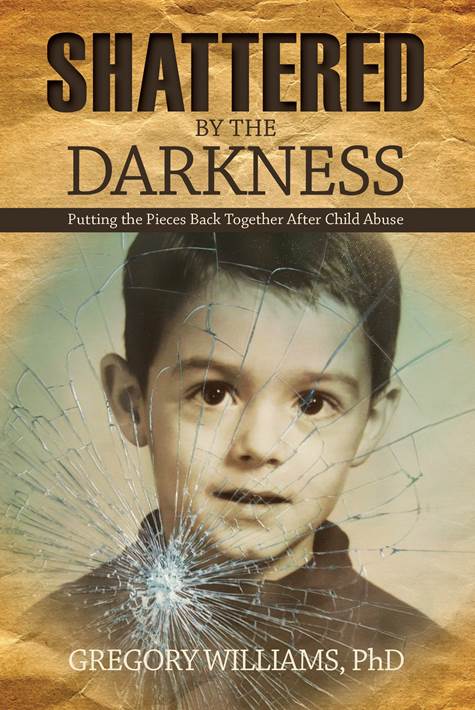
Gregory Williams, PhD, will help change the world by taking this book into medical schools and teaching physicians and nurses about the root cause of most adult illness: childhood trauma.
I just read this book in one sitting, save one hot tea refill. I could not stop reading it. Even though there were some passages that evoked anxiety, I couldn’t stop reading it, as I so wanted to learn more about this remarkable man and how he earned a PhD, had a normal family life, and earned the respect and confidence of physicians and other healthcare professionals.
This book is an amazing read. Greg’s writing is vivid. That he self-published the book is testament to his willingness to do whatever it takes to help himself and others heal. I wondered about his dad. What prompted this man to abuse a small child daily? Sometimes twice a day? To try to destroy an adolescent? To try to control and bend a young man to the breaking point? I wonder what pain his father had, or what from his past would compel such behavior?
Greg’s compassion toward his dying father gives insight into his ability to heal, to somehow stay in the moment and heal. In the book, he relates a long, healing talk with his father that ended with a statement of forgiveness, about which Greg says, “Immediately when I said those words, something happened inside my mind and body. There was a sense of letting a huge weight off my back.”
Though I have heard them again and again, I remain stunned by the statistics of the number of children who are sexually abused: one in six boys; one in four girls. And we wonder why there is so much depression, suicide, violence, domestic abuse.
I hope getting this book into the light, and Greg using his leadership position at Baylor College of Medicine, where he is an administrator, will raise awareness among doctors, nurses, therapists, social workers, and teachers of the need to learn and teach all professions about the devastating consequences of childhood trauma. That Greg is still alive with an adverse childhood experiences score of 8, is remarkable. Childhood trauma kills and makes people want to die. Greg helps get this point across by sharing about his heart surgery and challenges with suicidality, obsessive-compulsive disorder, PTSD, sleeplessness, and perfectionism.
This is a powerful book by a humble man willing to be of service to prevent what happened to him from being repeated. I hope his audience is wide, loyal, accepting, and encouraging. He will change the world by taking this book into medical schools and teaching physicians and nurses about the root cause of most adult illness: childhood trauma. He understands and makes clear that while the sexual abuse was the most dramatic part of the trauma, that the secrecy, isolation, neglect, verbal, and other physical abuse was deadly as well. I deeply admire and respect this work, and wish Greg and his family success and peace on their healing journey. Greg truly is helping to prevent and heal childhood trauma, and to build resilience.
Note: A blog about Gregory Williams’ sharing his story with physicians was posted on ACEs Connections in September, and is accessible here.
Gregory Williams, PhD, will help change the world by taking this book into medical schools and teaching physicians and nurses about the root cause of most adult illness: childhood trauma.
I just read this book in one sitting, save one hot tea refill. I could not stop reading it. Even though there were some passages that evoked anxiety, I couldn’t stop reading it, as I so wanted to learn more about this remarkable man and how he earned a PhD, had a normal family life, and earned the respect and confidence of physicians and other healthcare professionals.
This book is an amazing read. Greg’s writing is vivid. That he self-published the book is testament to his willingness to do whatever it takes to help himself and others heal. I wondered about his dad. What prompted this man to abuse a small child daily? Sometimes twice a day? To try to destroy an adolescent? To try to control and bend a young man to the breaking point? I wonder what pain his father had, or what from his past would compel such behavior?
Greg’s compassion toward his dying father gives insight into his ability to heal, to somehow stay in the moment and heal. In the book, he relates a long, healing talk with his father that ended with a statement of forgiveness, about which Greg says, “Immediately when I said those words, something happened inside my mind and body. There was a sense of letting a huge weight off my back.”
Though I have heard them again and again, I remain stunned by the statistics of the number of children who are sexually abused: one in six boys; one in four girls. And we wonder why there is so much depression, suicide, violence, domestic abuse.
I hope getting this book into the light, and Greg using his leadership position at Baylor College of Medicine, where he is an administrator, will raise awareness among doctors, nurses, therapists, social workers, and teachers of the need to learn and teach all professions about the devastating consequences of childhood trauma. That Greg is still alive with an adverse childhood experiences score of 8, is remarkable. Childhood trauma kills and makes people want to die. Greg helps get this point across by sharing about his heart surgery and challenges with suicidality, obsessive-compulsive disorder, PTSD, sleeplessness, and perfectionism.
This is a powerful book by a humble man willing to be of service to prevent what happened to him from being repeated. I hope his audience is wide, loyal, accepting, and encouraging. He will change the world by taking this book into medical schools and teaching physicians and nurses about the root cause of most adult illness: childhood trauma. He understands and makes clear that while the sexual abuse was the most dramatic part of the trauma, that the secrecy, isolation, neglect, verbal, and other physical abuse was deadly as well. I deeply admire and respect this work, and wish Greg and his family success and peace on their healing journey. Greg truly is helping to prevent and heal childhood trauma, and to build resilience.
Note: A blog about Gregory Williams’ sharing his story with physicians was posted on ACEs Connections in September, and is accessible here.
When you first hear about it, it sounds unlikely, fact that something that happened to someone in utero, at the age of two months, or four years, or any time in childhood, is what is killing them as an adult, or making them want to die, or making them want to hurt themselves or others.
Yet the connection between childhood trauma and adult disease, mental illness, addiction, suicide, violence – most all of society’s ills – is as irrefutable as the myriad truths revealed about it in the CDC-Kaiser Permanente Adverse Childhood Experiences Study (ACE Study). The groundbreaking research shows that the more childhood trauma you experience, the greater your likelihood of having serious illness, social and emotional problems — a life punctuated with trauma and drama.
Gregory Williams learned about the ACE Study around the same time he started telling people about his childhood trauma. That he learned about it as he began speaking his truth is no accident. That the science explained so much about his life and touches so many aspects of it – personally and professionally – has made him passionate about spreading the word about ACEs science. His passion is, for many reasons, an incredible gift to the world.
A little background on ACEs science
The original ACE Study queried more than 17,000 people in San Diego in the mid 1990s. The participants — mostly white, college-educated, all with jobs and great health care — completed a questionnaire of nearly 200 questions about their health and wellbeing. Researchers distilled the results of those questions to 10 types of childhood trauma that most people had experienced as children in their families, up to age 18. Five questions asked about physical, emotional or sexual abuse, and emotional or physical neglect. Five more asked about family dysfunction – violence against the mother, parental separation, mental illness, alcoholism or other addiction, and incarceration of a family member.
The study showed that 64% of the respondents had at least one ACE (adverse childhood experience), and that ACEs usually did not occur alone; if you have one ACE, there’s an 87% chance you have two or more. For the 12% of respondents with an ACE score of four, the consequences proved serious and expensive: The likelihood of chronic pulmonary lung disease increases 390 percent; hepatitis, 240 percent; depression 460 percent; alcoholism, 700 percent; attempted suicide, 1,220 percent. For people with an ACE score of 6 or higher, the risks are grave, literally. Their lifespan is shortened by 20 years.
The ACE Study produced 70 research papers and led to 37 US states doing their own ACE surveys, which produced similar results. Several nations and cities, as well as hundreds of organizations, have also done ACE surveys. The ACE Study has led to more than 1,000 research publications that show the link between ACEs and all types of disease, including auto-immune diseases, skin cancer, diseases of the eye, etc. — each supporting the original finding that childhood trauma causes adult disease and dysfunction.
There are many reasons why this is the case. A big part of it, though, can be explained by brain science and physiology. Toxic stress harms the structure and function of the brains of children. Basically, children with high ACE scores become “wired” for “flight, fight, freeze” behavior, and their lives – with higher incidence of illness, violence, drama, risky behavior, and trauma – are the living proof.
In addition to the fact that the wiring — the connections of brain cells (synapses) – becomes more developed in the parts of the brain that deal with survival than the parts of the brain that deal with long-term planning, the stress hormones of cortisol and adrenaline flooding a stressed body cause, over time, increased inflammation of all organ systems. At the cellular level, constant stress is like an ongoing chemical boil in the body. Kids who are constantly exposed to toxic stress are likely to grow into teens and adults whose brains and bodies are set to react to everyday challenges with fight, flight, or freeze fear. Think of an engine constantly revved at the highest revolution per minute. Such an engine is likely to break down more frequently and burn out more quickly.
The ACE Study was developed by two visionary physicians courageous enough to risk their reputations to make the connection between toxic stress and adult health issues. The life work of Drs. Vincent Felitti and Robert Anda, the study helps make sense of some of what has happened to Gregory in the decades since the day, as a 17-year-old with strength and a voice, he looked his father in the eye and told him to STOP the horrific sexual abuse he had experienced daily for 13 years.
Childhood trauma makes some people sick; it makes others want to die. Gregory helps get this point across by sharing the truths of his resulting heart condition, surgery, and challenges with suicidality, obsessive-compulsive disorder (OCD), post-traumatic stress disorder (PTSD), insomnia, and perfectionism.
Borrowed time, buffering factors, resilience, hope.
Gregory, with an ACE score of 8, also knows he would be living on borrowed time, and would most likely be dead, were it not for his also being an example of another aspect of the science: how buffering factors – in his case, caring relatives – helped offset some of the negative physiological consequences of the abuse, helping him become somewhat resilient, which he will share more about in subsequent work.
How Gregory survived the pain, shame, guilt, fear, and the physical manifestations of those emotions – the toxic stew of stress hormones that eat away at every cell in the body – can be explained, in part, perhaps, by research on resilience, another part of ACEs science.
Resilience research shows what helps people build the ability to respond to adversity and survive. We know from these studies what a profoundly positive impact that one consistently caring adult can have on a child who is being abused.
That Gregory survived is a miracle. That he had caring adults in his life, I believe, made all the difference. Even though, perhaps, they didn’t know what was going on, an aunt and uncle whom Gregory saw several times a week from the ages of four through about age eight, provided a home base of safety and stability, love and some joy in the midst of the terror you’ll read about soon.
I tell you this because despite Gregory’s story being so horrific, it is because of who he is as a person who somehow maintained optimism, that this is also a story of hope and triumph over adversity. His recognition of the people who loved him as a child is to me one of the most important parts of his story. It is also a call to action to all of us to look for opportunities to be that caring adult for a child, and to be the caring adult to question why a child is upset, is acting out, or is not thriving.
Explanations, divine timing, how speaking his truth is saving Gregory’s life, and will help save the lives of others.
For Greg, discovering ACEs science – information shared with him by a close friend and physician at Baylor College of Medicine – was a life-changing moment. ACEs science might explain why a valve in his heart had given way and needed to be repaired when he was 48. It certainly explained why he suffered from OCD. The science helped make sense of why he could not sleep – his hypervigilance – even though it’s been 38 years since the last time his father abused him. Even after his father’s death in 2002.
Yes, darkness had always brought fear, but Gregory’s new understanding of the physical effects of that fear – the impact of cortisol, adrenaline, and other stress hormones — helped him make sense of his health and mental health issues, and also inspired him to speak the truth about what happened to him to anyone who would listen, and especially to physicians. That Gregory works with and hires physicians is one more amazing aspect of his remarkable and profoundly important story.
For Gregory, speaking his truth is saving his life. When abuse survivors cannot tell the truth, cannot share their stories, or when their stories are not believed, the results can be toxic. The stress of trauma builds up in the body. There is much science to support the statement best summed up as the title of a best-selling book on toxic stress and trauma: The Body Keeps The Score.* Gregory’s failing heart valve is an anecdotal case in point.
Out of respect to his mother, Gregory did not share his story publicly, until her passing in 2017. It was when he was able to share his story without fear of harming his mother that this next phase of Gregory’s life’s work was revealed, and began in earnest.
Though I’ve not met Gregory in person, and have only known him for a few months, I know we share a bond that covers lifetimes and a faith that is as deep and wide, as we are both abuse survivors and know, without a lot of elaboration, much about what comes with that experience.
We both know that it is remarkable that we’ve survived into our fifties and sixties. It is fair to say that we both believe our meeting, and my connecting Gregory to his publisher, is no accident.
And then there is the way Gregory and I met, which is as the result of my being offered the dream position of opening up the southeastern United States to help build communities for an organization that advances ACEs science. I’d hoped for that opportunity for five years before the funding came for me to be hired by ACEs Connection, an international social network dedicated to advancing ACEs science, preventing and healing childhood trauma, and building resilience. It was through his research and finding ACEs Connection that Gregory found my address and included me in a mass emailing about his book. I was one of a handful of people who answered the email.
I answered his request for ideas about how to help him get the word out about his book because I wanted to help, and I because wanted to know more about someone who would share the most intimate, sad, dark corners of his life with others, yet who looked so happy about doing it.
Speaking with Gregory, I immediately understood: After having the story bottled up for decades, his being able to speak and write about his abuse is cathartic, healing, and again, is literally saving his life.
It is nothing short of incredible to me though, that in less than seven months since I answered Gregory’s introductory email, Gregory’s self-published book sold more than 100,000 copies, his book is now being published and distributed by a major publishing house (Health Communications, which published a book of mine 11 years ago), he is working on his own radio show (Breaking the Silence), and he is creating, via the book, radio show, his website, and his work with me to take ACEs science into medical schools, an important space for others to be heard, believed, and affirmed.
Further, Gregory is playing an important role in his own community by managing the Baylor College of Medicine ACEs Connection community site. That site is one of more than 170 geographic community sites supporting ACEs initiatives in those communities. Among the sectors represented are pediatrics, education, justice, social work and more. Their members meet and look for ways to bring ACEs science and trauma-informed practices into their communities. Doing so helps communities in many ways, as evidence shows improved school attendance and grades, decreased crime, improved health outcomes and more in areas communities that have been keeping track of the effects of this work. ACEs Connection would welcome your community group into our growing community of communities which includes neighborhoods, cities, regions, states, and nations dedicated to preventing and healing trauma.
Gregory’s work, and the work of ACEs Connection, is creating the space for millions of people – and thousands of physicians – to be educated, engaged, and offered the chance to become activists to help prevent childhood trauma and its devastating lifelong impacts.
That Gregory has the trust, respect, and attention of physicians can change medicine, and more.
Gregory’s experiences are likely to have special impact on the lives of the one in four girls and one in five boys who are victims of sexual abuse. For millions upon millions of adult men and women survivors, Gregory’s story and awareness of ACEs science will help explain the “why” of so many of their lifelong physical and mental health challenges, and why their lives – our lives – have seemed, or been, harder than most. For many of us who experienced a high load of toxic stress, our brains were literally wired to create and be attracted to more toxic stress. This revelation will, I hope, inspire a tremendous amount of self-empathy, and empathy from and for others. Yes, the old saw is true: Hurt people do hurt people. Understanding the why behind the hurts, the addiction, the impulsivity, the violence, can help stop the pain, shame, guilt, and hurt.
My hope is that Gregory’s story will help prevent sexual abuse and other childhood traumas, and I know that is his greatest hope, too.
That Gregory speaks to physicians, has their respect, trust, and attention, and has the complete backing of his employer, the Baylor College of Medicine, is especially heartening to me, and to others who advocate for medical professionals to recognize childhood trauma as the root cause of most all adult disease, most all social ills.
I know we both want to
see the science of childhood trauma and resilience research taught in medical schools, so physicians can better understand why a patient is suffering from a stress-related illness, and, in addition to prescribing traditional medical interventions, can also offer recommendations and supports that may help reverse the damage done by years of toxic stress. Imagine a prescription to “spend a day in nature” or “go help coach a little league baseball team” or “join a choral group”? Physicians who are prescribing just such “therapies” are seeing success in programs to prevent opioid addiction relapse, depression, and more.
see physicians ask what’s going on “at home,” and ask, even if informally, questions about their patients’ trauma history, even if it is on an ACE survey that only shows the total score and is not included in a medical record,
see obstetricians, gynecologists, pediatricians, and family practice physicians ask pregnant women about their own childhood trauma, as studies show that pregnant women who are aware of their own childhood traumas, and of the impact of childhood trauma, are less likely to experience post-natal depression or to abuse their children.
see kindergartens, elementary, middle and high schools become places where children aren’t shamed and blamed for acting out and asked, “What’s wrong with you?” but are instead asked, “What’s happened to you? How can I help?” and where their parents are not shamed or blamed, either. When parents understand more about the lifelong health consequences of trauma, the likelihood of children being traumatized decreases; children who feel safer at home do better in school.
help people learn that the body is resilient, our brains and bodies want to heal. Given understanding, acceptance, community, and information about resilience research, people with high ACEs scores can develop greater resilience as individuals, and in their families, workplaces, and communities.
see communities foster groups of laypeople and professionals from all sectors, including education, medicine, justice, the arts, mental health, and housing, to identify and prevent trauma including structural racism and income, health, and education inequality, as racism and poverty are as every bit as stressful and toxic to a child as any other type of abuse.
Though we didn’t know each other through our years of parenting – Gregory has two adult sons and three grandchildren, and I have a son and a daughter – we both vowed to stop the cycles of abuse with our own children. We are both grateful to have relatively healthy, happy adult children, and worked hard and mindfully to prevent cycles of addiction and abuse.
That Gregory works for a leading medical institution that supports his promulgating ACEs science is no accident. That I work for an organization that is all about preventing and healing childhood trauma; building resilience, creating a trauma-informed world, is no accident. Again, our faith is affirmed as we marvel at the timing!
I hope that helping to bring this book into the light, and Gregory’s using his radio show, prodigious talents as a writer, speaker, and interviewer, as well as his leadership position at Baylor College of Medicine, will raise awareness among doctors, nurses, therapists, social workers, teachers, law enforcement officers and policymakers of the need to learn and teach all professions about the devastating consequences of childhood trauma. I hope policymakers will hear the alarm to understand that policies that punish people for the addictions and behaviors that are the direct result of childhood trauma do not help, but instead further traumatize already traumatized people.
I hope Gregory’s audience is wide, loyal, accepting, and encouraging.
I truly believe Gregory will change the world by taking this book into medical schools and teaching physicians and nurses about the root cause of most adult illness: childhood trauma. He understands and makes clear that while the sexual abuse was the most dramatic part of his trauma, that the secrecy, isolation, neglect, verbal, and other physical abuse was deadly as well. This is, indeed, important information to share as policymakers learn about creating schools, hospitals, businesses, cities, states, nations that are about preventing and healing childhood trauma, and building resilience. As we face, in our communities, adverse community experiences including structural racism, bullying, income inequality, and, in our world, increasing numbers of adverse climate experiences – the loss of homes, livelihood, a way of life – as the result of wildfires, storms, floods and other natural disasters, I hope we will become gentler with each other and more mindful of protecting our environment, our natural resources.
I look forward to Gregory’s subsequent books about how he is continuing to heal, as I believe he will shed light on childhood trauma and its impact across the lifespan. He will educate a new generation of physicians and allied health professionals about ACEs science and resilience research and findings, and share ways patients can use their own agency to find life solutions that do not include addiction and risky behaviors to handle their fears.
ACEs scores and “obits” and hopes
In the effort to demystify, remove stigma, and help prevent AIDs some 30 years ago, families started sharing that their loved ones had died of acquired immune deficiency (AIDS). Some shame was lifted. Acceptance was more widespread. Empathy helped spur funding research into cures, and campaigns to raise awareness. Education, and prevention, helped slow the spread of the disease.
As suicide has become epidemic, many families of loved ones are choosing to share, in obituaries, the cause of death as suicide, in hopes of raising awareness, reducing the stigma, encouraging others to get help.
Someday perhaps ACEs scores will be listed in obituaries, in hopes of people understanding the direct correlation between childhood trauma and adult disease and premature death. As a woman in my early sixties, I’ve lost many friends who had high ACE scores, and am watching others suffer from chronic diseases that are, no doubt, related to their ACEs. I know I want my ACE score listed in my obituary, not as a point of shame or pride, but in hopes of its being a “teachable moment.” I also want to include information about resilience research, as in, “despite having an ACE score of 8, Sipp credited her long life to the exercise, diet, community work, and other healthy endeavors that were part of resilience research, an evidence-based way of helping to reduce the impact of ACEs, which she practiced and promoted as a part of her work.”
That Gregory and I have both been able to share our truths, learn about ACEs science and resilience research, and find joy and purpose in helping to prevent childhood trauma will, I hope, prevent our obituaries from being published any time soon! I hope that is true, too, for the millions who will experience “aha moments” as they learn the truths about the importance of our preventing trauma in the lives of others, be it by preventing blame, shame, bullying, racism, and violence, or by our promoting health, acceptance, empathy and love, especially toward children and their families. As families and communities heal, I believe we will heal the earth. Learning and teaching ourselves how to be kinder and gentler to ourselves, each other, our earth? There is nothing more sacred; no work more vitally important.
*The Body Keeps the Score Brain, Mind, and Body in the Healing of Trauma by Bessel Van der Kolk, MD, 2014
Raising yellow “Visions & Commitments” cards, 550 attendees at yesterday’s Creating a Resilient Community: From Trauma to Healing Conference pledged their enthusiastic support to create a more resilient Central Florida.
The standing-room-only crowd heard Dr. Vincent Felitti deliver a morning keynote address detailing the findings of the CDC-Kaiser Permanente Adverse Childhood Experiences Study (ACE Study). He also shared moving testimonials of people who are realizing the effects of the toxic childhood stress they reported more than 20 years ago.
The event, presented by the Peace and Justice Institute of Valencia College, the Early Learning Coalition of Orange County, and the Florida Department of Health Orange County, was spearheaded by Rachel Allen, director of the Peace and Justice Institute.
Event sponsors included Orlando Health; Central Florida Foundation; the National Association of Social Workers, Florida Chapter; and the Kamran Farid Foundation.
A panel of speakers included Clayton Lodes, president of First National Bank & Trust of Ardmore, OK; Lucy Morse, executive director of Family Hui in Sacramento, CA;
Robin Saenger, founding director of Peace4Tarpon, the first trauma-informed community in the nation; and Candice Jones, a practicing general pediatrician in Orlando, FL.
As a part of the day’s events, Allen introduced the community’s new ACEs Central Florida community site on ACEs Connection and let all attendees know they would be receiving an invitation to join. The site is described as: “A network for community members, professionals and leaders to collaborate across sectors in a movement to prevent adverse childhood experiences (ACEs), heal from trauma, and build resilience in Central Florida. We encourage the use of this network to collaborate across sectors and communities and to transform our region into one of hope, healing, and resilience for all..”
Within 18 hours of the invitation being sent, more than 100 people have joined the group’s online community. They can post events, ask questions of the community, and share what they are learning about ACEs science and creating resilience in their all parts of their community.
For more information about the event, please see the event program posted below.
Here’s a compelling interview with David Brooks, op-ed columnist for The New York Times, introducing his latest book,The Second Mountain: The Quest for a Moral Life. In the interview Brooks discusses his nonprofit, Weave: The Social Fabric Project, “a community of people who are helping each other answer this question: What can I do today and tomorrow to replace loneliness, division and distrust with relationship, community and purpose?”
On the Weave website Brooks says, “We seek to learn from those who are weaving communities everywhere, establishing connection, building relationships, offering care and creating intimacy and trust. We want to spread the values they live out every day. We want to be part of a cultural revolution that replaces a culture of hyper-individualism with a culture of relationalism, a way of living that puts our connections with one another at the center of our lives. The revolution will be moral or it will not be at all.”
Brooks, a best-selling author, appears regularly on “PBS NewsHour,” NPR’s “All Things Considered” and NBC’s “Meet the Press.” His books also include The Social Animal: The Hidden Sources of Love, Character, and Achievement; Bobos in Paradise: The New Upper Class and How They Got There; and On Paradise Drive: How We Live Now (And Always Have) in the Future Tense.
During a candid interview with Judy Woodruff, PBS NewsHour anchor, Brooks opens up about realizations made during a hard and lonely time, a time that gave rise to changes in his life and thinking.
“I discovered you can either be broken or you can be broken open. And some people get broken. They turn fearful in their bad moments, and they lash out. They turn hostile and violent and tribal. And they’re full of resentments.
“But some people get broken open. You just realize the depths of yourself, and you realize that only spiritual and emotional food is going to fill those depths. So, you think I got to change my world view. So, I spent five years looking at people who had done it and trying to learn from them,” he said.
In the wide-ranging interview Brooks touches on the distinction between happiness and joy, the joy of self-giving, the human need to feed the yearning to be good, how “the Trump moment is a spiritual and moral crisis. We just treat each other badly. We’re not compassionate towards one another. We stereotype, rather than see the dignity of each human person.
“And I think it flows out of loneliness and disconnection. A lot of people who voted for him, their communities are falling apart. And they needed something new,” he adds.
What’s missing?
While Brooks shares stories “Weavers” – people who’ve endured unbearable loss and are going on to live lives of service – he stops he stops short of naming the root cause of the loneliness, despair, schism, inequality, poverty, racism, disease, violence, addiction, abuse, waste, pollution, intensity, political insanity, homelessness, greed, war, and other seemingly intractable ills: adverse childhood experiences.
I understand that spiritual practice, whatever that may mean for an individual or community, can help build resilience to or recovery from trauma. I do think Brooks is speaking beyond a particular diety or moral code to a much deeper contact with life and humanity through experiencing the deepest lows in life. However, I think one has to have an opportunity to process and make sense of those soul crushing experiences. His premise, if you take it to a logical conclusion (which he doesn’t really;I think Brooks is still taking his baby steps to a more compassionate world view) is that one is ultimately called to fight to address the root causes and work in service of alleviating the suffering of others.
I was introduced to this ACE’s study and test during my trauma informed training for my current position as a foster parent recruiter, and educator. I myself scored a 9 out of 10 on this exam, and as a newbie to this website I am thrilled to learn as much as I can to help the foster parents that I am working with. I too am a firm believer that Christ was and is my ultimate savior from the cycle of traumas and my reactions to them in my past, and certainly in my future. However, I also know Christ will use everything and everyone to protect his children, and I appreciate the wisdom shared above. Shame and guilt do separate the lost. It is through healthy community and open conversations that people will begin to feel more connected and more valued.
I don’t believe ACE’s are the root cause of loneliness, despair, etc. We need to go deeper and ask what is the root cause of ACEs. Why is there an epidemic of substance abuse and suicides? What is the answer? In my humble opinion it is the loss of relationship with our Creator. I know, many of you just checked out of this comment. I’m not talking church or religion; they’ve proven to be less than trustworthy. I’m talking a simple, personal relationship with Jesus. He spent his life reaching out to those who had no voice, who were poor, messy, broken. In fact he felt more comfortable around them (me) then around the rich and religious. He’s changed my life and cut the cords to the anchors of ACEs that were wrapped around my legs so I can now soar like an eagle. I hope you will consider him again.
TraumaInformedJobs.com is a new job board for the trauma and resilience communities. PACEs Connection members can save 10% on posting with code PACES10
(L-R) Dr. Jacob Ham, comedian Darrell Hammond, documentary director/producer Michelle Esrick , and Road to Resilience podcast host Jon Earle, talk about the “mental injury” caused by toxic childhood stress, and ways to help trauma survivors gain resilience.
“It’s almost as if my brain is doing military preparedness drills,” said Darrell Hammond, the venerable Saturday Night Live cast member as he describes his complex post-traumatic stress disorder, in a recent Road to Resilience podcast.
Hammond’s life of living as a trauma survivor — the addiction, depression, cutting, and other self-destructive behaviors as well as the self-doubt, confusion, despair, and agony — is explored in a new documentary film, Cracked Up, directed and produced by his friend and fellow trauma survivor, filmmaker Michelle Esrick.
Hammond and Esrick joined Dr. Jacob Ham on the monthly podcast series from Mount Sinai Health System hosted and produced by Jon Earle to talk about their experiences with toxic childhood stress. Ham (pronounced Hom) is a clinical psychologist and director of the Center for Child Trauma and Resilience at the Icahn School of Medicine at Mount Sinai.
“There’s not a real war going on, but my brain is going to stay ready just in case somebody comes into the room with a hammer,” said Hammond, explaining the hyper-alert state he has stayed in throughout his life as the result of devastating childhood trauma he experienced at the hands of his parents in Melbourne, FL.
Hammond, Esrick and Ham talked about the long-term health effects of adverse childhood experiences (ACEs), how to deal with triggers in daily life, and the ways loved ones can support survivors in their recovery. They also talked about how sharing these painful truths, and helping others understand how damaging childhood trauma is, bring opportunities to heal.
“We all either have our own trauma, or we know somebody with trauma. We’re just all connected to it,” Esrick said. “If you want to help somebody, listen with love and curiosity, and be willing to believe what’s being said, even if it’s hard or painful.”
“[Psychologists] still focus on big ‘T’ traumas — like combat and sexual violence — but it’s the day-to-day neglect that is most impactful on the person’s ability to have loving relationships and connection with other human beings,” explained Ham.
Hammond, a regular cast member for 14 seasons on Saturday Night Live, entertained millions with his spot-on impersonations of Bill Clinton, Sean Connery, and others. While preparing for scenes, and at other times, Hammond cut himself with razor blades to create a “manageable crisis.” He also abused drugs and alcohol to help cope with the pain of the memories and sense of terror.
Hammond started drinking to escape his pain while still a teenager, a point he makes in the documentary, and in his autobiography, God, If You’re Not Up There I’m F*cked. He was a repeat visitor to New York emergency rooms to receive treatment for cutting and other self harm. Over the course of his lifetime struggle with depression, anxiety, and other symptoms of complex PTSD, he was seen by more than 40 doctors. He was misdiagnosed for decades, and given medications for multiple psychiatric disorders.
The truth about his “mental illness” came when Hammond was in his 50s. He was finally correctly diagnosed by Dr. Nabil Kotbi at Weill Cornell Medicine in New York as a survivor of intense childhood trauma who had experienced “mental injury” as the result of the toxic stress hormones flooding his body as an infant, toddler, and child.
Having been on a path of recovery for many years led Hammond to ask, “How many people in AA, drug addicts and alcoholics — what percentage of them are trauma survivors?”
Esrick’s documentary Cracked Up reveals the lifelong effects of Hammond’s childhood trauma and addiction, and shares his heroic efforts to recover from an almost ever-present sense of terror prior to his being diagnosed by Dr. Kotbi in 2011.
The documentary includes extensive and deeply personal interviews with Hammond, as well as the insights on trauma from leading experts such as Dr. Nabil Kotbi and Dr. Bessel van der Kolk, psychiatrist and author of The New York Times bestseller The Body Keeps the Score: Brain, Mind, and Body in the Healing of Trauma.
An ACEs Connection webinar will offer helpful self-regulation tools to those rocked by recent shootings in Gilroy, CA, El Paso, TX, and Dayton, OH.
The Building Resilient Communities webinar is offered by ACEs Connection this Thursday, August 9, at 10:00 AM PDT / 1:00 PM ED and will last approximately 1 hour. Elaine Miller-Karas will teach her Community Resiliency Model. Find registration details below. This webinar is free and open to the public. It serves professionals and community members.
Author and therapist Miller-Karas says the model has helped hundreds of thousands of disaster survivors be more available to serve themselves, their children, and their communities following traumatic events around the world.
“This webinar will explore integrating a biological-based model to reduce the impacts of toxic stress for children and adults. Due to the events of the last two weeks, Elaine will also include how CRM skills can help in the aftermath of tragedies such as mass shootings,” said Carey Sipp, ACEs Connection southeast community facilitator, who is hosting the webinar.
“CRM is a model both for prevention and to use in the aftermath of adverse events,” said Miller-Karas, who has circled the globe teaching CRM.
“Parents are the tuning forks for their children. Children may be worried about the events of the last week. It is important for the parents to ‘put their oxygen mask on first.’ Community Resiliency Model Skills can help with simple self-regulation skills for parents and their children,” said Miller-Karas.
“The Community Resiliency Model has been integrated worldwide into the Social, Emotional, and Ethical (SEE) Learning Program, a curriculum for schools K-12, inspired by his Holiness the Dalai Lama. SEE Learning provides educators with the tools they need to foster the development of emotional, social, and ethical intelligence for students and themselves. The SEE Learning’s Chapter 2 is based upon the Community Resiliency Model,” Miller-Karas said.
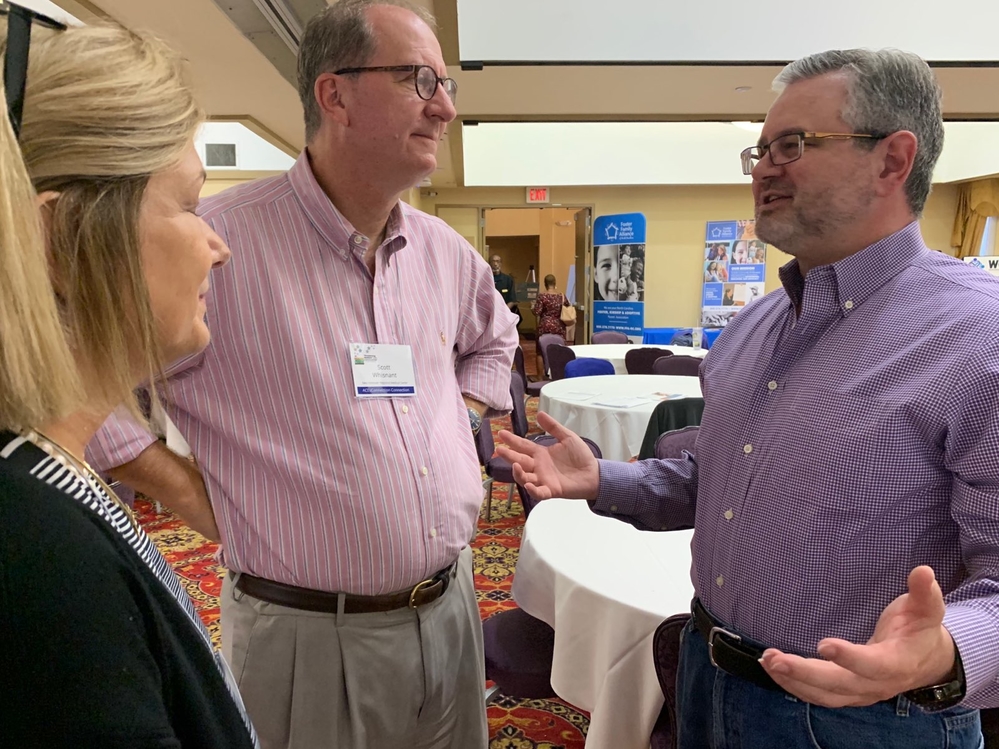
New Hanover Resiliency Task Force Chairman Scott Whisnant thanks Executive Director Mebane Boyd for her leadership, and his “Resilient Vision Award.”
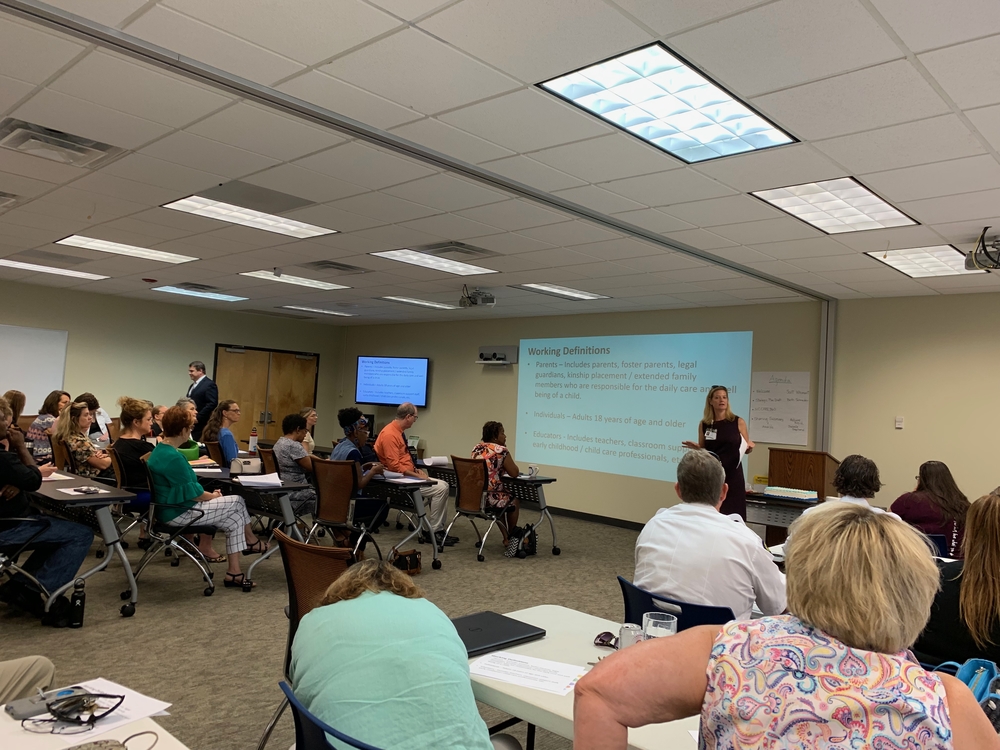
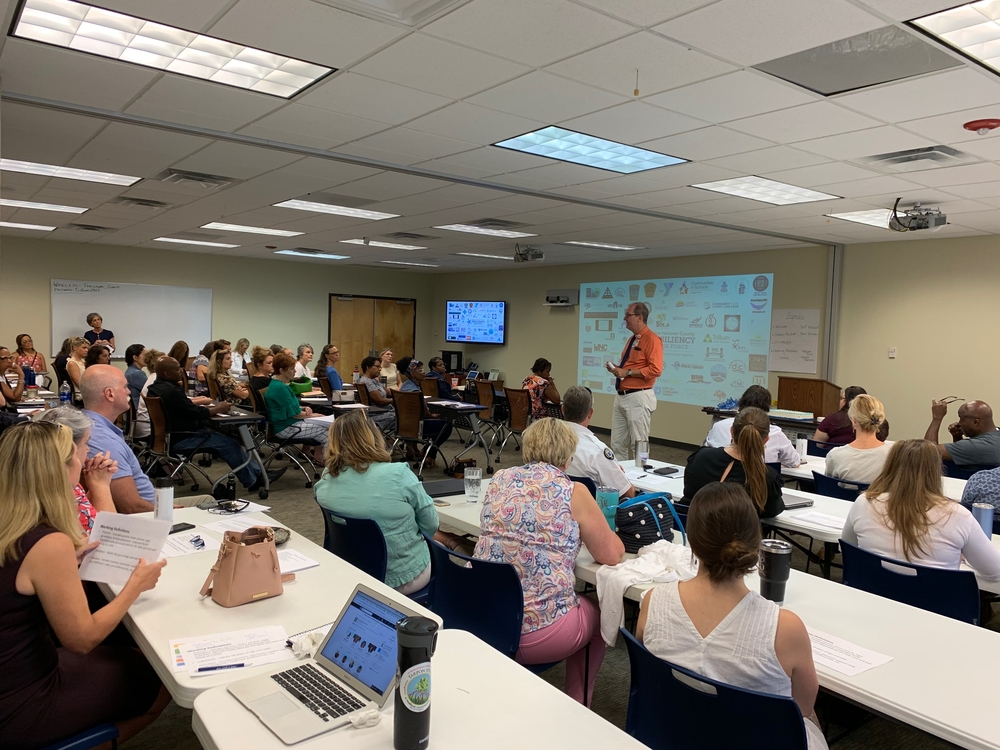
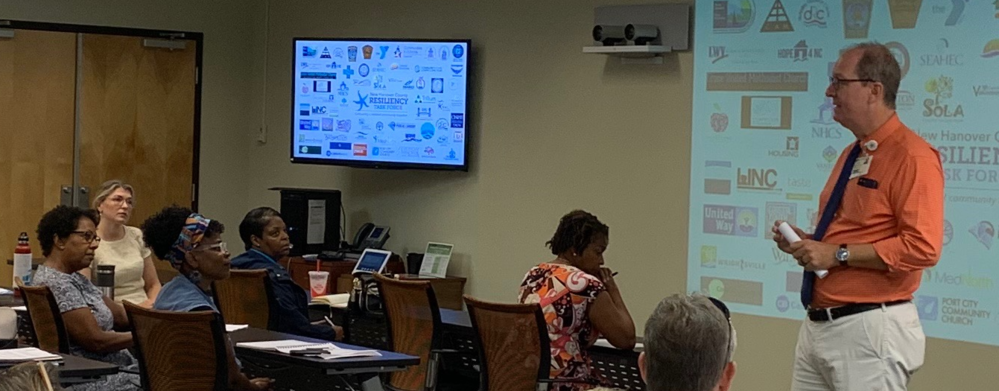
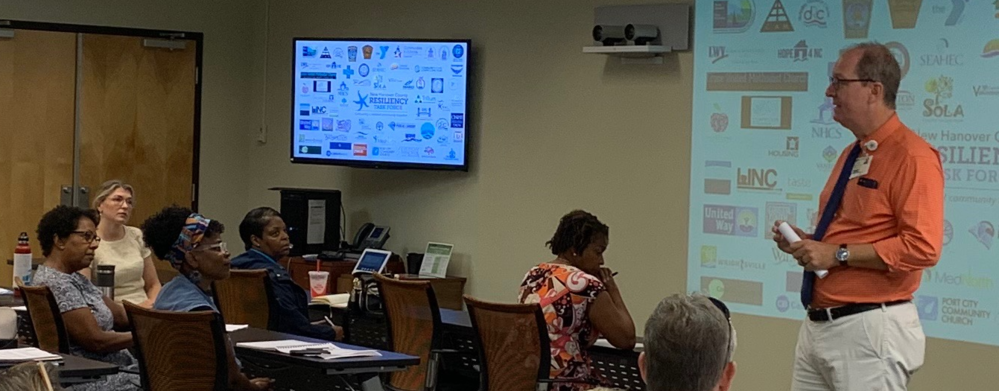
The July 27, 2019 meeting of the New Hanover Resiliency Task Force marked the first year of the group’s work since hiring a coordinator, but the gag gifts handed out in celebration told the real story of the community building, affection, and joy experienced in the members’ work together.
New Hanover County’s Chief Planning Officer, Beth Schrader, shared a draft of the strategic plan the group had been working on for a year. The Task Force reviewed highlights of a year of intense work – including helping county citizens recover from Hurricane Florence. And then the fun began, as Task Force Executive Director Mebane Boyd started handing out gifts, ultimately including something for everyone – about 70 people in all.
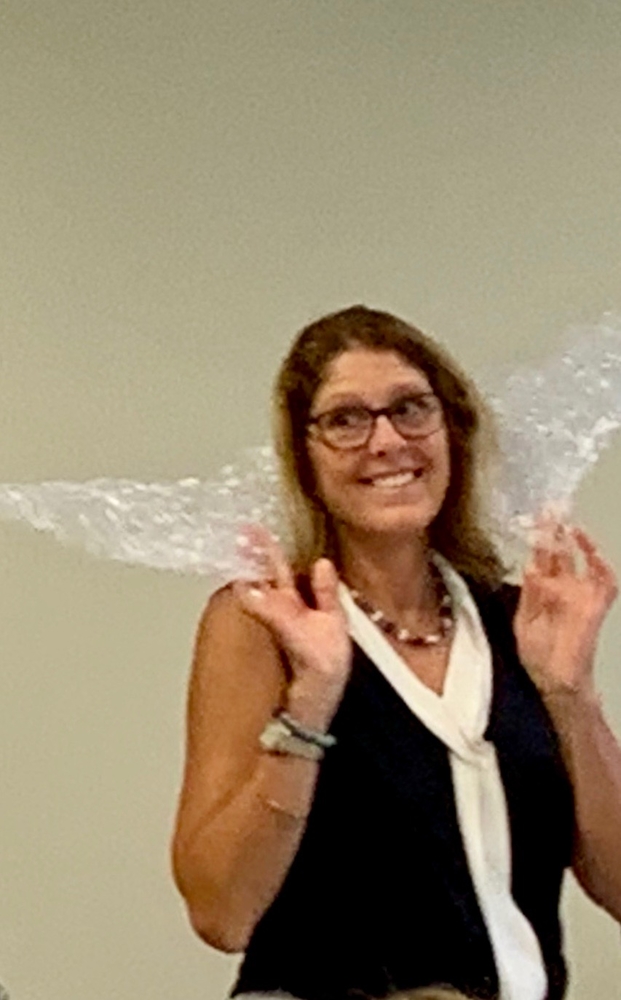
There was bubble wrap to pop as a stress-reliever for members Lori Wainwright and Shelly Harney, who’d worked tirelessly on juvenile justice programs. Cliff Barnett was honored with a Snickers bar for making the group laugh. Beth Schrader received Smarties candy for leading the strategic planning. A 100 Grand candy bar went to Louise Hicks, who’d helped secure funding to keep an executive director on board for two years. And a bag of Halloween eyeballs, the Resilient Vision Award, went to Task Force Chairman Scott Whisnant.
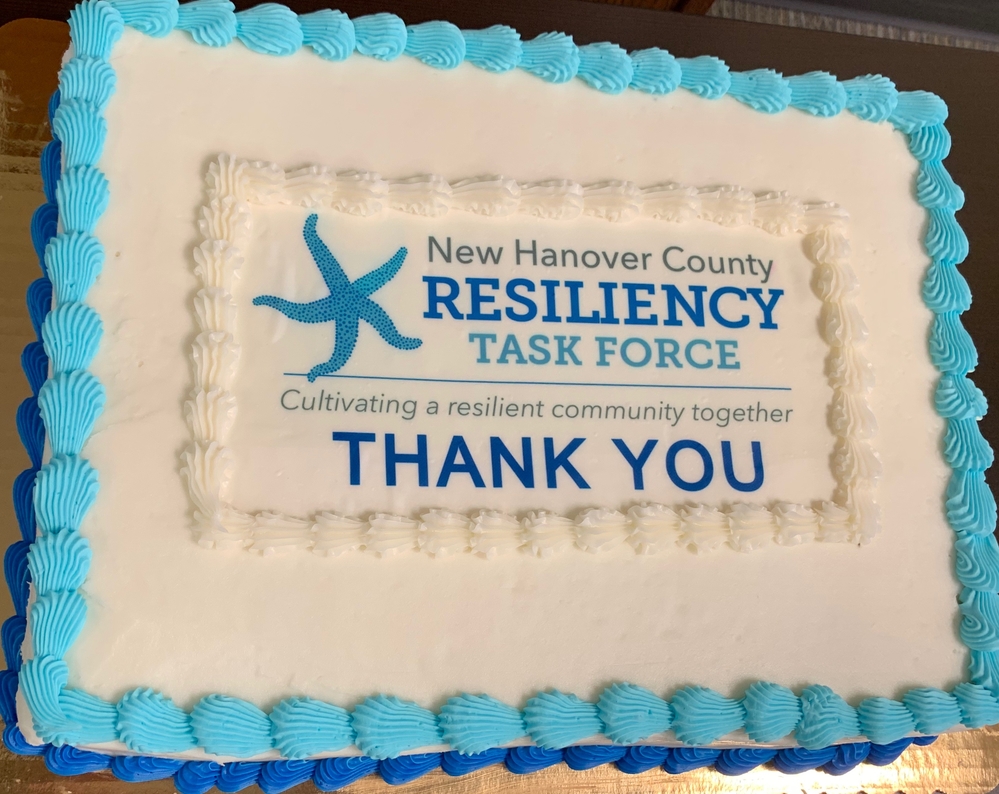
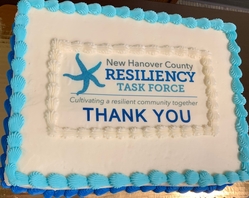
Applause from fellow Task Force members showed the enthusiasm and warm regard this group has built in a year’s time under Boyd’s leadership. Boyd made sure the celebration included a cake decorated with the group’s symbol — a starfish, because their legs can regenerate after breaking off. She also made sure everyone who wanted one received a token gift to mark the date: a Carolina-blue ribbon adorned with a tiny gold starfish.
As one of approximately 300 ACEs Connection community managers, Boyd seems to naturally embody the qualities so important to an ACEs initiative’s success. She is inclusive, quick to thank volunteers, attentive to the big picture of overall objectives, while at the same time being attentive to details. She is not afraid to ask for help or resources. She makes sure meetings are regular, well-run, involve reports from several members, and that they end on time.
“I’ve been working in nonprofits in Wilmington since 1992. I knew we needed a group that was open, inclusive, and as transparent as we knew how to be. I knew we needed to work on diversity, and though we still have a long way to go, we’ve begun to attract more people of color to our meetings. A year later, we’re at more than 500 individual members,” said Boyd.
Resilience Documentary was the Beginning
A viewing of the documentary Resilience: The Biology of Stress & the Science of Hope, in January, 2018, started Boyd’s association with what would become the New Hanover Resiliency Task Force.
“We screened the documentary at the New Hanover County office of Smart Start, a local affiliate of North Carolina’s early childhood initiative, where I was working. The people in the room – there were about eight elected officials – said it was time to stop talking about doing something about preventing trauma and building resilience. Scott Whisnant, with the local regional hospital, wrote the grant to help fund the coordinator position.
“It’s been good to hear from so many community members speaking through the ‘ACEs lens’ of how the science and the learning touches the areas we’re concentrating on for the community: better health, less violence, few or no racial disparities, health, education, and justice outcomes, strong education, positive workplaces, becoming a ‘resources rich community,’ supporting individual and family resiliency,” said Boyd.
“We know some of the things we are working on can and will make a difference in how we deal with stress, and how we can reduce chronic disease. We are working with our county’s chief strategy officer and others to measure our progress,” she said.
Hurricane Florence; Planning for Disasters with Children’s Needs in Mind
Only two months into her work coordinating the Task Force, Boyd saw Hurricane Florence change the landscape of southeastern North Carolina, bringing a new kind of trauma to the region.
The storm was a common denominator, solidifying work to recover from a recent stressful event shared by all members. The storm also brought assistance and guidance from the National Center for Disaster Preparedness, which reached out to the Task Force to help work on preparedness in the context of recovery. Currently, members of the Resiliency Task Force and others are looking, with children’s needs in mind, at how to plan for future disasters.
The Task Force has also taken advantage of assistance from the Duke Center for Child and Family Wellness through a grant from the North Carolina Department of Health and Human Services. A community needs assessment was undertaken, and the results have guided the types of trainings offered to the community.
Other highlights of milestones achieved in the first year of the Task Force include:
Training or introducing 600 individuals in the Community Resiliency Model
Launching a trauma-sensitive pilot schools project
Securing funding for a trauma-sensitive child care center
Funding the director position for two years
Attracting 100+ member organizations
Attracting 500+ individuals join the Task Force
Showing the documentary Resilience to more than 1200 individuals
Hosting a Resilience screening and educational event for physicians, which also included a providers’ showcase so physicians could become more aware of mental health resources in the area.
Boyd is quick to recognize and thank others for the work being done in the subcommittees, which also meet monthly between meetings of the entire Task Force.
In closing the meeting, she thanked attendees and hinted at bigger things to come as the group reviews their strategic plan later in August, with Beth Schrader, New Hanover County’s Chief Strategy Officer.
“Thank you so much to everyone who has helped. I cannot wait to see what the coming year will bring,” said Boyd, as she shared, between smiles and hugs, the little starfish bedecked blue ribbons — her thank-you and tribute to a more resilient New Hanover County.
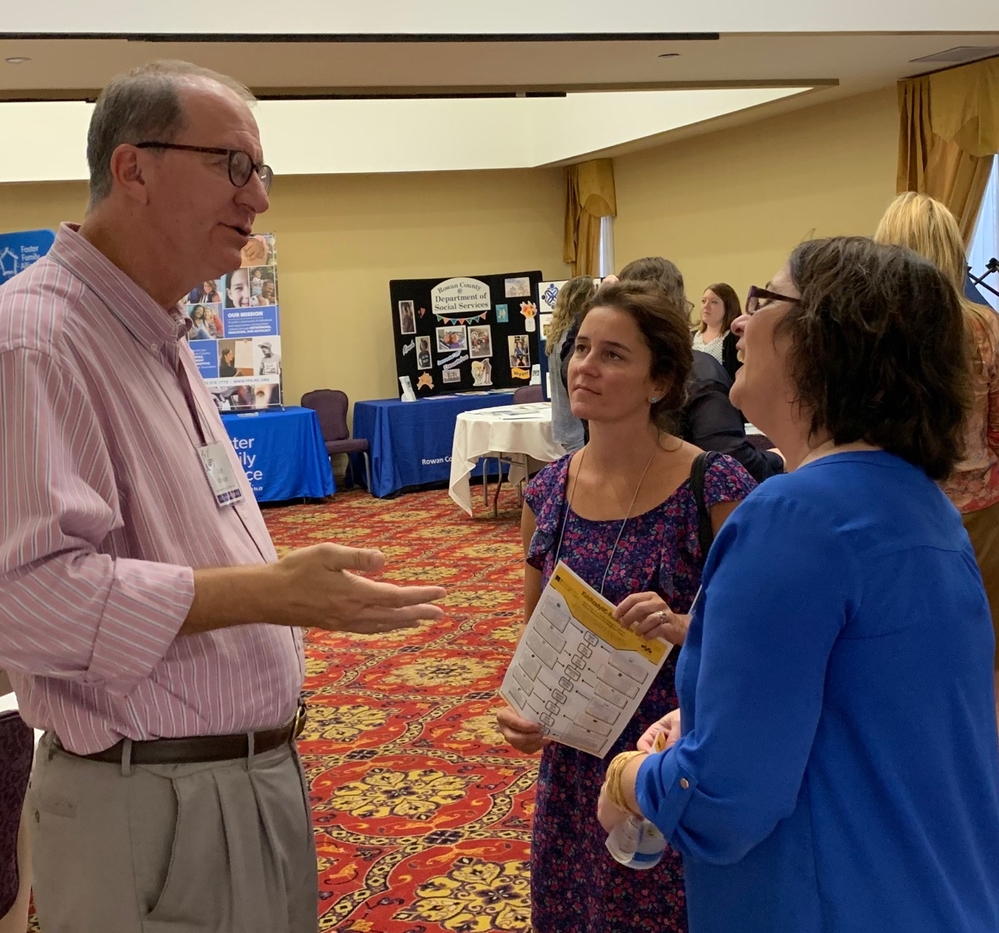
Community managers from 12 of 17 North Carolina ACEs Initiatives and the North Carolina statewide site met and exchanged information and ideas.
North Carolina launched a statewide ACEs Connection site at the Benchmarks’ Partnering for Excellence Annual Conference today.
“We are excited to organize the state and connect people with their local resources to each other, and to be able to capture and catalogue all the great work that is being done on the community level,” said Catherine Joyner. Joyner is executive director of the Child Maltreatment Prevention Leadership Team that’s part of Essentials for Childhood in the Division of Public Health, Women’s and Children’s Health Section, North Carolina Department of Health and Human Services.
North Carolina joins 29 other states with a statewide ACEs Connection site and a statewide ACEs initiative. A state-by-state listing is in the State ACEs Action community.
Currently North Carolina has 17 communities with ACEs initiatives. Representatives from 12 of the communities and the statewide site are attending an ACEs Connection event this evening to connect with each other, share information about their work, learn from each other, and see how they may be able to help each other in their work in the state’s ACEs movement.
For more information about creating an ACEs community initiative in the Southeastern United States, contact Carey Sipp, SE region community facilitator for ACEs Connection, at csipp@acesconnection.com or 404-408-9566. Please visit Growing Resilient Communities 2.0 to find out how to start an ACEs initiative in your community, and to identify and connect with the community facilitator in your region.
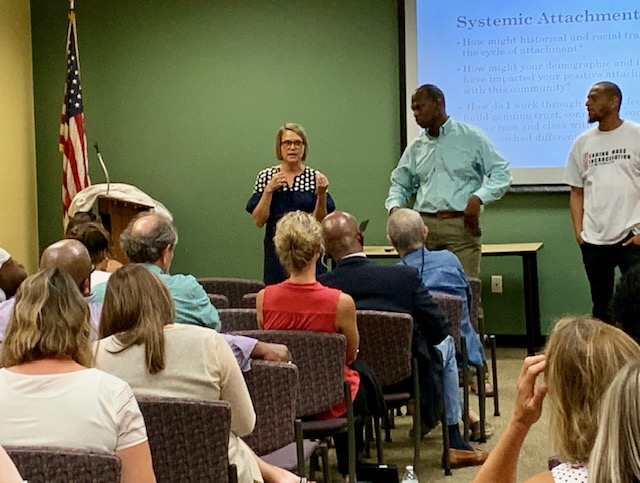
At a standing-room-only workshop on historical and racial trauma in Wilmington, NC this week, one of the workshop leaders, Jen Neitzel, Ph.D., executive director of the Educational Equity Institute , shared a list of resources on the topic of racism, trauma, white fragility, inequity, social justice and more.
Neitzel and fellow presenters Justin L. Perry, a therapist in private practice, and Jaraun “Gemini” Boyd, a client advocate for The Bail Project, spoke and interacted with an audience that included a physician, educators, social workers, parents, state, county, and city employees, and non-profit and faith community leaders.
At the end of the three-hour workshop most of the crowd lingered, many saying they wanted to continue the conversation on the different types of trauma and their causes and symptoms, the importance of the attachment cycle and how it plays out in different situations, and strategies for working with children and families who experience racial and historical trauma.
Here is Neitzel’s list of recommended resources to learn more about historical and racial trauma:
 Carey Sipp 11/19/188:05 PM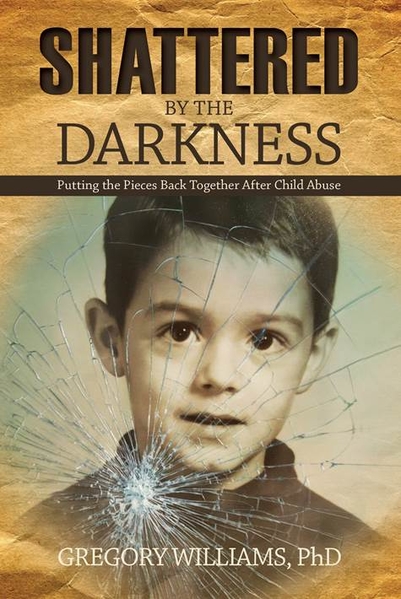








 Applause from fellow Task Force members showed the enthusiasm and warm regard this group has built in a year’s time under Boyd’s leadership. Boyd made sure the celebration included a cake decorated with the group’s symbol — a starfish, because their legs can regenerate after breaking off. She also made sure everyone who wanted one received a token gift to mark the date: a Carolina-blue ribbon adorned with a tiny gold starfish.