 Jane Stevens 4/23/124:30 PM
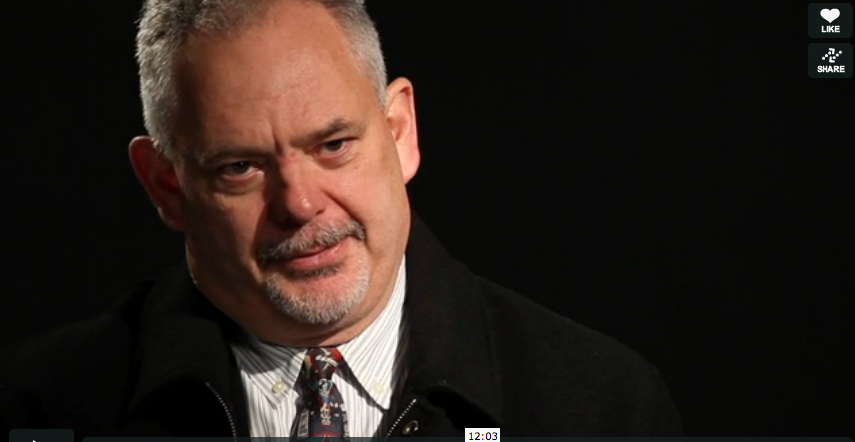 Jim Sporleder, principal of Lincoln High School
THE FIRST TIME THAT principal Jim Sporleder tried the New Approach to Student Discipline at Lincoln High School in Walla Walla, WA, he was blown away. Because it worked. In fact, it worked so well that he never went back to the Old Approach to Student Discipline. This is how it went down:
A student blows up at a teacher, drops the F-bomb. The usual approach at Lincoln – and, safe to say, at most high schools in this country – is automatic suspension. Instead, Sporleder sits the kid down and says quietly:
“Wow. Are you OK? This doesn’t sound like you. What’s going on?” He gets even more specific: “You really looked stressed. On a scale of 1-10, where are you with your anger?”
The kid was ready. Ready, man! For an anger blast to his face….”How could you do that?” “What’s wrong with you?”…and for the big boot out of school. But he was NOT ready for kindness. The armor-plated defenses melt like ice under a blowtorch and the words pour out: “My dad’s an alcoholic. He’s promised me things my whole life and never keeps those promises.” The waterfall of words that go deep into his home life, which is no piece of breeze, end with this sentence: “I shouldn’t have blown up at the teacher.”
Whoa.
And then he goes back to the teacher and apologizes. Without prompting from Sporleder.
“The kid still got a consequence,” explains Sporleder – but he wasn’t sent home, a place where there wasn’t anyone who cares much about what he does or doesn’t do. He went to ISS — in-school suspension, a quiet, comforting room where he can talk about anything with the attending teacher, catch up on his homework, or just sit and think about how maybe he could do things differently next time.
Before the words “namby-pamby”, “weenie”, or “not the way they did things in my day” start flowing across your lips, take a look at these numbers:
2009-2010 (Before new approach)
- 798 suspensions (days students were out of school)
- 50 expulsions
- 600 written referrals
2010-2011 (After new approach)
- 135 suspensions (days students were out of school)
- 30 expulsions
- 320 written referrals
“It sounds simple,” says Sporleder about the new approach. “Just by asking kids what’s going on with them, they just started talking. It made a believer out of me right away.”
________________
The dark underbelly of school discipline
Take a short walk on the dark side of our public education system, and you learn some disturbing lessons about school punishment.
First. U.S. schools suspend millions of kids — 3,328,750, to be exact. Since the 1970s, says a National Education Policy Center report published in October 2011, the suspension rate’s nearly doubled for white kids, to 6%. It’s more than doubled for Hispanics to 7%, and to a stunning 15% for blacks. For Native Americans, it’s almost tripled, from 3% to 8%.
Second. If you think all these suspensions are for weapons and drugs, recalibrate. There’s been a kind of “zero-tolerance creep” since schools adopted “zero-tolerance” policies. Only 5% of all out-of-school suspensions were for weapons or drugs, said the NEPC report, citing a 2006 study. The other 95% were categorized as “disruptive behavior” and “other”, which includes cell phone use, violation of dress code, being “defiant”, display of affection, and, in at least one case, farting.
Third. These suspensions don’t work for schools. Get rid of the “bad” students, and the “good” students can learn, get high scores, live good lives. That’s the myth. The reality? It’s just the opposite. Says the NEPC report: “…research on the frequent use of school suspension has indicated that, after race and poverty are controlled for, higher rates of out-of-school suspension correlate with lower achievement scores.”
Fourth. They don’t work for the kids who get kicked out. In fact, these “throw-away” kids get shunted off a possible track to college and onto the dead-end spur of juvenile hall and prison.
“Studies show that one suspension triples the likelihood of a juvenile justice contact within that year,” California Chief Justice Tani Cantil-Sakauye told the California Legislature last month. “And that one suspension doubles the likelihood of repeating the grade.”
Fifth. All these suspensions have led many communities to create “alternative” schools, where they dump the “bad” kids who can’t make it in regular public school. Lincoln High School was set up as one of those alternative schools.
How Mr. Sporleder stumbled across an epiphany in Spokane
It’s the Spring of 2010, and Jim Sporleder’s mind more or less silently exploded.
This is the guy with 25 years experience as a principal. In Walla Walla, he’s got a rep for really connecting with kids. He preaches “discipline with dignity”.
John Medina – a developmental molecular biologist who’s an improbable cross between an old-time rip-snortin’ preacher and Jon Stewart – just drilled a hole in Sporleder’s brain and dropped this in:
Severe and chronic trauma (such as living with an alcoholic parent, or watching in terror as your mom gets beat up) causes toxic stress in kids. Toxic stress damages kid’s brains. When trauma launches kids into flight, fight or fright mode, they cannot learn. It is physiologically impossible.
Sporleder was three years into an exhausting stint as principal of the Lincoln Alternative School. He’d asked for the position after reading a report about the troubled school. The report quoted a couple of Lincoln High’s kids: “We’re the dumping ground,” one said. “Who cares about us,” another said. It wasn’t a question.
“That report riveted me,” says Sporleder. “I’m a person of faith. I felt called to come over here.”
Gangs controlled the school. It had only 50 students, but they were the toughest in the school system – the kids who’d been kicked out of other schools. Lincoln was their last chance.
“I didn’t know if I was going to make it,” recalls Sporleder. “We had some pretty rough kids. It took me quite a while to get on top of that.”
And then, at the behest of Teri Barila, co-founder of the Children’s Resilience Initiative in Walla Walla, he goes to this meeting where this guy who’s part comedian, part evangelist, part scientist (and best-selling author of Brain Rules) more or less tells him that this “discipline with dignity” stuff is, well, useless. Punishing misbehavior just doesn’t work. You’re simply adding trauma to an already traumatized kid.
“He explained it in lay terms,” says Sporleder. “I got it.”
Now, some people who are well into their careers can’t handle a paradigm shift. It’s overwhelming. That’s mostly because it’s just too much trouble to change the way you do…everything.
Spoiler alert: Sporleder isn’t one of those people.
He returned from Spokane to light a fire under his teachers. He felt compelled to figure out a way to do something different to reach his kids, but wasn’t sure exactly how. Teri Barila was in a perfect position to assist.
This is your (damaged) brain on ACEs
Really good ideas that help people solve problems often take such a long time to move from research to implementation that it can cost a community millions of dollars. Twenty years ago, Washington State created a state network — the Family Policy Counciland 42 community public health and safety networks — to share good information FAST to tackle a big, expensive problem: the high rates of child abuse and youth drug and alcohol abuse in the state. Teri Barila, a former fish biologist, leads the network in Walla Walla, a city of about 30,000 people in southeastern Washington.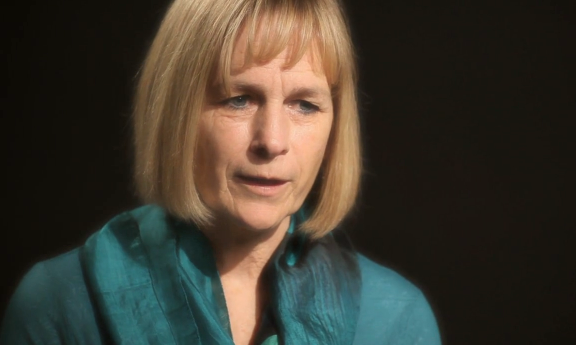 Teri Barila
About 10 years ago, the council caught wind of two major game-changing discoveries. One was the CDC’s Adverse Childhood Experiences Study (ACE Study). It showed a stunning link between childhood toxic stress and the chronic diseases people developed as adults. This includes heart disease, lung cancer, diabetes, some breast cancer, and many autoimmune diseases, as well as depression, violence, being a victim of violence, and suicide.
The ACE Study measured 10 common types of childhood trauma. Five were the usual suspects: emotional, sexual and physical abuse, and emotional and physical neglect. Five were family problems: a parent addicted to alcohol or other drugs, seeing a mother being abused, a family member in prison, a family member diagnosed with a mental illness, and a parent who’s disappeared through abandoning the family or divorce. (Although the word “trauma” is more commonly used to describe physical injury, in this milieu, it refers to any experience that causes toxic stress.)
The study’s researchers came up with an ACE score to explain a person’s risk for chronic disease. Think of it as a cholesterol score for childhood toxic stress. You get one point for each type of trauma. The higher your ACE score, the higher your risk of health and social problems.
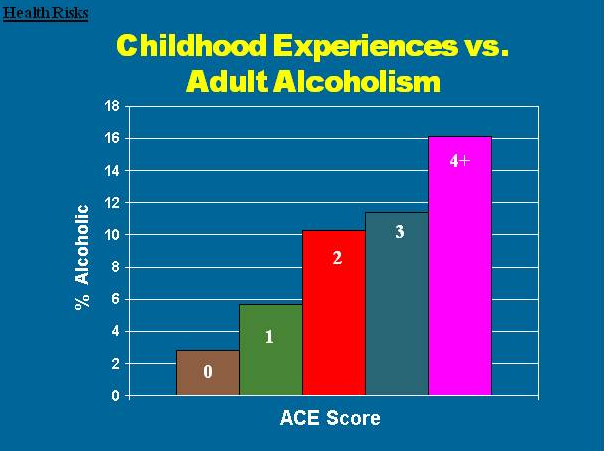
A whopping 70 percent of the 17,000 people in the study had an ACE score of at least one; 87 percent of those had more than one. With an ACE score of 4 or more, things start getting serious. The likelihood of chronic pulmonary lung disease increases 390 percent; hepatitis, 240 percent; depression 460 percent; suicide, 1,220 percent.
The percentages climb to grim and astounding levels as the ACE score climbs – people with an ACE score of 6, for example, have a 4,600 percent increase in the risk of becoming an IV drug user. Grow up with an ACE score of 10, and you’re likely to find yourself homeless, in prison for life, or end up dead by your own hand. People with high ACE scores die, on average, 20 years earlier than those with low ACE scores.
By the way, lest you think that the ACE Study was yet another involving inner-city poor people of color, take note: The study’s participants were 17,000 mostly white, middle and upper-middle class college-educated San Diegans with good jobs and great health care – they all belonged to Kaiser Permanente, a health maintenance organization. As Dr. Robert Anda, one of the co-founders of the ACE Study says, “It’s not them. It’s us.”
The second game-changing discovery explained why childhood trauma had such tragic long-term consequences: Toxic stress physically damages a child’s developing brain. This was determined by a group of researchers, including neurobiologist Martin Teicher and pediatrician Jack Shonkoff, both at Harvard University, and neuroscientist Bruce McEwen at Rockefeller University. In a nutshell, toxic overdoses of stress hormones stunt the growth of some parts of the brain, and fry the circuits in others.
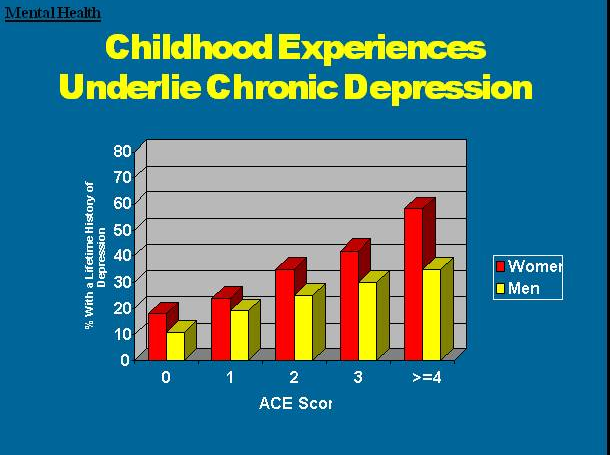 Children with toxic stress live their lives in fight, flight or fright (freeze) mode. They respond to the world as a place of constant danger. They can fall behind in school, fail to develop healthy relationships with peers, or develop problems with authority because they are unable to trust adults. With failure, despair, and frustration pecking away at their psyche, they find solace in food, alcohol, tobacco, methamphetamines, inappropriate sex, high-risk sports, and/or work. They don’t regard these coping methods as problems. They see them as solutions to escape from depression, anxiety, anger, fear and shame.
When Barila learned all this at a meeting that the Family Policy Council organized, it chilled and angered her. Determined to do something about it, she co-founded the Children’s Resilience Initiative to educate the Walla Walla community about ACEs and to build resilience to combat ACEs.
Barila brought Natalie Turner, an expert in creating trauma-free schools, to town to help Sporleder and his teachers.
Natalie Turner’s two simple rules for dealing with troubled students
When she met with the Lincoln High staff, Natalie Turner, from Washington State University’s Area Health Education Center, picked up right where John Medina, who lit up Sporleder’s brain, left off.
Toxic stress comes from complex trauma, she said.
Complex trauma ain’t pretty.
It’s when your dad’s in prison AND your mom’s a meth addict AND she’s too drugged out to move in the mornings, so you’ve got to take care of your little brother, get him fed and off to school, AND you’re despairing about being evicted for the third time because she hasn’t paid the rent and the landlord’s screaming at you to do something.
Or your dad’s a raging alcoholic AND he beat the crap out of your mom again last night AND the cops came and took him away at 2 a.m. AND the EMTs took your mom to the hospital and you hardly slept a wink and you’re frantic with worry because you don’t know what’s going to happen, but you’ve got to stay cool or otherwise you’ll have a complete meltdown.
Or your fat step-dad’s sneaking into your bed in the middle of the night AND you’re too terrified to move because he says if you say anything he’ll kill you and your sister and your mom, who’s depressed AND doesn’t talk much anyway.
Teens who live with complex trauma are walking post-traumatic stress time bombs, says Turner. They teeter through their days. The smallest incident can push them into a full-blown meltdown. Some kids run away. Some explode in rage. Some just mentally check out.
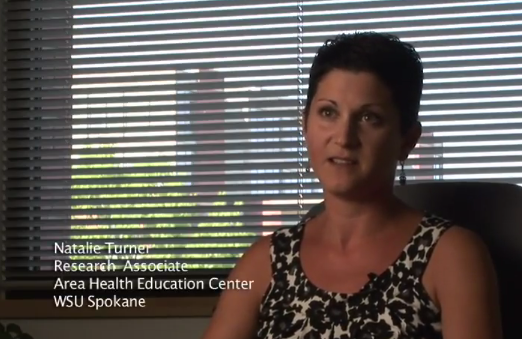 “In flight, fight or freeze mode,” Turner explains, “survival trumps everything else.” So when a kid who’s got complex trauma feels threatened or overwhelmed, exploding in rage at something that most people wouldn’t even shrug over is a perfectly normal response.
That’s worth repeating: exploding in rage, getting pissed off, stomping, hitting….it’s all normal. Until a school helps kids learn how to control their emotions, they’ll just keep losing it. For some kids, erupting is a stress reflex response.
“That’s the hardest pill to swallow,” says Erik Gordon, a science teacher at Lincoln High. “Trying to figure out how much of their behavior is from a choice and how much is outside their control. It’s a drag when you believe it’s outside their control, because all of the easy disciplinary action doesn’t work.”
There are just two simple rules, says Turner.
Rule No. 1: Take nothing a raging kid says personally. Really. Act like a duck: let the words roll off your back like drops of water.
Rule No. 2: Don’t mirror the kid’s behavior. Take a deep breath. Wait for the storm to pass, and then ask something along the lines of: “Are you okay? Did something happen to you that’s bothering you? Do you want to talk about it?”
It’s not that a kid gets off the hook for bad behavior. “There have to be consequences,” explains Turner. Replace punishment, which doesn’t work, with a system to give kids tools so that they can learn how to recognize their reaction to stress and to control it. “We need to teach the kids how to do something differently if we want to see a different response.”
Kids need adults they can count on, who they know will not hurt them, and who are there to help them learn these new skills, Turner tells the Lincoln High staff. If it’s not happening at home, it had better happen at school. Otherwise that teen doesn’t have much of a chance at life.
(For those of you who are interested in the underlying model that guides Turner’s teaching, it’s the ARC model developed at the Trauma Center at Justice Resource Institute. Turner and her co-workers were also influenced by the trauma-sensitive classroom movement, for which more information can be found in The Purple Book, published by Massachusetts Advocates for Children.)
The red zones of Lincoln High
The Lincoln High staff took Turner’s information and flipped its system of school discipline like a pancake.
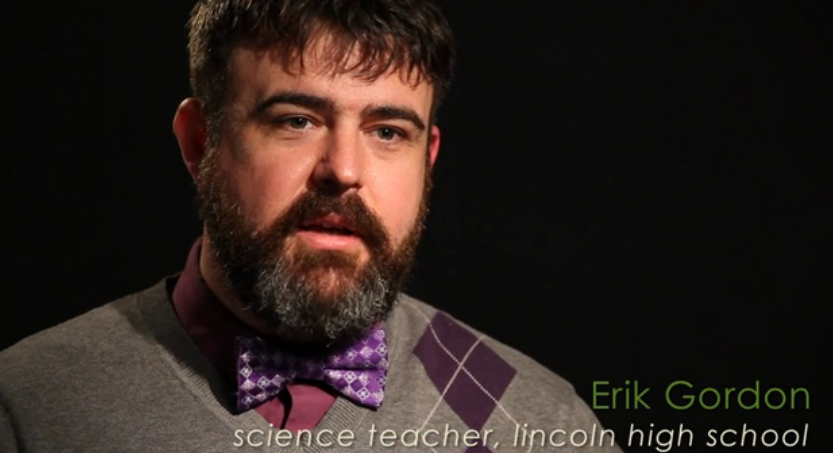
The changes began in the classroom. “Teachers started becoming detectives,” says Gordon. “We began focusing our concern on what we know that’s going on that might be causing behavior in a kid,” versus what type of punishment to mete out.
When a kid erupts in class, teachers intervene quickly. “A kid that I have a really great relationship with might blow up,” says Gordon. “So, I step out of the classroom with that kid and ask: ‘What’s going on? Because that was really intense.’ I know that something is bumming this kid out, because normally, we really enjoy each other.”
Other responses include:
- “Class isn’t working today, how about taking a time out with Shelly (in the ISS Room) so that you can get yourself calmed down?”
- “I feel that I really blew it and I feel like I have set you off. I want to apologize and see if there is anything that I can do to help you.”
- “You seem really upset, would you like to speak to someone in the Health Center?”
If it escalates to principal level, Jim Sporleder uses his infamous zone system: red, yellow and green. Here’s how that works:
Three boys don’t respond to their teacher, who asks them politely, but firmly to leave class and talk with the principal. Although three fuming teens sit down in front of Sporleder, he sees three brains under extreme stress, unable to take in anything useful or to solve a problem.
“You’re in the red zone,” he tells them succinctly. He doesn’t yell. He doesn’t roll his eyes. There’s no body language that says “I can’t stand you kids,” because he actually thinks the world of them.
“Let’s meet tomorrow morning. You’re going to take the rest of the day and night to process this.” (Sometimes Sporleder has found himself in the red zone, and tells the kids: “I’m in the red. I don’t want to make any decisions that could come from my own anger or stress. Let’s take a break and meet later.”)
The next morning, Sporleder says, all three approach him and say they’ve talked over the problem with the teacher, have apologized and figured out a solution. “We’ve got it all worked out,” they explain.
“That’s more common than not these days,” says Sporleder.
But if they had refused to apologize to the teacher and refused to solve the problem, or their infraction was more serious, they would have gone to ISS – in-school suspension.
“I don’t have kids arguing about the consequences,” says Sporleder.
Well…mostly he doesn’t. Sometimes he still gets kids asking to be suspended to home instead of in school, which tells him that ISS may be more uncomfortable, but it’s more effective. In that quiet room, they can’t distract themselves with TV, video games or drugs. A staff member offers conversation – about how the teen is dealing with the incident, or other issues in her or his life. Other teachers stop by to make sure the teen is caught up on homework.
“At home, there’s no accountability,” he explains. During in-school suspension, the teens can’t escape their issues. It’s not fun to have to give up old beliefs and habits. But they all get lots of support to get into the green zone.
“We tell our kids we love them,” says Sporleder. “They’re important to us.”
The third big change occurs in the school’s monthly staff meetings. Instead of talking about disciplining problem kids, they focus on why that teen’s having problems, develop a plan to help the teen, and make sure to follow up.
In the last two years, the Lincoln High staff has noticed that the kids’ ability to regulate their own emotions has dramatically improved. “There’s not near the number of huge emotional explosions that there used to be,” says Gordon. “Even the way the kids interact with each other is more subdued.”
They way the kids see it is that the teachers have chilled out.
What else do the kids say?
At Lincoln High, the kids not only live ACEs, but they talk them.
As senior Heidi Schoessler, 18, explains it: Students have ACEs (adverse childhood experiences). Those are the bad things going on in their lives. Resilience factors – such as asking for help, helping a friend, experiencing success, having hope — trumps those ACEs. They’re beginning to learn about those resilience factors in school and in the school’s health clinic.

When Schoessler showed up at Lincoln, she couldn’t be in a classroom with more than two or three people at a time, says Sporleder. She’d been bullied and harassed so much in elementary and middle school, that being around too many students caused a stress response that made her sick. Sixteen-year-old Aron Wulf was so withdrawn, he hardly talked. Jordan Massey, 17, had anger issues. Brendon Gilman, 15, who was removed from a family of meth addicts and has lived in several foster homes, says in this video about The Health Center at Lincoln High he was so angry with life that he didn’t care about the future because he was so mad about the present.
Today, all four chat easily about the school and its changes. Gilman went from failing grades to A’s. Schoessler’s taking college classes. Wulf is active in the production of the school play. All four do presentations for the community about the changes in the school.
“I got here, and my whole high school experience flat-out changed,” says Massey, a junior who transferred in halfway through his freshman year. “People came up to me and greeted me. It felt like I had real friends here. I loved it. I call it my home away from home. It really feels like a family here. The teachers are amazing. That’s how a high school should be.”
Here’s how Wulf describes the changes in his life: Shortly after he was born, his parents divorced. He’s been living with his mother. When he was younger, he spent every other weekend with his father.
“My dad’s verbally abusive. He has a really bad temper,” Wulf says quietly. “My mom has always been sick in bed pretty much. The people who should have been around were never around, basically. She has problems with depression and what not. She might commit suicide. There are financial issues.”
When he talks about Lincoln, his voice gets strong, and hopeful. “Lincoln’s the first school I’ve been to that I actually loved,” he explains. “It was the first time I ever felt that somebody actually cared to hear my story to know how I was feeling. My own teachers understand me better than my mom does.”
Wulf is an example of the type of quiet, isolated student that Dr. Vincent Felitti, co-founder of the CDC’s ACE Study, advises educators to “make sure you always connect with,” says Sporleder. The quiet students – the ones who respond to toxic stress with “fright” or “flight” – sit quietly in the back of the room with their heads down. They’re often labeled as “lazy” or “unmotivated”. They might not be as loud or belligerent as those who drop into “fight” mode, but they’re hurting just as much.
“I’m always looking for kids who are isolated,” says Sporleder.
“What is happening at Lincoln is completely different,” says Schoessler. “There’s so much more of a caring atmosphere. Students will come to the teachers when they need help. It’s something I have never seen in any other school.”
Even in-school suspension is useful, says Gilman, who spent time in ISS for getting in a dust-up with his ex-girlfriend at school. “I couldn’t handle being around her,” he says. “It kind of helped, even for just the day, to be away from everyone and everything, including her. It helped me reflect why I was there and why I had acted the way I did — without someone telling me how I’m wrong for what I did. It helped me look at the situation and what I can do to prevent it from happening again.”
School’s ACE survey helps kids, teachers understand each other
The kids talk ACEs because, as part of a science class on data and analysis, they developed a survey of 96 questions that include the shortened version of the ACE survey.
“It is so invasive,” says Sporleder, barely suppressing a shudder. “If an outsider developed it, it would never have been used.”
Since the original research in San Diego, 18 states have done ACE surveys, including Washington. If not the first high school in the U.S., Lincoln is certainly among the first in the U.S. to do its own ACE survey.
The survey’s anonymous, and students can skip questions if they want to. Some examples:
- “Has there ever been an adult in your household that has hit you so hard that you had marks or were injured?” One-quarter of the kids said yes.
- “How many sexual partners have you had? Ten percent said 4 to 6.
- “Have you ever been forced to do something sexual that you didn’t want to do?” Almost 20 percent said yes.
The results show that these kids are grappling with way more than any kid – or adult, for that matter — should:
- 25% of the students are homeless.
- 84% have lost a loved one.
- 66% feel abandoned by their parents.
- 65% have an immediate family member in jail.
- 80% have suffered serious depression
- 50% live with someone who abuses alcohol or other drugs.
The survey’s useful, says Gilman, because “it gives you this feeling that ‘I’m not the only person who’s gone through that’. It’s easier to interact with people and to understand the way some people act.
The staff uses the survey to help understand the level and intensity of the teens’ stress. They also use it to teach the students that they cannot control and are not accountable for the trauma they have endured.
“When students understand they’re not responsible for the family they were born into, but they are responsible for who they will become as adults, and when they can see the power in that, it’s just amazing what happens,” Barila says in the Health Center video.
The grim reality is that the average ACE score for the teens at Lincoln High is 4.5. These kids are at high risk for developing chronic diseases when they’re older, becoming violent or being a victim of violence, suffering from depression or committing suicide.
ACE Study co-founder Dr. Robert Anda says that the study exposed “a chronic public health disaster”. So if a teen’s bad behavior or isolation or lack of motivation is a normal response to complex trauma, then that behavior is also a health issue. That’s what pediatrician Alison Kirby says.
The Health Clinic at Lincoln High
Four years ago, says Sporleder, “we needed a doctor to provide physicals for our first boys basketball team. Dr. Alison Kirby, a local pediatrician, volunteered to do all the exams for free.
“When’s the last time you had a physical?” she blithely asked the first boy. Ten years ago, he answered, before he started first grade. Her eyebrows shot up. She asked another. Never, he said. Dr. Alison Kirby
Kirby was appalled. She didn’t realize that there were children in Walla Walla who hadn’t seen a doctor in 10 years.
“In my regular clinic, I see with kids with insurance,” says Kirby. “The students at Lincoln are a different group of kids. They are invisible. It doesn’t really connect with most people in this community that these kids are the future of our small town. Once you do see it, it’s unethical to look away.”
In all communities, kids are the future – a costly future or a beneficial future. They grow up to live out their lives in healthy or unhealthy ways, in ways that contribute to the growth and health of their community or to the economic and emotional afflictions. And how they live their childhood determines their future. If a large number have high ACE scores, then the community ends up spending more money for cops, courts, prisons, welfare, social services, medical and mental health than for schools, playgrounds, community pools, and libraries. People working in education, prisons, child welfare agencies and juvenile justice have known this intuitively for a long time. Now the research proves it.
Kirby didn’t look away. She cajoled, rounded up, lobbied, wheedled, coaxed, prevailed upon, inveigled and persuaded the community to step up, fund and volunteer at a health clinic that’s right next to the school. Open 10 a.m. to 2 p.m., five days a week, it’s the only school health center in eastern Washington.
Kirby expected 90 percent of the clinic work to be “treating asthma, infections, stitches.” It turns out that 90 percent of the work focuses on the kids’ mental health.
“What we were finding is that there are not enough psychologists and counselors to go around,” she says. Given the toxic stresses that the kids are dealing with, she says, it’s no surprise.
“If your brain isn’t healthy and you’re not doing well, your body physically isn’t going to do well, either,” says Katherine Boehm, clinic coordinator in the health center video. “If you are struggling with depression or anxiety, you’re going to have a much harder time concentrating in school and being able to complete your work.”
The staff at the health center uses the student ACE survey to develop programs and services that help the kids learn skills to build resilience, specifically to:
- create social connectedness
- provide concrete support in times of need
- teach social and emotional competence
Last year, 175 of the school’s 200 students made 1,500 visits to the clinic. Still, nearly 20 percent of the students “still don’t trust us,” says Kirby. “They’re so beat up emotionally that they have huge vulnerability issues. They’ll come in with a friend for 6 months to a year before they come on their own.”
Part of that reticence comes from their treatment at other clinics. They have homemade tattoos and shaved eyebrows. They might smell bad because they’re homeless and haven’t been able to take a shower for three days. “At a big clinic, if they’re judged on appearance or smell,” says Kirby, “they get treated badly and the kids won’t go back. We accept them for who they are. Their future is more important than their past.”
Some have lived in dysfunctional families for so long that they don’t know what healthy is, so they’re vulnerable to abusive relationships, says Kirby. One 15-year-old girl, desperate for interaction with a loving adult, went online and found a “foster-daddy”.
“She got a ride 50 miles to a bigger city, where he was,” says Kirby. “She had severe depression, was “cutting”. His solution was to beat her.” The clinic treated her festering wounds and talked with her about healthy relationships.
“Many of these kids don’t have a parent who says ‘I love you’ and means it,” says Kirby. “Instead it’s ‘I love you, so now go score some dope for me’.
Kirby and the staff want to provide the support for the students to heal and to develop enough self-confidence to live healthy lives. For some, that means living different lives than their families are living. Many education experts say that kids wouldn’t have problems if their parents would just get involved. But the parents of most of the students at Lincoln HIgh are themselves are struggling with the effects of their own childhood trauma, and many are passing the trauma on to their children.
As Kirby puts it: “Their family is in a plane that’s going to crash. We tell them: ‘You’re going to parachute out. You’re going to college.’ Their family is likely to say to them: ‘Hey you in the parachute — get back in this plane. We need you to go to work and support us.’ The people in the plane give lots of pushback: ‘What? You’re too good to be with our family now?’ Sometimes kids change back. Sometimes kids get healthy and say: ‘I don’t want to live like that anymore.’”
Lincoln High’s metamorphosis is just beginning
Natalie Turner says that of all the schools she and her co-workers at the Area Health Education Center work with, “Lincoln’s at the top of the list.”
One of the keys has been a staff that embraces two basic concepts: toxic stress prevents kids from learning, and moving from a punitive approach to a supportive, educational approach changes behavior. Gordon says it’s also the unconditional love that the teachers at Lincoln High show the kids on a regular basis. Lincoln High School, Walla Walla, WA
“Watching Jim Sporleder’s paradigm shift over the last five years has been just awesome,” says Gordon. “I’ve seen that guy cry talking about our kids. Lincoln is just a collection of staff that unconditionally love these kids. The rest is just mental hoo-ha.”
The mental hoo-ha has allowed and encouraged that kind of overt love, caring and support that’s characteristic of Lincoln and that inspires many people to go into the teaching profession. Turner has worked with educators who just won’t budge from clinging to a system that clearly shows no progress in helping the “troublemakers” and “unmotivated” students.
“If the staff aren’t ready, there’s no point in going in and trying to move a system,” she says. “There have been a couple of schools where they’ve had a very resistant staff, and we’ve decided to leave and try again another time.”
Although it’s made significant changes, Lincoln’s not finished, says Sporleder. “Part of what we’ve done is the relationship piece,” he explains. “That’s the powerful piece – we’ve built strong relationships with our kids. Now I want to move forward to help kids understand how resilience trumps ACEs.
Since he’s found no guidelines for this part, he’s trying this approach: He’s put together a chart that hangs on a wall in his office. It shows ACEs and, on red cards, the qualities of resilience that can overcome those ACEs.
He’s asked some students to read the ten ACEs and tell him how many they have, says Sporleder. “I never ask them which ones. And then we start talking about resilience. I share with them qualities that I have seen them demonstrate that build that resilience.”
One student told him: “I get it — the more red cards you have the greater the chance it trumps your ACEs.” Sporleder emphasizes how important it is for them to connect with positive caring adults to help them to continue to build their character and to build their resilience.
The changes at Lincoln have not eliminated expulsions. And the school hasn’t done the analysis to know for certain if the changes have resulted in better grades and attendance.
Nevertheless, Lincoln’s results are showing the community that change is possible. If suspensions can be reduced by 85 percent among teens whom most of the community had given up on, if they can blossom into happy kids who suddenly see themselves as having a future, perhaps the same changes can occur in other settings.
“We intentionally focused on Lincoln as a pilot of sorts,” says Barila, “with the full support of the assistant superintendent, so we could learn what strategies work and how, so we could then ‘pass it on’ throughout the school district.”
The next chapter, she says, is to see if the rest of the schools in the district can accomplish similar results. That includes Walla Walla High School, with its 2,000 students and larger class sizes, as well as six elementary schools, two middle schools, a Catholic school system and a Seventh Day Adventist school.
There’s little doubt that many of the 6,000 other kids in Walla Walla’s school district have adverse childhood experiences, too. Perhaps they don’t have ACE scores as high as Lincoln students, but ACE scores are more common than not. According to Washington State’s 2009 ACE survey, 62 percent of the state’s population has at least one ACE, and 27 percent have an ACE score of 3 or more.
But Lincoln alone can’t make enough changes to help every child, says Barila. “That social-emotional competency has to be built in soooo much sooner than Lincoln,” she notes. The goal of the Children’s Resilience Initiative is to educate the entire community about adverse childhood experiences, the effect of toxic stress on kids’ brains, and to encourage all organizations, agencies, clinics and youth groups to build and increase resilience factors. That’s why she named the organization the Children’s Resilience Initiative and not the ACEs Education Initiative, she says.
Still, if other schools adopt this approach, it won’t be easy, says Sporleder. He knows that his peers discipline “like I used to discipline. I think our educational system reacts to the action. We need to respond to what is causing the action.
“This is such a paradigm shift, you have to believe in it to make change happen,” Sporleder says. “The administration has to show support. That’s what I’ve seen. You’ve just gotta believe in it. You’ve gotta know that it’s true.”
Jane Stevens
Publisher, ACEsTooHigh.com
Founder, PACEs Connection
Views: 1,616
Add Comment
 Carey SippFormats
javascript:””
Comments (6)
Jane StevensPublisher, ACEsTooHigh; founder, PACEs Connection
Thank you, Shelley. The school staff continue to do amazing work.
FMFormer Member
This article is a mind-blower. Thank you, Jane for posting! Amazing!
Jane StevensPublisher, ACEsTooHigh; founder, PACEs Connection
I think so, too!
Vincent J. Felitti, MDMember
This was a tremendously impressive place to visit. It deserves a documentary TV show to illustrate what’s being done about problems that generally are comfortably not acknowledged or understood.
Jane StevensPublisher, ACEsTooHigh; founder, PACEs Connection
Thanks, Laura!
FMFormer Member
Wonderful article. Thanks, Jane!