(Published on PACEs Connection on May 16, 2026)
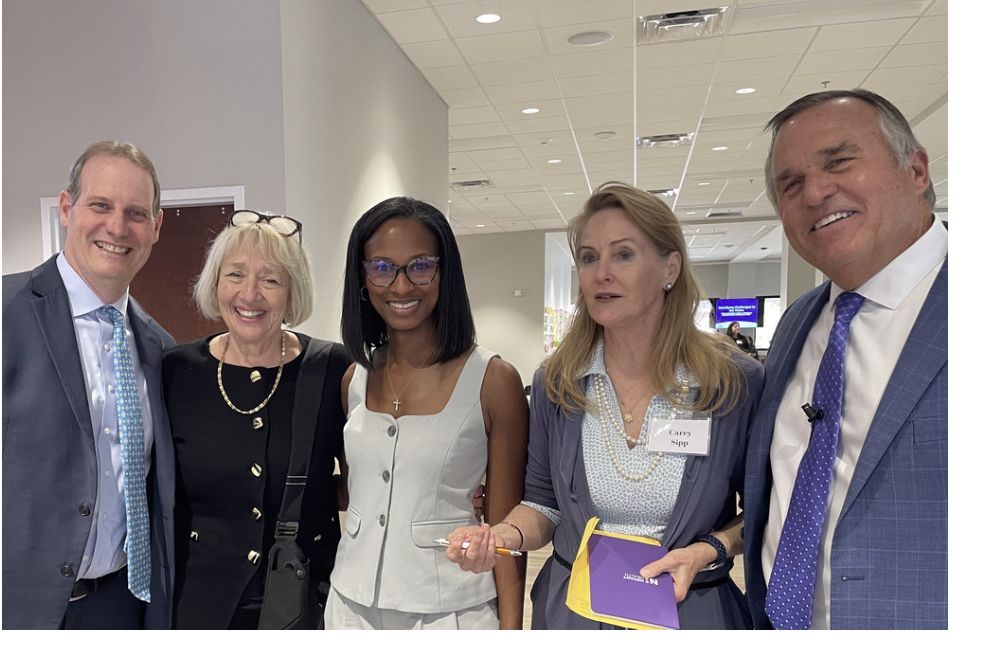
Photo from May 13, 2026 of Ben David, chief executive officer of the New Hanover County Community Justice Center; Elaine Miller-Karas, key creator of the Community Resiliency Model (CRM) and co-founder of Trauma Resource Institute; J’vanete Skiba, director, New Hanover County Resiliency Task Force; myself, and Casey Gwinn, founder, Alliance for Hope International, co-founder, Camp Hope, on break at a strategic planning session for the New Hanover County Community Justice Center. Elaine visited Wilmington and Raleigh, North Carolina, from California to meet with business leaders and CRM trainers in the region and dropped by the planning session to meet Ben, Casey, and Catherine Johnson, president of Alliance for Hope International. This photo represents a few of the hundreds of thousands of people working upstream to prevent and heal trauma, to create the positive childhood and community experiences that help prevent next-generation trauma. Their work — and that of their predecessors over generations, including that of grandparents, teachers, coaches, neighbors, family friends, and more who have provided safe, stable, nurturing environments for newborns and children enduring trauma — is a major reason why high ACE scores do not automatically equate, at the individual level, to negative outcomes. Your work — our work — matters!)
Reading the 1998 ACE Study in 1999, freaking out, doubling down on self-care
About 27 years ago, when I first learned about the science of adverse childhood experiences (ACEs) via the 1998 ACE Study, I was so devastated by my ACE score that I wept — and put the study in a drawer.
Fortunately, I’d already increased my activity in several supportive communities following a divorce, as I sought help rearing my two precious children as a single working mom.
About three years later, I took the ACE study out of the drawer. Brain science had come out with a lot more information on neuroplasticity — how we’re not “stuck” with the brain we’re born with, or that might have been harmed by ACEs. I started doing more research and writing on parenting, health, brain health, recovering from trauma, and ultimately, ACEs, and then positive and adverse childhood experiences (PACEs) science.
Reparenting and parenting
Fast forward through years of reparenting myself as I parented my children — with the belief that we needed to be in healthy communities where they could have as much exposure as possible to happy, healthy families and adults modeling great relationships. I encouraged my kids to be glad they had “other mothers and fathers” — lots of strong, positive influences in their lives.This was 20 years before the Positive Childhood Experiences (PCEs) study of 2019. But when it was published, it was deeply affirming of how relying on a “village” and asking for help, as instinct guided, had been the right habit.
We were NOT our ACE scores. My high ACEs didn’t mean I was doomed — as I’d so feared when I first read the 1998 study. And low ACEs didn’t mean anyone was “out of the woods.” We all need as many PCEs as possible.
Here is a truth I want every person with a high ACE score to hear: a high ACE score is not a death sentence. It is not a destiny. The ACEs study measures population-level risk — and at the population level, the implications are sobering. But populations are made up of individuals. And individuals have agency. There are outliers. There always have been.

The 2019 PCEs study and many subsequent studies on the power of PCEs affirm what many of us had already lived: positive childhood and community experiences are buffering and protective; that they can and do change trajectories. For people without those buffers — facing greater poverty, isolation, racism, inequity, and lack of healthcare and support — the risks the ACEs study describes are more likely to materialize. That is chief among the real injustices we must address.
For those of us who fell into or found community, who were held by neighbors and grandmothers and the parents of friends — those relationships were medicine.

I have had health challenges that line up perfectly with the assault on my developing brain and central nervous system — digestive, respiratory, and sleep issues. AND the communities my children and I were part of boosted our health and stability. Years of meditation taught me how to breathe and calmed my nervous system. My respiratory issues are now few and far between.
*My* children are now 33 and 36. Both are in terrific marriages. A first grandchild is due soon; he will be welcomed with and into tremendous love. I am in a safe, stable, nurturing relationship, surrounded by one of the most caring communities I’ve ever known.
#WeAreTheMedicine. Creating and being in community — and knowing we have agency — changes everything. Community is the preventive and antidote to trauma and the trauma of isolation, loneliness, “othering.”
People with high ACE scores are not broken. We are not necessarily destined for an early grave. The science tells us about risk. It does not tell us about about you and me!
*********************
Invitation to learn more, so much more, about positive and adverse childhood experiences on Friday, May 22nd. Register now for Scars to STARS Day, global summit on the future of ACEs Science.

Please join the PACEs Connection community by registering now for the “ACEs the Next 30 Years” Summit this Friday. We’ll be honoring the two principal co-authors of the 1998 ACE Study, Vincent Felitti, MD, and Robert Anda, MD, MS, and welcoming notable speakers including the Hon. Patrick Kennedy, co-founder of The Kennedy Forum; Melissa Merrick, PhD, president of Prevent Child Abuse America; Diana Fishbein, PhD, founder and director of the National Prevention Science Coalition to Improve Lives; Jennifer Hays-Grudo, PhD and Amanda Sheffield Morris, PhD of the Oklahoma State University Center for Health Sciences, Center for Integrative Research on Childhood Adversity , presenting on ACEs to PACEs — Defining the Next Era of Prevention; Jesse Kohler, founder and president of The Change Campaign; Michael Menard, founder of United Against Childhood Trauma; Jamie Huysman, PsyD, LCSW, founder and executive director, STAR Network Foundation, and Mercie Josina DiGangi, DO, regional chair of the Child Abuse Prevention Program at Kaiser Permanente, Southern California.

Free: Register now at Scars to STARs Summit 2026 – STAR Network. (STAR stands for Survivor of Toxic Abusive Relationships) Registration is free though a donation is encouraged. Download the agenda here to learn more!
*Some 10,000 people in New Hanover County have been trained to some degree in the Community Resiliency Model (CRM), proven to help users re-regulate and increase nervous system resiliency in response to stressful situations, including natural disasters, which is of great benefit in decision-making and providing care in times of crisis.


