Note – With PACEs Connection switching over to a splash page on August 10, 2026, I wanted to save some of the most important posts written by Jane Stevens, a couple of other staff people, and myself. I didn’t save even a 10th of what I would like to have, but I am assured that a “data dump” of all posts and the entire social networking site exists and that we will be able to access what’s needed when the need arises. AND… just in case, I am posting this and a couple of others Jane wrote — which in no way does justice to the volumes of materials she created to help people begin to grok the connection between adverse childhood experiences (ACEs) and our most intractable social ills, or how Jane said PACEs science could help us prevent perpetuating those ills with the flip side of adverse childhood experiences — positive childhood experiences — and policies supporting PCEs and more. Please know I apologize in advance for not uploading more pieces here. Jane’s beloved “ACEsTooHigh.com” site went down earlier in 2026 and I was stunned that that decade plus of work just disappeared. My hope is that the archives of the PACEs Connection social networking site will live on and we can someday create a history of this movement, as I, too, believe the answers to all of our most intractable problems are in this science. How to prevent multi-generational ACEs, how to foster “Neuro-Nurturing” to create the early relational health that is foundational to a lifetime of better health and better choices; how to leverage finding and norming the positive to create ever-widening circles of healthy communities, families, people. Thank you, Carey Sipp
 Jane Stevens 7/28/207:36 PM
A baby is born into a family where he’s ignored by his father. When he does receive his father’s attention, his father constantly yells at, criticizes or punishes him. For the first two years of his life, this child’s mother is perfunctorily attentive, but not loving, and then abandons him for a year. From the time he was born until he is an adult, he witnesses his father abuse his older brother by terrorizing him verbally. This leads to his older brother becoming an alcoholic and dying at the age of 42. He sees his parents engaged in an emotionally neglectful, if not emotionally abusive, marriage.
This is the story of the early years of President Donald J. Trump, according to the captivating book, “Too Much and Never Enough: How My Family Created the World’s Most Dangerous Man.” The book was written by the president’s niece, Mary L. Trump, the daughter of Donald Trump’s older brother. It bursts open the doors to understanding why Donald Trump behaves the way he does. It is also is a cautionary tale for how we decide who becomes a leader, whether that leader is a president, CEO, judge or school superintendent.
In Mary Trump’s words: “Child abuse is, in some sense, the experience of ‘too much’ or ‘not enough.’ Donald directly experienced the ‘not enough’ in the loss of connection to his mother at a crucial developmental stage, which was deeply traumatic. Without warning, his needs weren’t being met, and his fears and longings went unsoothed. Having been abandoned by his mother for at least a year, and having his father fail not only to meet his needs but to make him feel safe or loved, valued or mirrored, Donald suffered deprivations that would scar him for life.”
Anyone who knows about the science of adverse childhood experiences has suspected all along thatcritical aspects of the president’s formative years contributed to his behavior today.
Mary describes Fred Trump, Donald Trump’s father, as a “high-functioning sociopath.”
“In order to cope,” writes Mary, “Donald began to develop powerful but primitive defenses, marked by an increasing hostility to others and a seeming indifference to his mother’s absence and father’s neglect….In place of [his emotional needs] grew a kind of grievance and behaviors—including bullying, disrespect, and aggressiveness—that served their purpose in the moment but became more problematic over time. With appropriate care and attention, they might have been overcome.”
But Donald Trump had practically no positive childhood experiences that could buffer the abuse he endured. “Unfortunately, for Donald and everybody else on this planet,” writes Mary Trump, who has a Ph.D. in psychology, “those behaviors hardened into personality traits…”
Donald Trump didn’t have a chance. The only thing that kept him from ending up as a small-time crook with a prison record is money, and lots of it.
Most people think of child abuse as sexual abuse or the physical abuse of being beaten. But the science of adverse childhood experiences found that other types of childhood abuse—experiencing emotional abuse, emotional neglect, living with a parent who’s addicted to alcohol or other drugs or is mentally ill, having a relative who’s incarcerated or witnessing a mother being abused, witnessing a sibling being abused, bullying, racism and other traumatic experiences—can do just as much damage. That’s because the brain itself can’t distinguish between types of trauma. It’s all just trauma that a child’s brain has to adapt to in order to survive. For example, when a father’s only interactions with a child are to suddenly rage without warning, the stress hormones in the child’s brain trigger a kid to flee for his life, fight or freeze in fear. And if that kid has to protect himself from that father every day, eventually that kid’s brain is altered.
Science is very clear that babies need two important types of positive experiences to lay a solid foundation for a healthy life, notes Mary Trump. One is physical and emotional closeness: “Being held and comforted, having our feelings acknowledged and our upsets soothed are all critical for the healthy development of young children.”
The second is mirroring, “the process through which an attuned parent reflects, processes, and then gives back to the baby the baby’s own feelings,” she writes. “Without mirroring, children are denied crucial information both about how their minds work and about how to understand the world. Just as a secure attachment to a primary caregiver can lead to higher levels of emotional intelligence, mirroring is the root of empathy.”
Although the CDC-Kaiser Permanente Adverse Childhood Experiences Study still isn’t widely known, even though it’s been around for 20 years, it and the other parts of ACEs science are providing a profound shift in our understanding about why we humans behave the way we do. ACEs science also shows that to change behavior that is unhealthy, criminal or unwanted requires a very counterintuitive approach. Instead of using practices based on blaming, shaming and punishing, as we have for centuries, incorporating policies and practices on understanding, nurturing and healing have seen remarkable results in every sector in tens of thousands of organizations (but there are millions of organizations). Schools that integrate practices based on ACEs science, sometimes called trauma-informed schools, are able to eliminate suspensions and expulsions. Hospital emergency rooms see a 30% drop in visits. Suicide attempts by youth drop 98%. Recidivism rates by graduates of batterer intervention courses drop from 60% to 1%. A year after families participate in Safe Babies Courts, 99% of children suffer no further abuse.
The ACE Study found that the higher someone’s ACE score—the more types of childhood adversity a person experienced—the higher their risk of adverse social, economic, health and civic consequences. The study found that most people (64%) have at least one ACE; 12% of the population has an ACE score of 4 or higher. Having an ACE score of 4 nearly doubles the risk of heart disease and cancer. It increases the likelihood of becoming an alcoholic by 700 percent and the risk of attempted suicide by 1200 percent. It increases obesity, violence, and mental illness. Forty-three U.S. states, many countries and countless organizations have done their own ACE surveys, and the results are remarkably similar. (To calculate your ACE and resilience scores, go to: Got Your ACE/Resilience Score?)
Subsequent research links ACEs to Alzheimer’s, dementia, maternal ACEs and infant development, obesity in youth, gynecology patients with chronic pelvic pain….you name the disease or condition, and it’s likely to be exacerbated by ACEs.
By applying this rough, but insightful, way to assess the risk of childhood adversity, and based on the information in Mary Trump’s book, Donald Trump’s ACE score is a 6.
- Trump’s father emotionally neglected his son when he was a baby and a toddler.
- When Donald Trump was older, his father was emotionally abusive.
- Trump’s mother emotionally neglected her son when he was a toddler, at a formative time for his brain development. In other words, he didn’t receive the positive experiences necessary for healthy development.
- Trump watched his older brother be abused by his father for years.
- Trump’s mother had mental health problems that seem to have gone undiagnosed and untreated for several years.
- Trump’s parents were in a relationship that was emotionally neglectful.
Mary Trump chronicles the lives of three generations of Trumps in her book, and shows how trauma is passed from generation to generation. The Trump family considered their lives to be normal. They probably never gave a thought to how their behavior was shaped by what they experienced as children. When people—a few hundred thousand by now—with similar backgrounds have learned about ACEs science, a constant refrain is: “I didn’t know that what I experienced was abuse. I thought it was normal. This explains my life. Why did it take so long for me to hear about this?”
The participants in the ACE Study were 17,000 mostly white, middle- and upper-middle class, college-educated people with jobs and great health care. Looking at Donald Trump’s ACEs is a potent reminder that ACEs apply to people of all economic classes, something to which the ACEs movement and research hasn’t paid much attention lately because people of color and low economics bear the burden of ACEs.
We know that the phrase “hurt people hurt people” emerged from the understanding that most people who’ve committed violent crimes have high ACE scores.
However, hurt people hurt people on many levels, including enacting policies and laws that are just as harmful as interpersonal violence, and often more harmful because they affect hundreds or thousands or millions of people.
People with high ACE scores go in one of two general directions: They see the world as a place of suffering that needs healing, encourage people to work together to solve problems, and believe that the world works better without conflict than with it. Generally speaking, their positive childhood experiences have mitigated the adversity they experienced.
Or they see the world as a dark and dangerous place where carnage is rampant, problems are everywhere and are best solved by identifying and defeating enemies, building walls, and cutting off communication from people identified as “other.” And if enemies do not present themselves, they who see the world as a dangerous place will create enemies and make them larger than they really are, so that their “defeat” empowers them to find more enemies to conquer. Generally speaking, people in this group haven’t had enough protective factors in their lives, and thus favor punitive approaches to changing behavior, such as harsh prison sentences or zero-tolerance schools, even with ample evidence that they don’t work.
People who have high ACE scores and experienced few protective factors in their childhood can heal and change—ACEs aren’t destiny—but it often requires years of effort and constant reinforcement to at least ameliorate what’s been hard-wired into a baby’s brain. Mary Trump believes that her uncle Donald is very likely never to heal. She writes:
“Donald continues to exist in the dark space between the fear of indifference and the fear of failure that led to his brother’s [Fred’s] destruction. It took forty-two years for the destruction to be completed, but the foundations were laid early and played out before Donald’s eyes as he was experiencing his own trauma. The combination of those two things—what he witnessed and what he experienced—both isolated him and terrified him. The role that fear played in his childhood and the role it plays now can’t be overstated. And the fact that fear continues to be an overriding emotion for him speaks to the hell that must have existed inside the House [the Trump family home] six decades ago.
“Every time you hear Donald talking about how something is the greatest, the best, the biggest, the most tremendous (the implication being that he made them so), you have to remember that the man speaking is still, in essential ways, the same little boy who is desperately worried that he, like his older brother, is inadequate and that he, too, will be destroyed for his inadequacy.”
I don’t hate Donald Trump. I’m very sad for the things he experienced—no child should go through what happened to him. However, I hate many of the things he’s done. Authorizing ripping children out of the arms of their parents and separating them for months, years or forever, for example, sets me to writhing in helpless fury, and I wonder: Did the experience of having his mother ripped from his life so suddenly and for so long cause him such pain that it snuffed out the light of his empathy? Mary Trump thinks so.
For those of you who don’t like him, I’m not saying you have to feel sorry for him. I’m saying: You must understand him. You must understand him so that we don’t create more Donald Trumps in this world.
Jane Stevens
Publisher, ACEsTooHigh.com
Founder, PACEs Connection
Views: 134,493
Add Comment
 Carey SippFormats
javascript:””
Comments (29)
SLSarah Leverett
I am a special educator for emotional/ behavior disorders. I do a lot of research on poverty and the ACE’s. I spend my time making connections and sometimes the only one believing in my students. I passionately continue my education and influence my colleagues on the importance of recognizing trauma. I am so disappointed this article was published in a forum I value and respect. President Trump has a resilience story. The poor choice to publish a politically charged article is a decision that is costing you members.
 Alison CebullaMember
@Catherine April Watters posted:
I read the book also. I was very happy to read someone who witnessed much of the abuse and dysfunction illustrating how $ can be used to paint what ever picture the possessor wishes. No matter How much $ a “family” has it can be used to make GMO people out of their children. I’ve known, felt and been saying this for decades. Most “families” just want their children to make $. It’s a very rare Family who actually raises their child to be Authentic. To be who they’re naturally meant to be THEN make $ being That. Is how I’ve been trying to live for decades with Not much luck. I never expected this country to be a SICK as it’s proven to be.
I felt it by the early 80s as I was getting older and had to “get a job”, after living with psych torture for nearly 2 decades, that my health was going One way and $ the other. I needed to focus on my health, recovery. Since I fought my abuser back for over 5 years at least,, I wasn’t like Donald, Freddy or the others,, but, I was criminalized for it and Everyone around Guilted me and made excuses For the Abuser ever since. But, I still had that part of me that was able to fight back, speak truth to “power” to hold onto that a lot of people don’t seem to have, they were indoctrinated like D.T.
I figured that if $ was real I should be able to follow the Health and the $ would follow. NOPE! I turned to Fitness because I KNEW that for anything to be Legit it needed to be aligned With Natural Law, physics, like an athlete scores a goal. It’s Clearly been the other way around even for people WITH a lot of money as it is for those “families” who don’t.
I will NEVER understand WHY so many people follow $ when it’s Clearly Illegitimate and the exact OPPOSITE of supporting health. Maybe if people realized that Health is More than just physical,, Emotional/Spiritual/Relationships,, we Might just get somewhere
I will never understand either and I guess I tend to think of things I don’t understand and spiritual questions. Why do people choose to follow a path of making the most money possible, instead of, say, becoming the most loving person they can be? That’s what you’re asking, right? I think that our work at ACEs Connection shows that childhood can be a sort of brainwashing, and that because Trump learned from his father, “your only value is as a real estate investor,” that’s what he spent his life pursuing, even though, as his numerous bankruptcies show, it’s not something that he had any sort of special talent in.
After reading Snowball, a biography about Warren Buffett, it seemed to me that pursuing money doesn’t always have evil intentions. As a kid, finding interesting ways to make money was a hobby of Buffett’s. The companies he would choose to invest in always had to make sense on paper for the long run–he was never interested in show or quick money. I don’t think billionaires need to exist in our society but he has shown to be someone who values investing in people and using his money to make the world a better place.
But back to the spiritual question…there seem to be ego callings that are false and its our work to sort them out as we grow.
 Catherine April WattersMember
I read the book also. I was very happy to read someone who witnessed much of the abuse and dysfunction illustrating how $ can be used to paint what ever picture the possessor wishes. No matter How much $ a “family” has it can be used to make GMO people out of their children. I’ve known, felt and been saying this for decades. Most “families” just want their children to make $. It’s a very rare Family who actually raises their child to be Authentic. To be who they’re naturally meant to be THEN make $ being That. Is how I’ve been trying to live for decades with Not much luck. I never expected this country to be a SICK as it’s proven to be.
I felt it by the early 80s as I was getting older and had to “get a job”, after living with psych torture for nearly 2 decades, that my health was going One way and $ the other. I needed to focus on my health, recovery. Since I fought my abuser back for over 5 years at least,, I wasn’t like Donald, Freddy or the others,, but, I was criminalized for it and Everyone around Guilted me and made excuses For the Abuser ever since. But, I still had that part of me that was able to fight back, speak truth to “power” to hold onto that a lot of people don’t seem to have, they were indoctrinated like D.T.
I figured that if $ was real I should be able to follow the Health and the $ would follow. NOPE! I turned to Fitness because I KNEW that for anything to be Legit it needed to be aligned With Natural Law, physics, like an athlete scores a goal. It’s Clearly been the other way around even for people WITH a lot of money as it is for those “families” who don’t.
I will NEVER understand WHY so many people follow $ when it’s Clearly Illegitimate and the exact OPPOSITE of supporting health. Maybe if people realized that Health is More than just physical,, Emotional/Spiritual/Relationships,, we Might just get somewhere
 Laurie UdeskyMember
I think that the rules for discussing a private citizen and a powerful public figure who makes decisions that profoundly affect people’s lives is more than warranted. It is the responsibility to do so in any democracy. It is necessary to shine light on the powerful — regardless of their political party or beliefs — to better understand them, and when applicable to hold them accountable.
Jane StevensPublisher, ACEsTooHigh; founder, PACEs Connection
Thank you for your comment, Amy. And I’m sorry to see you go. The door is always open here.
FMFormer Member
Jane, you are using ACES Connection as a political platform. First I saw this article that had nothing to do with preventing ACES, healing trauma and building resilience: https://www.pacesconnection.com…s-washingtonpost-com. Now this article based on a book that was not written by the POTUS himself. Wouldn’t that be breaking a very important rule of trauma informed care? Not giving the person impacted by trauma some control, a voice for their own story? I imagine we will be seeing many, many more articles about the POTUS from you putting him in the light you choose as we are approaching 11/3/20. I will be unsubscribing.
 Elizabeth PerryMember
Thanks for compiling this synopsis Jane. The more we realize the extent of pain experienced by the powerful and privileged who are making and implementing destructive policies, the faster we will reprioritize our societies. This is the focus of my work regarding ACEs. It’s not them, it’s us. And financial security or wealth, whiteness, education, or an intact family doesn’t protect most of us. That is the salient point of the original ACE Study that stands out most to me. Donald Trump is a symptom, of the pervasive problem of unresolved childhood trauma plaguing humanity from the echelons of power around the world. The blatant example we see every day of a pained human dissociated from his self, others, nature, and reality is my source of hope for our long awaited awakening to who we are as humans and our need to reset our priorities to meet our children’s needs to prevent creating any more broken men.
MMMichael McCarthyMember
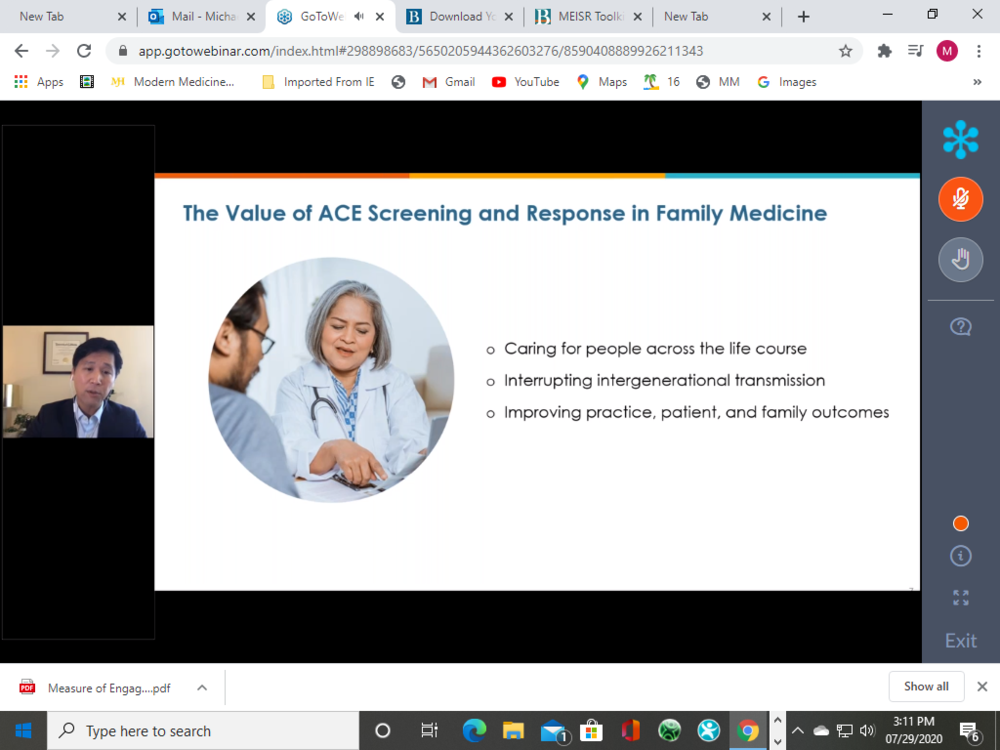
This is a slide from today’s ACEs Aware webinar. As you can see, interrupting intergenerational transmission is one the goals of screening for ACEs in medical practice. It’s not really about blaming, it’s about freeing people from passing these physical and mental health risks to future generations, none of whom deserve to be born into these ongoing processes. I’d like to acknowledge some other posts that have added the very important dimension of marginalized populations’ stressors, present, and historical, into the calculus. ACEs Aware was founded and supported by the California Surgeon General, Dr Burke Harris, who deserves effusive praise for her work on ACEs. Included in the today’s presentation was the epigenetic factors of trauma and how they affect every body system of those exposed.
Attachments
Images (1)
 Tony BuffingtonMember
Well written, thank you. Like a few others, I’m somewhat concerned by what I perceived as some “blame” directed toward Mr. Trump’s parents. In my view ACEs are an expression of “the biology of Karma”, and without detailed knowledge his parent’s early environments, and their parents, etc. it might be more useful to regret what he was exposed to and focus on “now what?”
TDToni DuPont-Morales, PhDMember
I am placing my comments based on the years I spent as a PO addressing heinous crimes and tragically raised individuals who had little opportunity to address their lives and move toward developing positive change. The social part of the pre-sentence report addresses the upbringing and traumas of the criminal as well as those of their family. Regardless of their history, they received consequences that were often severe at times. The bottom line was that they faced consequences, irrespective of their ACES. Poverty and race were rarely seen as extenuating circumstances.
In all the years I worked, I can not tell you how rare it was to have a wealthy spoiled deviant person in front of me. They had the benefit of the expensive defense team against the State. I’ve read Mary Trump’s book and her warning is that Donald Trump was raised with the ability and skill to avoid consequences and surround himself with enablers. It was a warning as to how pervasive the depravity of the family and their enablers are/were. ACES is about identifying the issues where we as a society, can assist in programs and policies to facilitate positive change and understanding.
MMMichael McCarthyMember
There is a fairly broad consensus that President Trump is suffering from mental health problems. I’m an a Green Party member, so I’m not trying to sway anyone’s towards VP Biden, who I serious reservations about also in the mental health area. This is one more example of a source concerning President Trump’s mental health.
“The Dangerous Case of Donald Trump is a 2017 book edited by Bandy X. Lee, a forensic psychiatrist, containing essays from 27 psychiatrists, psychologists, and other mental health professionals describing the “clear and present danger” that US President Donald Trump’s mental health poses to the “nation and individual well being.”
VYVivian YacopiMember
Although, the results of such upbringing can cause the end results, I do not think it is fair to use ACES Connection to target Donald Trump. What is Mary Trump getting out of this? ($$$$) Not comfortable with this article and seems to be more of a political platform. I will unsubscribe today.
 Elizabeth FitzgeraldMember
Brilliant Jane. If only there were some professional gate keeping within professions (outside of mental health) that would allow us to intervene when a person’s personal trauma was causing them to become a danger to themselves and/or others. Cops, politicians, lawyers, cashiers, landscapers, servers…I mean really, we all need each other to help us see what we can’t see. I guess that’s why we need the trauma-informed revolution.
 Leslie Schwartz LeffMember
Excellent article! I have been both fascinated and repulsed by the idea of reading Mary Trump’s book. Reading this synopsis through a trauma-informed, ACEs lens, was powerful, informative and important. Thank you, Jane!
Jane StevensPublisher, ACEsTooHigh; founder, PACEs Connection
@Molly Reagh posted:
Hmmm…something does not sit well with me about this article. Many, myself included, have long felt that mainstream ACEs movement does not sufficiently address the intersections of race, class, geography and other socio-environmental factors. This article seems like an apologist stance for bad behavior, without taking into account the extreme privilege that paved the way for Trump to maintain class privilege and be elected president. The ACEs he experienced, while I’m sure traumatizing, should not be extricated from the race and class privilege he also experienced. This argument seems to parallel the narrative that gets played out in the media that white people who commit crimes (the Dylan Roof’s of the world) have mental health issues, when Black, Indigenous People of Color (BIPOC) folks get labeled as thugs. It glaringly leaves out the institutional and systemic racism that overwhelmingly bars BIPOC people from gaining wealth or political power and has no impact on white cisgender men who still hold disproportionate and harmful amounts of power. Honestly, it is further proof of our society’s horrifyingly entrenched white supremacy and I highly encourage you to re-think posting this article in its current form.
I agree with you completely, Molly. This essay strives to explain so that we can understand and change our systems, with the understanding that we are our systems. It’s definitely not an apology.
 Mike FlaningamMember
Jane, thank you for your fascinating article. A challenge I frequently come across in my practice as a primary care physician for adults, is how to effectively and respectfully get a person, who has certain maladaptive coping mechanisms, to see that their ways of coping are destructive. I wouldn’t expect Mr. Trump to hear Mary Trump’s assessment and respond by thanking her and asking how he can work on changing himself. Patient’s usually don’t come to me because they’ve identified their maladaptive coping as a problem, but instead focus on their headaches, insomnia, or other symptoms. When ACEs are a contributing cause to such symptoms, and we discuss ACEs science, some people have “a ha!” moments, and start on a path towards healing. However, a lot don’t see the connection, even when I’ve (gently) brought up the topic again.
I also want to comment that I appreciate the concern Anna expressed earlier, about all of us associated with ACEs Connection needing to not allow this forum to devolve into political bickering (my description, not Anna’s). However, I feel it’s appropriate to discuss Mr. Trump’s case here, as long as our goal is to advance the awareness and understanding of ACEs, as opposed to people expressing their negative feelings toward him. Many precedents have been set, in this forum, to discuss the childhood experiences of still living people (Darrell Hammond being a recent example). I realize that in most previous cases, it’s people sharing their own stories, while in this case, Mr. Trump is not doing the sharing. I believe we therefore, in a trauma-informed way, should be sensitive to the possibility the person who didn’t share their own story might have a different story to tell.
 Molly ReaghMember
Hmmm…something does not sit well with me about this article. Many, myself included, have long felt that mainstream ACEs movement does not sufficiently address the intersections of race, class, geography and other socio-environmental factors. This article seems like an apologist stance for bad behavior, without taking into account the extreme privilege that paved the way for Trump to maintain class privilege and be elected president. The ACEs he experienced, while I’m sure traumatizing, should not be extricated from the race and class privilege he also experienced. This argument seems to parallel the narrative that gets played out in the media that white people who commit crimes (the Dylan Roof’s of the world) have mental health issues, when Black, Indigenous People of Color (BIPOC) folks get labeled as thugs. It glaringly leaves out the institutional and systemic racism that overwhelmingly bars BIPOC people from gaining wealth or political power and has no impact on white cisgender men who still hold disproportionate and harmful amounts of power. Honestly, it is further proof of our society’s horrifyingly entrenched white supremacy and I highly encourage you to re-think posting this article in its current form.
LHLaura Haynes CollectorMember
Counting ACEs = essentially a rough sorting-hat for being raised in a dysfunctional family/ by dysfunctional adults. Functional healthy families have fewer ACE-level events (though something like the death of a parent can strike even a very wholesome home).
Donald had a huge multitude of “baby ACEs” or “shadow ACEs” as I call them. You can be rich, fed, never hit, ‘privileged’ — but if your own parents do not *connect* with you, it is much worse than an isolated horrible event like a divorce. Being neglected profoundly is orders of magnitude worse than your attentive, loving parents getting a divorce. For you have no resources to deal with anything bad that happens.
Nobody TOOK PLEASURE in baby Donald. Nobody interpenetrated with him. Nobody was his safe place, his place of refuge. Nobody modeled a safe and interested, caring “other.” All the experiences by which human beings learn to attach and self-regulate were robbed from him.
When you never receive secure attachment as a baby, that’s the worst ACE that can exist. A securely attached human being can withstand something like a parental divorce in a VERY different way than a person without that ballast of relational security. A securely attached person has internalized their own worth.
I see the child separation at the border as a kind of sick theatre of DJT’s past. Being ripped away from his mother (the mom as ‘criminal’) as a kind of large scale re-enactment.
 Rebecca Lewis-PankratzMember
Beautiful. There are no bad guys. It is a bitter pill to swallow but so incredibly necessary to do the work of healing the River of Cruelty.
EMEdith MannMember
Ever since 2016 I have observed and wondered about Trump and ACEs, and have occasionally shared my view with others. My ACEs perspective is one of understanding behavior, not as an excuse for behavior.
Denise BusleyMember
Dearest Jane, You are a stunningly powerful and gifted writer. Thank you for continuing to use your gifts in such a profound way. I continue to be thunderously grateful.
MMMichael McCarthyMember
@Karen Anthony posted:
I’m reading this book now. As an infant mental health therapist I continue to wonder: what happened to Fred Trump in his early childhood? Or Mary? How did they become the parents they were to the Trump children? How far back do we go?
Yes Karen, as a psychologist with an interest in transgenerational transmission of symptoms, I’ve wondered about our president’s family history and reflect on the concept of “undifferentiated ego mass.”
MMMichael McCarthyMember
I have Mary’s book and have to admit, I haven’t read it yet. I know about the existence of the Goldwater rule concerning not diagnosing those we have not interviewed or tested. That being said, his niece does have insider, collateral information and is a professional herself. I don’t think you need years of training as a clinician to spot something is very wrong with our president at a time in which we need leadership the most. His lack of empathy and self-referented style is apparent. Thank you posting this. He is definitely a tragic man (from Kohut) and even more tragic, is imbued with power that affects us all.
 Anne Moss RogersMember
Excellent article. Thank you for sharing. I have wondered many times what Trump’s childhood must have been like to produce what we see today. I also think the media played a lot into what he is today. The adoration by them in the early 90s gave him the attention he so desperately craved and fueled his narcissism that had taken root in childhood as a defense mechanism.
KAKaren AnthonyMember
I’m reading this book now. As an infant mental health therapist I continue to wonder: what happened to Fred Trump in his early childhood? Or Mary? How did they become the parents they were to the Trump children? How far back do we go?
 Laura PinheyMember
Jane, thank you for expressing what many of us have been thinking for several years.
Jane StevensPublisher, ACEsTooHigh; founder, PACEs Connection
Thank you for posting your comment, Anna. I always value your opinion and participation.
 Anna RunkleMember
Im going to say it: I’m really uncomfortable with this, that this movement and this platform have become so political that it’s now OK to pathologize the private details of a living person’s childhood — details they did not themselves choose to disclose and in fact fought to stop (and that may not even be true).
An adult’s public actions may be fair game, but it is most definitely NOT fair to use a person’s childhood in order to diagnose them, read their mind, or make damning claims that because of trauma, they can “never heal,” they can’t feel empathy, they are destined to be a “small time crook in Jail” (unless wealthy) or that people like them should not be “created.” These kinds of statements are uncomfortably familiar from other times when “science” was used to label and marginalize others.
I hope ACEs Connection will be extra careful never to “weaponize” ACEs science against anyone, whether you like their policies or not.
 David DooleyMember
This is why parenting education must be a part of the solution. Not conventional parenting education, but a new kind…one that reaches everyone, everywhere, all the time.
The Centers for Disease Control, the American Academy of Pediatrics, the National Alliance on Mental Illness, and the National Institute of Mental Health should be working furiously on this new kind of parenting education. Perhaps parenting education campaigns akin to the smoking and seat belts campaigns of the past. Perhaps multi-media messaging that teaches parenting behaviors and practices generally recognized as supporting the healthy development of children.
Visit www.advancingparenting.org. Use a computer…our website is not optimized for phones. We are all about finding interesting and perhaps more effective ways of teaching everyone about parenting.
Comments Per Page: 20 · 40

