Category Archives: Uncategorized

Look at how the 1% are doing right now, and tell me the system isn’t rigged [theguardian.com]

Carey Sipp Carey Sipp 1/25/231:00 PM

By Nesrine Malik, Illustration: Matt Kenyon, The Guardian, January 23, 2023

ou may have forgotten by now, but there was a brief moment during the pandemic when hopes were raised for a new “roaring 20s”. The Yale sociology professor Nicholas Christakis predicted that as in the 1920s, after the 1918 Spanish flu, society would embrace indulgence, with a rise in “sexual licentiousness” as well as a “reverse of religiosity”. We were poised to emerge from lockdown randy and flush. We certainly weren’t supposed to plunge, as we have in Britain, right into political crises and strikes, have three prime ministers in as many months, and sit at home too skint to turn on the heating or socialise.

But a roaring 20s is actually happening, just not for most of us. According to Oxfam’s annual inequality report, released to coincide with the World Economic Forum meetings in Davos, the richest 1% of people have captured nearly twice as much new wealth as the rest of the world combined since the pandemic. Their fortune soared by $26tn, increasing their share of new wealth from 50% to two-thirds.

The breakdown of these figures exposes how on a global basis, extreme wealth is accumulated not by innovating or increasing production, but by taking advantage of rising prices and exploiting labour. In this effort, wealthy people are enabled by lack of regulation and taxation. The result is a bonanza of plunder with no sheriff in town.

[Please click here to read more.]

Carey Smith Sipp

carey.pacescommunites@gmail.com

People With HIV Are Still Being Criminalized in 25 States [truthout.org]

Carey Sipp Carey Sipp 1/26/231:00 PM

By Victoria Law, Photo: Erik McGregor/Lightrocket/Getty Images, Truthout, January 25, 2023

In 2008, Robert Suttle’s life was upended. The 30-year-old had been working as an assistant law clerk at the Second Circuit Court of Appeal in Shreveport, Louisiana, when police arrested him in front of his colleagues. A former partner had accused him of not disclosing his HIV status and, in Louisiana, that constituted a felony charge of intentional exposure to the AIDS virus.

It didn’t matter that Suttle, who had learned about his HIV status several years earlier, had HIV, not AIDS. It didn’t matter that he had been receiving medical care since he first learned his diagnosis and that he said he had disclosed his status. No one asked about whether his viral load was undetectable, which would prevent HIV transmission. It did not matter that, by 2008, HIV and AIDS were no longer considered the death sentence that they had been during the 1980s.

What did matter was that, in 1987, Louisiana had been one of the first states to pass a law making it a felony for a person who knows that they are HIV-positive to not disclose their status before engaging in any type of contact. Between 2011 and 2022, Louisiana state law enforcement received at least 137 reports alleging an HIV-related crime. Black Louisianans, particularly Black men like Suttle, were the majority of people arrested under HIV criminalization laws.

[Please click here to read more.]

Carey Smith Sipp

carey.pacescommunites@gmail.com

💯 1

Views: 232

Add Comment

Carey SippCarey SippFormats 

Encore ‘History. Culture. Trauma.’ podcast begins Black History Month with author Bruce Perry discussing historical trauma & ‘What Happened to You?’

Carey Sipp Carey Sipp 1/31/233:45 PM

“What Happened to You?” – the book and the question – speak to the PACEs Connection commitment to explore and share our nation’s history of trauma, racism, genocide and colonization. We begin Black History Month 2023, with an encore discussion by Bruce Perry, co-author of The New York Times Best-seller, “What Happened to You? Conversations on Trauma, Resilience and Healing.”

In this episode, Perry and podcast hosts Ingrid Cockhren, CEO of PACEs Connection, and Mathew Portell, director of outreach and education, discuss the importance of learning about  our past to understand how the United States is in such a state of collective trauma at this time in our nation’s history.

Screen Shot 2023-01-31 at 5.40.15 PM“If you don’t understand history,” said Perry, “you’re never going to understand trauma. And if you don’t understand trauma, you’re never going to understand history. And this is part of our problem as a field.”

Tune in Thursday at 1 p.m. PT  to hear Perry, Cockhren, and Portell address the history of colonialism, treatment of Indigenous people, and the kidnapping and enslavement of Africans that are such a part of the ongoing history and historical trauma of the United States.

Cockhren and Portell interviewed Perry about the book, which he wrote with author Oprah Winfrey in July 2022, as a part of the launch celebration for the PACEs Connection Connecting Communities One Book At A Time book study initiative.

“You know, we are living in systems that are fundamentally colonial in construction,” Perry said. “And colonialism basically means I’m going to come into your space, your place, and I’m going to take your things and I’m going to make you feel privileged if I give you a little bit of it back.”

Historical perspectives about trauma deserve “as much attention and funding and support” as is given to people studying the effects of a drug on post traumatic stress disorder (PTSD), or the effects of other treatments, he said.

For more information about this podcast, you can watch the full interview here.

Perry leads the Neurosequential Network, is senior fellow of The Child Trauma Academy, and adjunct professor in the departments of psychiatry and behavioral sciences at the Feinberg School of Medicine at Northwestern University in Chicago and the School of Allied Health, College of Science, Health and Engineering, La Trobe University, Melbourne, Victoria Australia.

To listen to Thursday’s podcast at 1 p.m. PT, 4 p.m. ET,  or whenever, as it is an encore episode, please clickhere.

Show Links

Encore ‘History. Culture. Trauma.’ podcast begins Black History Month with author Bruce Perry discussing historical trauma & ‘What Happened to You?’

Carey Sipp Carey Sipp 1/31/233:45 PM

“What Happened to You?” – the book and the question – speak to the PACEs Connection commitment to explore and share our nation’s history of trauma, racism, genocide and colonization. We begin Black History Month 2023, with an encore discussion by Bruce Perry, co-author of The New York Times Best-seller, “What Happened to You? Conversations on Trauma, Resilience and Healing.”

In this episode, Perry and podcast hosts Ingrid Cockhren, CEO of PACEs Connection, and Mathew Portell, director of outreach and education, discuss the importance of learning about  our past to understand how the United States is in such a state of collective trauma at this time in our nation’s history.

Screen Shot 2023-01-31 at 5.40.15 PM“If you don’t understand history,” said Perry, “you’re never going to understand trauma. And if you don’t understand trauma, you’re never going to understand history. And this is part of our problem as a field.”

Tune in Thursday at 1 p.m. PT  to hear Perry, Cockhren, and Portell address the history of colonialism, treatment of Indigenous people, and the kidnapping and enslavement of Africans that are such a part of the ongoing history and historical trauma of the United States.

Cockhren and Portell interviewed Perry about the book, which he wrote with author Oprah Winfrey in July 2022, as a part of the launch celebration for the PACEs Connection Connecting Communities One Book At A Time book study initiative.

“You know, we are living in systems that are fundamentally colonial in construction,” Perry said. “And colonialism basically means I’m going to come into your space, your place, and I’m going to take your things and I’m going to make you feel privileged if I give you a little bit of it back.”

Historical perspectives about trauma deserve “as much attention and funding and support” as is given to people studying the effects of a drug on post traumatic stress disorder (PTSD), or the effects of other treatments, he said.

For more information about this podcast, you can watch the full interview here.

Perry leads the Neurosequential Network, is senior fellow of The Child Trauma Academy, and adjunct professor in the departments of psychiatry and behavioral sciences at the Feinberg School of Medicine at Northwestern University in Chicago and the School of Allied Health, College of Science, Health and Engineering, La Trobe University, Melbourne, Victoria Australia.

To listen to Thursday’s podcast at 1 p.m. PT, 4 p.m. ET,  or whenever, as it is an encore episode, please clickhere.

Show Links

With an eye on working families, Democrats launch the Congressional Dads Caucus [npr.org]

Carey Sipp Carey Sipp 2/1/233:00 PM

By Ximena Bustillo, Photo: Evelyn Hockstein/Reuters, National Public Radio, January 28, 2023

California Rep. Jimmy Gomez gained national attention as the House endured 15 votes to elect a speaker earlier this month, but not for how he was voting. It was for wearing his baby in the chamber as rounds went on for multiple days.

Gomez brought his infant son Hodge to witness the historical events unfold. A few weeks later, without a baby in hand, Gomez launched the Congressional Dads Caucus. While lawmakers have traditionally brought their children to witness the first days of a new Congress and many are parents, it’s not often you see a baby on the House floor or a lawmaker wearing one, especially a dad.

Speaking at a press conference this week announcing the new group, Gomez said he thinks his son’s appearance with him at his workplace “brought visibility to the role of working dads across the country.”

[Please click here to read more.]

Carey Smith Sipp

carey.pacescommunites@gmail.com

From Jan. 6 to Tyre Nichols, American Life Is Still Defined by Caste [time.com]

Carey Sipp Carey Sipp 2/4/231:00 PM

By Isabel Wilkerson, Artwork: Lavett Ballard/TIME, Photography: Eric James Montgomery, TIME, February 2, 2023

How did our country arrive at this moment of rupture and fury? How is it that mass shootings, even of children in their classrooms, and police killings of unarmed citizens of color like Tyre Nichols have become a feature of our days?

How is it that politicians are banning books in a country whose founding First Amendment protects the right to free speech? How is it that the U.S., despite its wealth and technology, leads the world with more than 1 million deaths from COVID-19—more than any other nation on earth? How is it that insurrectionists could storm the citadel of American democracy in a crusade to overturn a presidential election? How is it that we actually saw a Confederate flag inside the U.S. Capitol—that a rioter, in our era, could deliver the Confederate flag farther than Robert E. Lee himself?

In the two years since the global concept of caste entered the national conversation with the initial release of Caste: The Origins of Our Discontents, recent events have lamentably only affirmed its observations: that the will to maintain the caste system would drive some people to trample democracy itself, as we saw on Jan. 6; that powerful forces would seek to reverse the rights of the marginalized and less powerful, as we have seen in recent Supreme Court rulings; that these turns of events are a natural consequence of our unreconciled history. Because, all told, our country is not terribly unlike a patient with a pre-existing condition like heart disease, and if ever a heart patient, without treatment or intervention, has a heart attack, it should come as no surprise to anyone.

[Please click here to read more.]

Carey Smith Sipp

carey.pacescommunites@gmail.com

From Jan. 6 to Tyre Nichols, American Life Is Still Defined by Caste [time.com]

Carey Sipp Carey Sipp 2/4/231:00 PM

By Isabel Wilkerson, Artwork: Lavett Ballard/TIME, Photography: Eric James Montgomery, TIME, February 2, 2023

How did our country arrive at this moment of rupture and fury? How is it that mass shootings, even of children in their classrooms, and police killings of unarmed citizens of color like Tyre Nichols have become a feature of our days?

How is it that politicians are banning books in a country whose founding First Amendment protects the right to free speech? How is it that the U.S., despite its wealth and technology, leads the world with more than 1 million deaths from COVID-19—more than any other nation on earth? How is it that insurrectionists could storm the citadel of American democracy in a crusade to overturn a presidential election? How is it that we actually saw a Confederate flag inside the U.S. Capitol—that a rioter, in our era, could deliver the Confederate flag farther than Robert E. Lee himself?

In the two years since the global concept of caste entered the national conversation with the initial release of Caste: The Origins of Our Discontents, recent events have lamentably only affirmed its observations: that the will to maintain the caste system would drive some people to trample democracy itself, as we saw on Jan. 6; that powerful forces would seek to reverse the rights of the marginalized and less powerful, as we have seen in recent Supreme Court rulings; that these turns of events are a natural consequence of our unreconciled history. Because, all told, our country is not terribly unlike a patient with a pre-existing condition like heart disease, and if ever a heart patient, without treatment or intervention, has a heart attack, it should come as no surprise to anyone.

[Please click here to read more.]

Carey Smith Sipp

carey.pacescommunites@gmail.com

Burnout, Stress and the Great Resignation On History. Culture. Trauma. Thursday at 1 p.m. PT

Carey Sipp Carey Sipp 2/7/232:13 PM

The onset of the COVID-19 pandemic and the racial reckoning of 2020 pushed America’s already strained workforce to the brink, evoking a mass exodus of American workers looking to escape job dissatisfaction, microaggressions, unsafe work conditions and low wages. It was coined the “Great Resignation“.

Join History. Culture. Trauma. co-hosts  Ingrid Cockhren, CEO of PACEs Connection, and Mathew Portell, director of outreach and education, this Thursday at 1 p.m. PT as they discuss the role of toxic stress in the Great Resignation and how trauma-informed, healing-centered workplaces are the future of work in America.

Cockhren and Portell will be joined by Marnie Dobson and Mark Van Landuyt of the Healthy Work Campaign.

Dobson is the director of the Healthy Work Campaign and the associate director of the Center for Social Epidemiology. She is also an adjunct professor at the University of California, Irvine, Center for Occupational and Environmental Health.

For the last 13 years, Dobson has been involved in work stress research, including conducting qualitative, participatory research methods to enhance epidemiological studies, as well as workplace intervention development with several blue-collar working populations including firefighters and urban transit operators. Dobson continues to teach in occupational health classes at UCI and UCLA. She also publishes academic articles and book chapters and presents at scientific conferences.

Landuyt is the Campaign’s outreach director, co-founder of the California Bay Area Green New Deal Alliance, and a director of Generation Green. He worked as policy director for President Barack Obama and in myriad political campaigns, and is a  former vice chair of the California Democratic Party Progressive Caucus.

To listen to Thursday’s podcast at 1 p.m. PT, 4 p.m. ET,  or whenever, as it is an encore episode, please click here.

Show Links

Carey Smith Sipp

carey.pacescommunites@gmail.com

North Carolina moves closer to creating nation’s first ACEs-informed courts system

Carey Sipp Carey Sipp 2/7/232:47 PM

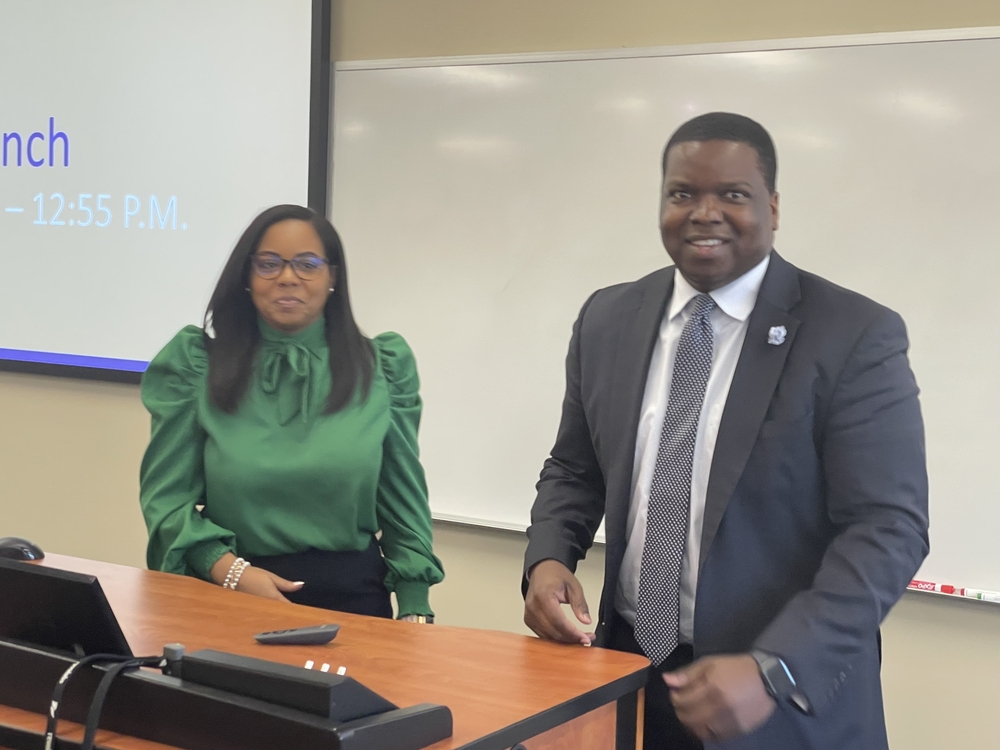
(l-r) Judge J. Corpening;  Ben David, district attorney, New Hanover County; Chief Justice Paul Newby;  Judge Andrew Heath, executive director, Administrative Office of the Courts of the Chief Justice’s ACEs Informed Courts Task Force. David and Heath serve as Task Force co-chairs.

“There is not any more important work going on in the State of North Carolina,” said Ben David, District Attorney for New Hanover County and co-chair of the Chief Justice’s ACEs-Informed Task Force . The Task force is nearing the end of two years dedicated to infusing the science and understanding of adverse childhood experiences (ACEs) into the court system of North Carolina.

“We have visited all 100 counties, and 102 court houses, and we’ve learned that one size does not fit all in helping all counties create ACEs–informed courts,” said Chief Justice Paul Newby, who announced the work of the Task Force in May 2021.

“We are encouraged by the work. Year one we gathered information; year two we are putting our work into action,” said Judge Andrew Heath, executive director of the North Carolina Administrative Office of the Courts (AOC) and co-chair of the Task Force.

In a statewide meeting to update their work, attendees included representatives from county government, healthcare, mental health, business, youth serving organizations, media, and a nonprofit serving people with developmental and other disabilities.

“What we are doing with this task force is bringing a great many disciplines together, focusing on the treatment of kids so they don’t have to grow up choosing bad relationships and drugs. We marry science and the law,” said David. The emphasis is on breaking down silos and having organizations from different sectors work together to develop an ecosystem of prevention and healing programs.

Transforming Healthcare
E5CB070D-F3FE-4392-9870-D2E8F14CE69BLaneita Williamson, trauma informed care manager at Atrium Health Wake Forest Baptist Hospital, gave an in-depth account of the last 10 years of integrating trauma-informed practices into the hospital.

“Before starting this work, the importance of trauma-informed care was not understood,” she said. “The many benefits of the patients needing this type of care had not been heard in a system where it takes a lot of noise to be heard.”

Williamson recounted the story of a trauma surgeon who dismissed the notion of trauma-informed care, despite her explanation that trauma-informed care really has to do with the safety of all people in a hospital: patients, nurses, doctors, housekeeping, administrators and security.

“I’ve heard it said that using trauma-informed practices is just an excuse to describe people’s ‘bad behavior’”, explained Williamson, who has trained thousands of nurses, medical students and physicians. “But people need to understand that trauma is an invisible brain injury. Just because we don’t see the abuse and the injury from that doesn’t mean it is not there.”

She has always emphasized the importance of professionals “learning about themselves, how you react, when you need self-care, when you need to step away, when you are able to come back.”

When people are resistant to integrating practices and policies based on ACEs science, they usually say they “aren’t comfortable talking about trauma with patients,” or “there isn’t enough time” or “there isn’t any financial gain in doing this,” or “I am afraid I will hurt my patients more.” But Williamson says professionals are usually surprised to learn that none of those assumptions are accurate.

“Trauma-informed care actually increases – and saves – time,” she said.

Educating Teens about Healthy Relationships

Quintin McGee, a New Hanover County public defender, and Amber Bellamy, a health educator specialist, reported on the “Success Sequence Program” in Columbus County.

There’s a good reason for implementing the program, explained McGee: “If you stay in high school and maintain full time employment, and wait until you are married to have children, there is an 80 percent chance that you will avoid poverty.”
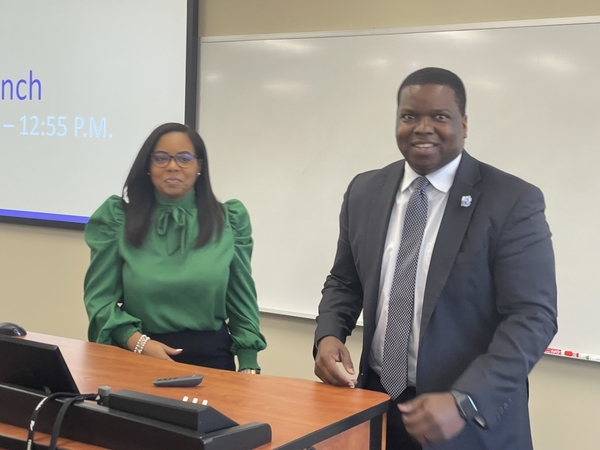
BE694279-299A-4EBF-ADD9-87E1B2E1E4BBUsing a program called “Love Notes” offered by The Dibble Institute, McGee and Bellamy work with teens from the Boys and Girls Home in Columbus County. They teach them “relationship smarts and sexual health, and how to make right and informed decisions,” said Bellamy. “We focus on what’s affecting them, including cyberbullying and sexting. The classes have a male and female facilitator and they are very open.”

The 13-week program encourages students to “Dream Big,” and ends with a Dream Big banquet where students tell attendees what their plans and visions are.

“Columbus County is rural. It is the 96th most unhealthy county in the state. We are hoping with this program we can change that, by helping students learn ‘who I am and where I am going,’ said McGee. “Kids are blunt. I am amazed by how sincere they are, their knowledge. It is so important that they be exposed to this positive environment.”

In Robeson County, two former educators and counselors came out of retirement to help share the Love Notes curriculum with students there. Sibyl Farr and Mazie Gibson have a combined 80+ years of education and counseling experience among them, but said they could not stay in retirement knowing how much students today need a trusted adult in their lives.

“We’ve seen the parents bringing their children to the church where we’re doing the work, and we started doing the work with the parents,” said Farr, who would like to see the curriculum made mandatory. “The parents are traumatized themselves. They work separately. But at the end of the 13 weeks, we are seeing that the parents and the children can talk together and ca50617DBD-7E4E-4F62-86D2-3B188FBE4B94n have a trusted connection.”
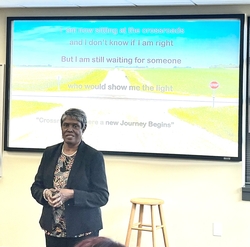
“It makes all the difference for these girls and their parents to know someone knows what they are going through, and that ‘we are here for you,’” said Gibson.

Safe Babies Courts

Judge Julius H. Corpening of New Hanover County discussed Safe Baby Courts. These courts, which have been adopted in many states, essentially provide a system in which parents accused of child abuse or neglect are asked,”What happened to you?” instead of “What’s wrong with you?” They are offered services such as parenting classes,  counseling, job training, housing services, transportation services—anything to help the family get back on its feet.
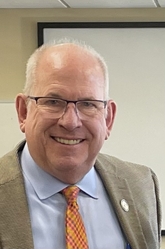
5FFFE06F-376F-458D-B089-E9451A64676D“We wanted to find a better way to take care of babies, for kids to have a healthy family,” explained Corpening. “We’re piloting Safe Babies Courts, the Zero-to-Three model, to address the root cause. We want to protect that relationship between the baby and the mother.”

“We want mothers to see hope instead of despair, and inspire them to build resilience by helping them bond with their babies, with intensive reunification when a baby is taken from a mother at birth,” he said.

Other programs
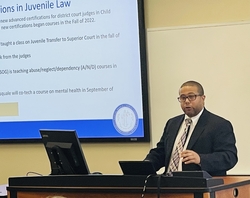
  • 56A22E96-F19D-4FFC-961E-41654C6D4972Mike Silver, training and services director for the AOC, said “Our program was recently granted unlimited use of the documentary, ‘Resilience: The Biology of Stress & The Science of Hope’. The film’s producers are so impressed by the number of screenings we are doing.”
  • The School-Justice Partnership has reduced court referrals by 60 percent the first year, by giving schools the ability to help kids who were acting out because of trauma instead of sending them into the justice system.
  • Kevin Leonard, executive director of the North Carolina Association of County Commissioners, and Amber Faith Harris, director of government relations for the association, provided an opioid settlement update. They also provided resources to help counties seek and manage these funds.

With the North Carolina General Assembly in session, David reminded Task Force members of the need to “leave a legacy on our legislative priorities.” Two ways to do that are to request a research study on the courts’ progress, and a staff position to help administer Safe Baby Courts.

For more information about the North Caroina Chief Justice’s ACEs Informed Courts Task Force, contact Mike Silver, training and services director, North Carolina Administrative Office of the Courts.

Additional resources may be found at the links below:
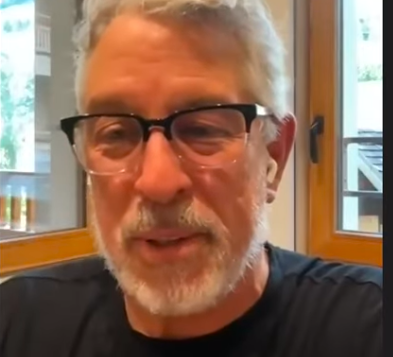
Author Bruce Perry and the Neuroscience Insights We Need Today [earlylearningnation.com]

Carey Sipp Carey Sipp 2/9/231:00 PM

By Mark Swartz, Early Learning Nation, February 8, 2023

A decade ago, early childhood advocacy could be a lonely pursuit. “It felt like we were talking to an empty auditorium,” says Bruce D. Perry, MD, Ph.D. “Now there are more people in the auditorium. They’re recognizing the power of early childhood, the importance of creating policy and practice that will benefit children and that will meet the needs of the adults who are caring for young children.”

Perry is best known as the co-author, with Oprah Winfrey, of the bestselling What Happened to You?: Conversations on Trauma, Resilience and Healing(2021). The book, however, is just one highlight of a 30+-year career as teacher, clinician and researcher in neuroscience and children’s mental health. His research and clinical experience show the importance of the first years—and in particular, the first few months—and he has been a steadfast champion of early education.

“Perry’s work,” says Dr. Kristie Brandt, director of the University of California Davis Infant-Parent Mental Health Fellowship, “has advanced the early childhood field to new levels. He has revolutionized our understanding of the importance of the first months, without adopting a fatalist position in the event of early trauma. He champions truly personalized care with greater potential for helping and healing.”

Please click here to read more.]

Carey Smith Sipp

carey.pacescommunites@gmail.com

Teen girls ‘engulfed’ in violence and trauma, CDC finds [washingtonpost.com]

Carey Sipp Carey Sipp 2/13/231:00 PM

By Donna St. George, Photo: Caitlin O’Hara/The Washington Post, The Washington Post, February 13, 2023

Teen girls across the United States are “engulfed in a growing wave of violence and trauma,” according to federal researchers who released data Monday showing increases in rape and sexual violence, as well as record levels of feeling sad or hopeless.

Nearly 1 in 3 high school girls reported in 2021 that they seriously considered suicide — up nearly 60 percent from a decade ago — according to new findings from the Centers for Disease Control and Prevention. Almost 15 percent of teen girls said they were forced to have sex, an increase of 27 percent over two years and the first increase since the CDC began tracking it.

“If you think about every 10 teen girls that you know, at least one and possibly more has been raped, and that is the highest level we’ve ever seen,” said Kathleen Ethier, director of the CDC’s Division of Adolescent and School Health, who said the rise of sexual violence almost certainly contributed to the glaring spike of depressive symptoms. “We are really alarmed,” she said.

[Please click here to read more.]

Carey Smith Sipp

carey.pacescommunites@gmail.com

Views: 702

Add Comment

Carey SippCarey SippFormats 

javascript:””

Comments (1) 

Newest · Oldest · Popular

Robert OlcottRobert OlcottMember

Hopefully, the CDC will share their data with at least the eight different individual State Attorney General’s who brought the Class Action Lawsuit against Facebook/Meta/Instagram for their ‘misuse’ of Teen Girls noted on the weekday daily front page headlines the third week of September 2022 in the Wall Street Journal…

The fastest-growing homeless population? Seniors [calmatters.com]

Carey Sipp Carey Sipp 2/14/231:00 PM

By Ana B. Ibarra, Photo: Martin do Nascimento/CalMatters, CalMatters, February 10, 2023

Norma Johnson cracks a faint smile as she adjusts her stylish cat-eye glasses.

She’s at St. Mary’s Center’s cafeteria in West Oakland, where older adults in interim housing or living on the streets can drop by for a free meal. But Johnson’s mind is elsewhere.  Her treasured red leather rocking chair, along with most of her belongings, sits in a storage unit. She’s afraid if she doesn’t pay her $500 balance soon, the storage unit operator will auction everything.

“I gotta pull a rabbit out of my hat,” Johnson, 65, said during a rainy January day.  “I don’t want to lose the things I do have. I don’t have a house, and now I won’t have,” she hangs her head before finishing that sentence.

[Please click here to read more.]

Carey Smith Sipp

carey.pacescommunites@gmail.com