Note: Due to a weather emergency, our podcast hosts have postponed this week’s interview with Mary Giuliani until next Thursday, February 23 at 1 p.m. PT. We apologize for any inconvenience.
“It’s Not About Food, Drugs, or Alcohol: It’s About Healing Complex PTSD”, a new book by PACEs Connection member Mary Giuiliani, launches next week. For a preview of what the longtime student of ACEs science, now PACEs science, shares in her revealing “teaching memoir”, tune into our ‘History. Culture. Trauma.’ podcast for a lively conversation between Giuilani and hosts Ingrid Cockhren and Mathew Portell this Thursday at 1 p.m. PT.
In the book—chock-full of quotes from top experts on the science of adverse childhood experiences (ACEs), complex post traumatic stress disorder (CPTSD), and healing from codependency, addiction, and abuse—Giuliani describes her journey as she applies the learnings to her own life.
”Even though I was in long-term recovery with food, severe obesity, drugs, and alcohol, and had what most people would consider a successful life,” says Giuliani, “behind closed doors, I still struggled and wondered why I had so few close friends, such difficulty finding a fulfilling romantic relationship, struggled so with food, sleep and caffeine, failed to find the flow and passion in my career, and felt the need to hide my struggles with weight and substances.”
Finally, in mid-life, Giuliani says she discovered the root cause driving her past struggles.
“It wasn’t the food, the alcohol or the drugs,” she writes. “I finally realized it was complex PTSD (C-PTSD), a more severe form of PTSD that developed from being raised in a chaotic alcoholic home, among other challenges.” Giuliani cites challenges including finding comfort, as a child, by sneaking into the kitchen in the middle of the night to cook, eat, and clean up pancakes; being bullied at school; and coming to terms with her lesbianism while attending Catholic high school in the homophobic culture of the 1970s.
Join Giuliani, Cockhren, and Portell this Thursday as they discuss Giuliani’s five-year journey studying the research from leading experts in the fields of C-PTSD, neuroscience, developmental psychology, adverse childhood experiences, and addiction medicine, and how she synthesizes her experience and the experts’ information to find “the most effective treatments for optimal healing.”
The Quitco family got financial coaching through a program at their pediatrician’s office. It’s helped them get ahead.Quitco family
By Pien Huang, National Public Radio, February 15, 2023
In 2018, Chris and Daisy Quitco of Compton, Calif., had a baby girl. When they brought her to the pediatrician for a one-month checkup, they expected to encounter doctors, crying babies and flu shots. They didn’t expect to see a personal finance coach in the exam room.
For the Quitcos, it turned out to be a lifeline – a well-timed intervention that helped stabilize their finances. “We never expected to walk into a clinic and be able to speak to someone about what we’re going through, especially our life experiences and debt,” Chris Quitco says.
At the time, he worked as a repairman, making $18 an hour. Daisy stayed home with the baby. They had a load of debt and bad credit scores.
The Quitco family got financial coaching through a program at their pediatrician’s office. It’s helped them get ahead.Quitco family
By Pien Huang, National Public Radio, February 15, 2023
In 2018, Chris and Daisy Quitco of Compton, Calif., had a baby girl. When they brought her to the pediatrician for a one-month checkup, they expected to encounter doctors, crying babies and flu shots. They didn’t expect to see a personal finance coach in the exam room.
For the Quitcos, it turned out to be a lifeline – a well-timed intervention that helped stabilize their finances. “We never expected to walk into a clinic and be able to speak to someone about what we’re going through, especially our life experiences and debt,” Chris Quitco says.
At the time, he worked as a repairman, making $18 an hour. Daisy stayed home with the baby. They had a load of debt and bad credit scores.
By Sareen Habeshian, Axios.com, February 17, 2023 – One of the nation’s largest food sanitation companies was fined $1.5 million for illegally employing more than 100 minors to carry out hazardous jobs, the Department of Labor announced Friday.
Driving the news: Children as young as 13 were working with hazardous chemicals and cleaning meat processing equipment at 13 Packers Sanitation Services Inc. facilities in eight states, the department said its Wage and Hour Division investigation found.
At least three minors suffered injuries while cleaning slaughterhouses, including a chemical burn to the face, the Washington Post reports.
The minors worked overnight shifts and used caustic chemicals to “clean razor-sharp saws” and other high-risk equipment, the Labor Department said.
The states with facilities listed in the department’s announcement were mostly across the South and Midwest, including Arkansas, Minnesota and Nebraska.
By the numbers: Under the Fair Labor Standards Act, the Labor Department fined the company $15,138 fine for each minor who was employed in violation of the law.
Details: The Wisconsin-based company provides cleaning services under contract to some of the nation’s largest meat and poultry producers, including JBS Foods, Tyson and Cargill, none of which were charged or fined, per the Post.
The federal investigation began in the August, and a U.S. district court judge issued a temporary restraining order in November forbidding the company and its employees from committing child labor violations, per the department.
In December, the U.S. District Court of Nebraska entered a consent order and judgment, and the company agreed to comply with the child labor provisions in all of its operations nationwide, and to take significant steps to ensure future compliance with the law.
What they’re saying: “The child labor violations in this case were systemic and reached across eight states, and clearly indicate a corporate-wide failure by Packers Sanitation Services at all levels,” Jessica Looman, principal deputy administrator of the department’s Wage and Hours Division, said in a statement.
To read the rest of this story, please click the link below
By Andrew Van Dam, Image: From article, The Washington Post, February 17 2023
Today, we look at a big, fat map of credit scores reproduced from a recent economics paper. And while the map suggests any number of tantalizing questions, we are most intrigued by that big band of credit-score calamity that stretches across the American South.
Almost every corner of America’s most populous region — every race, every income bracket — appears to have low credit scores. But why?
With precious few exceptions, it looks to be a neatly regional phenomenon. We spent hundreds of hours scraping Airbnb listings to determine the true extent of the American South, but we could have saved a lot of time if we’d just drawn a line around the contiguous places with low credit scores.
By Richard Sima, Illustration: George Wylesol/The Washington Post, The Washington Post, February 23, 2023
One in five Americans will experience major depressive disorder in their lifetime, and many will not find relief from current therapies. But now researchers have identified an unexpected source of the problem: inflammation.
Inflammation in the bodymay be triggering or exacerbating depression in the brains ofsome patients. And clinical trial data suggests that targeting and treating the inflammation may be a way to provide more-precise care.
The findings have the potential to revolutionize medical care for depression, an often intractable illness that doesn’t always respond to conventional drug treatments.While current drug treatments target certain neurotransmitters, the new research suggests that in some patients, depressive behaviors may be fueled by the inflammatory process.
Join hosts Ingrid Cockhren, CEO of PACEs Connection, and Mathew Portell, PACEs Connection director of communities, for this encore episode of their interview with Melissa T. Merrick, Ph.D., president and CEO of Prevent Child Abuse America (PCA America), wherein she focusses on “celebrating the possibility of prevention,” and the importance of examining the socio-political conditions we as a society must address to help all people thrive.
For the month of March, PACEs Connection’s History. Culture. Trauma. (HTC) honors Women’s History Month by featuring women in the positive and adverse childhood experiences (PACEs) science movement.
During this wide-ranging discussion, Merrick touches on the importance of public health and what we as a society do collectively to affect conditions, as well as the importance of positive childhood experiences (PCEs), and partnerships to achieve prevention.
“We must become ‘comfortable with being uncomfortable’ to change outcomes caused by ‘racist and inequitable policies,'”Merrick said.
“There is a lot of trauma, but there is also a lot of opportunity for healing,” Merrick said of our post-pandemic society wherein there was terrific inequity in healthcare, as well as who was affected by Covid 19.
PCA America is the nation’s oldest and largest nonprofit organization dedicated to the primary prevention of child abuse and neglect. Merrick has more than 20 years of clinical, research, and leadership experience related to the etiology, course, and prevention of child abuse and neglect.
Previously Merrick was a senior epidemiologist at the National Center for Injury Prevention and Control at the Centers for Disease Control and Prevention (CDC) in Atlanta.
Merrick is recognized as one of the country’s foremost experts on adverse childhood experiences (ACEs). In partnership with the US Department of Health and Human Services’ Office of Child Abuse and Neglect, she served for eight years as the lead scientist for the adverse childhood experiences (ACES) study at CDC and is the lead author of CDC’s Vital Signs: ACEs, the most nationally representative report on the topic.
Fromher bio: Merrick successfully leverages her significant clinical and research experiences to communicate and disseminate the critical public health importance of preventing early adversity to key stakeholders with diverse priorities, backgrounds, and knowledge, including legislators, business and civic leaders, and members of the academic and medical communities. She is one of the principal architects of Thriving Families, Safer Children: A National Commitment to Well-being, which aims to reshape child welfare in the United States by focusing explicitly on equity and prevention. Thriving Families unites PCA America, the Children’s Bureau, Annie E. Casey Foundation, and Casey Family Programs, among numerous other local partners, to proactively create the conditions and contexts for strong families and communities across the country.
Tune in to Thursday’s episode, at 1p.m. PT; 4 p.m. ET, here.
A mother and son living in a Walmart parking lot in North Dakota in 2012.Credit…Eugene Richards
By Matthew Desmond, The New York Times, March 9, 2023
In the past 50 years, scientists have mapped the entire human genome and eradicated smallpox. Here in the United States, infant-mortality rates and deaths from heart disease have fallen by roughly 70 percent, and the average American has gained almost a decade of life. Climate change was recognized as an existential threat. The internet was invented.
On the problem of poverty, though, there has been no real improvement — just a long stasis. As estimated by the federal government’s poverty line, 12.6 percent of the U.S. population was poor in 1970; two decades later, it was 13.5 percent; in 2010, it was 15.1 percent; and in 2019, it was 10.5 percent. To graph the share of Americans living in poverty over the past half-century amounts to drawing a line that resembles gently rolling hills. The line curves slightly up, then slightly down, then back up again over the years, staying steady through Democratic and Republican administrations, rising in recessions and falling in boom years.
What accounts for this lack of progress? It cannot be chalked up to how the poor are counted: Different measures spit out the same embarrassing result. When the government began reporting the Supplemental Poverty Measure in 2011, designed to overcome many of the flaws of the Official Poverty Measure, including not accounting for regional differences in costs of living and government benefits, the United States officially gained three million more poor people. Possible reductions in poverty from counting aid like food stamps and tax benefits were more than offset by recognizing how low-income people were burdened by rising housing and health care costs.
UN Secretary-General Antonio Guterres warned gender equity remains “300 years away.” AFP VIA GETTY IMAGES
By Brian Bushard, Forbes, March 6, 2023
TOPLINE Decades of global progress on women’s rights are “vanishing before our eyes,” United Nations Secretary General Antonio Guterres warned in an emotional speech at a U.N. Security Council meeting Monday afternoon, just two days ahead of International Women’s Day, arguing sexual abuse, a lack of educational and employment opportunities and the rollback of reproductive rights have pushed the goal of gender equality “300 years away.”
KEY FACTS
Guterres argued women’s rights are being “abused, threatened and violated around the world,” in his speech on the first day of a two-week series of discussions led by the Commission on the Status of Women.
In his speech, Guterres called for “urgent action to equalize power” by increasing education and employment opportunities for women and girls “particularly in the global south,” promoting women’s participation in science and technology and creating a “safe digital environment for women and girls.”
Specifically, he pointed to Taliban-controlled Afghanistan, where he said “women and girls have been erased from public life”—the U.N.’s internal organization U.N. Women had found human rights violations against women “mounted steadily” one year after the Taliban took control of the country in 2021, while girls have been barred from attending school past the sixth grade and women have been ordered to cover their faces in public and stay at home unless of a case of necessity.
Because of a collaboration with Columbia University and UW-Madison, we have answers to these questions.
By Peter Peter Pecora, Casey Family Programs, March 17, 2023 –
Overview
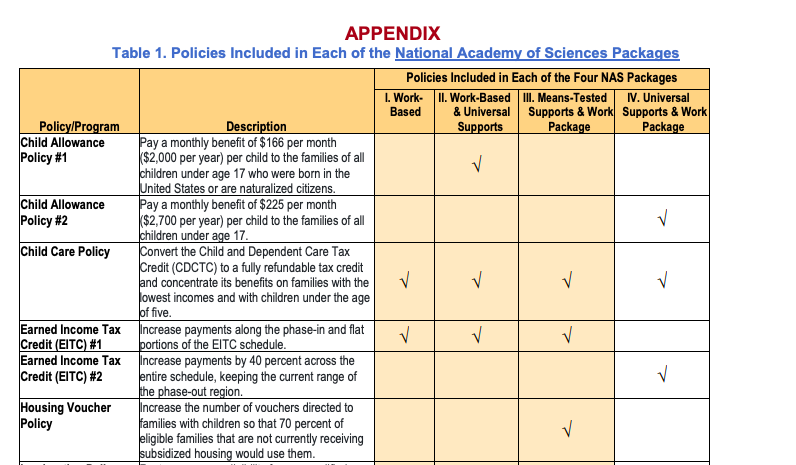
The National Academy of Sciences (NAS) recently released a “roadmap” to reduce child poverty by as much as half through the implementation of a series of social policy packages. The aim of this study was to simulate the reductions in Child Protective Services (CPS) involvement and foster care placements that are likely to result from implementation of three of the NAS policy packages. In addition to the introduction of a child allowance, the proposed policy packages include reforms to the EITC, SNAP, and the federal minimum wage, among others. (The NAS poverty reduction packages are summarized on page 2 of the study abstract document, and pp. 79-80 in the article.)
Reduction in CPS Investigations
Depending on the policy package and simulation specifications modeled, we find that the child poverty reductions expected under the NAS recommendations have the potential to reduce CPS investigations by 11.3% (Package 2, low threshold) to 36.4% (Package 4, high threshold) — constituting approximately 386,000 to 1.2 million fewer CPS investigations per year.
Moreover, we find particularly large reductions in CPS involvement that would reduce racial disproportionality substantially. We estimate an 18.7 to 42.8 percent reduction in investigations for Black children, and 13.3 to 47.6 percent for Hispanic children, compared to 6.7 to 27.9 percent for white children.
Reduction in Out-Of-Home Care Placements
Our simulated effects on CPS involvement imply that 16,000 to 23,000 fewer children would be removed from their home and placed in out-of-home care each year.
The project purchased a special license so thatthis article can be shared with anyone.
Reference:
Pac, J., Collyer, S., Berger, L.M., O’Brien, K., Parker, E., Pecora, P.J., Rostad, W., Waldfogel, J. & Wimer, C. (2023). The effects of child poverty reductions on child protective services involvement and placement into out-of-home care. Social Services Review,97(1), 43-91.
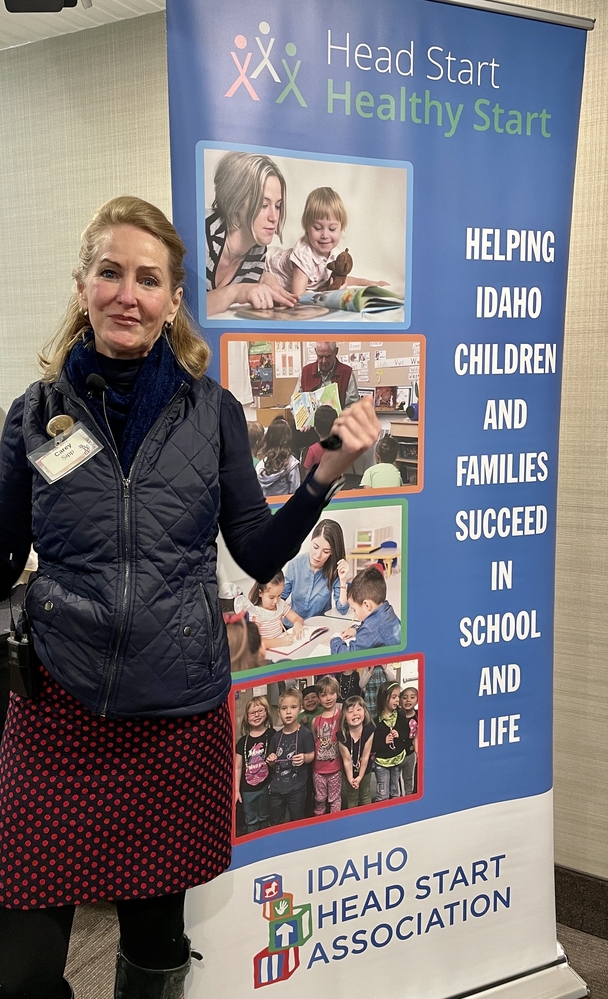
Bill Foxcroft, executive director of the Idaho Head Start Association and me with Tommy Sheridan, deputy director of the National Head Start Association.
There’s some irony in asking for help after giving a talk on asking for help.
I’ll explain.
Sitting at the airport in Salt Lake City, two talks for the Idaho Head Start Association completed, I was glancing through the evaluations of my talks—95% were 8+. Whew. Apparently the topic—how asking for help as a single mother of two helped save my family and me—resonated with staff, teachers, and parents in the Head Start program in Idaho.
I loved the audience, love the organization, and am a long-time proponent of early childhood education, intervention, and support. The National Head Start program has served more than 36 million children over its 58-year history. Today more than a million children attend Head Start programs, which employ more than 257,000 people! The talks and new friendships made in Boise were affirming for myself as well.
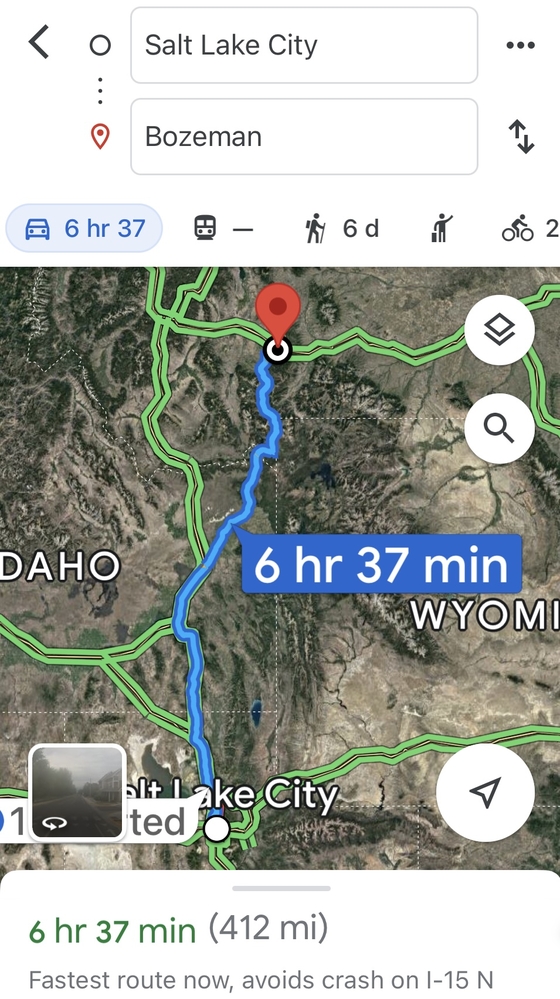
Next stop? Bozeman, Montana, for a brief visit with my grown children, their respective significant others, and my grandpuppies. It would be my first-ever foray into the “Treasure State” in the worst part of the winter. It was supposed to be -17 degrees in Bozeman when I landed.
When I looked up from the evaluations, I noticed the woman sitting next to me doing something I recognized, and said: “I know that move. You’re checking on a child sleeping behind that column, aren’t you?”
Yes, she replied and told me that she and her daughter, age 11, had been traveling all day from Belgium, where they’d spent time with her parents. We laughed about a similar experience I’d had with my daughter when she was about the same age—we’d spent the night under a desk at the Portland airport waiting to catch a flight to Atlanta.
Geraldine—by that time we’d exchanged names—agreed to watch my things while I went to the ladies’ room. When I returned, she said our flight had been canceled, and that she’d booked the last room at the airport Radisson. I gave her a thumbs up and said I was going to look for an alternate fight.
Maybe I could fly into Billings tonight.
Or rent a car. It was a six-hour-plus drive. The roads were rough. No dice.
No flights to Billings, either.
I started zigging and zagging over the map of Montana to see what else could work, and thought about Helena. It wasn’t that far from Bozeman. Meanwhile the line to the Delta service desk, which was about 100-people deep when I got to the gate, had about 200 people waiting impatiently.
Then, jackpot. There was a flight to Helena—a 90-minute drive from Bozeman—the next morning. Better still,I booked a seat.
I told Geraldine and she started checking availability for the same flight. A few minutes later, she and her daughter, Nelle, booked their seats.
Relief in the air, I made a big ask: Would Geraldine be willing to split the cost of the room and perhaps she, her daughter and I could have a Salt Lake City girls’ night sleepover?
I didn’t know the extent of Geraldine’s world traveling experience at that time, but I could tell she’d sized me up. In the little bit of conversation that we’d had—I’d told her I was coming from giving a talk to the Idaho Head Start Association and that I was eager to see my adult children in Bozeman for the first time in months—she’d decided I was a safe risk. She said yes, and I said I’d pay for the ride to the hotel.
Long story short: We did have the last room at the Airport Radisson. It had two queen-sized beds. Nelle and Geraldine bedded down quickly; they’d had a long day. I sent a few messages to the kids, confirming everything, did an abbreviated cleanup, and went to sleep around 1 a.m., grateful to be in a clean bed instead of trying to sleep in a chair at the airport.
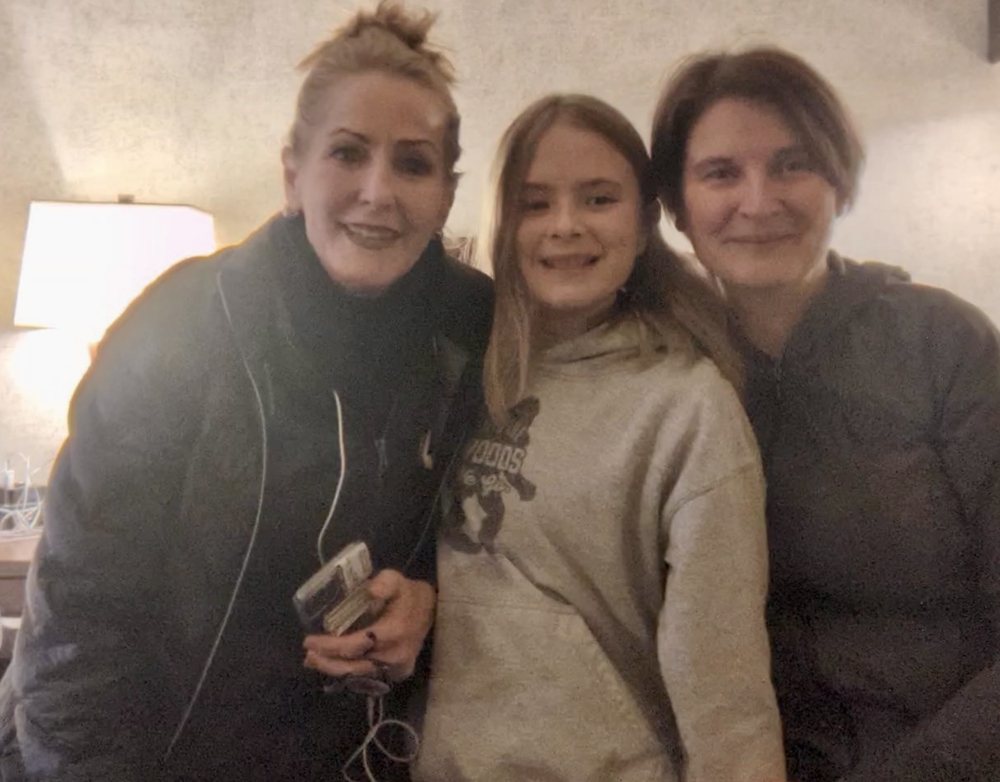
Geraldine, Nelle, and me before heading back to the airport, after our pop-up girls-only Salt Lake City slumber party!
At 6:30 a.m. we headed back to the airport. While waiting, Geraldine and I shared more bits of personal histories. She’d been a college recruiter, and had traveled throughout China, India, and Malaysia before having children. We talked a bit about having daughters, and how grateful I was that my daughter is not a pre-teen at this time when the news about teenage girls and the post-pandemic pressures they are feeling with social media and more, is a great cause of concern. These facts are well-documented in a book I recommended to Geraldine, Girls on the Brink by author and friend Donna Jackson Nakazawa.
When we boarded the plane, our conversation ended; our seats were far apart. After landing, we hugged and thanked each other. My daughter arrived to whisk me away; Geraldine’s husband came to pick up his wife and daughter. And our adventure seemed to come to an end.
But I decided there was something to be learned from writing about this experience.
Later, I texted Geraldine to ask if she was okay if I wrote a story about what we’d experienced in the last 14 or so hours, if I only used their first names and sent it to her first. She was good with that.
And here we are.
I’m back from a great experience of meeting wonderful people who work with Head Start, and spending an incredibly sweet time with my children, during which I thanked them for living so close to each other.
They’d always been close, so when Patrick left Georgia for Montana six years ago, Louisa, who also loves the outdoors, followed suit. They have been rock-solid supports for each other. They know how to ask each other for help when they need it, and they know how to offer support in healthy ways. This served them well when Patrick and a friend of his bought a white-water rafting business, and Louisa helped him with bookings and more for several summers.
There was so much gratitude gained during this brief adventure.
Gratitude for my health, my children and their great relationships with their significant others and amazing dogs. Gratitude that I had enjoyed giving the talks I gave and that they were so well received. Gratitude for the confidence to ask for help and that I’d listened when people along the way told me that asking for help is a sign of maturity. Gratitude that I’d made new connections with people who were enthusiastic about the work being done at PACEs Connection, and how well it aligns with work being done by the thousands of employees at Head Start who are eager, too, to prevent and heal trauma.
Writing this blog was a kind of gift to myself on this March day, which is also my birthday. It is also a way of marking and celebrating these new friendships and possibilities, and affirming the fact that we’re never too old to ask for help, or to have a pop-up, girls-only slumber party.
 Carey Sipp 2/14/234:45 PM
 In the book—chock-full of quotes from top experts on the science of adverse childhood experiences (ACEs), complex post traumatic stress disorder (CPTSD), and healing from codependency, addiction, and abuse—Giuliani describes her journey as she applies the learnings to her own life.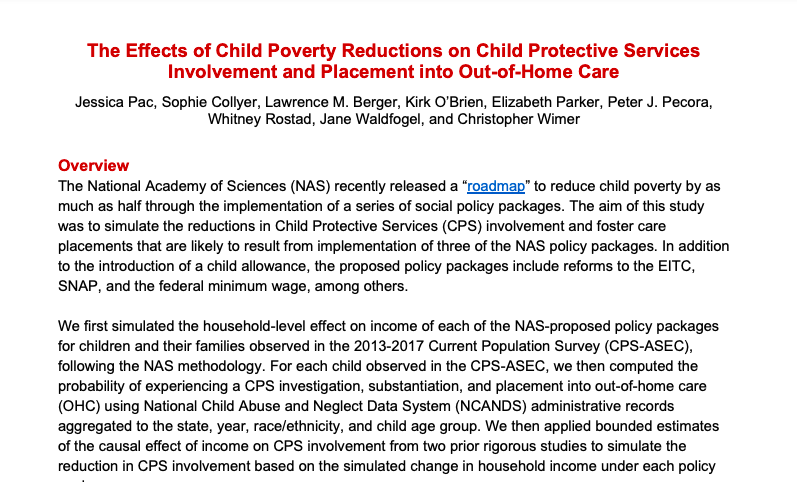
 They’d always been close, so when Patrick left Georgia for Montana six years ago, Louisa, who also loves the outdoors, followed suit. They have been rock-solid supports for each other. They know how to ask each other for help when they need it, and they know how to offer support in healthy ways. This served them well when Patrick and a friend of his bought a white-water rafting business, and Louisa helped him with bookings and more for several summers.