NOTE from Carey on 8.12.26 : The PACEs Connection social network was replaced by a splash page on August 10, 2026. Knowing this was happening, I urged leadership to let the most prolific content providers and donors know, and started saving blogs I’d written over my 13-years of knowing Jane Stevens, founder and publisher of PACEs Connection and the now disappeared ACESTooHigh.com. This history, written by Jane, is saved on my site now for posterity. Someday the history of how this movement came about, who led it, who funded it, how it grew, expanded, contracted, and more, will be told. Saving this and other information on my careysipp.com site is an attempt to capture as much of this information as possible. It’s here for use while the PACEs Connection site is revitalized, and here in case some of this information doesn’t make it to the new site. AGAIN, this is a limited selection of article I deemed most important, and is in no way a comprehensive or fair representation of the wide scope of PACEs Connection in its heyday, when we had about 20 staffers and were offering frequent “A Better Normal”, “Historical Trauma in America” (by region), “Connecting Communities One Book at a Time”, and other webinars and events. For more of the history, another separate site, https://www.pacesconnectioninfo.com/ is still up. I will try to add more content from it, hoping that if it is saved in several places, it will be available for the revitalized site and/or posterity.
Jane Stevens launched PACEs Connection in January 2012 with ACEsConnection.com, now PACEsConnection.com, a community-of-practice social network and ACEsTooHigh.com, a news site for the general public. The intent was to inform people, organizations, and communities about a new understanding of human behavior that had been emerging since 1980s. It was clear that this new knowledge had the potential to solve our most intractable problems. The network was designed to connect the pioneers who were integrating trauma-informed and resilience-building practices based on PACEs science across sectors. This included pediatricians, educators, business owners, judges, community activists, people participating in associations, people working in juvenile justice, social workers, people in the faith-based community, emergency medical technicians, etc.
In 2014, PACEs Connection received funding from the Robert Wood Johnson Foundation and The California Endowment and began operating as a nonprofit through a fiscal sponsorship with Prevention Institute. At that time, a small team of people began working with Stevens to grow PACEs Connection. In March 2016, PACEs Connection received another round of funding from the Robert Wood Johnson Foundation, which sunsets in 2021, and TSNE MissionWorks, which is a 501c3, became our fiscal sponsor. Subsequently, at the end of 2016, PACEs Connection received a second round of funding from The California Endowment. In 2017, the Lisa & John Pritzker Family Fund, and The George Sarlo Foundation provided two years of funding. Genentech’s Resilience Effect philanthropic initiative began providing funding, which mostly supports a reporter who covers pediatrics. In 2020, Blue Shield of California Foundation began providing funding for work in California.
PACEs Connection has become the hub for the PACEs movement. Between 2012-2021, PACEsConnection.com grew from 200 members and no community sites, to more than 52,000 people from every state in the U.S. and more than 40 countries, with more members joining daily. More than 400 communities representing PACEs initiatives have launched in nearly every state in the U.S. and in several countries, with more community sites launching weekly. The community sites can be thought of as mini-PACEsConnections that support PACEs initiatives in cities, counties, regions, states, and nations. The network also supports interest communities such as PACEs in Education, PACEs in Pediatrics, and Parenting with PACEs, and organizational groups such as California Essentials for Childhood.
On ACEsTooHigh.com, articles receive from a few hundred to more than two million page views. Since its inception, ACEsTooHigh.com has also grown: in 2012, it had 471,000 page views and 3,600 visitors; by 2021, it had nearly 10 million page views and six million visitors.
Since 2012, PACEs Connection has used Marshall Ganz’ five-pronged approach to grow the PACEs movement — relationship building, storytelling, structure, strategy, and action. Our initial strategy focused on educating people and organizations about PACEs science, telling stories about people and organizations in different sectors who developed practice-based evidence that inspired others to take action, connecting people who were doing similar work, and developing a networking structure to support all this.
In our next phase, we are focusing focus on systems and policy change. That means creating a national scaffolding using distributed networking technology that links the “mini-movements” taking place in thousands of geographic- and interest-based communities, providing them tools to support their work, and then scaling up that approach. To accomplish this, we launched the PACEs Connection Cooperative of Communities for communities that need advanced tools to measure progress, as well as more guidelines and services.
From these communities will emerge new healing-centered systems that integrate PACEs science from the start (for example, creating a healing-centered system that merges schools and healthcare…something that the State of Oregon is developing) and that can be replicated throughout the world. Our relationship-building and storytelling continues; we have seen those elements light a fire of participation, innovation and sea-change across the world.
Over 250 people from around the United States participated in “Historical Trauma in the American South” on July 15, 2021, the first of six events in PACEs Connections’ Historical Trauma in America Series that examines the impact of intergenerational trauma on the health and well-being of individuals today.
Historical trauma—another term for intergenerational trauma—is defined by Dr. Maria Yellow Horse Brave Heart as multigenerational trauma experienced by a specific cultural group resulting in “a cumulative emotional and psychological wounding over the lifespan and across generations, emanating from massive group trauma” (Brave Heart, N.D.). As recent advances in the science of positive and adverse childhood experiences (PACEs science) continue to show the profound impact of historical trauma on society today, PACEs Connection launched this series to educate and empower people to take action to mitigate its adverse impact and promote resilience in their regions.
Ingrid Cockhren, PACEs Connection director of PACEs Connection’s Cooperative of Communities, and Carey Sipp, who is the organization’s community facilitator for the Southeast, facilitated the first event. It focused on the specific cultural and historical factors that have shaped intergenerational trauma in the South, including the treatment of Indigenous Americans, chattel slavery, Jim Crow, mass incarceration and segregation.
Cockhren, who is an expert in historical trauma and critical race theory, provided an introductory overview of PACEs science and the role of intergenerational trauma. Sipp described the trauma that Southern Indigenous tribes—such as the Creeks, Seminoles, and Cherokees—experienced during their battles with white settlers during the American-Indian Wars between 1622 and the late 19th century (Drake, 2004). Cockhren followed by discussing historical trauma among African Americans in the South, including chattel slavery and the Jim Crow Era to lay the foundation for the systemic racism present today.
The event concluded with a conversation among participants from different geographic locations—including California, the Carribean, Georgia, Illinois, Indiana, and Tennessee—and different sectors—including mental health, social work, and healthcare—to share experiences.
“My heart is so very heavy,” said one participant. “Our Indigenous sisters disappear, and their remains are found, the reporting process and forensics causes me to ask myself if we have really progressed as a nation.”
Many participants expressed surprise at the extent to which historical trauma still impacts people of color living in the South today in the modern forms of discrmination such as environmental racism and microaggressions.
“I spent 15 years working in South Arkansas in the Mississippi Delta Region as a mental health professional,” said one person. “My primary clients were African American, impoverished children and families. There is a very distinct parenting strategy I witnessed of teaching kids not to trust the White people and all the White people are bad or racist or trying to make money off them. There is also an underlying treatment of Black people as ‘less than’ or ‘beneath them’ by White people. Sometimes it is very direct, especially by older White people but a subtle, indirect kind, pretty constant by many White people, not even conscious at times. I also witnessed that the economic differences were huge, as well as enrichment activities for children or community services. Many of the kids I worked with had never been out of the rural county they lived in.”
Other people were surprised to learn that the physical segregation present during the time of chattel slavery and the Jim Crow Era South is still present today.
“I wonder if there are still ‘sundown towns’ in places like Mississippi?” asked one person. The answers were chilling.
“There are!”
“Vidor, Texas, is a sundown city for sure—very scary.”
“We have towns in Oklahoma where Blacks know not to go after sundown.”
One participant described their surprise: “As a woman of color and from the Caribbean, I thought I knew history but there is so much more to learn and understand.”
“The question remains,” said one person as the conversation pivoted to what to do about this dire situation. “How do we talk to, teach children about these conflicting and erroneous narratives?”
“If CRT (Critical Race Theory) wasn’t such a hot topic,” said another participant, “it wouldn’t be banned. Yes, we KNOW America is a racist country and was founded as a racist country with social constructs that still exist today, but people are still in denial and are still making laws to prevent this discussion. We can not conquer what we won’t confront or even confess.”
Before the webinar ended participants were sharing educational resources on historical trauma with each other. Those resources are listed below.
“What’s so interesting about this webinar is the change in human understanding of slavery,” said Jane Stevens, PACEs Connection’s founder and publisher. “Just two centuries ago, most people in the world were in slavery or serfdom. Throughout history, slavery was prevalent in almost every culture. Romans and Greeks had slaves. Incas and Aztecs had slaves. Slavery existed before money or written laws, according to Adam Hochschild, author of Bury the Chains. Although we’ve made considerable progress, the situation we’re in now, reflected in this amazing webinar, shows how difficult it is for humans to change. However, I believe that with the spread of PACEs science, we have a good chance to accelerate change.”
Cockhren and Sipp hope that the Historical Trauma in the American South and the upcoming events in this series will empower individuals and communities to mitigate the adverse impact of historical trauma and promote resiliency. For ideas of how you can become involved with PACEs Connection to advance the PACEs movement, you can:
Continue to expand your knowledge of historical trauma by using resources such as the “PACEs Connection Historical Trauma in the American South Resource List” compiled by participants during this webinar featured below.
PACEs Connection Historical Trauma in the American South Resource List (As shared by attendees using the Zoom chat box during the webinar.)
By Greta Anderson, Inside Higher Education, October 23, 2020
Black students continuously experience, fight against and bear emotional scars from racism, which can lead to increased anxiety and poor mental health outcomes. Some colleges are just starting to address these issues.
Colbie Lofton’s first week of classes at Appalachian State University is sealed in her mind.
Lofton, who is Black, asked her macroeconomics professor a question during class and heard someone sitting behind her say, “I guess n****rs don’t understand.”
Lofton, “completely shocked” to hear a racial slur used so casually, said nothing, and neither did her professor, who Lofton said paused and appeared to have heard the comment. When the class ended, Lofton left, reeling from hurt, and went to a nearby bathroom to cry. She then returned to her dorm and confided in her roommate, but she said she didn’t report the comment to the university because she was not aware of the process to do so.
That 2018 incident was a marker for other racial incidents that would follow at the predominantly white campus in North Carolina and leave Lofton without any illusions about the deep prejudices that some students on campus have against Black people. She has felt “out of place” ever since and hyperaware of her surroundings, which has taken a toll on her mental health.
“That is a story that continues to sit with me,” said Lofton, who is now a junior.
She is not alone. Black students at many predominantly white colleges have long complained of the racial hostility, subtle and blatant, that they regularly encounter on their campuses. Whether victims of constant microaggressions or outright verbal or physical assaults, many have stories of being called a racial slur directly or seeing it scrawled on a campus wall, viewing racist posts by classmates on social media, or sitting through a presentation by a classmate professing a white supremacist conspiracy. The incidents were the focal points of protest movements and demands for change for several years, but the calls for action seemed to reach a crescendo this year as Black students at colleges across the country repeatedly called for college administrators to condemn and address racism on their campuses.
By Gene Nichol, The Charlotte Observer, December 28, 2020
It doesn’t happen as often as one might wish. But, on occasion, you can still be surprised by what someone says. For example, earlier this month, the Donald Trump-appointed Chair of the Federal Reserve, Jerome Powell, explained to the Senate Banking Committee:
“Disparate economic outcomes on the basis of race, have been with us for a very long time, they are a long-standing aspect of our economy, and there is a great risk that the pandemic is making them worse. Because the people who are most affected by the job losses are people in relatively low-paying parts of the service industries that happen to skew more to minorities and women, there is a real concern that if we don’t act as quickly as possible to support these people then we’ll leave behind an even more unequal situation. We need to do as much as we can to avoid exacerbating inequality.”
Seriously, the guy Bloomberg News calls “Wall Street’s Head of State” lectured the country on the challenges of economic justice. Man.
The traditional patterns of racial economic subordination Powell referenced have long dominated every component of life in North Carolina. Today, for example, twice as many African-American Tar Heels live in poverty as whites. The numbers are even worse for Black kids – nearly three times as many are poor as whites.
Racial income disparity is huge. But racial wealth disparity astonishes. Black households, on average, claim less than a tenth of the economic assets of white Tar Heel families. Racial minorities are dramatically more likely, in North Carolina, to be unemployed, uninsured, food insecure, housing insecure, and trapped in low wage work. Such defining disparities have existed throughout the entirety of our state’s history. Radical, systemic, disproportional racial economic impact, as Chairman Powell put it, has “been with us for a very long time.”
Growing up in Canada, Agnes Woodward, who’s Plains Cree and originally from Kawacatoose First Nation, always knew that her family cared deeply about missing and murdered Indigenous women. In the 1990s, she watched as her aunt Mona and a few others began trying to draw attention to the lacking police response when Indigenous women went missing: They would hold up images of missing friends on street corners. In 1992, they organized the first march in Vancouver in memory of missing and murdered Indigenous women (MMIW).
Then, in 2015, the Canadian government approached Woodward’s family to ask if they wanted to add her aunt, Eleanor (Laney) Ewenin, to the list it was compiling as part of its National Inquiry into Missing and Murdered Indigenous Women and Girls. The entire family gathered to talk over the decision and concluded that “if we step up and we tell our story” and it helps any other families, “then it’s our responsibility to do so,” Woodward recalled. Her mother, uncle and aunts had been taken from their parents in Canada’s so-called Sixties Scoop, a period that lasted into the 1980s during which the Canadian government removed Indigenous children from their parents’ care and placed them with foster families. Laney had been separated from the other children, and in 1982, when she was just 23, she was killed.
Woodward, now 38, became a seamstress and began designing ribbon skirts in honor of her aunt and other missing women, eventually creating the company ReeCreations in 2018. Her ribbon skirts quickly became a continentwide symbol of the MMIW movement.
June is Pride Month in the United States, commemorating the Stonewall riots which began on June 28, 1969. According to research by Public Broadcasting Service writer Beatrice Alvarez, the riots marked a turning point in the lesbian, gay, bisexual, transexual and queer (LGBTQ) movement for civil rights.
“The riot began when a group of people at the Stonewall Inn, a gay bar in New York City, were being harassed by police officers. The harassment by police wasn’t new to the bar’s patrons, but that night the community rose up against it. The decision of a few brave Stonewall Inn patrons to fight back and stand against police brutality and injustice kicked off days of demonstrations throughout the city to protest the discrimination and mistreatment of gay and lesbian communities. The first anniversary of the Stonewall riots was celebrated with gay pride parades in Chicago, San Francisco, Los Angeles, and near the Stonewall Inn New York,” Alvarez writes.
To celebrate the month at PACEs Connection our History. Culture. Trauma. podcast will recognize the impact LGBTQ+ people have had in the world.
“This week’s guest, Joe Brummer, continues to utilize his life experience to impact schools across the country to shift their paradigm towards strengthening individual and student school experiences through restorative practices,” said Ingrid Cockhren, PACEs Connection CEO, who hosts the podcast each week with director of communities Mathew Portell.
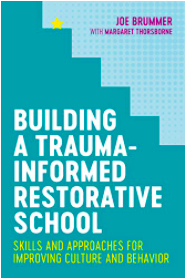
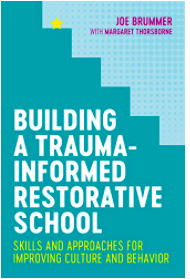
Brummer, author of the book, “Building a Trauma-informed Restorative School”, writes that he is the survivor of child abuse, bullying, and two separate violent anti-gay hate crimes.
“What began as a personal healing response to the trauma has transformed into professional involvement in community and restorative justice,” he says.
Since 2010, Brummer has actively helped schools implement peer mediation programs and school-wide restorative practices. As a private consultant beginning in 2015, Brummer has designed a trauma-informed approach to restorative practices and infused this model in schools.
While news of mass shootings, such as the July 4th shooting at an Independence Day Parade in Highland Park, Illinois, dominates media feeds, community gun violence takes more lives and impacts more people in the United States.
This week the PACEs Connection podcast History. Culture. Trauma, again focuses on gun violence in America, with a conversation departing from the focus on mass shootings, to instead look at community violence and solutions to community violence with policy analyst and activist Timothy Hughes.
“Whereas, active shooter situations and school shootings tend to dominate our mainstream news outlets, community gun violence is often not given as much attention,” said Ingrid Cockhren, PACEs Connection CEO and co-host of the podcast.
“Community violence overwhelmingly impacts low-income communities and communities of color. Mainstream news coverage of this type of violence seldom focuses on mental health, trauma or even real solutions. Instead, violence in these communities is often viewed through the lens of culture.” said Cockhren.
Hughes, who is currently a research fellow at The Mosaic Changemakers, is also commentator, columnist, community organizer, educator, human rights advocate, and public intellectual, working at the intersection of public policy and social justice. He’s been involved with Gideon’s Army in Nashville, Tennessee, and their group of community members called Violence Interrupters.
He recently appeared in a PACEs Connection webinar about gun violence with Cockhren, who has hosted several 2022 events to explore gun violence, including the first episode of the History, Culture, Trauma podcast in which she and PACEs Connection founder and publisher Jane Stevens discussed “How the News Media Suck at Violence Reporting” and how “integrating knowledge of the science of positive and adverse childhood experiences could help reduce and prevent violence, [and] help reduce systemic racism and its effects.”
“In this year alone, there have been more mass shootings in America than in any other year on record. Since 2020, America has been ravaged by a pandemic and endured political divide, nationwide protests and civil unrest. It is apparent that the collective traumas of the past two years have accelerated America’s already dire gun violence crisis,” said Cockhren.
According to statistics from Giffords, the gun violence information and prevention website founded by former congresswoman Gabrielle Giffords, herself a victim of gun violence, in 2020 gun deaths reached their highest level in at least 40 years. Citing the Centers for Disease Control, the site reported 45,222 deaths in 2020.
Further, firearm-related injuries became the leading cause of death in children ages 1 – 19, according to the 2020 statistics from The New England Journal of Medicine.
Tune in Thursday at 1 p.m. PT; 4 p.m. ET, to hear more of the discussion on the community gun violence as a social justice issue, and ways to reduce community gun violence.
To hear prior episodes via your favorite podcast service, use the links below.
“If you don’t understand history, you’re never going to understand trauma. And if you don’t understand trauma, you’re never going to understand history. And this is part of our problem as a field,” said Dr. Bruce Perry in a webinar interview last month, highlights of which will be shared in our “History. Culture.Trauma.” podcast this Thursday at 1 p.m. PT; 4 p.m. ET.
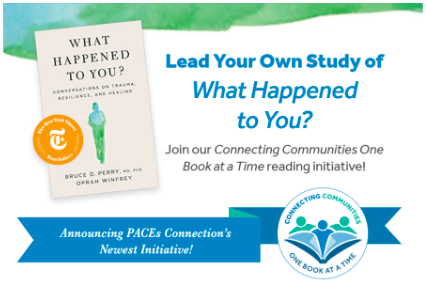
In the webinar, attended by more than 1200 registrants, Perry and hosts Ingrid Cockhren, CEO of PACEs Connection, and Mathew Portell, director of communities, discussed the intersecting fields of trauma and historical trauma and his best selling book, co-authored with Oprah Winfrey, “What Happened to You?”
“There are some really exciting and important things that are happening in the area of historical trauma,” said Perry. He addressed the history of colonialism, treatment of indigenous people, kidnapping and enslavement that are such a part of the history and historical trauma of the United States.
“You know, we are living in systems that are fundamentally colonial in construction,” he said. “And colonialism basically means I’m going to come into your space, your place, and I’m going to take your things and I’m going to make you feel privileged, if I give you a little bit of it back.”
Historical perspectives about trauma deserve “as much attention and funding and support” as is given to people studying the effects of a drug on post traumatic stress disorder (PTSD), or the effects of other treatments, he said.
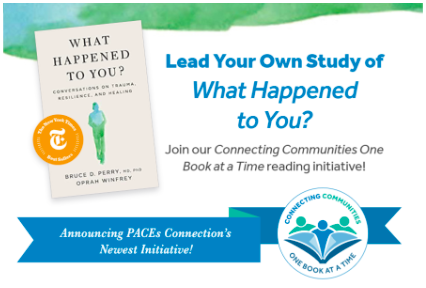
The June webinar also launched the Connecting Communities One Book at a Time community book study initiative. The initiative begins with a study of “What Happened to You?” in PACEs Connection communities across the country. For more information about this initiative you can attend our book study leader training with our partner Children’s Trust Fund Alliance on July 27 or visit here. To sign up as a book study leader, please complete the form available here.
Perry is the principal of the Neurosequential Network, senior fellow of The Child Trauma Academy and adjunct professor in the Departments of Psychiatry and Behavioral Sciences at the Feinberg School of Medicine at Northwestern University in Chicago and the School of Allied Health, College of Science, Health and Engineering, La Trobe University, Melbourne, Victoria Australia.
According to his website, “Over the last thirty years, Dr. Perry has been an active teacher, clinician and researcher in children’s mental health and the neurosciences holding a variety of academic positions. His work on the impact of abuse, neglect and trauma on the developing brain has impacted clinical practice, programs and policy across the world. Dr. Perry is the author, with Maia Szalavitz, of “The Boy Who Was Raised As A Dog”, a bestselling book based on his work with maltreated children, and “Born For Love: Why Empathy is Essential and Endangered”.
Perry, a native of Bismarck, North Dakota, earned his undergraduate degree at Stanford University and Amherst College. He attended medical and graduate school at Northwestern University, receiving both M.D. and Ph.D. degrees, and completed a residency in general psychiatry at Yale University School of Medicine and a fellowship in Child and Adolescent Psychiatry at The University of Chicago.
To listen to Thursday’s podcast at 1 p.m. PT, 4 p.m. ET, click here.
To hear prior episodes via your favorite podcast service, use the links below.
Note – We’re reposting this PACEs Science Champion feature by Laurie Udesky, from November 16, 2021, to share more about the life and work of Dan Press, who died yesterday. He was our remarkable friend and partner in preventing and healing adverse childhood experiences (ACEs) and promoting healthier, more compassionate, more resilient communities. Please see this post by Jesse Kohler for more information about Press, his life and legacy.
In 1964, Dan Press was in his first year of law school and was not liking it; he wanted a way out. He applied for a volunteer spot with AmeriCorps VISTA, the domestic version of the Peace Corps, and was intrigued by a position on an Indian reservation.
Dan Press
“I knew nothing about Indians, but it sounded like a good opportunity,” says Press, who was raised in Flushing, in the Queens borough of New York City. “So, I signed up and the next thing I knew I was on a plane to Montana,” he says.
It was a move that changed the course of his life.
Press, an attorney and now 78 years old, has spent his entire working life fighting on behalf of Indian tribes. He helped found the Tribal Employment Rights Office in 1977, which now has 300 offices around the country. His first legal battles involved pushing for enforcement of laws passed a half a century earlier to give Native Americans preference in hiring for employment on Indian lands brought by outside agencies and firms, but until Press challenged practices and won, those laws were largely ignored.
During his long legal career from working for The Navajo-Hopi Legal Services Program for the Navajo Nation in Arizona to his work at Van Ness Feldman, a law firm in Washington, D.C., he’s also counseled Indian tribes in advancing legislation that’s resulted in hundreds of millions of dollars in land settlements and the procurement of new health facilities. He helped found the first intertribal bank in the nation. Press has also been a champion of promoting trauma-informed initiatives, which in 2018 earned him a Public Advocacy award from the International Society for Traumatic Stress Studies for “Outstanding and Fundamental Contributions to Advancing the Social Understanding of Trauma.” In addition, he is the author of “A How-To Handbook on Creating Comprehensive, Integrated Trauma-Informed Initiatives in Native American Communities.”
Press is the general and legislative counsel for the Campaign for Trauma-Informed Policy and Practice (CTIPP), which helps local, county and state initiatives advocate for legislation to expand trauma-informed practices across the country. He also served as general counsel for The Roundtable on Native American Trauma-informed Initiatives. Both organizations are pro bono clients of his law firm. He has taught classes on tribal government at Columbia University, including “The Holocaust and Genocide in America”, in which students looked at common themes that arose in the genocides of Native Americans and of Jews.
On his first foray into Indian land in Montana, Press tutored children and coached basketball on the Crow Indian Reservation in the southern part of the state. While there, he was approached by Joseph Medicine Crow, the last living war chief of the Crow tribe, an oral historian and writer, who chronicled the living stories of the Crow. Medicine Crow asked Press to translate Crow treaties with the federal government into everyday language. (Medicine Crow, who won a Presidential Medal of Freedom for his war time service during WW II and for his work chronicling Crow history, died in 2016). The project was a turning point for Press. “It made me interested in Indian law,” he recalls.
Fortuitously, a couple he met in Montana who had just graduated from Yale Law School, which had coursework focused on law and society, helped him transfer from Columbia Law School to Yale, where he finished law school two years later in 1968. He then headed to the Navajo Indian Reservation in Window Rock, Arizona to take a job with The Navajo-Hopi Legal Services Program. He shed his urban roots enough to buy a horse, help friends herd cattle in his spare time, and he also attended native ceremonies.
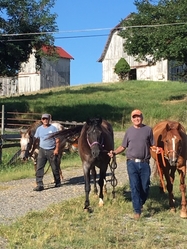
strolling with horses
That experience with the legal services program gave Press a window into the lives of the people he was representing. “We knew there was a lot of beauty out there; there were a lot of beautiful traditions and wonderful people who weren’t reaching their full potential,” he says. Press got involved in employment law, “because I thought if people had jobs, that would help them overcome some of the problems like alcoholism and suicide and other major problems that people suffered on the reservation.”
That employment work, pushing for Indians to have preference in employment over non-Indians for jobs brought into the reservation, led to the establishment of the first Tribal Employment Rights Office in Window Rock. Although there were laws to give that preference, explains Press, “nobody every enforced them.”
When Press moved to Washington, eventually taking a job at the law firm Van Ness Feldman where he spent more than three decades, he continued to fight for Indian preference in employment.
“We had battles with federal agencies who said, ‘You can’t tell our federal contractors or grantees what to do.’ Now we had to show that tribal sovereign authority was stronger than any of those federal regulations. And that tribes could tell federal contractors they have to comply with Indian preference requirements of the tribe. So, a lot of it was fighting to assert tribal sovereignty, which at that point, was still a very new concept.”
As a result of Press’s efforts to push and maintain enforcement of Indian preference law, some 300 Tribal Employment Rights Offices have sprung up around the country.
Despite these victories, Press was beginning to understand that improving employment rights among native people did not mean—as he had hoped—that the societal problems on Indian reservations would go away.
“By around 2010, I started getting very disillusioned. I noticed that 40 years after I’d left the Navajo reservation, the problems that I thought would gradually dissipate were still as bad as ever—the alcoholism and the suicide and all of the other health and social problems that the tribes lead the country in,” he recalls.
He took the problem to his Columbia University students in the first course he taught on Indian tribal government.
“The issue I put before the students is how do we explain all of this dysfunctionality that we see on reservations? Why haven’t those problems decreased? We’ve seen an increase in college graduates, we’ve seen an increase in economic status, but we still have huge unemployment problems, huge substance use problems, huge suicide problems, high school dropout problems,” he says.
It was his students, says Press, who first introduced him to the concept of intergenerational and historical trauma in 2011. They had worked with professors in the university’s psychology department who were investigating how trauma from stress caused changes in genes in mice that were passed down from one generation to the next. (For an example of research around generational trauma and epigenetics, see this study. For research on Holocaust survivors and epigenetics, see this study.)
“It was after that class that I became persuaded that historical trauma was by far the most viable explanation for all for a lot of the problems that you see on reservations,” Press says.
Around the same time as the class, Press’ wife emailed him a study that she thought he should read. It was the landmark Centers for Disease Control and Prevention/Kaiser Permanente Adverse Childhood Experience Study (ACE Study) that tied 10 types of childhood trauma, such as living with a family member who’s addicted to alcohol or is depressed, with chronic disease in adulthood. The ACE Study and subsequent research also showed links between childhood trauma and alcohol and drug abuse in adulthood.
“So, I read it and thought, ‘It really connects the dots between historical trauma and these other forms of trauma’,” says Press. “I began studying more about it and I became a convert, and thought it was one of the most important studies out there.”
In 2014, a phone call with a former client would send Press on his current path. The call was with Native American psychologist, Dr. Tami DeCoteau, whom he describes as his “guru on trauma,” who called Press up one day and said, “I never mentioned it, but I used to babysit for Senator Heidi Heitkamp from North Dakota, and she just called me and said: ‘Let’s have coffee. I want to just pick your brain on what issues I should be dealing with.’”
Press suggested that DeCoteau ask Heitkamp to hold a roundtable discussion on historical trauma in Indian country. Heitkamp, who said it was consistent with her interest in issues affecting children, agreed.
Press and DeCoteau brought together about 25 people in 2014 to speak, including PACEs Connection’s Elizabeth Prewitt, who described the ACE Study. DeCoteau spoke about the experience of trauma on Indian reservations, and representatives from the Menominee tribe in Wisconsin talked about their cross-sector work in implementing trauma-informed practices. (See this PACEs Connection storyfor more on this meeting.)
Heitkamp stayed put for a full hour of the three-hour roundtable, recalls Press. “Getting a senator to sit the whole hour was amazing… But as she walked out, she said, ‘I’ve walked out of this hearing room for the Senate Committee on Indian Affairs depressed so many times because of all the problems people have described. This is the first time I’m walking out optimistic that maybe we have a solution!’”
That meeting gave rise to The Roundtable on Native American Trauma-informed Initiatives in 2016. While the group, led by leaders volunteering their time, including Press, is no longer active, it held meetings to inform government officials about the merits of trauma-informed programs. It also organized conferences for Native Americans, including one entitled: Calling Upon the Warrior Spirit to Heal Historical Trauma Conference and Ceremony in 2018.
In 2017, Heitkamp, along with Illinois Senator Dick Durbin, introduced the Trauma-Informed Care for Children and Families Act of 2017. Provisions of the legislation were later included in legislation signed into law in 2018 to address the nation’s burgeoning opioid epidemic. Until she lost her reelection bid to the Senate in 2019, Press says that Heitkamp remained a staunch supporter of legislation to advance trauma-informed policy.
Around the same time, Press was introduced to Dr. Sandra Bloom, a psychiatrist who was among a group of clinicians who developed a trauma-informed practices protocol known as the Sanctuary model, which has been widely disseminated around the country in schools and organizations, and Dr. Andrea Blanch, the president and director of the Center for Religious Tolerance, who trains service agencies and communities in trauma-informed practices. The two told Press of their interest in forming a national organization with leaders from across sectors to spread the word about trauma-informed practices. They just needed a place large enough to hold the meeting. Press offered up a room at his law firm.
That conversation sparked the formation of the Campaign for Trauma-Informed Policy and Practice, and Press, who was winding down his legal practice, jumped in. CTIPP focuses on advocating for legislation that incorporates the science of positive and adverse childhood experiences (PACEs science) into federal programs and serves as a forum for trauma-informed coalitions to share ideas and resources. In February 2020, just before the COVID-19 pandemic took hold, CTIPP launched the National Trauma Campaign, which is focused on recruiting advocates for trauma-informed legislation in every Congressional district. (See the attached slide deck to learn more about the work of CTIPP.)
That effort has already produced results. “When we first started, there was really just Senator Durbin and Senator Heitkamp. Now there are probably a half dozen senators who have introduced trauma-informed legislation,” says Press. In June, Senators Durbin and Shelley Capito of West Virginia, and others introduced the Rise from Trauma Act, which would infuse trauma-informed policies into federal programs. The bill would also provide funding for community-level work on trauma-informed practices. That bill hasn’t moved yet, says Press. But he has hopes about the reconciliation bill (a.k.a. Build Back Better, click here for PACEs Connection story), which is before the House of Representatives for a vote, and includes $2.5 billion in funding, which could go towards trauma-informed community coalitions.
If that happens, he says, “we’ll achieve one of our most important goals, which is to get funding to these local coalitions because they’re springing up all over the country and you see them on PACEs Connection. But the thing they all struggle with is funding. We have a lot of great volunteers, but we don’t have funding to hire full-time staff. So as the reconciliation bill passes with the Senate for the first time, there’ll be a funding source for local trauma-informed coalitions, and that would be a huge, huge, huge win.”
Press points to the appropriations bill report that just came out of the U.S. House of Representatives as another sign of progress. It included 30 different items in which funding was provided for trauma-informed related programs.
Reflecting next steps, Press says, it’s really all about education. “We know how to help people who have suffered trauma. We know how to prevent trauma. It’s really the education piece that is the biggest barrier. If we get in front of every state legislator, every congressperson, every governor for a half an hour, and go through the [positive and adverse childhood experiences] science, I think all of the barriers would just fall like crazy.”
During this upcoming season of giving, we are making a special appeal. We are in deep financial straits. In a most un-trauma-informed move, a major foundation which had assured us that we would receive a second year of funding unexpectedly reversed course shortly before we were due to receive a $500,000 grant from them.
We’re fortunate to have a couple of funders who are providing support from January through December 2023. But we didn’t have enough funding remaining this year to take us through the end of this quarter, so we’ve cut our pay and time by 50%. If you’ve been through something like this, you know the hardship of making one paycheck last for two months. And almost all staff will be laid off for the month of December.
So, we’re modeling what we’ve written about for others for the last 11 years, quoting authority after authority about the need for people affected by trauma to “ask for help.”
We are asking you, our 57,300+ members, to make a donation, preferably, a monthly donation.
Because we’ve been funded by grants from generous donors over the last few years, we haven’t relied on donations. During a year-end funding campaign two years ago we received an unexpected matching gift of $50,000; you were kind enough to grow that to $105,000.
We are deeply grateful for that support, and for the $22,190 you donated over the last six months, since we began telling you of our situation. And now, as we enter the season of year-end giving, we ask for whatever you can give to assist PACEs Connection in its efforts to continue to solve our communities’ most intractable problems.
Given the current non-profit funding system, which tends to support organizations for only two or three years, we began planning six years ago to become self-supporting. That’s because we know that it will take communities 20 to 40 years to integrate policies and practices based on PACEs science. Earlier this year, we began accelerating those plans by diversifying our revenue streams.
We’re providing our expertise to create trauma-informed schools, trauma-informed workplaces that are anti-racist organizations, and helping local initiatives build partnerships to increase their funding and accelerate their growth.
We continue to recruit communities to join our Cooperative of Communities, which we launched in late 2019, only to see our progress delayed by COVID. The Coop offers unique and sophisticated tracking tools and other benefits to help community PACEs initiatives to accelerate growth, reduce ACEs and increase positive childhood experiences. Communities pay $5,000 a year for tools and benefits that would cost an individual community $80,000 to develop themselves.
Recruiting foundations to partner with us in our work. Besides the obvious consequence of losing much-needed funding, the loss of the $500,000 grant put us in the position of losing precious time to find another funder. Acquiring funding takes, on average, 18 months from first contact to money in the bank. Most funders won’t accept unsolicited requests for funding. You have to know someone who can provide an introduction.
Over the next couple of months, you won’t experience much of a difference in what you see from us. We’ll keep delivering the Daily Digest and Weekly Roundup, which we’ve provided for free for more than a decade. We’ll continue to provide support and training to the 440 or so cross-sector geographic communities and 40 or so interest-based communities that have free pages – their own mini-websites – on our site. We’ll keep offering our free Creating Resilient Communities trainings to the general public, and our Growing Resilient Communities trainings for managers of community initiatives.
We’ll be posting about our fundraising efforts, and asking some of you to post about what PACEs Connection has meant to you, your community, your growth and development as a human, parent, professional. If you’d like to share a video or a testimonial about the importance of our work, please do. We’d love to hear from you and ask that whether you post or not, to make a gift, preferably a monthly gift, to help us keep doing the work.
In the meantime, thank you for all you do in your life, your home, your community, your corner of the world, to help prevent and heal childhood trauma, to help build healthier, more resilient and compassionate communities.