Tag Archives: history

More than a day, we are and have been building a moral fusion movement [poorpeoplescampaign.org]

Carey Sipp Carey Sipp 1/16/238:14 AM

By The Rev. Dr. William J. Barber II and Rev. Dr. Liz Theoharis, Jan. 14, 2023 – The Poor People’s Campaign –  This Martin Luther King Day, we must continue a campaign for social, political and economic rights, not simply to commemorate a man. This nation needs a different kind of Martin Luther King Day. More than a day, we are and have been, building a moral fusion movement. We need a movement led by poor and low-wage workers pushing for a Third Reconstruction and declaring that we don’t want some of our justice, we want all of our justice.Fifty years after Dr. King and other leaders like Caesar Chavez, Hank Adams, Bertha Burres, Myles Horton, welfare rights moms, the Jewish Federation and others called for a Poor People’s Campaign, poor and marginalized people across America have united not to commemorate their vision, but to consecrate a new movement that has the ability to transform the heart and soul of this nation, and the moral structures of society. The legacy of Fannie Lou Hamer, Rev. Douglass Kirkpatrick, Jimmy Collier, Betty Mae Fikes, Mary Wright Edelman – who brought the idea of forming a Poor People’s Campaign along with The National Welfare Rights Organization – and countless unnamed leaders from the ranks of the poor is, us. We carry on their legacy by building this national campaign organized around the needs and demands of the 140 million poor and low-wealth people in this nation. With over 35 state coordinating committees across the country, we are declaring we won’t be silent anymore!
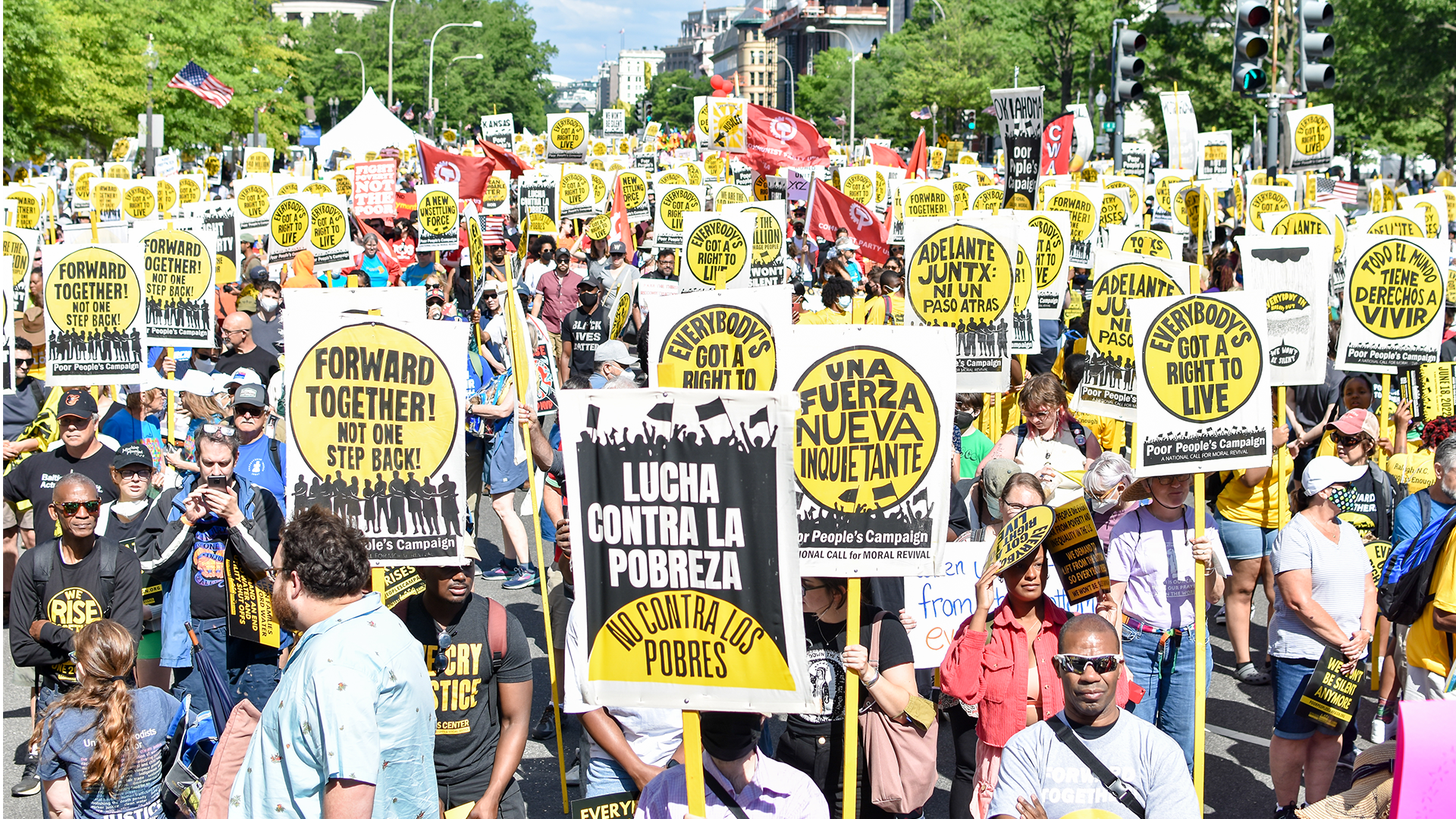
Picture by Emily Farthing from The Mass Poor People’s and Low-Wage Workers’ Assembly and Moral March on Washington and to the Polls . There are thousands of activists holding signs that read
This moral fusion movement is on the move! This weekend, state campaigns from coast to coast are taking action and shaking the very chains of the interlocking injustices of systemic racism, militarism, poverty, ecological devastation, and the false moral narrative of religious nationalism. The actions below serve as just a few examples of our work. It is important to reiterate this because we have built, and will continue, to build a movement, not just a moment.On January 16th, the California Poor People’s Campaign is hosting readings of our Third Reconstruction Agenda as part of the launch of their new Third Reconstruction Agenda campaign: Close the Wealth Gap, CA! They started this initiative last month to celebrate the success of the GOTV efforts across the state and outlined their plans for 2023.The Maine Poor People’s Campaign held a watch party of “Moral Policy Is Good Economics” featuring our Policy Director, Shailly Gupta Barnes.Earlier this week, the Maryland Poor People’s Campaign and other social change partners gathered in Annapolis for the opening of the 2023 Maryland General Assembly and handed out fact sheets with our 2023 legislative priorities.Yesterday, the Massachusetts Poor People’s Campaign gathered at The Cathedral Church of St Paul, Boston prior to the unveiling of The Embrace Sculpture to discuss the work and legacy of Dr Martin Luther King Jr and Coretta Scott King and the Poor People’s Campaign: A National Call for Moral Revival.The Mississippi Poor People’s Campaign continues to sound the alarm on the decades of neglect by crying out for clean water and the right to keep it public. These are just a few examples from our statewide coordinating committees.This weekend, the New York Poor People’s Campaign will be hosting three hybrid mass meetings to lift up a new ground-breaking State of the State Report (available in both English and Spanish) which documents the prevalence of poverty and mass inequality in the state. Did you know that more than half of all children in NY State are poor or low income and that homelessness in New York City is reaching the highest levels since the Great Depression?Last month the Rhode Island Poor People’s Campaign brought the lack of housing back to their State House, pointing out the “short term nature” of their Governor’s “response” to an exploding epidemic of homelessness.Indeed from Appalachia to Alabama, the Carolinas to California, the Borderlands to the Bronx, from the hood to the holler, people are uniting under the banner, “We Won’t Be Silent Anymore!!”
Picture by Steve Pavey from The Mass Poor People’s and Low-Wage Workers’ Assembly and Moral March on Washington and to the Polls . There are thousands of activists looking towards a stage with the Moral Justice Choir. The State Capital Building is in the background.
Last June, we held a historic, generationally transformative gathering of poor and low-wealth people at The Mass Poor People’s and Low-Wage Workers’ Assembly and Moral March on Washington and to the Polls which brought over 100,000 people to DC. In addition those in the streets, digital organizers with the PPC:NCMR have tracked several million people who watched on social media. Justice is coming.
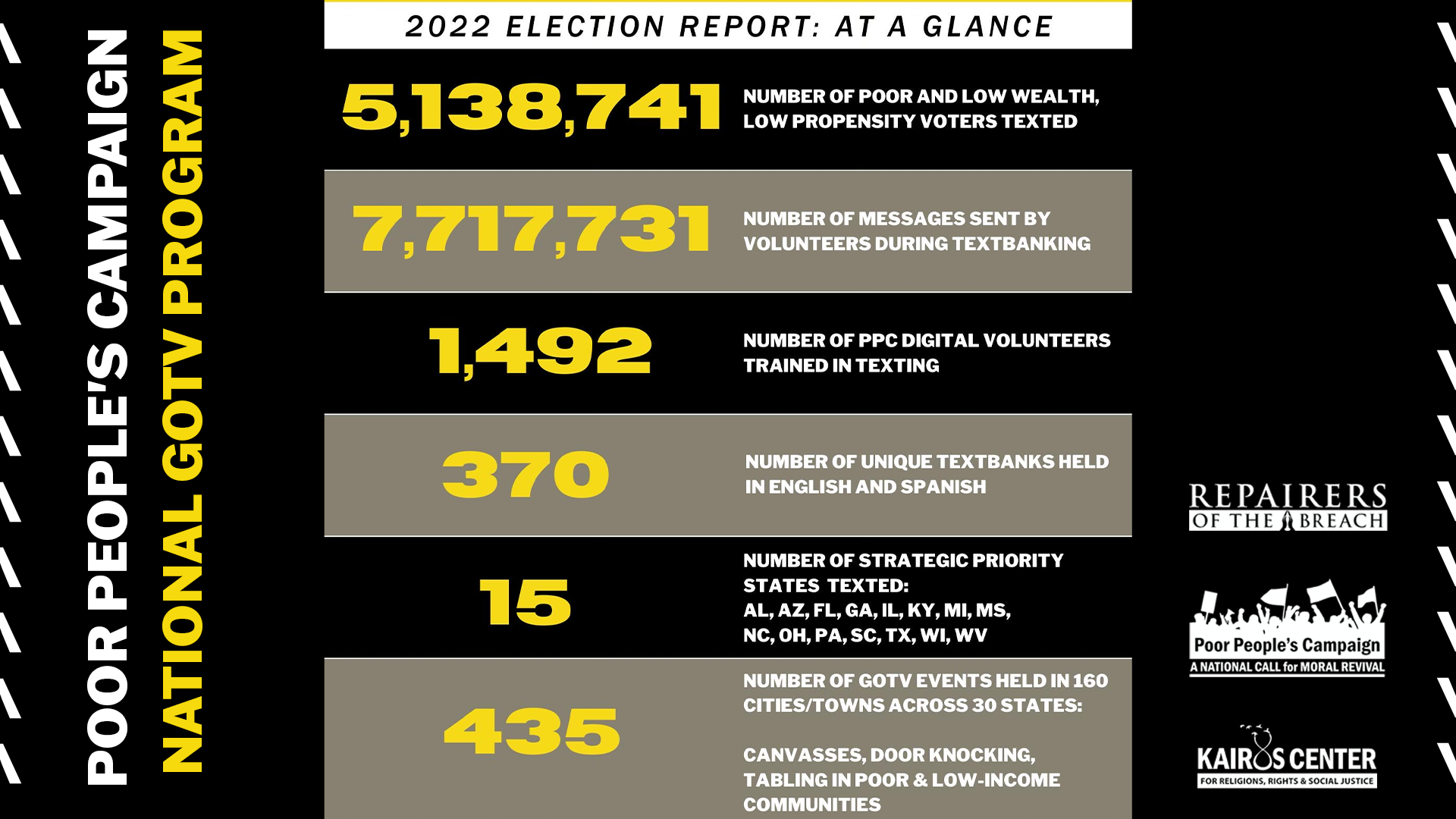
Picture of the successful stats from the PPC's National GOTV program. Over 5.1 million voters were contacted!
Last November, our nationwide Get Out The Vote Mobilization reached over 5.1 million poor and low-wealth voters in 15 priority states, representing 1 out of every 50 eligible voters. We more than doubled our reach from the last election! We are Waking The Sleeping Giant. Justice is coming.This June, we will hold our Poor People’s Moral Action Congress. We will hold major actions in state capitols across the country. We will continue to mobilize, organize, register, and educate. We won’t be silent or unseen anymore.Forward together, not one step back!The Rev Dr William J. Barber, II. President of Repairers of the Breach and co-chair of the Poor People’s Campaign: A National Call for Moral Revival.Rev. Dr. Liz Theoharis, Director of The Kairos Center for Religions Rights and Social Justice and co-chair of the Poor People’s Campaign: A National Call for Moral Revival.

Carey Smith Sipp

carey.pacescommunites@gmail.com

👍 1

Why Poverty Persists in America [nytimes.com]

Carey Sipp Carey Sipp 3/11/231:00 PM

A mother and son living in a Walmart parking lot in North Dakota in 2012.Credit…Eugene Richards

By Matthew Desmond, The New York Times, March 9, 2023

In the past 50 years, scientists have mapped the entire human genome and eradicated smallpox. Here in the United States, infant-mortality rates and deaths from heart disease have fallen by roughly 70 percent, and the average American has gained almost a decade of life. Climate change was recognized as an existential threat. The internet was invented.

On the problem of poverty, though, there has been no real improvement — just a long stasis. As estimated by the federal government’s poverty line, 12.6 percent of the U.S. population was poor in 1970; two decades later, it was 13.5 percent; in 2010, it was 15.1 percent; and in 2019, it was 10.5 percent. To graph the share of Americans living in poverty over the past half-century amounts to drawing a line that resembles gently rolling hills. The line curves slightly up, then slightly down, then back up again over the years, staying steady through Democratic and Republican administrations, rising in recessions and falling in boom years.

What accounts for this lack of progress? It cannot be chalked up to how the poor are counted: Different measures spit out the same embarrassing result. When the government began reporting the Supplemental Poverty Measure in 2011, designed to overcome many of the flaws of the Official Poverty Measure, including not accounting for regional differences in costs of living and government benefits, the United States officially gained three million more poor people. Possible reductions in poverty from counting aid like food stamps and tax benefits were more than offset by recognizing how low-income people were burdened by rising housing and health care costs.

[Please click here to read more.]

Carey Smith Sipp

carey.pacescommunites@gmail.com

How America Manufactures Poverty [newyorker.com]

Carey Sipp Carey Sipp 3/15/231:00 PM

“We typically don’t talk about poverty as a condition that benefits some of us,” Desmond writes in his morally charged manifesto. “It seems we prefer more absolving theories of the problem.”Photograph by Philip Montgomery for The New Yorker

By Margaret Talbot, The New Yorker, March 13, 2023

“Books about poverty tend to be books about the poor,” the sociologist Matthew Desmond writes in “Poverty, by America” (Crown). That’s true whether the motivation is to blame the poor for their lot—chronicling the supposed pathologies creating a “culture of poverty”—or, more commonly nowadays, to generate empathy via detailed ethnographies of survival and agency amid deprivation. It was true of the first books that set out to systematically map and measure poverty, such as the Victorian reformer Charles Booth’s seventeen-volume “Life and Labour of the People in London,” and of Progressive Era attempts to rattle the consciences of the well-off, like Jacob Riis’s document of New York tenement life, “How the Other Half Lives.”

When Michael Harrington wrote his 1962 classic, “The Other America,” a work of morally charged narrative nonfiction often credited with helping to inspire the War on Poverty, his aim was to reveal the “socially invisible” poor to the rest of America. A cocoon of postwar prosperity and complacency, he wrote, blinkered “middle-class women coming in from Suburbia on a rare trip,” who might “catch the merest glimpse of the other America on the way to an evening at the theater”; it also blinkered “the business or professional man,” who might “drive along the fringes of slums in a car or bus” without regarding it as “an important experience.” The book’s dominant rhetorical modes, as Harrington’s biographer Maurice Isserman notes, were paradox and revelation. If the scales were pulled from the eyes of his well-meaning readers, they would see, in the shadows of American plenty, tens of millions of poor people, whom Harrington catalogued and described: rural poor, city-dwelling slum poor, alcoholic skid-row poor, and so on—all of them urgently needing the help of the government and liberal élites. Even a book like Charles Murray’s “Losing Ground,” an influential neocon attack on “welfare dependency,” from 1984, focussed on the poor themselves, if only so that Murray might make an argument about how they had immiserated themselves by adapting to anti-poverty policies.

[Please click here to read more.]

Carey Smith Sipp

carey.pacescommunites@gmail.com

History of Juneteenth, how it’s celebrated, impact of trauma and enslavement today discussed on History. Culture. Trauma. encore with Brandon Jones Thursday

Carey Sipp Carey Sipp 6/13/233:10 PM

Juneteenth marks the day—June 19, 1865—when federal troops arrived in Galveston, Texas, led by Union Army general Gordon Granger. He announced General Order No. 3 that proclaimed freedom for all enslaved people in Texas, two years after President Abraham Lincoln issued the Emancipation Proclamation. The state was the last of the Confederacy that had institutional slavery.

Black communities began celebrating Juneteenth in Galveston in 1866, and since then the commemoration spread across the United States. On June 15, 2021, it was finally recognized by the U.S. government as a federal holiday.

Screen Shot 2023-06-13 at 5.07.09 PMThis This week’s “History. Culture. Trauma.” podcast examines trauma and resilience, not just at the individual level but at the systems and cultural level,” says Ingrid Cockhren, podcast co-host and CEO of PACEs Connection, who examines the questions, “How has the trauma of slavery and genocide impacted our current society? Why are the cultural manifestations of trauma, that is, community violence, school shootings, etc., so pervasive?

In this episode recognizing Juneteenth, Cockhren and guest Brandon Jones will discuss the historical and current context of Juneteenth, how it is recognized.

Jones, the executive director of the Minnesota Association for Children’s Mental Health (MACMH), has a consulting and training background in addressing adverse childhood experiences (ACEs), historical and intergenerational trauma, social/emotional Intelligence, leadership, and intercultural development inventory.

Jones holds a B.A. in sociology from the University of Minnesota, a master’s in community psychology from Metropolitan State University, and a master’s in psychotherapy from Adler Graduate School. He  is also a 2013 Bush Foundation Leadership Fellow. He provides “the MACMH staff and board with the leadership and vision necessary to keep MACMH at the forefront of mental health education and advocacy,” he explains.

Jones says he lives by the motto of, “Live life with purpose on purpose.”

To listen to History. Culture. Trauma. this Thursday at 1 p.m. PT, 4 p.m. ET, please click here.

Attachments

Encore History. Culture. Trauma. podcast with Vernisha Crawford on Intersectionality: The Trauma and Resilience of Girls of Color

Carey Sipp Carey Sipp 10/24/235:16 PM

Adolescent girls are experiencing extreme levels of trauma and adversity, especially African American, Hispanic/Latina and Indigenous girls, as we discussed with author Donna Jackson Nakazawa last year when her book “Girls on the Brink—Helping our Daughters Thrive in an Era of Increased Anxiety, Depression and Social Media.” launched.
This week host Ingrid Cockhren, CEO of PACEs Connection, will touch on those topics and more with guest Vernisha Crawford, who  discusses  the lives of girls of color and the intersectionality of racism and sexism in this encore podcast.Screen Shot 2023-09-19 at 4.13.41 PMCrawford is the CEO of Trauma Informed Institute, and has educated 15,000+ working professionals, helped secure and manage over $12 million, and has directly served hundreds of families. Her work has is in demand across many sectors and countries worldwide.Crawford earned her bachelor’s degree in sociology from the University of North Carolina Charlotte and a master’s degree in leadership from Grand Canyon University. She is a certified trauma informed executive coach, a certified health & wellness coach, a master level certified professional life coach, a business coach, and Scrum Master.As she pursues her Ph.D. in General Psychology with a specialization in trauma and disaster relief, Crawford says her most significant learning is being the mother of an elementary school-aged daughter.Crawford is also the Founder of the BYE Foundation, a 501c3 organization which she says offers a unique approach to systems change work by addressing equity gaps in funding, data, research, capacity building, and wellness.A guest facilitator at Davidson College, Belmont, Vanderbilt, and Fisk universities, Crawford has served as a member of the Early Childhood Executive Committee for Mecklenburg County, the North Carolina ACES Task Force Advisory Board, the North Carolina Juvenile Justice Behavioral Health Committee, the Charlotte Lab School Board, and the Charlotte Community Board for The Gathering Spot.In her free time, Crawford works with her passion project @DanceHerSize, a wellness program teaching women and girls about the eight dimensions of wellness through dance and exercise.Tune into the show here at 1 p.m. PT; 4 p.m. ET Thursday, October 26.Show LinksListen in Apple PodcastsListen in Google PodcastsListen on TuneInListen on iHeartRadioListen on SpotifyLike us on FaceBookConnect on LinkedInFollow on TwitterFollow on InstagramBookmark This ShowiTunes FeedGoogle FeedSubscribe to RSS Feed

Attachments

Hide

Images (1)

Screen Shot 2023-09-19 at 4.13.41 PM

Carey Smith Sipp

carey.pacescommunites@gmail.com

Elizabeth Prewitt, Former PACEs Connection Policy Analyst, Passes Away at 77 (wapo.com)

Carey Sipp Carey Sipp 9/3/254:35 PM

Editor’s note: It is with a heavy heart that Dana Brown and I share this information about our beloved former staff member of PACEs Connection, and friend, Elizabeth Prewitt.

Elizabeth and PACEs Connection founder Jane Stevens were lifelong friends and colleagues and would likely say their work together at PACEs was among the best they did.

We invite you to share remembrances of Elizabeth in space below this story. Together, we remember her determination, commitment to journalistic excellence, her fierce love of her children and her marriage, her love of books, yoga, community, and her grandchildren.

Washington Post – August 31, 2025 — Family-provided obituary — Elizabeth Harner Prewitt died on the morning of Tuesday, August 26, 2025 with her daughter and husband by her side at home in Washington, DC. Born in Lexington, Kentucky, she was 77 years old.

Employing skills gained during a five-decade career in government relations and advocacy, Elizabeth devoted much energy in the last five years of her life to learning and teaching members of the Mount Pleasant Village about the options that can be exercised as the end of life approaches. Her own final days became a lesson in clear planning and acceptance of death’s place in life’s arc.

Elizabeth’s start in Washington came in the office of Congressman Phil Ruppe of Michigan, who gave her a job when she arrived in the capital fresh out of the University of Kentucky. Eventually earning a Master’s degree from George Washington University, Elizabeth went on to work in government relations for the American Institute of Architects, the American College of Physicians, and the National Association of State Mental Health Program Directors. Her last professional position was as a writer and advocate for PACES Connection, working to increase knowledge about and demand for programs and policies aimed at preventing adverse childhood experiences and building resilience in individuals, systems, families, and communities.

The secret to Elizabeth’s professional standing and the love her family, friends, and neighbors felt for her was a rare combination of deep concern for others, gentle thoughtfulness, and a true moral compass. She loved living in Washington and, especially, the Mount Pleasant neighborhood, her home for the last decade and a half of her life. When the brain tumor that killed her was diagnosed, she was relieved to be facing a quick end, as she was grateful for the life she had led and wanted to avoid a prolonged decline if she could. As courageous as it was to forgo intrusive and unpleasant treatment, her decision was an instinctive reflection of her deeply held values. She knew very well that not everyone had the options that came her way.

She is survived by her husband William Emmet and daughter Elizabeth Castaneda. Known as Nookie by her siblings and childhood acquaintances, Elizabeth leaves sisters Sallie Prewitt, Susan Goodrich, Patricia Prewitt, and brother John Prewitt, along with their spouses and their children, her nieces and nephews. She will be missed by her grandchildren Mateas and Tiago Castaneda, step-grandchildren Flora and August Emmet Stewart and Juno Emmet, and stepchildren Nicholas Emmet and Susanna Emmet.

A gathering in Elizabeth’s memory will be scheduled in the fall, and her family will inter her ashes in Lexington Cemetery in Kentucky. Donations in her memory can be made to a cause of your choice or to Mount Pleasant Village (mountpleasantvillage.org).

To plant trees in memory, please visit the Sympathy Store.

Published by The Washington Post on Aug. 31, 2025.

Carey Smith Sipp

carey.pacescommunites@gmail.com

❤️ 1