 Carey Sipp 1/25/221:57 PM
This stunning illustration shows how adverse childhood experiences (ACEs) affected the family of Cendie Stanford, a former school principal, artist, and executive director of her own nonprofit, ACEs Matter. For a larger image, scroll to bottom of post.
Cendie Stanford says that ever since she first learned about ACEs (adverse childhood experiences) science and read Dr. Nadine Burke Harris’s, The Deepest Well, in 2020, she’d been thinking about her own upbringing—which included at least 10 ACEs. She feels strongly that everyone needs to know what she knew about what adversity does to people, because it “explains why people behave the way they behave.”
So Stanford, who lives in Winter Park, Florida, established a nonprofit organization, ACEs Matter, to help get the word out. She was especially interested in reaching neighborhoods where she believed many volunteer ACEs educators wouldn’t want to go, because of crime, danger, and poverty.
She learned everything she could about the science. She logged into PACEs Connection to make connections to identify support and other places she could get help. She also set about putting together a board of directors who could help guide and support her in her goal of educating the most vulnerable people in underserved populations in the seven states in which she’s starting out: Arizona, Florida, Georgia, Louisiana, Mississippi, Missouri, and Texas.
Then earlier this month, she held her first board meeting.
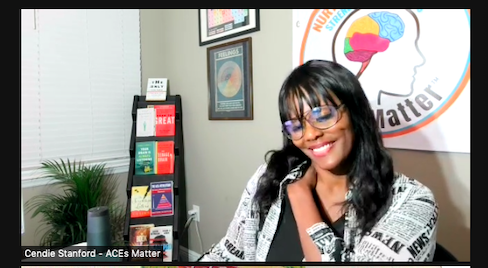 Technical glitches didn’t matter
“I was really nervous about the meeting because I was bringing six people together for the very first time to figure out how they could help with ACES Matter,” she said. “And if anything could go wrong, it did.
“I had six very professional, very educated individuals waiting on me on a Sunday, on a holiday, and there were problems with Zoom. And it was in that moment, with so many technical problems and all these people waiting on me, that I didn’t feel judged.”
It was a moment that called her to stop and share this realization with her board.
“We were talking about the importance of vulnerable communities hearing about ACEs,” she says. “And in that moment, they didn’t care about the sound not working. They didn’t care about the PowerPoint. They were compassionate. And I just felt so loved. And that’s how the (ACEs genealogy) drawing was inspired because when one in six people have four or more ACEs—which I knew on that call included me and at least one other person—I was met with compassionate people.
“In that moment, I said that people need to understand that sometimes there are not enough compassionate people. So in a world with so many of us with these high adversity scores, we live in a world filled with people who need to meet a compassionate person,” she says.
Her board, comprising professionals from the medical industry, educators, technology administrators, and leaders in the spiritual sectors, agreed with her assessment, bringing their professional expertise as well as their own lived childhood experiences to the table.
The next day—Martin Luther King Day—she was inspired to create her “My ACEs Genealogy Tree.” She hopes this resource will help her bring the science of adverse childhood experiences to life for others.
“I’d been thinking about this family tree for almost two years now. And I knew it was going to be a visual because when people can see stuff like that and see themselves in it, it’s so much more powerful than just the words or the data. It’s what had been on my heart, and I think I turned it out in a couple of hours. And it was the most rewarding experience for me to create that illustration,” she says.
“Doing this was just eye-opening,” she continues. “It confirmed all of these feelings that had been bubbling up inside of me that ACEs science is just deeper than our family tree, that it (trauma) was really ingrained in the roots. There’s a lot of work that needs to be done and there is a solution.”
And that solution begins with spreading the word.
“This is life-saving information; we need to share it with everybody we know. Now.”
Stanford talks about a childhood friend who shares about PACEs science whenever possible.
“My friend was home on a family visit in the neighborhood where we grew up, and a 4-year-old child was gunned down,” she recalls. “My friend stayed to attend the funeral of the child and ran into the mayor. In questioning him, she found he had never heard about ACEs, and wanted more information. She also ended up running into a news reporter and faith leaders who wanted to know more.
“We know we should have somebody inside of every community talking about ACEs, and creating safe spaces for people to have this conversation,” she says. “Yes, the conversation can be activating, but it can also be catastrophic if we don’t bring it up.”
This is part one of a three-part series. Next: My ACEs family tree: Life after ACEs.
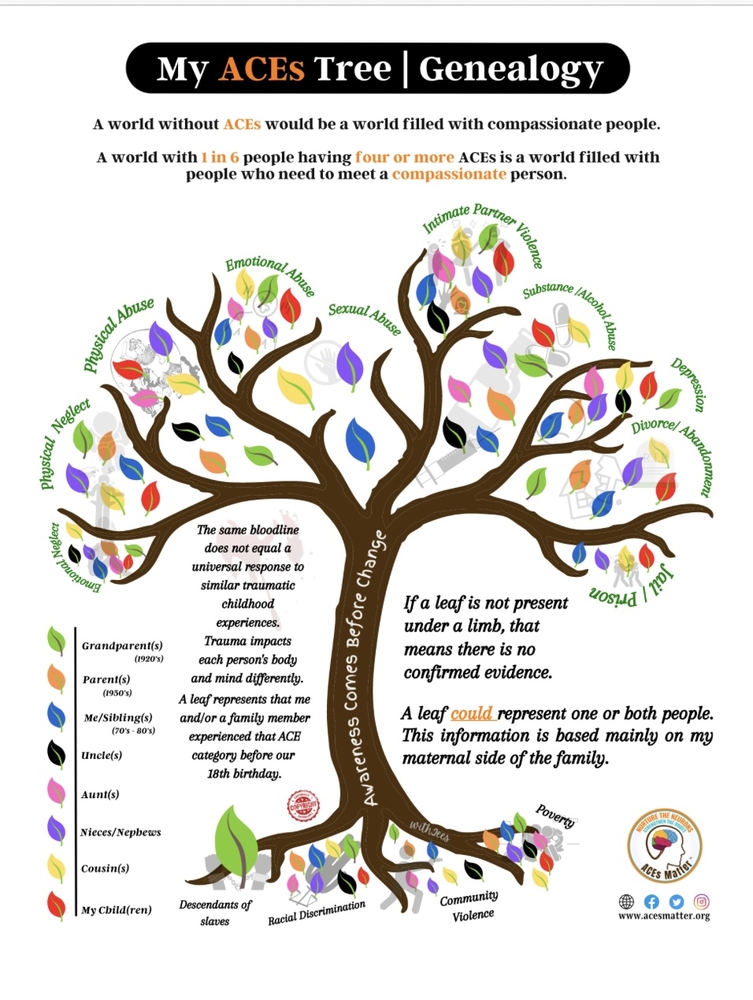
Click here to see the tree on the ACEs Matter website.
Attachments
Images (2)
Carey Smith Sipp
carey.pacescommunites@gmail.com
Views: 2,859


