 Jane Stevens 10/1/191:00 AM
What is PACEs science?
The science of PACEs refers to the research about the stunning effects of positive and adverse childhood experiences (PACEs) and how they work together to affect our lives, as well as our organizations, systems and communities. It comprises:
- The CDC-Kaiser Permanente ACE Study and subsequent surveys that show that most people in the U.S. have at least one ACE, and that people with four ACEs— including living with an alcoholic parent, racism, bullying, witnessing violence outside the home, physical abuse, and losing a parent to divorce — have a huge risk of adult onset of chronic health problems such as heart disease, cancer, diabetes, suicide, and alcoholism.
- Brain science (neurobiology of toxic stress) — how toxic stress caused by ACEs damages the function and structure of kids’ developing brains.
- Health consequences — how toxic stress caused by ACEs affects short- and long-term health, and can impact every part of the body, leading to autoimmune diseases, such as arthritis, as well as heart disease, breast cancer, lung cancer, etc.
- Historical and generational trauma (epigenetic consequences of toxic stress) — how toxic stress caused by ACEs can alter how our DNA functions, and how that can be passed on from generation to generation.
- Positive Childhood Experiences and resilience research and practice — Building on the knowledge that the brain is plastic and the body wants to heal, this part of PACEs science includes evidence-based practice, as well as practice-based evidence by people, organizations and communities that are integrating trauma-informed and resilience-building practices. This ranges from looking at how the brain of a teen with a high ACE score can be healed with cognitive behavior therapy, to how schools can integrate trauma-informed and resilience-building practices that result in an increase in students’ scores, test grades and graduation rates.
1. What are ACEs?
ACEs are adverse childhood experiences that harm children’s developing brains and lead to changing how they respond to stress and damaging their immune systems so profoundly that the effects show up decades later. ACEs cause much of our burden of chronic disease, most mental illness, and are at the root of most violence.
“ACEs” comes from the CDC-Kaiser Adverse Childhood Experiences Study, a groundbreaking public health study that discovered that childhood trauma leads to the adult onset of chronic diseases, depression and other mental illness, violence and being a victim of violence, as well as financial and social problems. The ACE Study has published about 70 research papers since 1998. Hundreds of additional research papers based on the ACE Study have also been published.
The 10 ACEs the researchers measured:
— Physical, sexual and verbal abuse.
— Physical and emotional neglect.
— A family member who is:
- depressed or diagnosed with other mental illness;
- addicted to alcohol or another substance;
- in prison.
— Witnessing a mother being abused.
— Losing a parent to separation, divorce or other reason.
Subsequent to the ACE Study, other ACE surveys have expanded the types of ACEs to include racism, gender discrimination, witnessing a sibling being abused, witnessing violence outside the home, witnessing a father being abused by a mother, being bullied by a peer or adult, involvement with the foster care system, living in a war zone, living in an unsafe neighborhood, losing a family member to deportation, etc.
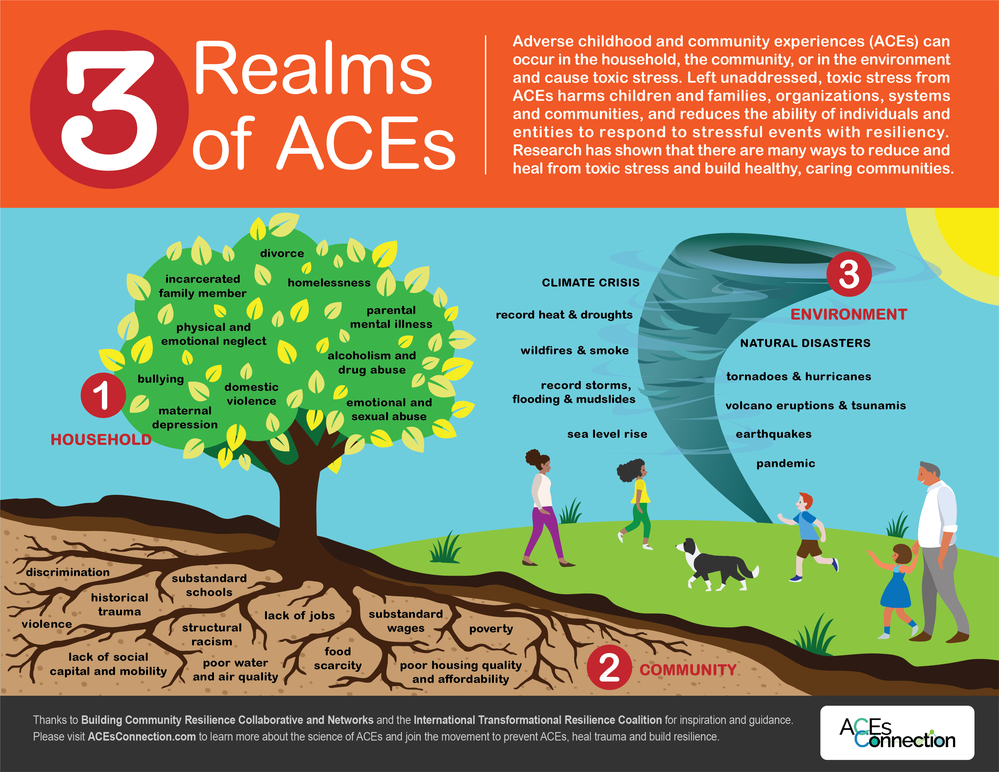
ACEs fall into three large categories:
- Adverse childhood experiences
- Adverse community experiences
- Adverse climate experiences
Resources:
Wikipedia — Adverse Childhood Experiences Study
The 10 ACE Questions (and 14 resilience survey questions)
The Pair of ACEs: The Soil in Which We’re Rooted, the Branches on Which We Grow
Why are ACEs significant?
1. The ACE Study revealed six main discoveries:
- ACEs are common…nearly two-thirds (64%) of adults have at least one.
- They cause adult onset of chronic disease, such as cancer and heart disease, as well as mental illness, violence and being a victim of violence
- ACEs don’t occur alone….if you have one, there’s an 87% chance that you have two or more.
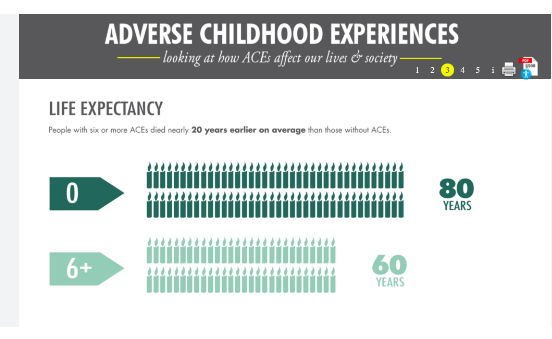
- The more ACEs you have, the greater the risk for chronic disease, mental illness, violence and being a victim of violence. People have an ACE score of 0 to 10. Each type of trauma counts as one, no matter how many times it occurs. You can think of an ACE score as a cholesterol score for childhood trauma. For example, people with an ACE score of 4 are twice as likely to be smokers and seven times more likely to be alcoholic. Having an ACE score of 4 increases the risk of emphysema or chronic bronchitis by nearly 400 percent, and attempted suicide by 1200 percent. People with high ACE scores are more likely to be violent, to have more marriages, more broken bones, more drug prescriptions, more depression, and more autoimmune diseases. People with an ACE score of 6 or higher are at risk of their lifespan being shortened by 20 years.
- ACEs are responsible for a big chunk of workplace absenteeism, and for costs in health care, emergency response, mental health and criminal justice. So, the fifth finding from the ACE Study is that childhood adversity contributes to most of our major chronic health, mental health, economic health and social health issues.
- On a population level, it doesn’t matter which four ACEs a person has; the harmful consequences are the same. The brain cannot distinguish one type of toxic stress from another; it’s all toxic stress, with the same impact.
What’s particularly startling is that the 17,000 ACE Study participants were mostly white, middle- and upper-middle class, college-educated, and all had jobs and great health care (they were all members of Kaiser Permanente).
Resources:
ACE Study primer — KPJR Films, which came out with Paper Tigers in 2015 and Resilience in 2016, put together this five-minute overview of the ACE Study.
ACE Study video — Three-minute trailer for a four-hour CD of interviews with ACEs researchers produced by the Academy on Violence and Abuse.
How childhood trauma affects health across a lifetime (16-minute TED Talk by Dr. Nadine Burke Harris)
Has anyone else done an ACE Study?
Thirty-six states and Washington, D.C. (infographic) have done one or more ACE surveys. Here are links to some of their reports (some states haven’t produced reports).
There are numerous other ACE surveys, including cities, such as Philadelphia; organizations, including the Crittenton Foundation; schools, including Spokane elementary schools; by pediatricians, including Dr. Nadine Burke Harris and Dr. Victor Carrion (2011 and 2013); several countries, including England, Saudi Arabia, and a World Health Organization ACE survey of university students in Romania,; and 64,000 juvenile offenders in the Florida juvenile justice system. You can find a list of ACE surveys, including expanded ACE surveys with more questions, in the Resources Section of ACEsConnection.com.
2. What’s the neurobiology of toxic stress?
Brain science shows that, in the absence of protective factors, toxic stress damages children’s developing brains. Stress is the body’s normal response to challenging events or environments. Positive stress — the first day of school, a big exam, a sports challenge — is part of growing up, and parents or caregivers help children prepare for and learn how to handle positive stress, which is moderate and doesn’t last long. It increases heart rate and the amount of stress hormones in the body, but they return to normal levels quickly.
But when events or the environment are threatening or harmful – we stumble across a bear in the woods – our brains instantly zap into fight, flight or freeze mode and bypass our thinking brains, which can be way too analytical to save us (Is the bear really mean? Is it more interested in berries or killing me? Should I wait until I see it charge?). With help from caring adults, children also recover from this tolerable stress.
Too much stress – toxic stress – occurs when that raging bear comes home from the bar every night, says pediatrician Nadine Burke Harris. Then a child’s brain and body will produce an overload of stress hormones — such as cortisol and adrenaline — that harm the function and structure of the brain. This can be particularly devastating in children, whose brains are developing at a galloping pace from before they are born to age three. Toxic stress is the kind of stress that can come in response to living for months or years with a screaming alcoholic father, a severely depressed and neglectful mother or a parent who takes out life’s frustrations by whipping a belt across a child’s body.
Resources:
Harvard University Center on the Developing Child
Video: Toxic Stress Derails Healthy Development (2 min)
An Unhealthy Dose of Stress (Center for Youth Wellness white paper)
The Science Behind PTSD Symptoms: How Trauma Changes the Brain
Brain Story Certification, Alberta Family Wellness Initiative
3. What are the health effects of toxic stress?
Chronic toxic stress—living in a red alert mode for months or years — can also damage our bodies. In a red alert state, the body pumps out adrenaline and cortisol continuously. Over time, the constant presence of adrenaline and cortisol keep blood pressure high, which weakens the heart and circulatory system. They also keep glucose levels high to provide enough energy for the heart and muscles to act quickly; this can lead to type 2 diabetes. Too much adrenaline and cortisol can also increase cholesterol.
Too much cortisol can lead to osteoporosis, arthritis, gastrointestinal disease, depression, anorexia nervosa, Cushing’s syndrome, hyperthyroidism and the shrinkage of lymph nodes, leading to the inability to ward off infections.
If the red alert system is always on, eventually the adrenal glands give out, and the body can’t produce enough cortisol to keep up with the demand. This may cause the immune system to attack parts of the body, which can lead to lupus, multiple sclerosis, rheumatoid arthritis, and fibromyalgia.
Cortisol is also extremely important in maintaining the body’s appropriate inflammation response. In a normal response to a bee sting or infection, the body rushes antibodies, white blood cells and other cell fighters to the site and the tissues swell while the battle rages. But too much swelling damages tissue. Cortisol controls this fine balance. So without the mediating effects of cortisol, the inflammatory response runs amok and can cause a host of diseases.
If you’re chronically stressed and then experience an additional traumatic event, your body will have trouble returning to a normal state. Over time, you will become more sensitive to trauma or stress, developing a hair-trigger response to events that other people shrug off.
Biomedical researchers say that childhood trauma is biologically embedded in our bodies: Children with adverse childhood experiences and adults who have experienced childhood trauma may respond more quickly and strongly to events or conversations that would not affect those with no ACEs, and have higher levels of indicators for inflammation than those who have not suffered childhood trauma. This wear and tear on the body is the main reason why the lifespan of people with an ACE score of six or higher is likely to be shortened by 20 years.
Resources:
What Happened To You? Conversations on Trauma, Resilience and Healing, by Dr. Bruce Perry and Oprah Winfrey
Childhood Disrupted: How Your Biography Becomes Your Biology and How You Can Heal, by Donna Jackson Nakazawa
The Body Keeps the Score: Brain, Mind and Body in the Healing of Trauma, by Bessel Van Der Kolk
The Deepest Well: Healing the Long-Term Effects of Childhood Adversity, by Nadine Burke Harris, 2018.
Biologial Embedding of Early Social Adversity, Proceedings of the National Academy of Sciences, 2012
PubMed childhood adversity research publications
4. What’s epigenetics and how does that relate to historical or generational trauma?
Most people believe that the DNA we’re born with does not change and that it determines all that we are during our lifetime. That’s true, but the research from epigenetics — the study of how social and other environments turn our genes on and off — shows that toxic stress can actually change how our genes function, which can lead to long-term changes in all parts of our bodies and brains. What’s more, these changes can be transferred from generation to generation.
Epigenetics means “above the genome” and refers to changes in gene expression that are not the result of changes in the DNA sequence (or mutations).
Resources:
WhatIsEpigenetics.com — This New York-based blog and news aggregator covers the field of epigenetics and is funded by EpiGentek. It includes backgrounders, including epigenetics fundamentals.
Epigenetics — From the Genetics Science Learning Center at the University of Utah, this section includes explainers and an overview of how the social environment affects your epigenome.
Epigenetics 101: A beginner’s guide to explaining everything (TheGuardian.com, 2014)
5. Positive Childhood Experiences and resilience research: If you have a high ACE score, are you doomed? No!
The good news is that the brain is plastic, and the body wants to heal.
The brain is continually changing in response to the environment. If the toxic stress stops and is replaced by practices that build resilience, the brain can slowly undo many of the stress-induced changes.
There is well documented research on how individuals’ brains and bodies become healthier through mindfulness practices, exercise, good nutrition, adequate sleep, and healthy social interactions.
Here’s a good article that weaves the unified science of human development together: Scars That Don’t Fade, from Massachusetts General Hospital’s Proto Magazine.
In the last few years, researchers have started to examine the impacts of positive childhood experiences (PCEs) on children and adults. We at PACEs Connection are particularly interested in the interplay between positive and adverse childhood experiences. Here’s some of the relevant research:
- A team of researchers — Dr. Christina Bethell, Jennifer Jones, Dr. Narangerel Gombojav, Dr. Jeff Linkenbach and Dr. Robert Sege — published research in 2019 that found a dose-response association between positive childhood experiences — such as feeling like family stood by one during difficult times and feeling safe and protected by an adult in the home — and adult mental and relationship health among adults who had experienced ACEs, irrespective of how many ACEs they had. Positive Childhood Experiences and Adult Mental and Relational Health in a Statewide Sample: Associations Across Adverse Childhood Experiences Levels | JAMA Pediatrics.
- That same year, Bethell, Gombojav, and Dr. Robert Whitaker reported that at each level of ACEs, “the presence of flourishing increased in a graded fashion with increasing levels of family resilience and connection.” Family Resilience And Connection Promote Flourishing Among US Children, Even Amid Adversity | Health Affairs
- In 2014, Bethell, Dr. Paul Newacheck, Dr. Eva Hawes, and Dr. Neal Halfon found that children with higher ACE scores were less likely to demonstrate resilience, live in a protective home environment, have a mother who was healthy, and live in safe and supportive neighborhoods. However, almost half of the children who had experienced ACEs also demonstrated resilience, and “resilience mitigated the impact of adverse childhood experiences on grade repetition and school engagement.” Adverse Childhood Experiences: Assessing The Impact On Health And School Engagement And The Mitigating Role Of Resilience | Health Affairs
- In a study published in 2021, Whitaker, Dr. Tracy Dearth-Wesley, and Dr. Allison Herman wrote that “greater childhood family connection was associated with greater flourishing in US adults across levels of childhood adversity.” Childhood family connection and adult flourishing: associations across levels of childhood adversity – Academic Pediatrics (academicpedsjnl.net)
- Dr. Yui Yamaoka and Dr. David Bard reported in 2019 that “the number of adverse childhood experiences was associated with both social-emotional deficits and developmental delay risks in early childhood; however, positive parenting practices demonstrated robust protective effects independent of the number of adverse childhood experiences.” Positive Parenting Matters in the Face of Early Adversity – PubMed (nih.gov)
- Among juvenile offenders, Dr. Michael Baglivio and Dr. Kevin Wolff discovered in 2020 that “high ACE scores were associated with increased reoffending, and high PCE scores were associated with decreased recidivism, as measured by both rearrest and reconviction. Further, among juveniles with four or more ACEs who have six or more PCEs, reconviction was 23% lower and rearrest 22% lower when compared to those youth with four or more ACEs and less than six PCEs, controlling for a host of demographic and criminal history measures.” Positive Childhood Experiences (PCE): Cumulative Resiliency in the Face of Adverse Childhood Experiences – Michael T. Baglivio, Kevin T. Wolff, 2021 (sagepub.com)
- Dr. Michael Baxter, Dr. Eden Hemming, Dr. Heather McIntosh, and Dr. Chan Hellman published research in 2017 that demonstrated that higher ACEs scores were associated with lower hope in a study of caregivers who brought children in for a child abuse medical investigation at a child advocacy center. Exploring the Relationship Between Adverse Childhood Experiences and Hope: Journal of Child Sexual Abuse: Vol 26, No 8 (tandfonline.com)
- In 2019, Dr. AliceAnn Crandall, Dr. Jacob Miller, Dr. Aaron Cheung, Dr. Lynneth Novilla, Dr. Rozalyn Glade, Dr. M. Lelinneth Novilla, Dr. Brianna Magnusson, Dr. Barbara Leavitt, Dr. Michael Barnes, and Dr. Carl Hanson observed in a study of adults that “higher counter-ACEs scores [i.e., positive childhood experiences] were associated with improved adult health and that counter-ACEs neutralized the negative impact of ACEs on adult health.”ACEs and counter-ACEs: How positive and negative childhood experiences influence adult health – ScienceDirect
- A study by Whitaker, Dearth-Wesley, and Herman in 2020 showed that across levels of childhood adversity, greater childhood family connection was associated with greater flourishing among young adults with type 1 diabetes. Childhood Family Connection With Flourishing in Young Adulthood Among Those With Type 1 Diabetes | Pediatrics | JAMA Network Open | JAMA Network
- Finally, in 2016, Bethell, Gombojav, Dr. Michele Solloway, and Dr. Lawrence Wissow examined ACEs, resilience, family protective factors, and emotional, mental or behavioral conditions (EMB) in children and youth in the U.S. The authors found that children with ACEs had higher EMB than children without ACEs, but the presence of resilience was significantly associated with lower amounts of EMB for both children with and without ACEs. In addition, the prevalence of EMB was lower when family protective factors were present, even if the child had ACEs, although the presence of two or more ACEs decreased the effect. Adverse Childhood Experiences, Resilience and Mindfulness-Based Approaches: Common Denominator Issues for Children with Emotional, Mental, or Behavioral Problems (nih.gov)
Who’s using PACEs science?
Many people, organizations, agencies, systems and communities are beginning to implement trauma-informed, resilience-building practices based on PACEs science.
- Pediatricians (here’s an update on the Children’s Clinic) and public health clinics are screening patients for ACEs. By the end of 2017, between 1,000 and 2,000 pediatricians had integrated ACEs screening into their practices. Here’s an article about Kaiser Permanente pediatricians in Northern California who have started screening kids for ACEs. Dr. Jeffrey Brenner, MacArthur genius award winner, recommends physicians adding ACE screening to measurement of other vital signs, such as blood pressure. A rural health clinic in Pueblo, CO, changed its medical practice after it integrated ACEs screening. A family physician in Tennessee educates his opioid patients about their ACEs, and it helps motivate them to heal themselves. The physician also understands that ACEs leads to damage that is chronic and, thus, he treats addictions as he does diabetes, as a chronic disease.
- Many schools — including schools in San Francisco, CA, Spokane, WA, San Diego, CA, and Walla Walla, WA — have integrated healing-centered/trauma-informed practices into classrooms, playgrounds and school policies. These schools have seen 90 percent drops in suspensions after one year; after three years, the schools no longer expel students and some no longer even have the need for in-school suspensions. The grades, test scores and graduation rates increased, and the students most benefitted were those with the highest ACE scores. By the end of 2017, several hundred schools across the U.S. were integrating trauma-informed and resilience-building practices based on ACEs science.
- Head Start (early childhood education program) in Kansas City has integrated trauma-informed practices in a program called Head Start Trauma Smart. (NYTimes article about the program.)
- Home-based early childhood intervention, such as Child First. (NYTimes article about the program.)
- Police departments and courts have integrated trauma-informed approaches. Safe Babies Courts have integrated PACEs science in resilience-building practices that provide wrap-around services for families; a year after participating in Safe Babies Courts, 99 percent of the children suffer no further abuse. Some prisons are beginning to educate inmates about PACEs science.
- Homeless shelters and the faith-based community are integrating practices based on PACEs research. At the heart of their approach is educating those who are homeless and people in rescue missions about PACEs science; it often changes their whole understanding of their behavior, because they realize that they weren’t born bad, that they had no control over what happened to them as children, that they coped appropriately, given what was available to them, and that they can change. Batterers intervention programs that have integrated PACEs science have reduced recidivism rates from what was accepted — 20 to 60 percent — to zero to four percent.
- Cities and states are integrating practices based on PACEs science. By the end of 2017, several hundred communities around the U.S. had launched PACEs initiatives. This report on self-healing communities describes how integrating ACEs science drastically reduced youth suicide, teen pregnancy, juvenile arrests, and high-school drop-out rates — all at the same time — in communities in Washington State that integrated practices based on PACEs science.
- Research on families shows that interventions — such as Nurse-Family Partnership, Healthy Steps, and Child First — can improve the lives of parents and children. Evidence-based parenting practices (Incredible Years, Triple P Parenting, etc.), increase the health of parents and children.
Resources:
Growing Resilient Communities provides guidelines and tools for communities to launch and grow local PACEs initiatives, and measure the progress of their work.
What does trauma-informed mean?
According to the Substance Abuse and Mental Health Services Administration (SAHMSA), part of the U.S. Department of Health and Human Services, a trauma-informed approach refers to how an organization or community thinks about and responds to children and adults who have experienced or may be at risk for experiencing trauma. In this approach, the whole community understands the prevalence and impact of ACEs, the role trauma plays in people’s lives, and the complex and varied paths for healing and recovery.
A trauma-informed approach asks: “What happened to you?” instead of “What’s wrong with you?” It is designed to avoid re-traumatizing already traumatized people, with a focus on “safety first” (including emotional safety), and a commitment to do no harm. But a trauma-informed approach is most successful when an organization or community builds policies and practices based on a foundation of ACEs science.
Resources:
SAMHSA overview of what trauma-informed is and isn’t
National Center for Trauma-Informed Care
SAMHSA’s Concept of Trauma and Guidance for a Trauma-Informed Approach — Introduces a concept of trauma and offers a framework for how an organization, system, or service sector can become trauma-informed. Includes a definition of trauma (the three “E’s”), a definition of a trauma-informed approach (the four “R’s”), 6 key principles, and 10 implementation domains.
Any legislation or federal policies?
Updates on U.S. state and federal legislation can be found in the State ACEs Resolutions and Laws section of State PACEs Action on PACEsConnection.com. Some examples:
California legislature resolution to reduce ACEs
Massachusetts bill on trauma-informed schools
Vermont attempt to pass ACEs bill
Overview of state, federal legislation
US Department of Health and Human Services guidelines to state health directors (and the letter to state health directors)
All resources:
A Critical Assessment of the Adverse Childhood Experiences Study at 20 Years (attached)
Wikipedia — Adverse Childhood Experiences Study
The 10 ACE Questions (and 14 resilience survey questions)
Harvard University Center on the Developing Child (neurobiology of toxic stress)
Alberta Family Wellness Initiative (Canada)
ACEsTooHigh.com – News site covering PACEs research and practices
PACEsConnection.com – Social network (with 60,000+ members across sectors) and more than 400 community sites that support ACEs initiatives in cities, counties, states, regions and nations.
WhatIsEpigenetics.com – News site covering epigenetics
Epigenetics — Explainers and backgrounders about epigenetics
National Center for Trauma-Informed Care
Community Resilience Cookbook — Nine case studies of cities and states that are integrating PACEs research)
SAMHSA’s Concept of Trauma and Guidance for a Trauma-Informed Approach — Introduces a concept of trauma and offers a framework for how an organization, system, or service sector can become trauma-informed. Includes a definition of trauma (the three “E’s”), a definition of a trauma-informed approach (the four “R’s”), 6 key principles, and 10 implementation domains.
Videos:
ACE Study video (three minute trailer)
Video: Toxic Stress Derails Healthy Development (2 min)
How childhood trauma affects health across a lifetime (16-minute TED Talk by Dr. Nadine Burke Harris)
Books:
Childhood Disrupted: How Your Biography Becomes Your Biology and How You Can Heal, by Donna Jackson Nakazawa
The Body Keeps the Score: Brain, Mind and Body in the Healing of Trauma, by Bessel Van Der Kolk
The Deepest Well: Healing the Long-Term Effects of Childhood Adversity, by Nadine Burke Harris, 2018.
The Last Best Cure: My Quest to Awaken the Healing Parts of My Brain and Get Back My Body, My Joy, and My Life, by Donna Jackson Nakazawa
For other books, go to the ACEs Connection Books community.
Documentaries:
Paper Tigers — What does it mean to be a trauma-informed school? And how do you educate teens whose childhood experiences have left them with a brain and body ill-suited to learn? This film follows six students through a year in America’s first trauma-informed high school.
Resilience — Resilience chronicles how trailblazers in pediatrics, education, and social welfare are using cutting-edge science and field-tested therapies to protect children from the insidious effects of toxic stress.
CAREgivers — How is the professional care provider affected emotionally and physically, and who helps them?
For a list of all documentaries addressing PACEs science, and how to access them, go here.
Attachments
Images (1)
Files (1)
Jane Stevens
Publisher, ACEsTooHigh.com
Founder, PACEs Connection
Views: 215,818
Add Comment
 Carey SippFormats
javascript:””
Comments (16)
MSMary SoleroMember
If individuals want society to be less aggressive, more calm, less reactive, and more cooperative and collaborative… For the developing brain to develop the capacity for empathy, compassion, and all that comes to mind when thinking about what it means to be human, it requires certain developmental and social experiences at crucial junctures. Drywall Installation Arlington Drywall Contractor Pros
FMFormer Member
ACE Science is woefully limited by leaving out everything about the development of the stress response system and healthy brain architecture, Resiliency is developed in infancy via a secure attachment. A secure and loving attachment in infancy develops a brain’s limbic and cortical regulation over the brainstem’s reactivity leading to control over violent, aggressive and impulsive behavior. Focusing on anything but healthy early brain development will always be radically suboptimal.
If people want the society to be less violent and more cooperative and collaborative, more relaxed and less reactive… the developing brain needs certain developmental and relational experiences at critical points in time in order for a brain to bring forth the capacity for empathy and compassion and everything one thinks of when one considers what it means to be human.
Jane StevensPublisher, ACEsTooHigh; founder, PACEs Connection
We’re in the process of revising our ACEs Science 101 PPT, Elaine. We’ll post it when it’s finished.
ESElaine SpicerMember
My question: is there a powerpoint that goes along with the ACES Science 101?
Thank you!
Dale FletcherMember
Gail Kennedy (ACEs Connection Staff) posted:
Dale- i encourage you to post your question to the ACEs in the Faith Based community!
I did that too Gail. Thanks!!
 Gail KennedyMember
Dale- i encourage you to post your question to the ACEs in the Faith Based community!
Dale FletcherMember
I’m presenting a talk to a group of Pastors on ACES but the slide deck on ACES that I received does not have any slides on Neuroplasticity, from either a science perspective or from a biblical perspective.
Do any of you have a few slides that you’d be willing to share with me?
Thanks so much in advance!!
Have an awesome day!
 Dominic CappelloMember
May I stress the link between family trauma and poverty. Living without resources means lack of access to survival resources like food, safe shelter, medical care, behavioral health care and transport to vital services. It also means lacking the resources to thrive: family centered schools, parent support, early childhood learning programs, youth mentors and job training. ACEs prevention programs, if it is to include our most vulnerable children and families, can build into theor strategic plan and priorities the strengthening of ten key family resources. For more information on a data-driven and cross-sector approach that addresses health disparities please visit www.resilienceleaders.org
Gail KennedyMember
Thanks for identifying that, Dale! I just fixed it.
Dale FletcherMember
Hi Jane,
FYI – a link above in the paragraph:
Who’s using ACEs science?
– Faith-Based Community – is broken. I found the new link:
http://www.mercedsunstar.com/n…/article3306980.html
Hope this helps! Have a great day!
Dale
 Emily Read DanielsMember
Jane, this is great! Great! I love ACES Connection; I am grateful for the resource. It is connecting me to fabulous people and fabulous efforts – thank you!
But there is one “bone of contention” that I will pick – this reference list is missing the work of Bessel Van Der Kolk, Peter Levine, Pat Ogden, Bruce Perry… we DESPERATELY NEED TO MOVE BEYOND COGNITIVE/BEHAVIORAL APPROACHES to treating trauma. As someone that has YEARS of experience working with children and teens and working with that kind of approach to treating depression, anxiety, suicidality, substance misuse, cutting, ODD – you name it, I have worked with it – it’s an epic fail. EPIC! The emerging modalities of treatment (e.g. somatic experiencing, trauma-informed yoga, trauma drama, rhythmic movement and music, etc.) make way for regulating the body’s stress response!
We are a culture OBSESSED with the mind and the power of the mind – to the detriment of the body. We must remember that when someone is struggling with anxiety, depression, rage, etc., the individual is experiencing an overwhelming visceral body experience.
I just had to share this…in all the trauma-informed training and efforts I see going on, I am thrilled. But then I get “un-thrilled” when it’s the same means of practice we have been endorsing and implementing for years (without success!). It’s time to move beyond behavioral and cognitive behavioral approaches to resolving trauma.
Jane StevensPublisher, ACEsTooHigh; founder, PACEs Connection
Thank you for your comment, Vincent, and for all the work you did that provided the solid foundation for this new understanding of us humans!
Vincent J. Felitti, MDMember
Jane, I am repeatedly grateful to you for your skills in disseminating all this information so interestingly and understandably. Thank you!
Jane StevensPublisher, ACEsTooHigh; founder, PACEs Connection
Thanks, Melissa & Paul. If there’s anything else we need to add, let me know.
 Melissa L. Baker, MPHMember
Jane, this is SUCH a valuable compilation to have in one place!
i will use these resources and links in my next presentation.
thanks!
 Paul GilmoreMember
Thank you for this concise review of ACE’s. My senior research project looks at the use of ACE scores in serving adjudicated youth with histories of harmful sexual behaviors. Your post provides a lot of information and resources that will be helpful to my project. Much appreciated!

Learn about PACEs Connection & who we are.
How to be a part of our social network.
Join local or interest based communities.
Invite others to join PACEs Connection!

Comments
Carey Sipp commented:
Thanks for posting, Laura! For posting this, and so many more blogs over the years. I’m thinking of the ones YOU’VE written (you are…
Carey Sipp commented:
Thanks, Jeoff. A lot of great relationships and ongoing work came from this incredible gathering. It laid the groundwork for deepening…
David Dooley commented:
Thank you for commenting, Mr. Holmes. I’m not sure what you’re getting at. Can you give me an example?

Tommy Holmes commented:
I loved how you highlighted the connection between ACEs and community resilience! It’s so important to empower people with this…

Patrick Anderson commented:
This one landed, Dr. Long. What I’d underline is that you’ve framed being pushed out as a pattern rather than a run of bad luck — and…

Robert Hawk commented:
That story is heartbreaking and really shows how history and present-day realities can intersect. Reading about Black history in China…

David Dooley commented:
Thank you for writing, Mr. Anderson. You wrote… “Your instinct that the utopia requires entirely new forms of parenting education that…
Cecilia Pace commented:
[heart] Pace, Cecilia reacted to your message:

TraumaInformedJobs.com is a new job board for the trauma and resilience communities. PACEs Connection members can save 10% on posting with code PACES10
Blog Archive
Blog Directory
Creating Resilient Communities
History. Culture. Trauma. Podcast
History. Culture. Trauma. Blog
Copyright © 2023, PACEsConnection. All rights reserved.




 If you’d prefer to mail your gift rather than give it online, here’s how…
 Making a wire transfer or need Tax ID information?