Category Archives: Uncategorized

Four NC affiliates of PACEs Connection Cooperative of Communities ready to measure their success in solving community problems

Carey Sipp Carey Sipp 7/13/213:16 PM

Leaders of PACEs science initiatives in four North Carolina counties are eager to begin measuring the impact of their work to solve the most intractable problems in their respective communities.

Screen Shot 2021-07-13 at 5.11.29 PM
Tommy Taylor

“Each of these broad-based, cross-sector task forces is about preventing childhood trauma and its negative effects on long-term health. We want to heal trauma and create and build on positive childhood experiences in our communities so individuals, families, and communities themselves can grow in health, strength, and resilience. Their work to shine a light on ways racism and inequity hurt our communities, and to improve diversity, equity, inclusion, collaboration and opportunities, is work we believe in and are behind,” said Tommy Taylor, executive director of the United Way of Cape Fear Area, who has worked closely with each of the resiliency task forces.

Task forces are in four counties: New Hanover, Brunswick, Pender and Columbus.

Soon, leaders of each resiliency effort will send a 14-question Milestones Survey, part of the PACES Connection Community Resilience Tracker, to organizations in each county that are participating in their respective resilience initiatives. The results of the survey will tell them how far these organizations have come on their path to becoming trauma-informed and healing-centered.
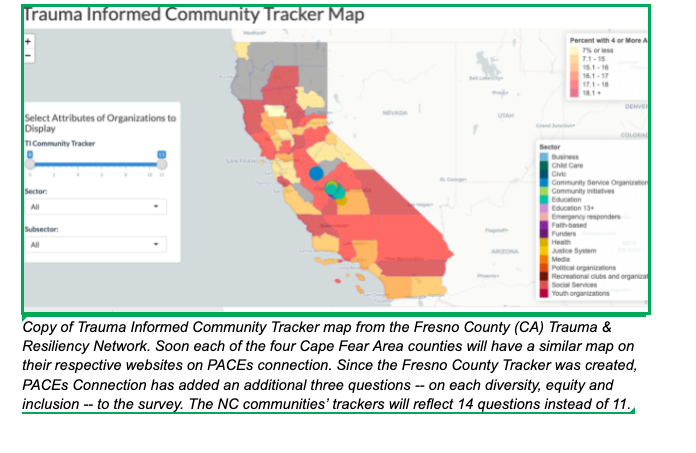
Screen Shot 2021-07-13 at 4.30.23 PMThey are able to undertake this measurement because the United Way of Cape Fear Area is underwriting their access to the sophisticated data tools offered to members of the PACEs Connection Cooperative of Communities. As part of the Coop, they will join other affiliates not only in tracking their progress, but also in network leadership training; learning collaboratives on subjects such as trauma-informed education; and in-depth training in how diversity, equity and inclusion intertwine with the science of positive and adverse childhood experiences. They will also be able to collaborate with fellow members of the Coop to share what works and what doesn’t to develop a community that integrates practices and policies based on PACEs science.

According to Jane Stevens, founder and publisher of PACEs Connection, who was with the Cape Fear Area community managers and members of their communities last week for the announcement of their joining the Coop, the first part of the data gathering process is also prescriptive.

“Milestones survey questions are prescriptive, in that going through them gives organization leaders a path to achieve goals that will actually help the organization and its employees improve relationships, safely explore causes of employee turnover and likely improve employee and customer, client, or patient satisfaction,” she said.

“The second part of the data work is the sector surveys. Using publicly available data, including some from the Cape Fear Collective, we will be able to show part of the impact of having trauma-informed policies and practices in schools, healthcare, law enforcement and other sectors,” Stevens said.

Joining the PACEs Connection Cooperative of Communities is another step along the long and sustained path that the counties are taking to educate all citizens about the science of PACEs.
Screen Shot 2021-07-13 at 5.10.38 PM
Mebane Boyd

“We are particularly interested in seeing the impact of having more than 4,000 people in New Hanover County trained in either theCommunity Resiliency Model(CRM) or theResources for4 Resiliency(R4R) model,” said Mebane Boyd, the former director of theNew Hanover Resiliency Task Force, who now serves as Resilient Communities Officer at theNorth Carolina Partnership for Childrenworking with coalitions throughout the state.

“In New Hanover County, community members have taken these trainings to help them function better in times of stress, whether it’s daily stressors at home, secondary trauma from working with traumatized children or adults, or natural disasters like hurricanes, tornadoes, or even the pandemic,” said Boyd.

A primary focus of the New Hanover County Resiliency Task Force’s work for almost three years, the CRM and R4R trainings offer an overview of the science of adverse childhood experiences, an understanding of the biology of stress and how the body and brain function—or don’t function—during traumatic stress.
Screen Shot 2021-07-13 at 5.26.31 PM
J’vanete Skiba

“Most importantly,” said J’vanete Skiba, acting director of the New Hanover County Resiliency Task Force, herself a CRM trainer, “the trainings show people how to move their brains and bodies from the state of flight, fight, freeze, where they can add to the trauma of themselves and others, to a regulated state, where they can access their reasoning brain to think, plan, and de-escalate trauma.”

“I’m thankful for the time our community took to create an action plan that could be applied to our many systems,” said Boyd. “The CRM and R4R trainings were a critical part of ‘taking care of the providers’ goal first before we began educating the general public about ways to manage stress. We realized very early on that those who were providing services in our communities were being traumatized at work themselves, and that unless those providing services were well, we couldn’t provide helpful, trauma-informed services to the thousands in our community. That’s why we put so much emphasis on these trainings first.”

Community managers Lauren Clark in Brunswick County; Amy Read in Pender County, who are also certified to teach CRM, and Selena Rowell and Jai Robinson in Columbus County, have also been leading efforts in their respective counties to make these trainings available.

Further, just as in New Hanover County, they have used documentaries such as “Resilience” or “Paper Tigers” to help community members learn about trauma, its impact, and how working together to prevent and heal trauma leads to healthier individuals and communities.

Last week’s announcement of the UW-CFA funding for the four counties to join the Cooperative of Communities was made after months of work by the community managers of each group to build their memberships and vet the tools and benefits of the Coop. They worked with members and member organizations to discern priorities, create plans, and gather membership agreements pledging involvement in the work to advance trauma-informed policies, as these documents must be signed for an organization to participate in the Milestones Survey.

Accelerating change

“The data tools will reveal extremely valuable information that can show progress and accelerate change,” said Stevens. “This information can ultimately be used to help calculate how much money a community is saving by integrating practices based on PACEs science.”

Task force leaders say the ultimate goal is to have the trauma-informed, healing-centered practices integrated deeper into each sector and organization in the communities. With the Coop survey tools to track and document what is working and how well, the efforts are more likely to be sustainable over time, showing an ongoing return on investments.

PACEs Connection is a nonprofit organization founded in 2012 to advance the science of positive and adverse childhood experiences (PACEs) and unite the people, organizations, systems and communities in the worldwide PACEs movement in solving our most intractable problems. The PACEs Connection social network serves as the movement’s main information exchange and resource, providing support for hundreds of local, state and national PACEs initiatives. It recently surpassed 52,000 members worldwide, and offers a free community site and assistance to some 400 geographic and more than 40 interest-based communities.

This is the second of a series of articles about the four resiliency initiatives from the Cape Fear Area of North Carolina joining the Cooperative of Communities, and the involvement of the United Way of the Cape Fear Area in each of the county’s efforts.

For more information about the PACEs Connection Cooperative of Communities, please contact the Community Facilitator for your geographic region of the country.

US Communities

Northeast, Mid-Atlantic, & Southwest states
Contact: Alison Cebulla

Southern states
Contact: Carey Sipp

Midwest states
Contact: Porter Jennings-McGarity

Washington, Oregon, Montana, Wyoming, Idaho, Alaska, and Hawaii
Contact: Karen Clemmer

California

Southern California
Contact: Lara Kain

Northern California
Contact: Karen Clemmer

San Francisco Bay Area
Contact: Donielle Prince

The Capitol Region, Central Valley, Monterey, East San Benito counties
Contact: John Dovales Flores

International Communities

Contact: Alison Cebulla

Attachments

Hide

Kentucky ranks high for childhood trauma. A coalition is uniting to do something about it [courier-journal.com]

Carey Sipp Carey Sipp 8/6/215:00 AM

By Sarah Ladd, Courier Journal, August 4, 2021

A massive and historical partnership between a slew of Kentucky foundations will tackle child trauma, or “ACEs,” in the commonwealth in the coming years through education, policy work and maybe the state budget.

The “Bloom Kentucky” partnership, more than two years in the making, doesn’t have an end date right now, Kentucky Youth Advocates executive director Dr. Terry Brooks said Monday: “It’s not a microwave proposition; it’s going to be much more of a crockpot effort.”

“It is wishful thinking to believe that a multi-generation issue is going to get solved in the immediate,” he added.

[Please click here to read more.]

Carey Smith Sipp

carey.pacescommunites@gmail.com

👍 1

The best way to start any meeting. Ever.

Carey Sipp Carey Sipp 8/17/2111:25 AM

Following a brief mindfulness check-in, PACEs Connection staff meetings begin with the review of our Vision, Mission, and Values statements, as well as our Equity and Inclusion Statement. At a recent meeting, top row, L-R, Ingrid Cockhren, Carey Sipp, Donielle Prince, Jane Stevens. Middle row, L-R, John Flores, Porter Jennings-McGarity, Jenna Quinn, Gail Kennedy. Bottom row, L-R, Rafael Maravilla, Natalie Audage, Alison Cebulla, Samantha Sangenito.


A couple of times last week I felt my body downshift to a more comfortable lower gear, the way it has several thousand times over the course of 26 years. This happens when I’ve “claimed” my seat at meetings for people recovering from having lived in the chaos and trauma of addiction, or in meetings for people who want help with their own addictions.

Many recovery meetings open with the oft-quoted Serenity Prayer, which asks petitioners to be granted “the serenity to accept the things we cannot change, the courage to change the things we need can, and the wisdom to know the difference.” We read the beautiful Promises of Alcoholics Anonymous, or a version of it appropriate to whatever group is meeting, along with the Twelve Steps and Twelve Traditions.

This “meeting norm” of reading through the mission of why we are there, the vision of what we’ll gain if we “keep coming back” and the 24 behavioral milestones of theTwelve Steps and the Twelve Traditions has served, for my central nervous system, as a signal to let down. Relax. Open my mind. Open my heart. Trust it is safe to be where I am and who I am and to speak my peace. Here I am welcomed, accepted, loved, appreciated before I am even known. Though I may be only tolerated by some, love and kindness is the code. With spiritual help I won’t “act out” or ask for special treatment as here I am “a worker among workers.” Though were I to act out, my loving accountability partners would likely not do so much judging as they would gently nudge to help me remember to look for “my part” in whatever is setting me off. It is a model for living that I love and treasure. And it helps the group focus, center, get in sync, and oftentimes come to a collective gratitude.

Gratitude was the feeling I had last week when at two PACEs Connection meetings. The first was a meeting with a couple of statewide organizers, one of whom had been through a harrowing week of family illness. The other was our weekly PACEs Connection staff update during which several of us expressed disappointment and exasperation about the increase in COVID-19 cases. Both meetings began by reading, out loud, the PACEs Connection Vision and Mission statements as well as our Values and our Equity and Inclusion Statement.

Our Vision

A resilient world where all people thrive.

Our Mission

The human and digital catalyst that grows and supports the worldwide PACEs and resilience movement, and tells its authentic stories.

Equity & Inclusion Statement

PACEs Connection is an anti-racist organization committed to the pursuit of social justice.

In our work to promote resilience and prevent and mitigate ACEs, we will intentionally embrace and uplift people who have historically not had a seat at the table. PACEs Connection will celebrate the voices and tell the stories of people who have been barred from decision making and who have shouldered the burden of systemic and economic oppression as the result of genocide, slavery, family separation, forced relocation, mass incarceration, red lining and all other practices, policies and institutions that have traumatized marginalized groups. These groups include people of color, people living with mental health and substance use challenges, people living with disabilities, and members of the LGBTQI community.

Our Values

As individuals and as an organization, it is our intention and daily practice to encourage and model these core values:

Integrity. Transparency.

Equity. Inclusion.  

Empathy. Compassion.  

Joy. Celebration.

Courage.

Integrity. Transparency. We manage through trust not control. To create trust and an accountable environment where everyone feels they can say what needs to be said when it needs to be said, we maintain an environment free from hidden agendas or conditions, accompanied by full information and no fear of retaliation. We speak directly, do what we say we will do and have pure motives. We contribute authentically and participate fully. We are leaders and we model leadership at every level.

Equity. Inclusion.  We regularly examine our roles in perpetuating inequitable systems and work to change inequitable practices, structures and policies that contribute to ACEs, and maintain an environment where everyone is welcomed, respected, supported and valued.

Empathy. Compassion.  We value empathy, which validates the experiences of others and is born from compassion.

Joy. Celebration.  We cultivate resilience and equanimity by sharing the truth of our stories and celebrating our lessons learned and our successes.

Courage. Knowing that we, ourselves, are the foundation for our success and the key to achieving our vision, we encourage and provide opportunities for personal growth and professional advancement and satisfaction. Our courage is grounded in the body and is a measure of our heartfelt participation in life, with one another, and with our work.

Something about reading these grounding, encouraging, compelling words centered us.

In several meetings of PACEs Connection communities in the Southeast, where I am our organization’s regional coordinator, readers begin with their own community’s vision and mission statements. They take a few minutes to check in and establish their meeting norms, including one person speaking at a time, staying on topic, etc.

The communities that open meetings with their vision, mission and some form of meeting norms tend to advance their PACEs science movements with focus and energy. There is purpose, cooperation, energy, effectiveness.

Does your community begin its meetings with a vision and mission, or words that unify and inspire your members? If you do, please post them in the comments. With more than 400 communities on PACEs Connection, I’d love to learn about the different ways we all begin.

How we end—in a world where all people thrive—depends on how we begin.

To me, this is a given: The 10 minutes we take to start our meetings are vitally important to help us start on the same page, to share a mental model of what we’re working for, to work together for our common goal.  

Thank you for all you do in your home, community, and the world to help prevent and heal trauma, and to lead us toward a more healing-centered and just society.

Carey Smith Sipp

carey.pacescommunites@gmail.com

❤️ 2

Views: 593

Add Comment

Carey SippCarey SippFormats 

javascript:””

Mental health among healthcare workers and other vulnerable groups during the COVID-19 pandemic and coronavirus outbreaks: a rapid systematic review [journals.plos.org]

Carey Sipp Carey Sipp 8/18/212:09 PM

By Eleonora P. Uphoff, Chiara Lombardo, Gordon Johnston et al., PLOS ONE, August 4, 2021

Abstract

Introduction

Although most countries and healthcare systems worldwide have been affected by the COVID-19 pandemic, some groups of the population may be more vulnerable to detrimental effects of the pandemic on mental health than others. The aim of this systematic review was to synthesise evidence currently available from systematic reviews on the impact of COVID-19 and other coronavirus outbreaks on mental health for groups of the population thought to be at increased risk of detrimental mental health impacts.

Materials and methods

We conducted a systematic review of reviews on adults and children residing in a country affected by a coronavirus outbreak and belonging to a group considered to be at risk of experiencing mental health inequalities. Data were collected on symptoms or diagnoses of any mental health condition, quality of life, suicide or attempted suicide. The protocol for this systematic review was registered in the online PROSPERO database prior to commencing the review (https://www.crd.york.ac.uk/pro….php?RecordID=194264).

Results

We included 25 systematic reviews. Most reviews included primary studies of hospital workers from multiple countries. Reviews reported variable estimates for the burden of symptoms of mental health problems among acute healthcare workers, COVID-19 patients with physical comorbidities, and children and adolescents. No evaluations of interventions were identified. Risk- and protective factors, mostly for healthcare workers, showed the importance of personal factors, the work environment, and social networks for mental health.

Conclusions

This review of reviews based on primary studies conducted in the early months of the COVID-19 pandemic shows a lack of evidence on mental health interventions and mental health impacts on vulnerable groups in the population.

[Please click here to read the article.]

Carey Smith Sipp

carey.pacescommunites@gmail.com

Civil rights groups hail court ruling they say will allow tens of thousands of ex-felons to cast ballots in North Carolina [cnn.com]

Carey Sipp Carey Sipp 8/26/215:00 AM

By Fredreka Schouten, CNN Politics, August 24, 2021

A preliminary ruling by a three-judge panel in North Carolina is clearing the way for roughly 56,000 of the state’s residents who have been convicted of felonies — but who aren’t currently serving prison time — to register to vote, civil rights groups said.

The action comes out of a lawsuit by civil rights groups and ex-offenders who have challenged a North Carolina law that denies the right to vote to felons until they have completed all aspects of their sentence, including probation and parole.

On Monday, Superior Court Judge Lisa Bell told participants during a brief hearing that two judges on a three-judge panel would issue a preliminary injunction that bars the state from denying voter registration from North Carolinians convicted of felonies who were on probation, parole or post-release supervision, voting rights groups said.

[Please click here to read more.]

Carey Smith Sipp

carey.pacescommunites@gmail.com

Views: 125

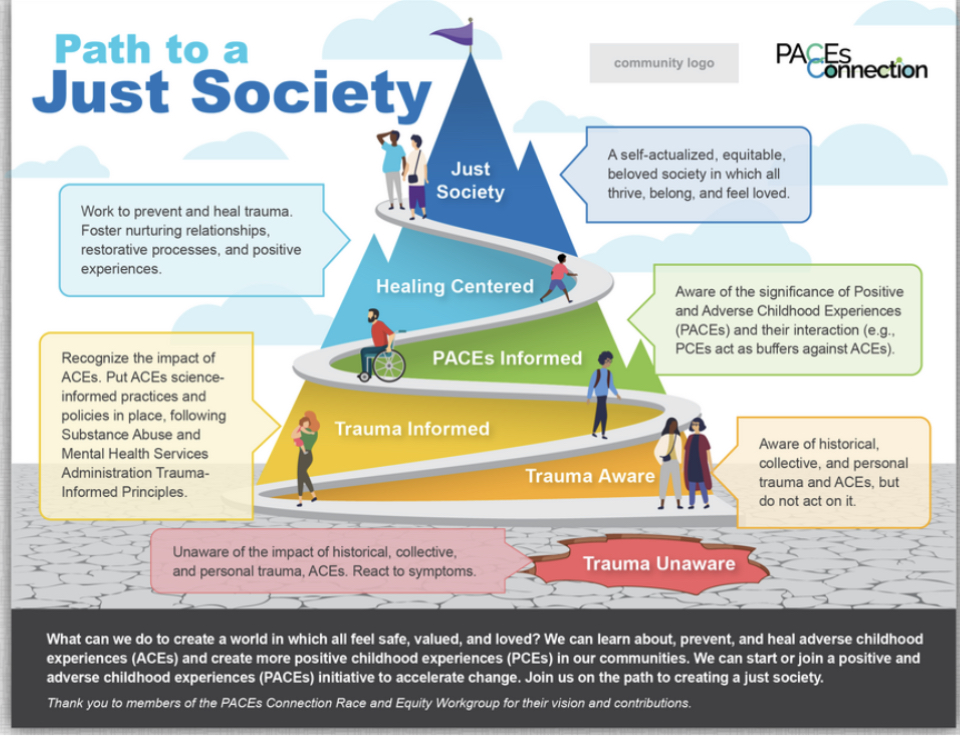
Path to a Just Society: Our new infographic shares common language and an aspirational path.

Carey Sipp Carey Sipp 9/14/212:43 PM

Our version of a “Path to a Just Society” is our first attempt at creating a common language and identifying points along the path to a just society.

The Race and Equity workgroup of PACEs Connection started the project in early 2021, following a staff meeting where we realized that we, our organization and the movement needed this. We think it can help all of us gauge where we are, where we want to be, and what’s needed to get to the next level of integrating practices and policies based on the science of positive and adverse childhood experiences (PACEs).

Over the last few months, we discussed and refined, opened the discussion to our entire staff, and then went outside the organization for more feedback.

There are a lot of terms used in describing the world we are in and the world we want to live in: trauma-informed, healing-centered, self-healing. We took the long view of where we want to see society and what it would take to get there. We developed this tool as a starting point for many conversations and actions to accelerate the PACEs science movement to prevent and heal trauma, help individuals, families, organizations, systems and communities—our world—flourish.

We hope this is useful, not only for the leaders of our 450+ communities and for the 53,000+ members of PACEs Connection, but also for everyone in the PACEs movement. Our goal is to see every organization in every community, as well as every system, integrate PACEs science into their individual and organizational lives. If you want to see how PACEs Connection has integrated these concepts into our organization, go to PACEsConnectionInfo.com.

While the tool is being introduced Thursday during the second webinar in our Historical Trauma in America series, we don’t see this as the final iteration. It’s a starting point.

We know there are many terms used to describe this work and the stages of it. Many people have provided ideas, and we welcome more. We’d love to hear from you. Please post your ideas in the comments section below this story.

Over the next few months, we will continue to work on this, and then share next iterations during upcoming presentations in our Historical Trauma in America series. For now, we invite PACEs Connection community leaders to download the infographic and distribute the piece to your members for their own use in sharing the work they are doing. Thank you for partnering with us in the essential work of creating a just society,

The Path to a Just Society infographic is available in both English and Spanish.

(Signed)

MEMBERS OF THE RACE AND EQUITY WORKGROUP

Natalie Audage

Marianne Avari

Dana Brown

Alison Cebulla

Karen Clemmer

Ingrid Cockhren

John Flores

Porter Jennings McGarity

Lara Kain

Gail Kennedy

Rafael Maravilla

Elizabeth Prewitt

Donielle Prince

Jenna Quinn

Carey Sipp

Jane Stevens

Laurie Udesky

Carey Smith Sipp

carey.pacescommunites@gmail.com

❤️ 8

Tags: Race & Equity WorkgroupSAMSHATrauma-InformedRace & EquityHealing-centeredJust Society

Views: 4,607

Add Comment

Carey SippCarey SippFormats 

javascript:””

Comments (2) 

Newest · Oldest · Popular

Christine BruglerChristine BruglerMember

WOW! So love this infographic – Very clear cut and action-oriented! I especially value the wording… We need to intentionally “act on” being TI, vs “saying” we are when our words/actions may not reflect it.

Kudos to a dynamic work group!


CGCasey G. GwinnMember

Thanks for your hard work on this, friends.  I would have loved to have seen reference to the science of hope and the importance of hope in well-being so much published research but this is really a great graphic.


✅ 1

Back To Top

Post

Add Comment

Manage Blog Post

Welcome to PACEs Connection

How to be a part of our social network.

Join local or interest based communities.

Invite others to join PACEs Connection!

The text 'donate' on a background with many inter-connected spheres

Comments

Carey Sipp commented:
Thanks, Jeoff. A lot of great relationships and ongoing work came from this incredible gathering. It laid the groundwork for deepening…

Carey Sipp

David Dooley commented:
Thank you for commenting, Mr. Holmes. I’m not sure what you’re getting at. Can you give me an example?

David Dooley

Tommy Holmes commented:
I loved how you highlighted the connection between ACEs and community resilience! It’s so important to empower people with this…

Tommy Holmes

Patrick Anderson commented:
This one landed, Dr. Long. What I’d underline is that you’ve framed being pushed out as a pattern rather than a run of bad luck — and…

Patrick Anderson

Robert Hawk commented:
That story is heartbreaking and really shows how history and present-day realities can intersect. Reading about Black history in China…

Robert Hawk

David Dooley commented:
Thank you for writing, Mr. Anderson. You wrote… “Your instinct that the utopia requires entirely new forms of parenting education that…

David Dooley

Cecilia Pace commented:
[heart] Pace, Cecilia reacted to your message:

CP

Patrick Anderson commented:
David — this is one of the most useful framings of the parenting question I have seen on this platform. Two things you get exactly right…

Patrick Anderson
PACEs Connection Discount for Trauma Informed Jobs

TraumaInformedJobs.com is a new job board for the trauma and resilience communities. PACEs Connection members can save 10% on posting with code PACES10

Blog Archive

August 2026(6)

July 2026(35)

June 2026(35)

May 2026(28)

April 2026(37)

March 2026(29)

February 2026(26)

January 2026(18)

December 2025(31)

November 2025(33)

October 2025(32)

September 2025(28)

August 2025(32)

July 2025(26)

June 2025(23)

May 2025(37)

April 2025(35)

March 2025(32)

February 2025(67)

January 2025(62)

December 2024(55)

November 2024(38)

October 2024(38)

September 2024(0)

Blog Directory

Foster Care

PACEs

PACEs Science 101

Resources

Creating Resilient Communities

Donor Profiles

Special Announcements

STAR Network

Research

Feature

Jane Ellen Stevens

History. Culture. Trauma. Podcast

History. Culture. Trauma. Blog

CRC Fellowship

PC Reacts

Blog Directory


Why Not Make the Kids Alright? [nytimes.com]

Carey Sipp Carey Sipp 9/23/215:00 AM

By Paul Krugman, The New York Times, September 21, 2021

Americans love rags-to-riches stories, tales of people who transcended childhood poverty to achieve adult success. Unless you’re totally oblivious to reality, however, you surely realize that such stories are the exceptions, not the rule. The disadvantages of growing up in poverty — poor nutrition, poor health care, an impoverished environment, the cognitive burden that goes along with never having enough money — can and often do hobble children for the rest of their lives.

That much is or should be obvious. What you may not know is that economists have actually quantified the damage from childhood poverty.

You see, America’s anti-poverty programs, such as they are — notably food stamps and Medicaid — weren’t rolled out all at once. Food stamps became available in some parts of the country earlier than in other parts; so did Medicaid, which was also expanded in a series of discrete jumps. This stuttering, haphazard approach to helping poor children amounted to an unintentional form of human experimentation: We can compare the life trajectories of Americans who received crucial aid as children with those of their contemporaries or near-contemporaries who didn’t.

[Please click here to read more.]

Carey Smith Sipp

carey.pacescommunites@gmail.com

❤️ 1

Views: 287

Add Comment

Carey SippCarey SippFormats 

javascript:””

Comments (1) 

Newest · Oldest · Popular

Carey SippCarey SippFormer Volunteer Co-Director, PACEs Connection Revitalization

Yes. Why not make the kids alright!?! Love this piece. Doesn’t include everything but is a start. And raises a fundamental, crucial question.

We all know it is less expensive — in pain and dollars and multi-generational conduction of misery and disease — to PREVENT abuse, disease, misery. The hesitancy is the systems change required. A wholesale flipping of where we are to where we need to be.

See our “Path to a Just Society” for the language, the path, the vision.

AC28346C-4479-43EF-B883-13C547502A40

Attachments

Hide

Images

Canada set to pay billions to Indigenous children removed from their families, court rules [cnn.com]

Carey Sipp Carey Sipp 10/4/214:16 PM

By Nicole Chavez and Elizabeth Joseph, CNN World, September 30, 2021

Canada observed its first national holiday honoring victims and survivors of the country’s residential school system.

The statutory holiday came a day after a federal court upheld a 2016 ruling ordering the Canadian government to compensate Indigenous children who were placed into foster care. Thursday’s National Day for Truth and Reconciliation and the court decision highlight the history of discrimination and harm toward First Nations communities.

Prime Minister Justin Trudeau said the holiday recognizes the “harms, injustices, and intergenerational trauma that Indigenous peoples have faced — and continue to face — because of the residential school system, systemic racism, and the discrimination that persists in our society.”

[Please click here to read more.]

Carey Smith Sipp

The statue of a doctor who experimented on enslaved women still stands in Alabama. But now there’s also a monument to his victims. [washingtonpost.com]

Carey Sipp Carey Sipp 10/5/215:00 AM

By Linda Matchan, The Washington Post, October 2, 2021

Michelle Browder is a Black artist and activist who runs a civil rights tour company called More Than Tours — so named, she says, because “it’s an experience.”

A sobering experience: stops include historical lynching sites, the city’s former slave market and the old Greyhound Bus Station where 21 young Freedom Riders were viciously beaten by an angry mob in 1961.

Still, no historic site on the tour riles Browder as much as a statue on the lawn of the Alabama State House. Not the one honoring Jefferson Davis, the president of the Confederacy and defender of slavery. It’s the one across the lawn, commemorating a 19th-century physician most people have never heard of: J. Marion Sims, the so-called “father of modern gynecology.”

[Please click here to read more.]

Carey Smith Sipp

carey.pacescommunites@gmail.com

What Social-Justice Efforts Can Learn From the Love-Based Activism of Gandhi, Martin Luther King Jr., and Nelson Mandela [philanthropy.com]

Carey Sipp Carey Sipp 10/7/211:00 PM

By Drew Lindsay, The Chronicle of Philanthropy, October 5, 2021

After Haiti’s August earthquake, as relief organizations rushed in, Eboo Patel pointed to a lesson for equity advocates in the United States. Many groups putting boots on the ground in the Caribbean country were anchored in a religious faith, with aid workers who were Catholic and Jewish, Islamic and evangelical Christianity, Lutheran and Episcopalian. Patel’s rhetorical question: If people who embrace different ideas of creation and salvation find common ground in a mission of mercy, couldn’t those who fight for justice do the same?

You might expect such an argument from Patel, who founded the Interfaith Youth Core some 20 years ago to make interfaith coalitions the norm, particularly in efforts for social good. But the message takes on even more importance today, he says, because religion is largely absent from equity campaigns. The movements of Gandhi, Martin Luther King Jr., and Nelson Mandela all drew strength from interfaith coalitions built on a shared belief in love, equity, and the dignity of every human being. “We need to bring that to the fore, we need to learn from that, and we need to do the 21st-century expression of it,” he says.

Patel has not always espoused what he calls “love-based activism.” In the 1990s, while a student at the University of Illinois, he was a racial-justice warrior fueled by anger. “I just would breathe fire wherever I went,” he says. His intensity was such that his roommate took to sleeping on a friend’s couch to escape his rage and his rants.

[Please click here to read more.]

Carey Smith Sipp

carey.pacescommunites@gmail.com