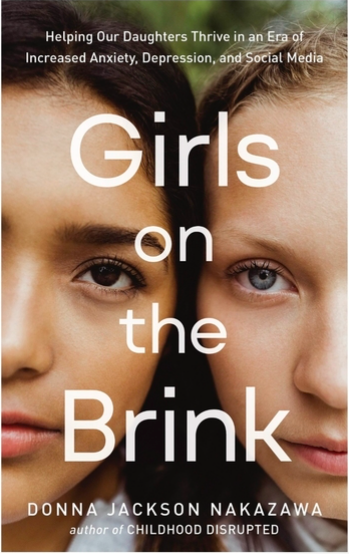
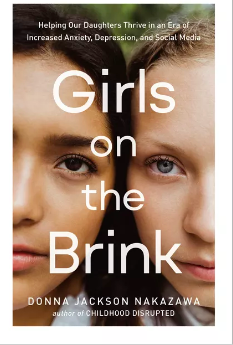
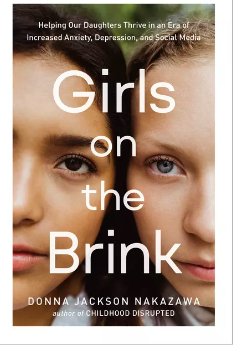
Donna Jackson Nakazawa, author of six books and longtime friend of PACEs Connection, joins the History. Culture. Trauma. podcast this week in an excerpt from the launch of her sixth book, “Girls on the Brink—Helping our Daughters Thrive in an Era of Increased Anxiety, Depression and Social Media.”
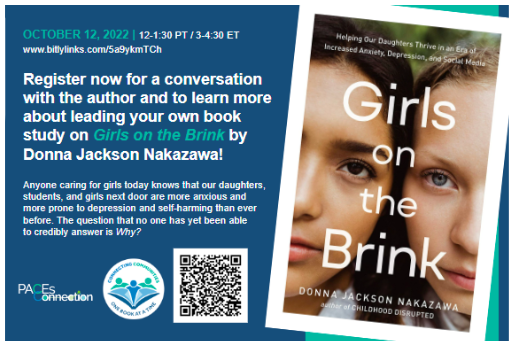
“Anyone caring for girls today knows that our daughters, students, and girls next door are more anxious and more prone to depression and self-harming than ever before,” said Nakazawa. But the question that seemed to have no answer was: “Why?” That’s why Nakazawa wrote the book, which she called a true labor of love.
The podcast comprises excerpts from a recent discussion among Nakazawa and PACEs Connection staff members Carey Sipp and Natalie Audage. Nakazawa noted that this time is especially challenging for girls. She cited the cultural challenges of social media and peer pressure as well as scientific evidence of hormonal and other biological changes in girls that are a cause for concern.
“The earlier onset of puberty mixes badly with the unchecked bloom of social media and cultural misogyny,” Nakazawa explained. “When this toxic clash occurs during the critical neurodevelopmental window of adolescence, it can alter the female stress-immune response in ways that derail healthy emotional development.”
The interview also focused on several of the 15 “antidotes” Nakazawa offers in this highly acclaimed book, as well as which factors in research on positive childhood experiences are most likely to help girls become secure and confident young women. Antidotes fall into three categories and include three on “the building blocks of good parent-child connection, and the importance of family connection,” six antidotes for “making her home a safe space,” and six antidotes to “bring in what the wider community can provide.” The interview honed in on at least one antidote from each of the three categories, including making it a good experience when your daughter turns to you, the importance of “wonder”, and encouraging a sense of mastery.
Nakazawa is an award winning science journalist, public speaker, and author of “The Last Best Cure”, in which she chronicled her year-long journey to health. “Childhood Disrupted” was born from the author’s own search to better understand the role her own childhood adversity played in the chronic health issues she faced as an adult.
Nakazawa lectures nationwide and has appeared on the TODAY Show, National Public Radio, and ABC News. Her work has been featured on the cover of Parade, in Time Magazine, USA Today Weekend, Parenting, and Psychology Today. She has been a regular contributor to More and her research has been covered by The Washington Post, Glamour, Ladies Home Journal, and AARP: the Magazine. Donna blogs regularly for Psychology Today.
The book is the second selection of the PACEs Connection Connecting Communities One Book at a Time book study. The first selection was “What Happened to You?” by Dr. Bruce Perry and Oprah Winfrey. More than 130 book studies formed as the result of the new initiative to communities together around books that help us have critical conversations about positive and adverse childhood experiences, racism, inequity, and how communities can prevent and heal trauma and create resiliency.
Tune into the interview broadcast at 1 p.m. PT; 4 p.m. ET on Thursday, October 27 here.
Note: PACEs Connection is in dire financial straits. We need you, our almost 58,000members,to help cover the loss of foundation funding that was promised and didnotcome through. Unfortunately, staff pay and hours have had to be cut for December. Thegood news is that, since sounding the alarm this summer,we’ve raisedmore than$52,000. Thank you to all who’ve donated. To get a sense of who your fellow membersare, who is donating, and why, please read and share this seventh in a seriesofdonor profiles. Now that you know we need your help, please join Sofiya Asedremandmake agenerousdonationto PACEs Connection!
Sofiya Asedrem is busy. She manages the Creating a Resilient Community (CRC) Network convened out of the Peace and Justice Institute at Valencia College and the PACEs Connection Central Florida website that advances and reports on all the work. There’s also a CRC conference each spring that brings in people from all over the country, and myriad other educational events throughout the year.
Deadly weather challenges and epic growth in her international community demand all of her skills. Her education—a bachelor’s degree in international affairs at the George Washington University where she was sponsored twice by the U.S. Department of State, and a master’s degree in political science from the University of Central Florida—is foundational to her success in community development. She also relies heavily on her expertise in mental health and trauma, women’s empowerment and gender issues, environmental sustainability, peace studies, and agricultural programs.
Another support in her work? The impact of PACEs Connection.
“PACEs Connection has been an immense factor in the growth of our group (the CRC Network),” she says. “We have been able to grow to over 500 members and 250 organizations in just three years.” The group is a cross-sector collective impact movement transforming the region into one of prevention, hope, healing and resilience for all, she continues. It provides space for information sharing as well as providing many opportunities for growth and networking/learning from other communities and experts around the nation.
“I was motivated to become involved with PACEs Connection because I saw opportunities for growth both internally (as a mother, wife, daughter, sister, etc.) and externally–as a working professional looking to help my organization and community along the journey of becoming trauma-informed,” she says. “With its future-oriented initiatives and scientific and expertise-led approach, PACEs Connection is a go-to resource.”
Changing the world with PACEs science
How does Asedrem see PACEs science making a difference in the world?
“My local community is facing so many challenges that are a microcosm of the world’s challenges—from the pandemic, to recent hurricanes, to community violence and economic disparities,’ she says.
“I hope PACEs science will change my community and the world by providing an awareness of positive and adverse childhood experiences, teaching individuals how to heal from toxic stress, and welcoming others to approach fellow humans in a way that is more trauma-informed,” she says. “By learning about PACEs science, I think we will be able to realize the goal of making mental health a human right and public good. As a result, we will see greater social well-being—providing people with the opportunity to live healthy, meaningful lives and contribute to the greater good of our communities.”
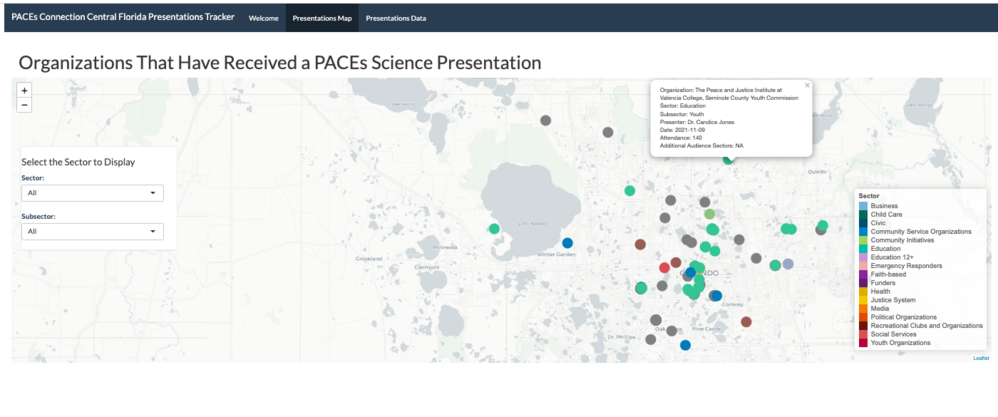
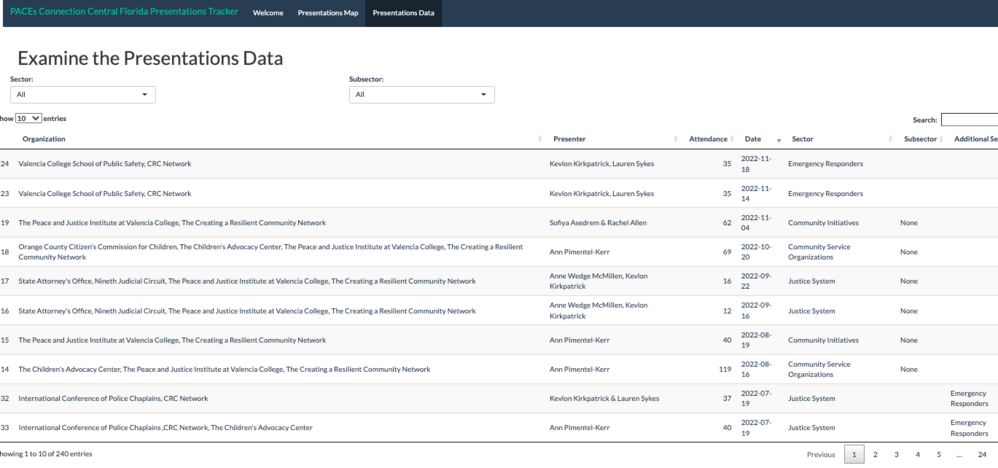
Asedrem is one of several members of the CRC Network to have given multiple PACEs science presentations in the community. All told, members of the Network, led by Peace and Justice Institute director Rachel Allen, have made some 240 presentations over the last four years!
A paradigm shift to a trauma-informed culture.
Asedrem supports PACEs Connection because it is one of the organizations actively dedicated to creating a paradigm shift to create a culture founded on the science of positive and adverse childhood experiences, and whose policies and practices are expressed in trauma-informed ways.
“By investing in PACEs Connection, members of our community can help communities address the root causes of some of the deep challenges we all face,” she adds.
Asedrem leverages her PACE Connection website to get the word out about resources and events. Within a day of Hurricane Ian’s record destruction, Asedrem hadposted a blog on PACEs Connection full of resources for her community, and leveraged the ability to share her blog out on other social media in calling her fellow Central Floridians to “look for the helpers.”
Asedrem encourages fellow members of PACEs Connection to join her in making a generous, tax-deductible donation to PACEs Connectionhere.
If you’d prefer to mail your gift rather than give it online, here’s how…
Make check payable to:
TSNE (Third Sector New England, our fiscal sponsor) and write PACEs Connection Donation on the memo line.
Mail check to:
PACEs Connection, c/o TSNE, 89 South Street, Suite 700, Boston, MA 02111
Making a wire transfer or need Tax ID information?
Please contact Carey Sipp, Director of Strategic Partnerships, at
Note: PACEs Connection is in dire financial straits. We need you, our almost 58,000members,to help cover the loss of foundation funding that was promised and didnotcome through. Unfortunately, staff pay and hours have had to be cut for December. Thegood news is that, since sounding the alarm this summer,we’ve raisedmore than$52,000. Thank you to all who’ve donated. To get a sense of who your fellow membersare, who is donating, and why, please read and share this seventh in a seriesofdonor profiles. Now that you know we need your help, please join Sofiya Asedremandmake agenerousdonationto PACEs Connection!
Sofiya Asedrem is busy. She manages the Creating a Resilient Community (CRC) Network convened out of the Peace and Justice Institute at Valencia College and the PACEs Connection Central Florida website that advances and reports on all the work. There’s also a CRC conference each spring that brings in people from all over the country, and myriad other educational events throughout the year.
Deadly weather challenges and epic growth in her international community demand all of her skills. Her education—a bachelor’s degree in international affairs at the George Washington University where she was sponsored twice by the U.S. Department of State, and a master’s degree in political science from the University of Central Florida—is foundational to her success in community development. She also relies heavily on her expertise in mental health and trauma, women’s empowerment and gender issues, environmental sustainability, peace studies, and agricultural programs.
Another support in her work? The impact of PACEs Connection.
“PACEs Connection has been an immense factor in the growth of our group (the CRC Network),” she says. “We have been able to grow to over 500 members and 250 organizations in just three years.” The group is a cross-sector collective impact movement transforming the region into one of prevention, hope, healing and resilience for all, she continues. It provides space for information sharing as well as providing many opportunities for growth and networking/learning from other communities and experts around the nation.
“I was motivated to become involved with PACEs Connection because I saw opportunities for growth both internally (as a mother, wife, daughter, sister, etc.) and externally–as a working professional looking to help my organization and community along the journey of becoming trauma-informed,” she says. “With its future-oriented initiatives and scientific and expertise-led approach, PACEs Connection is a go-to resource.”
Changing the world with PACEs science
How does Asedrem see PACEs science making a difference in the world?
“My local community is facing so many challenges that are a microcosm of the world’s challenges—from the pandemic, to recent hurricanes, to community violence and economic disparities,’ she says.
“I hope PACEs science will change my community and the world by providing an awareness of positive and adverse childhood experiences, teaching individuals how to heal from toxic stress, and welcoming others to approach fellow humans in a way that is more trauma-informed,” she says. “By learning about PACEs science, I think we will be able to realize the goal of making mental health a human right and public good. As a result, we will see greater social well-being—providing people with the opportunity to live healthy, meaningful lives and contribute to the greater good of our communities.”
Asedrem is one of several members of the CRC Network to have given multiple PACEs science presentations in the community. All told, members of the Network, led by Peace and Justice Institute director Rachel Allen, have made some 240 presentations over the last four years!
A paradigm shift to a trauma-informed culture.
Asedrem supports PACEs Connection because it is one of the organizations actively dedicated to creating a paradigm shift to create a culture founded on the science of positive and adverse childhood experiences, and whose policies and practices are expressed in trauma-informed ways.
“By investing in PACEs Connection, members of our community can help communities address the root causes of some of the deep challenges we all face,” she adds.
Asedrem leverages her PACE Connection website to get the word out about resources and events. Within a day of Hurricane Ian’s record destruction, Asedrem hadposted a blog on PACEs Connection full of resources for her community, and leveraged the ability to share her blog out on other social media in calling her fellow Central Floridians to “look for the helpers.”
Asedrem encourages fellow members of PACEs Connection to join her in making a generous, tax-deductible donation to PACEs Connectionhere.
If you’d prefer to mail your gift rather than give it online, here’s how…
Make check payable to:
TSNE (Third Sector New England, our fiscal sponsor) and write PACEs Connection Donation on the memo line.
Mail check to:
PACEs Connection, c/o TSNE, 89 South Street, Suite 700, Boston, MA 02111
Making a wire transfer or need Tax ID information?
Please contact Carey Sipp, Director of Strategic Partnerships, at
Sofiya Asedrem supports PACEs Connection to help address root causes in her fast-growing Florida community & make mental health a human right.
Note: PACEs Connection is in dire financial straits. We need you, our almost 58,000members,to help cover the loss of foundation funding that was promised and didnotcome through. Unfortunately, staff pay and hours have had to be cut for December. Thegood news is that, since sounding the alarm this summer,we’ve raisedmore than$52,000. Thank you to all who’ve donated. To get a sense of who your fellow membersare, who is donating, and why, please read and share this seventh in a seriesofdonor profiles. Now that you know we need your help, please join Sofiya Asedremandmake agenerousdonationto PACEs Connection!
Sofiya Asedrem is busy. She manages the Creating a Resilient Community (CRC) Network convened out of the Peace and Justice Institute at Valencia College and the PACEs Connection Central Florida website that advances and reports on all the work. There’s also a CRC conference each spring that brings in people from all over the country, and myriad other educational events throughout the year.
Deadly weather challenges and epic growth in her international community demand all of her skills. Her education—a bachelor’s degree in international affairs at the George Washington University where she was sponsored twice by the U.S. Department of State, and a master’s degree in political science from the University of Central Florida—is foundational to her success in community development. She also relies heavily on her expertise in mental health and trauma, women’s empowerment and gender issues, environmental sustainability, peace studies, and agricultural programs.
Another support in her work? The impact of PACEs Connection.
“PACEs Connection has been an immense factor in the growth of our group (the CRC Network),” she says. “We have been able to grow to over 500 members and 250 organizations in just three years.” The group is a cross-sector collective impact movement transforming the region into one of prevention, hope, healing and resilience for all, she continues. It provides space for information sharing as well as providing many opportunities for growth and networking/learning from other communities and experts around the nation.
“I was motivated to become involved with PACEs Connection because I saw opportunities for growth both internally (as a mother, wife, daughter, sister, etc.) and externally–as a working professional looking to help my organization and community along the journey of becoming trauma-informed,” she says. “With its future-oriented initiatives and scientific and expertise-led approach, PACEs Connection is a go-to resource.”
Changing the world with PACEs science
How does Asedrem see PACEs science making a difference in the world?
“My local community is facing so many challenges that are a microcosm of the world’s challenges—from the pandemic, to recent hurricanes, to community violence and economic disparities,’ she says.
“I hope PACEs science will change my community and the world by providing an awareness of positive and adverse childhood experiences, teaching individuals how to heal from toxic stress, and welcoming others to approach fellow humans in a way that is more trauma-informed,” she says. “By learning about PACEs science, I think we will be able to realize the goal of making mental health a human right and public good. As a result, we will see greater social well-being—providing people with the opportunity to live healthy, meaningful lives and contribute to the greater good of our communities.”
Asedrem is one of several members of the CRC Network to have given multiple PACEs science presentations in the community. All told, members of the Network, led by Peace and Justice Institute director Rachel Allen, have made some 240 presentations over the last four years!
A paradigm shift to a trauma-informed culture.
Asedrem supports PACEs Connection because it is one of the organizations actively dedicated to creating a paradigm shift to create a culture founded on the science of positive and adverse childhood experiences, and whose policies and practices are expressed in trauma-informed ways.
“By investing in PACEs Connection, members of our community can help communities address the root causes of some of the deep challenges we all face,” she adds.
Asedrem leverages her PACE Connection website to get the word out about resources and events. Within a day of Hurricane Ian’s record destruction, Asedrem hadposted a blog on PACEs Connection full of resources for her community, and leveraged the ability to share her blog out on other social media in calling her fellow Central Floridians to “look for the helpers.”
Asedrem encourages fellow members of PACEs Connection to join her in making a generous, tax-deductible donation to PACEs Connectionhere.
If you’d prefer to mail your gift rather than give it online, here’s how…
Make check payable to:
TSNE (Third Sector New England, our fiscal sponsor) and write PACEs Connection Donation on the memo line.
Mail check to:
PACEs Connection, c/o TSNE, 89 South Street, Suite 700, Boston, MA 02111
Making a wire transfer or need Tax ID information?
Please contact Carey Sipp, Director of Strategic Partnerships, at
“What Happened to You?” – the book and the question – speak to the PACEs Connection commitment to explore and share our nation’s history of trauma, racism, genocide and colonization. We begin Black History Month 2023, with an encore discussion by Bruce Perry, co-author of The New York Times Best-seller, “What Happened to You? Conversations on Trauma, Resilience and Healing.”
In this episode, Perry and podcast hosts Ingrid Cockhren, CEO of PACEs Connection, and Mathew Portell, director of outreach and education, discuss the importance of learning about our past to understand how the United States is in such a state of collective trauma at this time in our nation’s history.
“If you don’t understand history,” said Perry, “you’re never going to understand trauma. And if you don’t understand trauma, you’re never going to understand history. And this is part of our problem as a field.”
Tune in Thursday at 1 p.m. PT to hear Perry, Cockhren, and Portell address the history of colonialism, treatment of Indigenous people, and the kidnapping and enslavement of Africans that are such a part of the ongoing history and historical trauma of the United States.
Cockhren and Portell interviewed Perry about the book, which he wrote with author Oprah Winfrey in July 2022, as a part of the launch celebration for the PACEs Connection Connecting Communities One Book At A Time book study initiative.
“You know, we are living in systems that are fundamentally colonial in construction,” Perry said. “And colonialism basically means I’m going to come into your space, your place, and I’m going to take your things and I’m going to make you feel privileged if I give you a little bit of it back.”
Historical perspectives about trauma deserve “as much attention and funding and support” as is given to people studying the effects of a drug on post traumatic stress disorder (PTSD), or the effects of other treatments, he said.
For more information about this podcast, you can watch the full interview here.
Perry leads the Neurosequential Network, is senior fellow of The Child Trauma Academy, and adjunct professor in the departments of psychiatry and behavioral sciences at the Feinberg School of Medicine at Northwestern University in Chicago and the School of Allied Health, College of Science, Health and Engineering, La Trobe University, Melbourne, Victoria Australia.
To listen to Thursday’s podcast at 1 p.m. PT, 4 p.m. ET, or whenever, as it is an encore episode, please clickhere.
“What Happened to You?” – the book and the question – speak to the PACEs Connection commitment to explore and share our nation’s history of trauma, racism, genocide and colonization. We begin Black History Month 2023, with an encore discussion by Bruce Perry, co-author of The New York Times Best-seller, “What Happened to You? Conversations on Trauma, Resilience and Healing.”
In this episode, Perry and podcast hosts Ingrid Cockhren, CEO of PACEs Connection, and Mathew Portell, director of outreach and education, discuss the importance of learning about our past to understand how the United States is in such a state of collective trauma at this time in our nation’s history.
“If you don’t understand history,” said Perry, “you’re never going to understand trauma. And if you don’t understand trauma, you’re never going to understand history. And this is part of our problem as a field.”
Tune in Thursday at 1 p.m. PT to hear Perry, Cockhren, and Portell address the history of colonialism, treatment of Indigenous people, and the kidnapping and enslavement of Africans that are such a part of the ongoing history and historical trauma of the United States.
Cockhren and Portell interviewed Perry about the book, which he wrote with author Oprah Winfrey in July 2022, as a part of the launch celebration for the PACEs Connection Connecting Communities One Book At A Time book study initiative.
“You know, we are living in systems that are fundamentally colonial in construction,” Perry said. “And colonialism basically means I’m going to come into your space, your place, and I’m going to take your things and I’m going to make you feel privileged if I give you a little bit of it back.”
Historical perspectives about trauma deserve “as much attention and funding and support” as is given to people studying the effects of a drug on post traumatic stress disorder (PTSD), or the effects of other treatments, he said.
For more information about this podcast, you can watch the full interview here.
Perry leads the Neurosequential Network, is senior fellow of The Child Trauma Academy, and adjunct professor in the departments of psychiatry and behavioral sciences at the Feinberg School of Medicine at Northwestern University in Chicago and the School of Allied Health, College of Science, Health and Engineering, La Trobe University, Melbourne, Victoria Australia.
To listen to Thursday’s podcast at 1 p.m. PT, 4 p.m. ET, or whenever, as it is an encore episode, please clickhere.
“We typically don’t talk about poverty as a condition that benefits some of us,” Desmond writes in his morally charged manifesto. “It seems we prefer more absolving theories of the problem.”Photograph by Philip Montgomery for The New Yorker
By Margaret Talbot, The New Yorker, March 13, 2023
“Books about poverty tend to be books about the poor,” the sociologist Matthew Desmond writes in “Poverty, by America” (Crown). That’s true whether the motivation is to blame the poor for their lot—chronicling the supposed pathologies creating a “culture of poverty”—or, more commonly nowadays, to generate empathy via detailed ethnographies of survival and agency amid deprivation. It was true of the first books that set out to systematically map and measure poverty, such as the Victorian reformer Charles Booth’s seventeen-volume “Life and Labour of the People in London,” and of Progressive Era attempts to rattle the consciences of the well-off, like Jacob Riis’s document of New York tenement life, “How the Other Half Lives.”
When Michael Harrington wrote his 1962 classic, “The Other America,” a work of morally charged narrative nonfiction often credited with helping to inspire the War on Poverty, his aim was to reveal the “socially invisible” poor to the rest of America. A cocoon of postwar prosperity and complacency, he wrote, blinkered “middle-class women coming in from Suburbia on a rare trip,” who might “catch the merest glimpse of the other America on the way to an evening at the theater”; it also blinkered “the business or professional man,” who might “drive along the fringes of slums in a car or bus” without regarding it as “an important experience.” The book’s dominant rhetorical modes, as Harrington’s biographer Maurice Isserman notes, were paradox and revelation. If the scales were pulled from the eyes of his well-meaning readers, they would see, in the shadows of American plenty, tens of millions of poor people, whom Harrington catalogued and described: rural poor, city-dwelling slum poor, alcoholic skid-row poor, and so on—all of them urgently needing the help of the government and liberal élites. Even a book like Charles Murray’s “Losing Ground,” an influential neocon attack on “welfare dependency,” from 1984, focussed on the poor themselves, if only so that Murray might make an argument about how they had immiserated themselves by adapting to anti-poverty policies.
A headline earlier this year said it simply: Social Media is Devastating Girls Mental Health.Donna Jackson Nakazawa, an award-winning science journalist and the author of seven books exploring the intersection of neuroscience, immunology, and human emotion, is featured in this week’s episode of History Culture. Trauma, and explains the crisis facing today’s girls as being a biologically rooted phenomenon, and more, and offers solutions to the crisis that has many parents wondering what they can do.“The earlier onset of puberty mixes badly with the unchecked bloom of social media and cultural misogyny. When this toxic clash occurs during the critical neurodevelopmental window of adolescence, it can alter the female stress-immune response in ways that derail healthy emotional development,” explains Nakazawa.This week’s encore episode of History. Culture. Trauma. is an excerpt from a recorded interview of Nakazawa conducted by PACEs Connection team members Carey Sipp and Natalie Audage in October, 2022, as a part of the PACEs Connection Connecting Communities One Book at a Time initiative. The initiative featured her latest book Girls on the Brink:Helping Our Daughters Thrive in an Era of Increased Anxiety, Depression, and Social Media. The book was published last October.In this interview, Nakazawa focuses on the impact of modern society on adolescent girls. “Anyone caring for girls today knows that our daughters, students, and girls next door are more anxious and more prone to depression and self-harming than ever before. The question that no one has yet been able to credibly answer is “Why?”Nakazawa was clear that while she sees much to worry about girls’ mental health today, she also has hope. She offers 15 antidotes or “strategies for raising emotionally healthy girls” in the book and spoke about a several of them during the webinar from which this interview is gleaned. (See below for resources, including a link to the longer webinar interview in which she details the strategies.)Antidotes fall into three categories and include three on “the building blocks of good parent-child connection, and the importance of family connection,” six antidotes for “making her home a safe space,” and six antidotes to “bring in what the wider community can provide.” The longer webinar interview honed in on at least one antidote from each of the three categories, including making it a good experience when your daughter turns to you, the importance of “wonder”, and encouraging a sense of mastery.Jackson Nakazawa has appeared on The Today Show and NPR, and is a regular speaker at universities, including the Harvard Division of Science Library Series, Rutgers University, Johns Hopkins, Learning and the Brain, and the Andrew Weil Center for Integrative Medicine at the University of Arizona. She is also the creator and founder of the narrative writing-to-heal program, which uses a process called Neural Re-Narrating to help participants recognize and override their brain’s old thought patterns and internalized stories.
Listen to “History. Culture. Trauma.” here online on Thursday, or access this, or prior podcasts, at the podcast service of your choice listed below.
Adolescent girls are experiencing extreme levels of trauma and adversity, especially African American, Hispanic/Latina and Indigenous girls, as we discussed with author Donna Jackson Nakazawa last year when her book “Girls on the Brink—Helping our Daughters Thrive in an Era of Increased Anxiety, Depression and Social Media.” launched. This week host Ingrid Cockhren, CEO of PACEs Connection, will touch on those topics and more with guest Vernisha Crawford, who discusses the lives of girls of color and the intersectionality of racism and sexism in this encore podcast.Crawford is the CEO of Trauma Informed Institute, and has educated 15,000+ working professionals, helped secure and manage over $12 million, and has directly served hundreds of families. Her work has is in demand across many sectors and countries worldwide.Crawford earned her bachelor’s degree in sociology from the University of North Carolina Charlotte and a master’s degree in leadership from Grand Canyon University. She is a certified trauma informed executive coach, a certified health & wellness coach, a master level certified professional life coach, a business coach, and Scrum Master.As she pursues her Ph.D. in General Psychology with a specialization in trauma and disaster relief, Crawford says her most significant learning is being the mother of an elementary school-aged daughter.Crawford is also the Founder of the BYE Foundation, a 501c3 organization which she says offers a unique approach to systems change work by addressing equity gaps in funding, data, research, capacity building, and wellness.A guest facilitator at Davidson College, Belmont, Vanderbilt, and Fisk universities, Crawford has served as a member of the Early Childhood Executive Committee for Mecklenburg County, the North Carolina ACES Task Force Advisory Board, the North Carolina Juvenile Justice Behavioral Health Committee, the Charlotte Lab School Board, and the Charlotte Community Board for The Gathering Spot.In her free time, Crawford works with her passion project @DanceHerSize, a wellness program teaching women and girls about the eight dimensions of wellness through dance and exercise.Tune into the show here at 1 p.m. PT; 4 p.m. ET Thursday, October 26.Show LinksListen in Apple PodcastsListen in Google PodcastsListen on TuneInListen on iHeartRadioListen on SpotifyLike us on FaceBookConnect on LinkedInFollow on TwitterFollow on InstagramBookmark This ShowiTunes FeedGoogle FeedSubscribe to RSS Feed
A headline earlier this year said it simply: Social Media is Devastating Teen’s Mental Health.Donna Jackson Nakazawa, an award-winning science journalist and the author of seven books exploring the intersection of neuroscience, immunology, and human emotion, is featured in this week’s encore episode of History Culture. Trauma.Jackson Nakazawa explains the crisis facing today’s girls as being a biologically -rooted phenomenon, and more, and offers solutions to the crisis that has many parents wondering what they can do.“The earlier onset of puberty mixes badly with the unchecked bloom of social media and cultural misogyny. When this toxic clash occurs during the critical neurodevelopmental window of adolescence, it can alter the female stress-immune response in ways that derail healthy emotional development,” explains Nakazawa.This week’s episode of History. Culture. Trauma. is an excerpt from a recorded interview of Jackson Nakazawa conducted by PACEs Connection team members Carey Sipp and Natalie Audage in October, 2022, as a part of the PACEs Connection Connecting Communities One Book at a Time initiative. The initiative featured Jackson Nakazawa’s latest book, Girls on the Brink:Helping Our Daughters Thrive in an Era of Increased Anxiety, Depression, and Social Media. The book was published last October.In the interview, Jackson Nakazawa focuses on the impact of modern society on adolescent girls. “Anyone caring for girls today knows that our daughters, students, and girls next door are more anxious and more prone to depression and self-harming than ever before. The question that no one has yet been able to credibly answer is “Why?”Jackson Nakazawa was clear that while she sees much to worry about girls’ mental health today, she also has hope. She offers 15 antidotes or “strategies for raising emotionally healthy girls” in the book and spoke about a several of them during the webinar from which this interview is gleaned. (See below for resources, including a link to the longer webinar interview in which she details the strategies.)Antidotes fall into three categories and include three on “the building blocks of good parent-child connection, and the importance of family connection,” six antidotes for “making her home a safe space,” and six antidotes to “bring in what the wider community can provide.” The longer webinar interview honed in on at least one antidote from each of the three categories, including making it a good experience when your daughter turns to you, the importance of “wonder”, and encouraging a sense of mastery.Jackson Nakazawa has appeared on The Today Show and NPR, and is a regular speaker at universities, including the Harvard Division of Science Library Series, Rutgers University, Johns Hopkins, Learning and the Brain, and the Andrew Weil Center for Integrative Medicine at the University of Arizona. She is also the creator and founder of the narrative writing-to-heal program, which uses a process called Neural Re-Narrating to help participants recognize and override their brain’s old thought patterns and internalized stories.
Listen to “History. Culture. Trauma.” here online on Thursday, or access this, or prior podcasts, at the podcast service of your choice listed below.
How traumatizing is it when something that is supposed to be a support ends up evoking trauma?
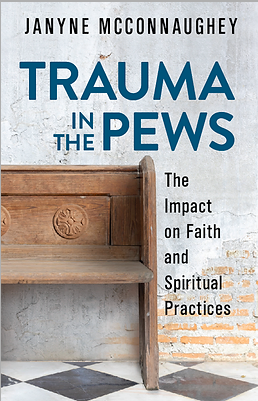
Tune into this Thursday’s History. Culture. Trauma. podcast at 1 p.m. PT; 4 p.m., ET, when guest Janyne McConnaughey, PhD, will talk with hosts Ingrid Cockhren, CEO of PACEs Connection, and Mathew Portell about how shame and blame theology, and the stigmatization of mental health supports, can inflict trauma.
“A supportive community can serve as a primary catalyst for healing individual and collective trauma,” said Portell, PACEs Connection director of communities. He grew up as the son of a minister, and has talked with McConnaughey about their mutual experiences in the church.
McConnaughey will discuss her latest book, “Trauma in the Pews: The Impact on Faith and Spiritual Practices”, and her extensive work as a trauma-informed author and speaker. The book draws on her 33-year career training teachers and ministry workers at colleges and universities, as well as her life-long involvement in church ministry.
McConnaughey began her healing from the impact of her childhood trauma at the age of 61. Realizing that healing was possible for survivors, she’s written two other books describing the effects of childhood trauma and the paths to healing that changed her life.
McConnaughey holds a PhD in educational leadership and innovation from Colorado State University–Denver and currently serves as president of the board of directors for the Attachment & Trauma Network (ATN).
She is also a distinguished visiting professor at Tabor College. She and her husband live with their rescue dog, Weber, south of Seattle, where they enjoy exploring the Pacific Northwest and spending time with their children and grandchildren.
Editor’s note: It is with a heavy heart that Dana Brown and I share this information about our beloved former staff member of PACEs Connection, and friend, Elizabeth Prewitt.
Elizabeth and PACEs Connection founder Jane Stevens were lifelong friends and colleagues and would likely say their work together at PACEs was among the best they did.
We invite you to share remembrances of Elizabeth in space below this story. Together, we remember her determination, commitment to journalistic excellence, her fierce love of her children and her marriage, her love of books, yoga, community, and her grandchildren.
Washington Post – August 31, 2025 — Family-provided obituary — Elizabeth Harner Prewitt died on the morning of Tuesday, August 26, 2025 with her daughter and husband by her side at home in Washington, DC. Born in Lexington, Kentucky, she was 77 years old.
Employing skills gained during a five-decade career in government relations and advocacy, Elizabeth devoted much energy in the last five years of her life to learning and teaching members of the Mount Pleasant Village about the options that can be exercised as the end of life approaches. Her own final days became a lesson in clear planning and acceptance of death’s place in life’s arc.
Elizabeth’s start in Washington came in the office of Congressman Phil Ruppe of Michigan, who gave her a job when she arrived in the capital fresh out of the University of Kentucky. Eventually earning a Master’s degree from George Washington University, Elizabeth went on to work in government relations for the American Institute of Architects, the American College of Physicians, and the National Association of State Mental Health Program Directors. Her last professional position was as a writer and advocate for PACES Connection, working to increase knowledge about and demand for programs and policies aimed at preventing adverse childhood experiences and building resilience in individuals, systems, families, and communities.
The secret to Elizabeth’s professional standing and the love her family, friends, and neighbors felt for her was a rare combination of deep concern for others, gentle thoughtfulness, and a true moral compass. She loved living in Washington and, especially, the Mount Pleasant neighborhood, her home for the last decade and a half of her life. When the brain tumor that killed her was diagnosed, she was relieved to be facing a quick end, as she was grateful for the life she had led and wanted to avoid a prolonged decline if she could. As courageous as it was to forgo intrusive and unpleasant treatment, her decision was an instinctive reflection of her deeply held values. She knew very well that not everyone had the options that came her way.
She is survived by her husband William Emmet and daughter Elizabeth Castaneda. Known as Nookie by her siblings and childhood acquaintances, Elizabeth leaves sisters Sallie Prewitt, Susan Goodrich, Patricia Prewitt, and brother John Prewitt, along with their spouses and their children, her nieces and nephews. She will be missed by her grandchildren Mateas and Tiago Castaneda, step-grandchildren Flora and August Emmet Stewart and Juno Emmet, and stepchildren Nicholas Emmet and Susanna Emmet.
A gathering in Elizabeth’s memory will be scheduled in the fall, and her family will inter her ashes in Lexington Cemetery in Kentucky. Donations in her memory can be made to a cause of your choice or to Mount Pleasant Village (mountpleasantvillage.org).
To plant trees in memory, please visit the Sympathy Store.
Published by The Washington Post on Aug. 31, 2025.
 Carey Sipp 10/25/223:32 PM
 “Anyone caring for girls today knows that our daughters, students, and girls next door are more anxious and more prone to depression and self-harming than ever before,” said Nakazawa. But the question that seemed to have no answer was: “Why?” That’s why Nakazawa wrote the book, which she called a true labor of love.
 The interview also focused on several of the 15 “antidotes” Nakazawa offers in this highly acclaimed book, as well as which factors in research on positive childhood experiences are most likely to help girls become secure and confident young women. Antidotes fall into three categories and include three on “the building blocks of good parent-child connection, and the importance of family connection,” six antidotes for “making her home a safe space,” and six antidotes to “bring in what the wider community can provide.” The interview honed in on at least one antidote from each of the three categories, including making it a good experience when your daughter turns to you, the importance of “wonder”, and encouraging a sense of mastery.
 Make check payable to:
 Making a wire transfer or need Tax ID information?