(This is a review of what I believe is an important new resource for the PACEs [for positive and adverse childhood experiences] science movement. Opinions expressed are my own, and are shared as a parent, advocate, author, and longtime student of trauma, healing, and prevention. Thoughts are also shared through my lens as someone who believes, deeply, in the incredible importance of and value in building healthier, more compassionate communities to support and nurture pregnant and new mothers; new parents and caregivers; young families. Full disclosure: Deborah McNelis’s company, Brain Insights, will soon be listed as a PACEs Connection partner, and is donating to PACEs Connection 5% of the profits from the sale of materials sold to our members or member organizations.)
Deborah McNelis’s newest offering, “The First 60 Days,” booklet (link is to a 12-page sample) is her heartfelt response to groundbreaking research by Dr. Bruce Duncan Perry and colleagues showing the negative developmental impact of toxic stress the first two months of life, and the importance of practicing what she calls “Neuro-Nurturing ®” during this influential time in infant brain development.
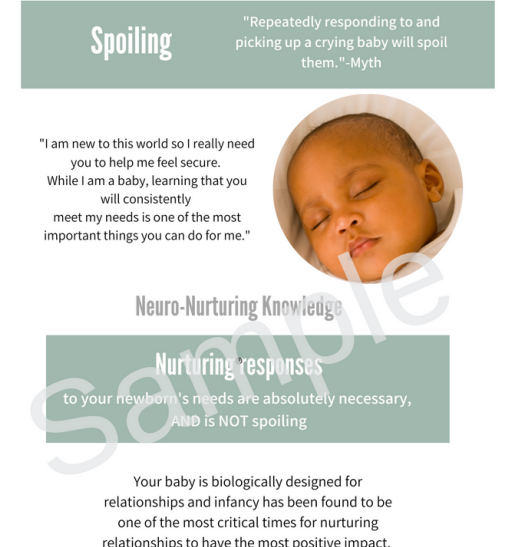
Her booklet dispels 22 potentially harmful myths about caring for newborns, among them:
Repeatedly responding to and picking up a crying baby will spoil them.
Just like the heart is fully developed at birth, the brain is fully developed.
Babies are too young. They don’t know what is happening.
Rocking the baby creates a bad habit.
Your level of stress doesn’t matter to a baby.
If left alone babies will learn to self-regulate.
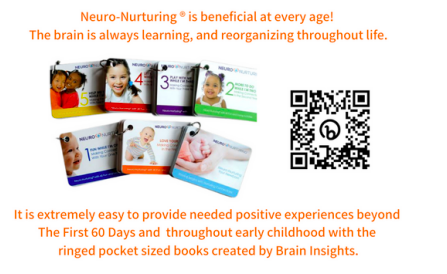
While it is not hefty, the booklet is packed with research-based recommendations, and is the capstone to McNelis’s decades of work with children and families. Over the course of some four decades in education, family support, and community building work, she created and introduced her “Neuro-Nurturing ® series of ringed, pocket-sized books, filled with loving and easy activities for caregivers to use with children at each age and stage, from newborn through age five. (These are books I definitely would have loved to have had when my children were young!)
What about those of us who didn’t necessarily have a Neuro-Nurturing ® start? Or children who may have experienced a lot of trauma? Or professionals who work with people who’ve experienced developmental trauma?
In their New York Times best-seller, Perry and Winfrey share ways to help heal Complex Post Traumatic Stress Disorder (C-PTSD) and Post Traumatic Stress Disorder (PTSD).
They also share causes of trauma as well as many ways we can help prevent it, including nurturing infants and children, building more compassionate communities, and being aware of the impact of racism and working to prevent it.
Those are parts of “What Happened to You?” that I loved most, so much so, in fact, that I have given away about twenty copies of it, reviewed it here on PACEs Connection, and last summer, with the help of partners including the Children’s Trust Fund Alliance and Prevent Child Abuse Georgia, helped drive a national book study of it, resulting in about 140 community-led book studies. That effort also resulted in a PACEs Connection webinar with Perry and PACEs Connection CEO Ingrid Cockhren and director of outreach and education Mathew Portell.
McNelis’s ringed books, though first published in 2008, show a mindfulness to racial diversity that was not often seen 15 years ago. The origin of the ringed books is quite dear, too.
“As a kindergarten teacher for 10 years, I was constantly asked by parents about what to do with their new babies and toddlers, the siblings of my students. So I created index cards of activities to promote bonding, fun, and love – by age and stage – and shared the cards to provide quick and easy answers. And that is how these popular ringed booklets came to be,” McNelis said.
We’d likely see a reduction in violence, child abuse, neglect, learning delays, school expulsions and suspensions, crime, domestic violence, poverty, racism and more.
Love begets love. Regulation begets regulation.
We have the resources to have a world influenced by Neuro-Nuturing ®, which could help babies receive the relational support science demonstrates helps promote healthy brain development and secure attachment.
A prediction?
I believe we’ll be hearing much more about the importance of the first two months of life from Oprah Winfrey, Perry’s co-author and friend of more than three decades, whose excitement in finding out about the adverse childhood experiences (ACEs) Study in 2018 is likely matched by her learning about Perry’s research on showing the importance of a baby’s first two months.
One of the key findings? An infant who has healthy relational connections the first two months of life and has high adversity the next 12 years will likely have a better outcome than the infant who has really bad experiences first two months of life and a healthy environment the next 12 years.
“Think of that,” Perry wrote in “What Happened to You?”.“The child who has only two months of really bad experiences does worse than the child with almost twelve years of bad experiences, all because of the timing of the experiences.
He continued, “This sounds discouraging, But we believe that poor outcomes are not inevitable; in fact, we believe that this is a perfect example of why we need developmentally informed, trauma-aware systems,” he said in the book.
Winfrey’s excitement about learning this information is palpable in the video clip below. In it Winfrey says she would be “so satisfied” if she could get the message out about the importance of the first two months of life.
As a society, we need to take our claims that we love our children and make them so!
If you are having a baby, have young children, or know people who’re having having a baby, consider these materials as a gift to yourself and your family, or as the perfect baby gift.
If you’re on a hospital board, or own a business having anything to do with children, consider buying the materials in bulkand customizing them with your logo. This also applies if you are part of an advocacy agency or organization, a medical practice, or community group. Or if you are a policymaker or work in city, county, or state government.
According to McNelis, “The materials are impressive promotional items that grab attention for your efforts, while contributing to a positive influence. State agencies, zoos, an Audubon Society chapter, health organizations, and more have bought these items as ‘premiums’ for new and expectant parents, as well as parents who needed parenting support. One state agency bought 47,000 sets and customized them with their logo.
“Visiting nurse organizations, a state representative who is also on a hospital board, judges and people in law enforcement are interested in the booklets for incarcerated mothers, foster parents, parents needing support,” she added.
Further, McNelis is donating five percent of the net profits from sales of the materials to PACEs Connection, when you mention PACEs Connection as the way you found out about her work.
For more information about ordering “The First 60 Days” booklets or the “Neuro-Nurturing ®” ringed books, please visit the Brain Insights website, or email McNelis at deb@braininsightsonline.com to receive your quantity order discount code.
While in many early reports it sounded as though babies born during the Pandemic would likely be affected by developmental delays, newer research shows mixed or fewer concerns.
There is no denying, though, that for families having new babies, or adopting, or providing foster care for babies during the Pandemic, there were additional stresses.
Join PACEs Connection for a free webinar October 19 from 12 p.m to 1:30 p.m. ET/ 9 a.m. – 10:30 PT, to explore how leaders in one state, and two PACES Connection senior staff members, have been addressing the challenges of welcoming a new baby – or multiple babies – during that time.
Trauma experts share their experiences of pregnancy and childbirth during the Pandemic
PACEs Connection CEO Ingrid Cockhren, leads, among multiple educational offerings, the PACEs Connection Historical Trauma in America series. She will share about historical trauma and the Racial Reckoning erupting during the Pandemic, as well as her personal experience of giving birth to twins – a girl and a boy – in November, 2021.
Cockhren will be joined by Porter Jennings McGarity, PhD, LCSW, and PACEs Connection trauma-informed criminal Justice consultant and director of continuous quality improvement (CQI). Jennings-McGarity gave birth to two sons during the Pandemic.
How Oklahoma looks to support parents, caregivers, families, children
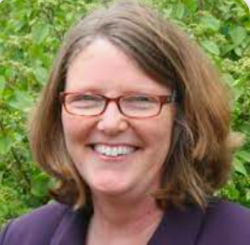
Linda Manaugh, chief program officer of the Potts Family Foundation, which is leading the work in Oklahoma, and Marlo Nash, a longtime consultant on early childhood and child welfare systems, will be joined by Laura Porter, international expert on the science of adverse childhood experiences, to discuss the work in Oklahoma.
Porter is the co-founder of ACE Interface, LLC. She, Manaugh and Nash have worked together to design, secure American Rescue Plan Act (ARPA) funding for, and implement the groundbreaking work in Oklahoma.
The work involves research in 15 communities to learn more about how young children and families are doing, what their needs are, and how well their communities are supporting them.
How can PACEs Connection members help support families who welcomed babies during the Pandemic?
Rounding out the webinar to share learning that can be used across all communities, Deborah McNelis, M.Ed, will share about ways to be supportive of babies born during the Pandemic, and their caregivers. McNelis is an early brain development specialists and the creator of resources to encourage positive childhood experiences in young families.
Full disclosure: McNelis donates to PACEs Connection five percent of net profits from related sales of her Neuro-Nurturing(R) materials from Brain Insights.
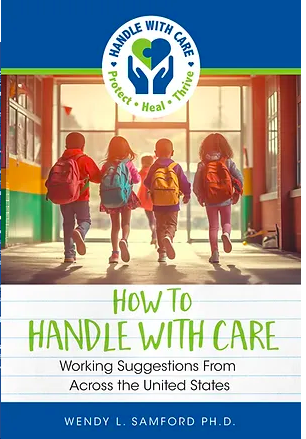
“How to Handle with Care”, a new book by author Wendy Samford, PhD, is step-by-step instruction manual to create — in your community — a best practice that can help end the racially-motivated school-to-prison pipeline one child at a time, and quickly!
How?
By addressing the trauma of each child individually, with a cross-sector approach to supporting hurting children that has law enforcement working with educators all across the United States. (www.handlewithcarewv.org)
Simply put, if law enforcement comes into contact with a child in the course of duty, the name of the child and the words “Handle With Care” will be sent to the child’s school.
This simple message lets trauma-informed school personnel know that something happened to that child and to treat them with kindness.
“If additional services are needed for the child, the family is then informed and bridges are built from law enforcement to schools, and schools to community service agencies,” said Samford.
If administrators, faculty, and staff in the school know a child has had a hard night, they can help protect the child from added stresses the next day. For example, instead of having a child who was up in the middle of the night take a test, give an oral book report, or run the risk of acting out emotionally and getting in trouble for it, the child can be led to a quiet corner to rest.
Samford’s fast-read guide will show communities starved for ways to stop systemic trauma in education and juvenile law exactly what to do. Best of all, it’s in a book you can read in an afternoon, and follow step-by-step.
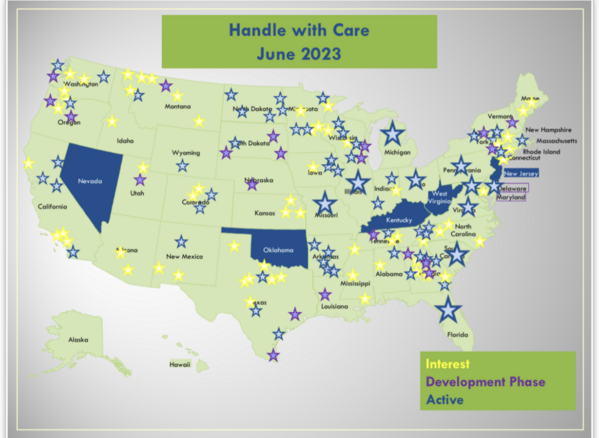
Already across the country, there are at least five states that are actively using the program, and it is in development in many more states and counties, and there is active interest in the program in almost every state.
For the full report, find the book on Amazon, Barnes & Noble, or any major book retailer.
For more information about the book, please contact Wendy Samford at www.wsamford.com
For more information about the Handle With Care program, contact Andrea Darr at adarr@jbsinternational.com.
(Activation warning. This is a first-person opinion piece sharing my thoughts on toxic abusive relationships [TAR] and a relatively new 12-step program,TAR Anon, which offers free, solution-oriented, acceptance-based, and psychologically-safe Zoom meetings from 6-7 PM ET on Mondays and Wednesdays, and from 12 Noon-1 PM ET on Fridays. This is a warning regarding potentially activating language, so you can choose whether or not you wish to continue reading. Further, I extend the activation warning to the program’sTAR Tales, where TAR Anon members share their stories.)
If there are adverse childhood experiences (ACEs) in your past, chances are good that you’ve been in a relationship with what Dr. Jamie Huysman, creator of the rapidly-growing 12-step program TAR Anon (Toxic Abusive Relationships Anonymous), calls a toxic abuser.
Huysman, a licensed clinical social worker (LCSW) and psychologist, is the founder and executive director of STAR Network Foundation, Inc., a 501(c)(3) nonprofit organization which incudes TAR Anon® and several other programs.
The STAR Network™ is rising in myriad ways.
Hearing Huysman speak regularly in TAR Anon meetings since being introduced to him about six weeks ago, it’s clear to me that he lives the organization’s mission to educate, energize, and empower people by giving them access to programs such as TAR Anon.
Meeting Huysman’s team, attending the two-year-old STAR Network’s “Scars to STARs” global online conference in May, and seeing the impressive list of the organization’s allies provides further evidence of the energy and gravitas backing the campaign to raise worldwide awareness of and treatment for the millions of people “whose emotional reality has been distorted by TAR”.
Also heavily involved is mental health advocate, author, and former U.S. Congressman Patrick Kennedy, who delivered the keynote address at Scars to STARs Day. During his speech, Kennedy – who grew up with the trauma and tragedy of losing to two high-profile uncles to assassinations, family addictions including his mother’s alcoholism, and the intensity of a father who advocated for mental health parity while at the same time self-medicating his grief with alcohol – writes and speaks passionately about his own struggles with bipolar disorder and substance abuse.
This is NOT to say that all people with mental illness or substance abuse disorder are or become toxic abusers. Far from it. Though it has been my experience – and well documented in research and reporting – that when people are depressed, anxious, at the effect of a substance or addictive behaviors, or are experiencing the challenges of mental illness, harsh words, neglect, and addictive behaviors can be among the consequences faced by the troubled person with regard to their own self-talk, as well as proximate family members and friends.
What pushes irritability and lack of awareness of the impact of one’s negative behavior into a diagnosis such as narcissism, borderline personality disorder, or Cluster B personality, as defined in the Diagnostic and Statistical Manual of Mental Disorder, 5th Edition (DSM-5) is a more consistent, pervasive, and intentional pattern of hurtful actions and personality traits that significantly impact relationships and the well-being of others.
TAR Anon is raising awareness of the prevalence of and solutions for these challenges.
Huysman shares in TAR Anon meetings that globally, approximately one-in-eight people have a personality disorder. Estimates in the U.S. are higher, with reports varying between being 10-15%. Regardless of the diagnosis assigned to the abuser, in the 12-Step TAR Anon meetings, the person in recovery from abuse is the most important person in the room.
As a person with an ACE score of nine, I can legitimately say there have been some toxic abusers in my life. I have been in therapy for Complex Post-Traumatic Stress Disorder (CPTSD) off and on for many years, and have the entire alphabet soup of different treatment methodologies in my recovery from early and ongoing relational trauma. My toolbox includes CBT (Cognitive Behavioral Therapy), DBT (Dialectical Behavior Therapy), EMDR (Eye Movement Desensitization and Reprocessing), IFS (Internal Family Systems Therapy), years of neurofeedback, two rounds of trans-cranial magnetic stimulation, countless hours of meditation, and a litany of different anonymous programs I will not share to protect my own anonymity, and the sanctity of the programs themselves.
With TAR Anon being a meeting ground for people from many different programs, or none, and toxic abusive relationships being evident in so many public places in our lives today, I am sharing information about this program and my involvement in it for the greater good.
Further, as TAR Anon is also a relapse prevention model that works well as a complement to all other 12-step programs, it can be used as a great primary or companion program.
Out of respect for the privacy of all people, and because dwelling on the past can be its own form of abuse, my toxic abusers will not be mentioned. It’s how I respond to myself and to them that is the most important aspect of this recovery.
Among the most important lessons learned from years of recovery and realizations that come with it, is that as an adult, I am not a victim and that my brain, and I, can change!
Looking back and realizing that even as a little kid I chose toxic friends, I see that the last 20 years have been way different and have given me great hope. Among the realizations that helped me change my thinking was learning that the brain has neuroplasticity — the ability to change throughout life.
This knowledge was and is incredibly freeing. I’ve seen the positive impact of changing my thought patterns, seeing clearly that I wasn’t stuck with the brain I was born with or had trained, as an infant and child by circumstance, to expect toxic inconsistency and unpredictability.
I learned to reparent myself and accept life-changing healing and support. Changing thought patterns is healing and life-changing, and many of the books, workbooks, and practices that have been so helpful to me over years of self-care are listed as resources in the thrice-weekly TAR Anon meetings, including The Body Keeps the Score by Bessel van der Kolk, MD, and Complex PTSD, From Surviving to Thriving by Pete Walker.
I’ve also learned through years of therapy, recovery, neurofeedback, meditation, journaling, being in community with sane people who love me, purposeful work I love, exercise, singing in choirs, spirituality, reparenting myself, parenting my children, and spending time in nature, that these resiliency boosters and the right dose of an antidepressant have helped me rewire my brain.
I am now much better at discerning and avoiding toxic people and relationships. The best part of this shift is developing a growth mindset, which has actually helped me attract the kind of people and opportunities that bring me joy and healthy relationships.
Had TAR Anon existed years ago, I might have learned much of this sooner, not had to do so much research, and could have saved many thousands of dollars in therapy.
It is also said that TAR Anon is the only 12-step program whose primary purpose is to help people recover from attachment disorders and CPTSD.
Other important messages I believe one can take from the TAR Anon meetings:
For most toxic abusers, it’s not their fault. They may have been born into homes where inconsistency, lack of nurturing, unpredictable care, domestic violence, mental illness, substance abuse, physical, verbal, or sexual abuse, neglect, or the death or loss of a parent – resulted in their own anxious, preoccupied, dismissive-avoidant, or fearful-avoidant (disorganized) attachment styles.
This toxic environment led them to adapt to survive. Adaptations could include, but are not limited to manipulation, dishonesty, abuse, cruelty, and/or addictions to substances or behaviors. They may have seen their parents and caregivers model changing roles as persecutors, rescuers, and victims. The childhood adaptations that helped them survive made it harder for them to attach in a healthy way. That attachment style followed them into adulthood, where it wreaked havoc on the abuser themselves as well as the people with whom they had relationships.
And guess what? The same could be said for most victims of toxic abusers.
Sadly, to feel safe, many of us who grew up in chaos subconsciously recreate the familiar, even if what we are recreating is toxic.
Many of us reared in toxic environments fell into the abuser-rescuer-victim cycle until we got some help recognizing the pattern. If help was not available, we might have become or married alcoholics, become gamblers, spenders, workaholics, hoarders, or the type of over-achiever who lands in the hospital from exhaustion, illness, or an epic burnout. I’ve been there.
In over 31 years of 12-step work, I learned early on to take an inventory of my resentments and fears, seeking for my part in any situation where I had a conflict, and looking for the pattern of my behavior so I could help disrupt it. I have also learned the value of accepting input from others to disrupt destructive behavior patterns.
Gratefully, I also learned this in Cognitive Behavioral Therapy (CBT) decades ago. In it, I was able to look at a situation and separate my thoughts, feelings, body sensations, and actions IN WRITING, so I didn’t collapse a story and miss the way I allowed my thoughts to create my emotions, the way I felt, and the way I reacted instead of responded. It’s true that if we knew how powerful our thoughts are, we would be very careful about what we choose to think about, or allow into our precious minds.
TAR Anon can help accelerate learning about complex or childhood post-traumatic stress disorder (CPTSD) in an anonymous and psychologically-safe online environment, with caring and TAR Anon-trained meeting facilitators. TAR Anon leaders and attendees are people who are there to listen and support each other.
TAR Anon meetings teach us that we repeat behavioral patterns from early, insecure attachments because it is what we know – and on some level, it feels safe. Even sleeping on broken glass can feel familiar and safe if that is what you knew as an infant and child. In meetings, though, we see how we need to form new behaviors to leave destructive behaviors behind. Learning and forming new behaviors may come through “aha” moments – feeling emotions, learning to love ourselves, and recognizing and avoiding toxic people. These are steps on the path to greater well-being.
Among the saddest facts I’ve learned from studying ACEs science, the science of positive childhood experiences (PCEs), and early relational health, is that children living in emotionally toxic environments (what I call toxic intensity) will often learn adaptive behaviors to survive. Some of the behaviors that can become “hardwired” in infants and children include:
disassociating or disappearing themselves to avoid attracting the attention of an abuser;
becoming a caretaker and/or protector of a perpetrator or perpetrators;
people-pleasing to avoid conflict or punishment;
overachieving and perfectionism designed to evoke positive attention and praise;
eating for comfort and gaining weight and/or developing anorexia or bulimia to have a sense of control and/or to avoid attracting – consciously or subconsciously – sexual advances; or
becoming controlling and manipulative to create a sense of safety or being in control.
With early childhood trauma (ages zero to three), and no experience of consistent nurture, the developing brain can be so harmed by the toxic stress hormones of cortisol and adrenaline that its function and structure are affected. Some infants and toddlers are actually wired to be fearful, distrustful, isolating, and chaos-seeking instead of being trusting, curious, and connection-seeking. This is why I advocate for, write, and speak so much about the need for early relational health as the basis of health and well-being across the lifespan, and share this seminal video of Bruce Perry, MD, with “What Happened to You: Conversations on Trauma, Resilience, and Healing” co-author Oprah Winfrey.
Though it is infinitely better to prevent toxic abuse by supporting pregnant women and new mothers and caregivers, their infants, and children to receive “neuro-nurturing” there is hope that people who have struggled with negative effects from a toxic childhood can find help and can change thought patterns. Factors are so variable though — severity of trauma, the environment, access to support and a sense of safety, exposure to positive childhood experiences, and on and on — one cannot make generalities about who can make such changes and to what degree. I only know what has worked for me and helped to lift me from multi-generational depression, abuse, and addiction, “one day at a time” dependent on my self and spiritual care.
The Hope of Recovery
I do believe there is hope for people who grew up in abuse as well as abusers who find their way into a 12-Step program, become willing to work a program, and who grow in the safety and acceptance of the program’s participants, because I have experienced and witnessed this over many years.
People can realize positive shifts in personality from programs including, but not limited to:
Alcoholics Anonymous (AA) and Narcotics Anonymous (NA) can help people who abuse substances see how their substance abuse affects their lives, families, and careers, and learn how to live “happy, joyous, and free” lives without the substance;
Adult Children of Alcoholics can help people who have grown up in relationships with addicted persons learn to reparent themselves by recognizing and practicing healthy behaviors (ACOA’s Yellow Workbook is terrific; working it with a friend from the program can be a game-changer.);
Al-Anon and Co-Dependents Anonymous (CoDA) can provide guidance and support for those in relationships with people who are addicted to substances or behaviors; or
Other anonymous groups addressing sex/love/romance addiction, over-spending, over-eating, and gambling can help abusers understand how these maladaptive behaviors may have started generations ago.
(Note: Addiction is often linked to likely epigenetic and genetic factors. In the interest of space and time, I am not addressing that topic here.)
As stated previously, I’ve been a member of multiple 12-Step programs; one for more than 30 years. Through the years the comfort, safety, security, friendships, and reparenting these programs have offered have helped me to rewire my brain. They have inspired and fueled me toward the designation I am most proud of in my life, that of Cycle Breaker.
I also believe the childbirth education (the Bradley Method) and early relational health support from the La Leche League I had, along with parenting classes, decades of therapy, journaling, 12-step meetings, and being blessed to have two precious children whom I swore would not grow up in the same toxic intensity as my brother and me, put me on the path to follow the steps I wrote about in my book, The TurnAround Mom: How an Abuse and Addiction Survivor Stopped the Toxic Cycle for Her Family – and How You Can, Too!
At the behest of one of the editors of this blog post, I am sharing a bit about my book. Its chapter titles offer a glimpse at some reparenting advice that worked for me, and incorporate so much of what I’ve learned over the years and attempted to crystalize and share in the book. I believe they also fit with what is being shared in TAR Anon. (Note: I don’t receive any income from the book and encourage you, if you wish to purchase it, to buy it used.)
Live a Life of Extreme Self-Care
Build a Strong Support Structure
Create a Sane and Strong Family Life
Establish and Keep Strong Boundaries
Make Better Decisions
Spend Your Precious Resources Wisely – Energy, Time, Money
Attract Healthy Relationships
Avoid Toxic Intensity
Practice Peace: Rushing is Abusive
Honor Your Family’s Future
All of this is to say: We don’t have to pass toxic behaviors on to our children. People can change. And I believe TAR Anon is a tool that can help anyone who has experienced ACEs begin a healing journey.
I believe that TAR Anon and the many programs the STAR Network is advancing can accelerate the change we want to see. And I believe this work will resonate with many here on PACEs Connection.
While I wish TAR Anon had been around earlier, I’m glad it’s here now and am thrilled to share it and reiterate that it meets online three times a week:
Mondays and Wednesdays from 6:00 – 7:00 PM Eastern Time and
Fridays from 12:00 Noon – 1:00 PM Eastern Time
While meetings are free, just as in any other 12-step meeting STAR Network Foundation accepts and gently encourages donations. The foundation is a 501 (c) (3) organization, so gifts are tax-deductible.
While attendees are required to register to join the virtual meetings, they do not have to share their real name or appear on video. Meetings are anonymous, and anonymity is practiced as an integral part of this program of recovery.
One final bonus to these meetings, and one that has been incredibly helpful to me.
Each meeting closes with breath work to help calm the central nervous system and help it go from the reactive, flight-fight-freeze-fawn state to a state of rest and digest, wherein we can access our thinking brain and not be run by our emotions. Instead, after just four rounds of breathing in for four seconds, holding the breath for seven seconds, and then blowing the breath out hard through the mouth for eight seconds — about 80 seconds in all — the nervous system and body shift to the “parasympathetic” or more relaxed state. The extended exhale helps slow the heart rate, lower blood pressure, and quiet the mind.
I know it has been a help to me. Since I started attending the meetings and practicing the 4-7-8 breath work, chronic painful stomach issues that have plagued me most of my life have lessened greatly.
Additional resources below include TAR Anon’s 12 steps, promises, and several of the videos found on the STAR Network Foundation’s Instagram page. New animations are added frequently.
Thank you, leaders and members of resiliency task forces, PACEs communities, and people just discovering the connection between childhood trauma and positive experiences and life outcomes, for helping raise awareness of the vital and undeniable connection between positive and adverse childhood experiences and lifelong health consequences of both.
Thank you to all who keep sharing ACEs science, who keep sharing the science of positive and adverse childhood experiences (PACEs). Who keep reminding people that what is predicable is preventable. And that child flourishing, too, is possible.
We know those positive experiences of belonging, feeling safe, being in a safe, stable, nurturing environment, feeling as if someone in your family has your back, having friends, experiencing community traditions, having two people other than one’s parents — that these are among the positive childhood experiences that help counter the adversity. And can help prevent adult mental illness.
Thank you to all the PACEs Connection members and community leaders who keep speaking truth to power about the science. The 1998 Adverse Childhood Experiences Study and the 2019 study on the impact of positive childhood experiences on adult mental health. And for those also promoting the 2018 study Bruce Perry, MD, PhD, MPA, did on the TIMING of ACEs, and how important consistent nurture is, especially the first two months of life, to infant brain development and laying a foundation for optimal brain development. Truly, early relational health is foundational to lifelong health and wellbeing.
Times are terrifying, sad, outrageous, exasperating, and more, to say the least. And yet I know so many leaders of resilient communities who are keeping their meetings going. Adding members to their task forces, taking on new projects to go way the heck upstream to prevent and hopefully heal trauma; to bring positive experiences to their communities by supporting pregnant and newly delivered women, families, schools, people across the lifespan.
This is a personal thank you. We see you. We love seeing you post in your communities and share about your meetings, plans, programs.
Thank you. Your sharing these lights inspires others. And may well be the single act of kindness that prevents or helps begin healing, or helps set someone toward nurturing a child or family. Or community.
Thank you. It has been a hard, hard couple of years, for myriad reasons including the loss of dear friends, mentors, leaders.
Thank you for keeping the work going. Thank you. Thank you to fellow volunteer co-director of PACEs Connection Dana Brown, and our fiscal sponsor and partners at National Prevention Science Coalition to Improve Lives, Diana Fishbein, PhD, and Jess Bair. Thank you to Alliance Practice Partners who continue to advise and help guide the work, and beloved donors, who we will name in full soon and who include Dr. Jamie Huysman of STAR Network Foundation; Harriet Stein, MD; The Parallel Foundation; Jeoffry Gordon, MD; The Langeloth Foundation and many more, who, again, will be named soon in a formal thank you.
(Originally posted on PACEs Connection May 25, 2026)
At a certain time each day, all world leaders are introduced to one of their newest constituents.
A young mother or perhaps a grandmother or father hands a sleeping newborn to each leader, who then sits quietly, holding the baby and feeling the weight of this new life in his or her arms. Perhaps there are no words spoken other than the name of the child, and where, in their mutual home nation, the baby is from.
There is only one photographer present. It is a quiet, solemn, awe-filled time — for about 20 minutes — for each of these leaders each day.
At the end of the 20 minutes of each leader holding the baby, studying his or her new face, feeling the warm breath of this new life, watching the tiny chest go up and down as they share space, time, and air — what a time this would be — each leader would carefully place their respective baby back into the waiting arms of his or her eager caregiver.
This could be a global oxytocin reset.
(Oxytocin is called the love hormone. People create it when they feel love. It is in all mammals and strengthens connection and bonding.)
This daily ritual could be global moments of regulation and consistent care — for the infants and the leaders, and ultimately, I believe, the planet, our fragile island home.
It would be care for each leader to have his or her central nervous system reset by stopping in the midst of whatever global crisis to breathe with, rock, or sway, and hold a part of the future for which he or she is responsible —in their hands.
I’ve dreamed of this idea for years. Just haven’t ever put it out here for people to react or respond to.
This Memorial Day, with so much global crisis and angst over wars, fuel, climate change, inequity, famine, disease, and on and on, it seemed like the right time to share this idea in print.
Perhaps it is because my family is expecting a little one.
This is the first grandchild for me. And I am praying for a safe and joyous arrival for his precious mother and father, and him. And am thus reflective and wishing the world were more welcoming.
And I am thinking of whether or not, if I were young again and of childbearing age, whether I would trust today’s global leaders to hold my newborn for 20 minutes? Much less hold their fate for a lifetime.
Perhaps if all leaders agreed to do this, and I were randomly chosen to share my child for 20 minutes on Day 321 of the “Global Reset Movement”, I could do it.
And I do believe posting photos of world leaders each day, faithfully honoring this global commitment, could someday replace the photos of war, of flag-draped coffins being met at airports, of another row of graves.
 Carey Sipp 7/25/236:28 PM
 Her booklet dispels 22 potentially harmful myths about caring for newborns, among them: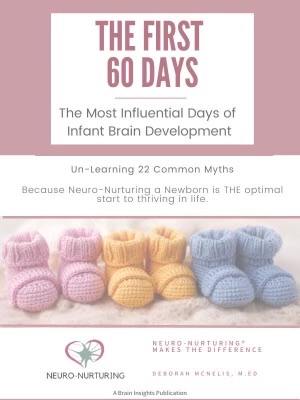
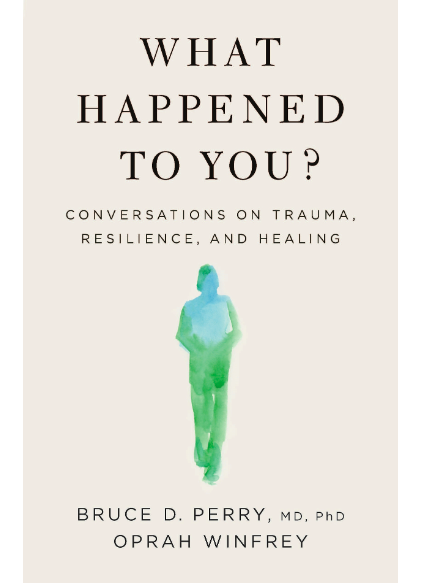 In their New York Times best-seller, Perry and Winfrey share ways to help heal Complex Post Traumatic Stress Disorder (C-PTSD) and Post Traumatic Stress Disorder (PTSD).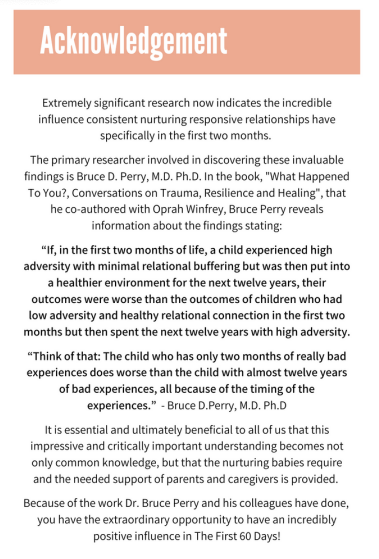



 PACEs Connection CEO
  Cockhren will be joined by P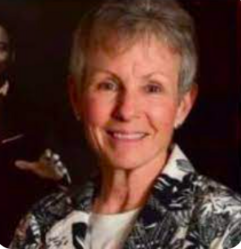
 to discuss the work in Oklahoma.
 The work involves research in 15 communities to learn more about how young children and families are doing, what their needs are, and how well their communities are supporting them.


 Already across the country, there are at least five states that are actively using the program, and it is in development in many more states and counties, and there is active interest in the program in almost every state.