It is difficult, however, to celebrate this year’s theme, “Our Bodies Belong to Us: Restoring Black Autonomy and Joy!” when our governments and healthcare systems are rolling back COVID protections while largely ignoring the devastating effects these actions will have on reproductive health inequities. How can we achieve autonomy and joy in birth if we fail to keep Black parents and babies safe from a virus that continues to kill an average of nearly 200 Americans daily and leaves countless others with long-term disabilities?
To be sure, a national focus on the longstanding Black reproductive health crisis is long overdue, even in the absence of COVID. We have known for over a century that Blacks are far more likely to die from pregnancy-related causes than their White counterparts and that Black babies are the least likely of any racial/ethnic group to celebrate their first birthdays.
By Thomas Bognanno, Image: Getty, Forbes, April 21, 2023
On my desk, I have always kept a small hourglass. Inevitably, I am drawn to it throughout the workday. As I write this, I have only a few hours remaining as CEO of CHC: Creating Healthier Communities. After more than 40 years of nonprofit leadership, the hourglass is a powerful symbol of how quickly time passes and the inevitability of change. More than that, it is a reminder that time is precious. With the hours, days and years we have left, we still have a calling in front of us.
We have urgent work to do if we want all individuals to have access to quality education, safe and healthy homes, adequate employment, transportation, healthy physical environments, food security and quality healthcare.
As those last sand crystals inexorably fall, I see more clearly than ever that the only way to achieve a healthy and equitable society—encompassing the physical, mental and spiritual aspects of human life—is to approach creating and sustaining healthier communities as part of a wider dynamic system: the social and political drivers of health. This is a complex system full of linkages, relationships, interactions and interdependencies—the root causes of most of our societal woes.
By Krista Goldstine-Cole, EdD, co-principal investigator, Into the Black Box study of developmental adversity, Billings, Montana – April 25, 2023
A team of researchers at the University of Montana School of Public and Community Health Sciences has launched Into the Black Box, an extensive and ground-breaking study of how some adult learners turn information about developmental adversity—the traumas, adversities, and significant stressors that are sufficient to alter the brain, body, or developmental trajectory—into transformative action.
Over the past ten years, community organizations, philanthropy and government have called for workforce development or training as a first and necessary step to achieve trauma-informed practice as well as wholesale systems change. To date, no studies or evaluations have been published examining whether developmental adversity education works as imagined, and if so, for which learners, according to co-principal investigator Krista Goldstine-Cole.
“It’s a big number,” Goldstine-Cole says. “But we are hoping to hear from the broadest possible group of people. We want to capture variation in who learners are, how and why they are learning, and what they have been learning about—adverse childhood experiences (ACEs), neurobiology, epigenetics, ACEs, and resilience (NEAR) science, trauma-informed practice, toxic stress, and adjacent topics.
“We also want variation in how long people have been involved in developmental adversity education. We want to hear from people in a range of professions as well as those who are learning about developmental adversity (DA) in the context of community,” Goldstine-Cole added.
“The potential to generate greater momentum in the trauma-informed movement.”
Jesse Kohler, executive director of the Campaign for Trauma Informed Policy and Practice (CTIPP) believes the study findings “have the potential to generate greater momentum in the trauma informed movement and build greater capacity to address the root causes of health and social issues throughout our society.”
“We want to understand “the spark” of DA education,” said co-principal investigator, Siwen Zhang Minero, EdD.
“Through interviews, we have found that some—but not all—learners really catch fire when they start to learn the science of developmental adversity. A few years ago, we did a video project where we asked innovators in the field how their thinking had changed over time. It taught me that learning about developmental adversity can be a source of personal and professional transformation. We want to open up that black box and see how often this kind of transformation happens, for whom, and under what circumstances,” Minero said.
While the questionnaire can be completed on a small screen, using a tablet or computer will ensure greater access for participants who use screen readers or other accessibility tools. Participation is limited to individuals over the age of 18, who have engaged in some form of developmental adversity learning, and who live or practice in the US.
“Developmental adversity education has grown hand-in-glove with the broader PACE movement,” Goldstine-Cole said.
“…there is an urgent need to equip our early learning and care providers, educators, and school personnel with foundational knowledge…”
Scientists at the US Centers for Disease Control, Kaiser Permanente, the Oregon Health Sciences Center and elsewhere have found that preventing developmental adversity and interrupting the progression of adversity over the life span holds the potential to reduce healthcare, social services, special education, incarceration, and other costs by over $100 billion.
DA education has increasingly been tied to crisis recovery as well. For example, Dr. Diana Ramos, California’s newly appointed surgeon general notes on California.gov “As we begin to recover from the trauma of the pandemic, there is an urgent need to equip our early learning and care providers, educators, and school personnel with foundational knowledge of Adverse Childhood Experiences and trauma- informed principles.”
Goldstine-Cole and Minero met at the Harvard Graduate School of Education while earning doctorates in human development. The two joined the University of Montana in January 2023, and with support from Susan Miller and ANSR and have formed the Developmental Adversity Resilience and Transformation (DART) lab with co-director, James Caringi, PhD.
Into the Black Box is DART’s first study.
Contact Info
Name: Krista Goldstine-Cole, EdD
Email: krista.goldstine-cole@umontana.edu
Org: University of Montana School of Public & Community Health Sciences
Dr. Judith Herman, a psychiatrist and pioneering researcher of trauma, had her career on hold for two decades as she navigated her own chronic pain and several surgeries after an accident.Credit…Kayana Szymczak for The New York Times
By Ellen Barry, The New York Times, April 24, 2023
In the fall of 1994, the psychiatrist Dr. Judith Herman was at the height of her influence. Her book “Trauma and Recovery,” published two years earlier, had been hailed in The New York Times as “one of the most important psychiatric works to be published since Freud.”
Her research on sexual abuse in the white, working class city of Somerville, Mass., laid out a thesis that was, at the time, radical: that trauma can occur not only in the blind terror of combat, but quietly, within the four walls of a house, at the hands of a trusted person.
More than most areas of science, psychology has been driven by individual thinkers and communicators. So what happened to Dr. Herman — as arbitrary as it was — had consequences for the field. She was in a hotel ballroom, preparing to present her latest findings, when she tripped on the edge of a rug and smashed her kneecap.
Bo Dean with New Hanover area Community Resiliency Model trainers Audry Hart, the late Chris Johnson, and J’vanete Skiba.
Bo Dean answered the call for monthly donations to PACEs Connection more than a year ago for many reasons, one of the main ones being that PACEs Connection and the work it supports helps us “live into our humanity.”
In addition to his supporting learning and development for some 2200 employees in New Hanover County, North Carolina, Dean also co-chairs the County’s Resiliency Task Force and helped found and support a new resource for people teaching various courses to help increase resiliency in the region, which was devastated by Hurricane Florence almost six years ago.
PACEs Connection CEO Ingrid Cochkren says she wishes more people would follow Dean’s lead in doing the work and in making monthly donations.
“While we’re steadily adding monthly donors, it would be good to see more of our almost 59,000 members — and hundreds of thousands of visitors — support our work to prevent and heal trauma,” said Cockhren.
She is asking members to sign on now to make a monthly donation to help fund the staff needed to support the site as well as our work with communities, and the newsletters, podcasts, webinars, Resource Center, and other free tools and guides offered by PACEs Connections.
“If just ten percent of our members made an automatic monthly donation of $10, you could help us cover a substantial portion of our costs,” said Cockhren.
Please consider following in the footsteps of community leader and PACEs Connection supporter Bo Dean, who shares below his reasons for making his monthly gift to PACEs Connection.
Name: Bo Dean
Occupation: Sr. Human Resource Analyst, Learning and Development, New Hanover County, NC
Connection to PACEs Connection/PACEs science? We are a trauma-informed/ACES informed county agency and have been working with and informed by ACES, now PACES, for over six years. We began our work by participating in and with the New Hanover County Resilience Task Force, a multi-agency partnership that began as a primary focus on childhood resilience, and still has that as its primary work, but has become a central change agent for building community resilience.
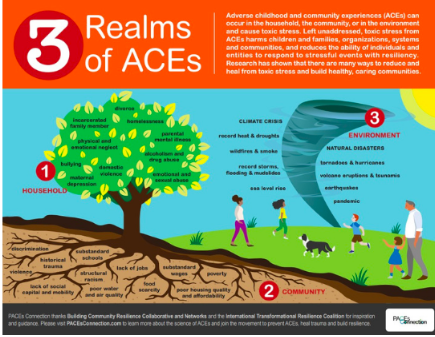
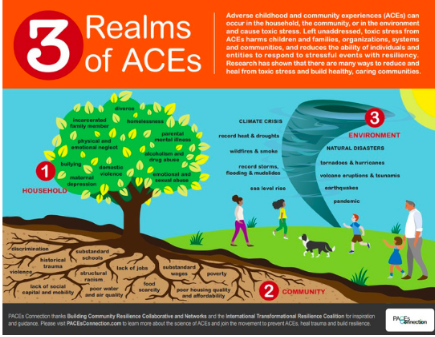
Do you work in the field? Yes. In my job, I work in PACEs science by using it in all I facilitate. I am the architect for learning and development of professional growth and strategic alignment for our agency for our over 2200 employees. In that work, I have found it essential to permeate our development with foundations of ACES-informed science and understanding in ALL of the work, whether we are looking at individual, team, department, or enterprise-wide learning. The four realms of trauma (as seen in the PACes Connection infographic below) affect our internal and external service, and drive some of the ways we can build compassion and empathy. The science drives the ways we connect to that service, but also how we see one another as we create care and understanding for ourselves to improve our overall well being. It factors into all aspects of how we optimize our service.
How did you find out about PACEs Connection? We are fortunate to have had Carey Sipp (PACEs Connection director of Strategic Partnerships) as a motivator, teacher, and partner from the very beginning. (Note: Sipp moved to Wilmington, NC, in 2018 to join the New Hanover Resiliency Task Force, learn from its leaders, use the learnings to guide her work with other communities in her role as as PACEs Connection’s southeastern community facilitator. Now as the national director of strategic partnerships for PACEs Connection, Sipp continues to learn from the local task force, and plans to stay in North Carolina because she loves it!)
Were you surprised to find PACEs Connection? Being a witness to so much good in public service, I am constant in awe at what IS done for others. Surprise is not the word I would use. It is gratitude that I have for those who see purpose in using data to drive efficacious practices to help connect us all to better means to serve everyone. In doing this work, we see revelations in the systems and issues that are not at the forefront of all discussions, but are related to living. These have to be addressed and discussed.Some of our folks see and deal with trauma-related challenges on the regular, but don’t always have the ability to articulate their needs and connect with resources. PACEs Connection is not only a connector; it is also a means to voice the validity, the reality of the issues we see, and to help those who want to make a difference to make a difference with a feeling of being supported. It helps those who don’t see these issues in the day-to-day, be able to hear and see it the traumas they might not have seen had they not been made more aware by information received in PACEs Connection.
What part of PACEs Connection do you like best? The ready access to information that has efficacy, and the connection to others nationally and locally.
How do you use PACEs Connection? I take the information and deliver it directly to our groups here in the county to help keep us updated. We have a Resilience Working Group that helps permeate the science into our work as well as professional staff. PACEs Connection helps me offer information for ongoing professional development resources.
Do you read the Weekly RoundUp? Yes. It is the summation that I can give to our leaders. They are inundated with information, but with the RoundUp, they can choose items that they then use for their own purposes. It is clear and concise. Digestible. That is so important.
Do you share stories from the Weekly RoundUp? Of course!
Do you belong to a resiliency initiative? I belong to several 😊. I am on the steering committee and I co-chair the NHC Resilience Task Force, which has over 100 agencies signed on! I staff our Resilience Working Group in the NHC government. I founded the Resilience Working Group that is now led by a chair, vice chair and secretary. Its members who have been through the eight-hour Community Resiliency Model (CRM) training. We are a peer support, trauma-informed leadership team. We have over 200 members and meet monthly. We also offer twice-monthly resilience “huddles” virtually for folks to check in and receive support. In addition, we hold eight-hour CRM training sessions each month. I am a CRM trainer and Resources for Resilience (R4R) Trainer.
What prompted you to support PACEs Connection with your gift? This is the most valuable work I have been involved in. This is where we SEE one another, open up lines of communication, compassion, empathy and support. This is where we lose judgment and find and practice “What happened to you?”NOT “What is wrong with you?” ways of being. The more we do this, the more we see one another and lift up one another, the more we begin to LIVE “What is right with you” and what can we do to celebrate one another.
What keeps you giving as a monthly donor? All that I said, this work has to continue. Shootings, drag bills, systemic issues that are engineered to separate us in sex and race and orientation, all of these wedges that draw us away from each other are so intentional and purposeful. We need one another. We are our brother’s and sister’s keepers. PACEs science and PACEs Connection allow us to be as one. To know we are not perfect, to know we all experience something and together. Together we heal; we thrive. This is the work of being human and living in that humanity.
What would you tell others, to encourage them to support PACEs Connection on a monthly basis? I don’t give a ton, but folks, if each of us gave $25 a month, think of the multiplier effect of that! All for less than five coffees a month.
What is your greatest hope for what happens with PACEs science? That we end child abuse? Create equity? Eliminate racism? Do away with poverty? Create a trauma-informed and healing-centered planet? I said it before. My hope is that we live into our humanity. We can end the issues that challenge us by connecting. We can find, secure and share empathy and compassion. We are human. We are wired for connection and protection even though we have a negativity bias. What we feed the protection and connection, what we share in our experiences, what we give to each other in those connections and sharing will make that difference. We don’t change who we are as biological animals, but we can create better spiritual beings and “human livings” that are connected to the best of what and who we are.
Dean encourages fellow members of PACEs Connection to join him in making a monthly tax-deductible donation to PACEs Connectionhere.
One-time donations are encouraged as well!
If you’d prefer to mail your gift rather than give it online, here’s how…
Make check payable to: TSNE (Third Sector New England, our fiscal sponsor) and write PACEs Connection Donation on the memo line.
Mail check to: PACEs Connection, c/o TSNE, 89 South Street, Suite 700, Boston, MA 02111
Making a wire transfer or need Tax ID information?
If you would like to be featured as a monthly donor, please send an email to Carey Sipp, director of strategic partnerships, with “Donor Spotlight” in the subject line to answer the 15 questions and let your fellow community members know more about you, how you use PACEs Connection, why you support the work.
Surgeon General Dr. Vivek Murthy testifies before the Senate Finance Committee on Capitol Hill in Washington, on Feb. 8, 2022, on youth mental health care. – Susan Walsh/AP
By Caitlynn Peetz, Education Week, April 25, 2023
U.S. Surgeon General Vivek Murthy called out social media as a driving force behind the surge in children’s mental health challenges on Tuesday, and encouraged lawmakers to regulate how the platforms are marketed to and used by kids.
In a conversation with Vermont Sen. Bernie Sanders livestreamed on Twitter, Murthy called the increase in youth mental health needs “the defining public health crisis of our time,” and underscored that kids’ mental health has taken a hit as they turn to social media more often and at younger ages. The increased use has led to more feelings of isolation, stress, and inadequacy as they constantly compare themselves to others, he said. It also keeps kids awake well into the night when they should be getting much-needed rest and makes it harder for young people to focus.
And, Murthy said, the companies that own the platforms aren’t doing enough to address the damage they’re causing.
The Hearst Foundations announced it would award $300,000 to PACEs Connection as a part of the philanthropic organization’s effort to support nonprofits working across a range of disciplines.
The award reflects the philanthropic interests of William Randolph Hearst and the Foundations’ goal of providing opportunities to people of all backgrounds.
“We are thrilled to receive this generous support,” said Ingrid Cockhren, CEO of PACEs Connection (PACEs stands for positive and adverse childhood experiences).
“These funds will help us on our mission to raise awareness of the negative health consequences of adverse childhood experiences (ACEs), and the buffering effects of positive childhood experiences (PCEs).
“Racism, poverty, climate trauma, inequity, injustice, domestic and community violence, environmental racism, and the collective and historical traumas our nation’s people have endured for hundreds of years and are enduring now have major health and economic consequences for all of us,” Cockhren said.
PACEs Connection is a social network that supports communities to accelerate the global PACEs science movement, to recognize the impact of positive and adverse childhood experiences (PACEs) in shaping adult behavior and health, and to promote trauma-informed and resilience-building practices and policies in all communities and institutions — from schools to prisons to hospitals and churches — to help heal and to develop resilience instead of traumatizing already traumatized people. Learn more about us here.
Cockhren encourages fellow readers of PACEs Connection to join her in making tax-deductible donations to PACEs Connectionhere.
If you’d prefer to mail your gift rather than give it online, here’s how…
Make check payable to: TSNE (Third Sector New England, our fiscal sponsor) and write PACEs Connection Donation on the memo line.
Mail check to: PACEs Connection, c/o TSNE, 89 South Street, Suite 700, Boston, MA 02111
Making a wire transfer or need Tax ID information?
Please contact Carey Sipp, Director of Strategic Partnerships, at csipp@pacesconnection.com
Each year millions of Americans face the reality of living with mental health struggles. The collective trauma of COVID-19 has exasperated our country’s mental health crisis.
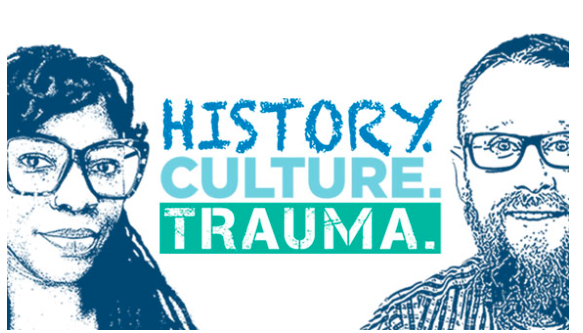
In honor of May’s designation as Mental Health Awareness Month, co-hosts of the History. Culture. Trauma. podcasts Ingrid Cockhren, CEO of PACEs Connection, and Mathew Portell, director of communities, speak with guests about our country’s science, support, education, advocacy, and policies focused on mental health.
This week’s episode—at 1 pm PT, 4 pm ET, Thursday—features an encore of an interview with Rebecca Lewis-Pankratz.
Lewis-Pankratz is a learning centers director and poverty consultant. She regularly speaks on rural poverty and systems, including foster care, and how they affected her journey.
Despite growing up in addiction and poverty, Lewis-Pankratz was able, against all odds, to fight her way out of poverty. Her journey from the trailer park where she was living with her three young sons began in 2011 when she connected with a local poverty resolution project.
Lewis-Pankratz later went to work for that non-profit, and went on to build multiple projects like it to help more families.
More about Rebecca Lewis-Pankratz
Today Lewis-Pankratz works with communities and schools across the US to solve poverty and heal trauma. She does this by helping caring leaders create sustainable ecosystems of resilience based on building better relationships.
In 2015, Lewis-Pankratz started working with public education and ignited a trauma-informed schools movement in her state and beyond. From her experience of trauma and poverty, and by accessing buffering relationships, Lewis-Pankratz healed from both poverty and addiction and continues to light the path for others.
Lewis-Pankratz and her team have partnered with Youth Core Ministries out of Greensburg, Kansas, to establish and sustain poverty resolution projects across Kansas and Illinois. Currently, they are working with over 200 families who are systematically building their paths out of poverty. Lewis-Pankratz is widely known in Kansas and across the United States for her extensive work in building trauma-informed schools.
More than 550 researchers, advocates, educators, community stakeholders, clinical and practitioner groups, persons with lived experience, legislators, and representatives from state agencies, among others, attended a statewide summit in Raleigh, North Carolina—“Leveraging North Carolina’s Assets to Prevent Child Trauma,” April 27-28.
Diana Fishbein, Ph.D., senior scientist in the Frank Porter Graham Child Development Institute (FPG), University of North Carolina, in Chapel Hill, and the primary organizer of the event, said the purpose of the Summit was to “scaffold community activism with solid research and supportive legislative and agency policies.”
Melissa Clepper-Faith, MD, MPH, who works with Fishbein in FPG, co-chaired the event, and said, “Time spent making connections across all these groups was precious.”
“What became clear is that NC is primed and ready to institute the reforms needed to protect our children from harm. We are ahead of many other states given the dozens of entities working toward this goal. However, there’s a difference between intervening at the level of the risk factor for trauma and focusing our efforts on the underlying social and structural determinants of trauma,” said Fishbein.
“We must move upstream to the roots of the problem, such as the uneven distribution of resources and opportunities, health disparities, racism and discrimination, poverty, violence, and other adversities, to strive to eradicate the sources of trauma before it’s felt”. said Fishbein.
“The more than 50 speakers – all but three were from NC – were all outstanding and 100% aligned with our agenda to activate communities using solid research and supportive legislative and agency policies,” said Fishbein, adding, “Rather than exhaustion after two days of back-to-back talks, our speakers energized us around a common goal and hope for what we can do collectively to exert a profoundly meaningful impact on child trauma.”
In a post-Summit report to attendees, Fishbein and Clepper-Faith said the Summit was a “call to action to establish a protocol for partnerships across NC that can play an instrumental role in invoking meaningful change to prevent trauma.”
Their report detailed the need for an action plan based on
The notion that community activism is at the heart of true change. Community members must be the central decision-makers, as reflected throughout all our discussions and action plans. We want to lift up the voices of “quiet constituents” to be sure they are heard and are co-equal in the co-creation process.
The recognition that solid, culturally sensitive research provides the foundation, backing and support for activism at the community level and policy change. That tack ensures our methods are well-tested and that we can expect desirable results.
The need for agency-level and legislative policies that are informed by communities and the existing evidence about what works to implement, scale and sustain that change.
“This is the beginning, not the end,” said Fishbein.
The organizers detailed next steps, which include the production of an Executive Summary and 6-8 articles on key topics raised during the summit.
“We will also work on a set of specific policy recommendations to share with the General Assembly, state agencies and local officials. There will be webinars—we welcome the opportunity to work with some of you on specialized topics—meetings, and other follow-on activities,” said Clepper-Faith.
Clepper-Faith and Fishbein also said they advocate for “a task force comprised of a wide range of constituent groups and individuals to co-create a statewide action plan for NC.”
For opportunities to become involved and advocate nationally for policies that consider evidence from trauma science, Fishbein invited attendees to visit the National Prevention Science Coalition to Improve Lives: https://www.npscoalition.org/. There, speaker Whitney Marris’ training in advocacy is available on the home page by scrolling down for the video “Science Advocacy Training.”
“Another avenue for advocacy at the national and community levels is with the Campaign for Trauma Informed Policy and practice, CTIPP, directed by our speaker Jesse Kohler, who is the group’s executive director.”
“We also recommend joining and turning to PACEs Connection, which supported the Summit with social media and networking efforts. PACEs Connection works across NC and around the world to raise awareness of the impact of positive and adverse childhood experiences across the lifespan, and to prevent and heal trauma. PACEs Connection helped boost attendance for the Summit as a part of its critical work to promote resilient communities,” said Fishbein.
Summit sponsors and contributors included the FPG, The University of North Carolina Seminar Series, the North Carolina Department of Health and Human Services, the Substance Abuse and Mental Health Services Administration, SmartStart, HopeStar, Child Trust Foundation, Duke Endowment, Prevent Child Abuse North Carolina, KB Reynolds Trust, the Campaign for Trauma Informed Policy and Practice, the National Prevent Science Coalition, and summit coordinators, Wake AHEC.
This report is absolutely inspirational! A lot of groundwork and effort must have gone into bringing this array of concerned parties together. May the force be with you! Obviously the potential for improving many lives and families in North Carolina is terrific. This also serves as a template for other states as we all work to create/recreate a humane and empathetic civil society.
The question remains: does this coalition have the momentum to confront the political gerrymandering and the legislative imposition of values that do not support every family and do not value every human life equally?
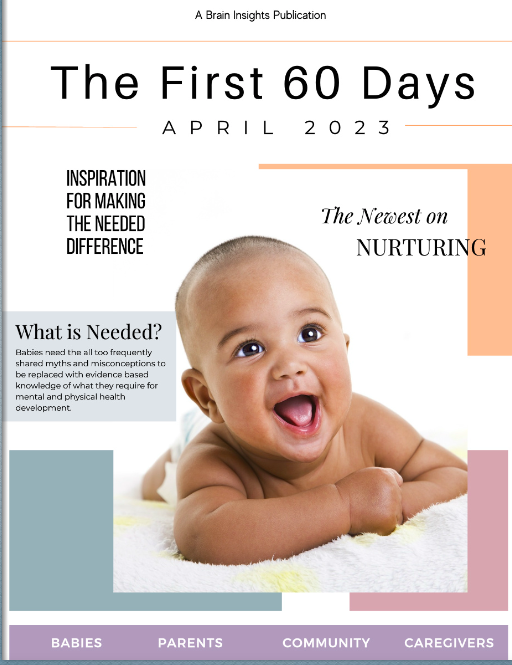
Deb McNelis, M.Ed, is an international speaker and author of materials supporting healthy infant and child brain development and the parent-child bond. She leads “The First Sixty Days” movement.
Twitter first made Deb McNelis aware of PACEs Connection. When she saw it pop up on her LinkedIn feed, she followed the links and was thrilled to find a community of “almost” like-minded people.
“We absolutely share the passion for preventing and healing childhood trauma; for building community,” said McNelis. But she says her work brings a sharper focus to the PACEs science movement, and a movement she herself is hoping to grow via PACEs Connection.
“I’ve been producing materials and speaking internationally for years about the importance of creating nurturing relationships with babies to establish that all-important ‘secure attachment.’ But when Bruce Perry and fellow researchers produced the 2018 study on the importance of the timing of developmental adversity – and laid it out that the first two months are likely the most consequential two months in brain development for any child – I felt an even stronger passion for ensuring this essential and significant knowledge is understood by all adults.”
“Essentially, Dr. Perry said the study shows that a child who has a horrible first two months – neglect or abuse, exposure to domestic violence, toxic stress – and a great next 12 years, is likely to have a worse life outcome than the child who has a nurturing, peaceful first two months and a horrible next 12 years! That should speak volumes to all of us, but especially expectant parents, employers who don’t offer paid parental leave, policymakers who don’t understand the need and the ultimate benefit of supporting families – especially in the tender early years,” said McNelis.
She now works in earnest to promote “The First 60 Days” movement, educating parents, people working in parenting, home visiting, obstetrics and gynecology, pediatricians, educators, policymakers and everyone else she can think of, to make that first 60 days of life a sacred time of connection and secure attachment for mothers, parents, caregivers, and those precious newborns.
PACEs Connection CEO Ingrid Cockhren, herself the mother of a five-year-old and twins who are 18 months old, says she wishes more people would follow McNelis’s work, as she is beginning to do, and take McNelis’s lead in making monthly donations to PACEs Connection.
“We so appreciate Deb and the dozens of other people like Deb who are making small, steady, monthly donations. While we’re adding monthly donors, it would be good to see more of our almost 59,000 members – and literally millions of visitors – support our work to prevent and heal trauma,” said Cockhren.
“If just ten percent of our members made an automatic monthly donation of $10, you could help us cover a substantial portion of our costs,” said Cockhren.
Please consider following in the footsteps of early brain development specialist and the creator of the Neuro-Nurturing(R) materials from Brain Insights – proud PACEs Connection monthly donor Deb McNellis.
1. Name – Deborah McNelis, M.Ed
2. Occupation – I am an Early Brain Development Specialist who is the Founder of Brain Insights, LLC. In this role I am an international speaker, an author of numerous materials, the creator of Neuro-Nurturing® and the initiator of The First 60 Days Movement.
3. What is your connection to PACEs Connection/PACEs science? – The emphasis of my work and purpose of Brain Insights is entirely focused on prevention. This especially is the reason behind writing The First 60 DaysBooklet and initiating The First 60 Days Movement. Creating an awareness and understanding of the essential need for consistent nurturing responsiveness in the earliest days, weeks, and months makes an incredibly positive difference.
We in this movement need to make this common knowledge, so we can better support parents and caregivers. An awareness of early brain development — with the realization of the impact of relationship trauma, stress, and neglect and an understanding of the need for meeting physical needs, providing nurturing, security and play — ultimately benefits everyone of us. It is “preventive justice”, as it truly puts infants, babies, and children on a path to achieving their highest potential, by wiring their brains for connection, love, and healthy relationships, as opposed to distrust, disconnection, and the greater potential to seek out relationships and situations that reinforce unworthiness, poor self-perception, neglect, or danger.
4. Do you work in the field? – Yes, all of my work is based on child development and brain science with a focus primarily on the earliest months and years since that is the time the brain is most malleable, providing us with the most positive opportunity for well-being in life.
5. How did you find out about PACEs Connection? – Through LinkedIn and Twitter.
6. Were you surprised to find this resource? – I am not sure that surprised is the word, but I was definitely delighted.
7. What part of PACEs Connection do you like best? – It is not easy to choose a part that I would label as best. There is such a wealth of information and resources provided in various ways. It is all great. But if I would single out one aspect, I would say the Weekly RoundUp.
8. How do you use PACEs Connection? – I use it as a source of gaining awareness of what is being done in various locations and in various ways toward creating positive outcomes and increasing needed awareness. It is encouraging to see numerous efforts taking place.
9. Do you read the Weekly RoundUp? – Yes. It is helpful.
10. Do you share stories from the Weekly RoundUp? – Yes, I have.
11. Do you belong to a resiliency initiative? – I currently do not but would like to explore getting involved in this way.
12. What prompted you to support PACEs Connection with your gift? – I fully support providing financial help in hopes of reducing the number of children and families experiencing ACEs.
13. What keeps you giving as a monthly donor? – I want to continue to support the efforts of people who are leading the way toward significantly reducing the number of children whose brains are being developed in the midst of toxic stress. The science is there to show that it isn’t healthy for children to be in constant toxic stress. There are buffering effects as the result of positive childhood experiences – PCEs. It is essential that we get this message to everyone that has a direct or indirect influence on the development of children. Every child needs at least one nurturing relationship!
14. What would you tell others, to encourage them to support PACEs Connection on a monthly basis? – Something I say frequently is, EVERYONE needs to understand the impact experiences have on the developing brain, because when ALL children have the positive experiences they require from the start, we ALL benefit.
15. What is your greatest hope for what happens with PACEs science? That we end child abuse? Create equity? Eliminate racism? Do away with poverty? Create a trauma-informed and healing-centered planet? – Every aspect listed here needs to happen. My greatest hope is that through sharing the understanding of early brain development and the importance of nurturing our babies and children, and each other, that the shared value of commonality and community can grow. We can create a ripple effect of support and acceptance, instead of judgment and labels. It really does make a difference. There is great power in even just one caring adult positively interacting with a child. We can help people become that caring adult. We can help activate people to share the word about the importance of making the first 60 days of life a time of sacred connection and secure attachment that lays the foundation for physical and mental health, learning, positive behavior and self-perception, and the increased likelihood of overall well-being across the lifespan.
McNelis encourages fellow members of PACEs Connection to join her in making a monthly tax-deductible donation to PACEs Connectionhere.
One-time donations are encouraged as well!
If you’d prefer to mail your gift rather than give it online, here’s how…
Make check payable to: TSNE (Third Sector New England, our fiscal sponsor) and write PACEs Connection Donation on the memo line.
Mail check to: PACEs Connection, c/o TSNE, 89 South Street, Suite 700, Boston, MA 02111
Making a wire transfer or need Tax ID information?
Please contact Carey Sipp, Director of Strategic Partnerships, at csipp@pacesconnection.com
If you would like to be featured as a monthly donor, please send an email to Carey Sipp, director of strategic partnerships, with “Donor Spotlight” in the subject line to answer the 15 questions and let your fellow community members know more about you, how you use PACEs Connection, why you support the work.
 Carey Sipp 4/20/231:00 PM


 If you’d prefer to mail your gift rather than give it online, here’s how…
 Making a wire transfer or need Tax ID information?