NOTE FROM Carey Sipp on 8.9.26 – This grant, announced in September of 2020, was ultimately rescinded. Right now I am uploading stories I wrote or posted on for the social network over the course of nine years. There was a post subseqent to this one in which Jane Stevens shared that the grant was rescinded. If/when I find it, I will do my best to link it back to the post below. Following the Pandemic, there were many shifts in priorities by grant-making organizations and funding became harder and harder to secure.
ACEs Connection — the digital catalyst, information exchange and resource uniting the people, organizations, systems and communities in the worldwide adverse childhood experiences (ACEs) movement — was today awarded a $500,000 grant from Blue Shield of California Foundation for its work to support communities and families in these challenging times.
“This inspiring and impactful grant supports our mission to make California the healthiest state and end domestic violence,” said Debbie I. Chang, MPH, foundation president and CEO.
“Prevention, equity, and changing systems so that they support the needs of individuals and families are key elements of health. We are proud to contribute to collaborations and organizations like ACEs Connection that address critical issues today while also building a better tomorrow,” said Chang.
ACEs Connection was among 20 organizations receiving grants that totaled $10.6 million. (ACEs Connection’s award is listed as TSNE, which is ACEs Connection’s fiscal sponsor.) Those organization’s missions include preventing domestic violence, strengthening the economic position of childcare workers and families who rely on them, and enabling multi-sector collaborations that drive health equity.
“We are honored, grateful and thrilled to receive a grant from Blue Shield of California Foundation,” said Jane Stevens, founder and publisher of ACEs Connection. “ACEs Connection is working at the nexus of the most pressing issues of the day. Racism, the inequitable response to the pandemic, lack of healthcare, lack of childcare, domestic violence, affordable housing …. ACEs are at the root of all of these challenges and more, and the pioneers in the ACEs science movement have already shown that incorporating ACEs science into organizations in any sector can solve communities’ most intractable problems. We are overjoyed to work together with Blue Shield of California Foundation on this mission to build a healthier and safer California for all.”
ACEs Connection has nearly 9,000 members in California, the most in any state, and all 58 counties have ACEs initiatives at various stages of development. The social journalism network has nearly 47,000 members total and provides guidance and tools for more than 300 communities with ACEs initiatives. Its staff and members post solution-oriented articles, essays and videos, and contribute to resources and calendar sections. The network also posts a daily digest and weekly roundup. For an overview of ACEs Connection, please go to ACEsConnectionInfo.com.
By Greta Anderson, Inside Higher Education, October 23, 2020
Black students continuously experience, fight against and bear emotional scars from racism, which can lead to increased anxiety and poor mental health outcomes. Some colleges are just starting to address these issues.
Colbie Lofton’s first week of classes at Appalachian State University is sealed in her mind.
Lofton, who is Black, asked her macroeconomics professor a question during class and heard someone sitting behind her say, “I guess n****rs don’t understand.”
Lofton, “completely shocked” to hear a racial slur used so casually, said nothing, and neither did her professor, who Lofton said paused and appeared to have heard the comment. When the class ended, Lofton left, reeling from hurt, and went to a nearby bathroom to cry. She then returned to her dorm and confided in her roommate, but she said she didn’t report the comment to the university because she was not aware of the process to do so.
That 2018 incident was a marker for other racial incidents that would follow at the predominantly white campus in North Carolina and leave Lofton without any illusions about the deep prejudices that some students on campus have against Black people. She has felt “out of place” ever since and hyperaware of her surroundings, which has taken a toll on her mental health.
“That is a story that continues to sit with me,” said Lofton, who is now a junior.
She is not alone. Black students at many predominantly white colleges have long complained of the racial hostility, subtle and blatant, that they regularly encounter on their campuses. Whether victims of constant microaggressions or outright verbal or physical assaults, many have stories of being called a racial slur directly or seeing it scrawled on a campus wall, viewing racist posts by classmates on social media, or sitting through a presentation by a classmate professing a white supremacist conspiracy. The incidents were the focal points of protest movements and demands for change for several years, but the calls for action seemed to reach a crescendo this year as Black students at colleges across the country repeatedly called for college administrators to condemn and address racism on their campuses.
My heart broke for my children when I first read the 1998 CDC-Kaiser Permanente Adverse Childhood Experiences Study, mailed to me by a mentor in 2000. I wept about my high score (9) and then shoved the report in a drawer, resolving to not pass on the pain and to minimize my children’s ACEs. That report scared the hell out of me.
Years later, I plowed through the report again in earnest, and learned that most of my quirky behaviors: inability to focus, trouble with relationships, earlier fatalistic view, deep fears, etc, were likely due to developmental trauma at the hand of parents whose own lives had been severely affected by childhood trauma.
I’d been in recovery, in a program for children of alcoholics and their families, for many years at that time, and had learned how to be kinder and gentler with myself, as opposed to listening to my “inner parent” and beating myself down. I’d been taking medication for attention deficit disorder (ADD) so I could focus at work and hit deadlines — most of the time. But I hadn’t tied my need for medication to what had likely happened to my brain when I was in utero, when I likely experienced the toxic crush of my terrified mother’s adrenaline and cortisol as she carried me. My father was many things, among them, an abusive alcoholic.
Today I share great news: At 64, I continue to grow healthier thanks to the “resilience” part of ACEs science that explains and promotes actions we can take to become healthier as individuals, and as members of our families and communities. And that’s a relief, because research published in 2009 from the ACE Study showed that having six or more ACEs can chop 20 years off your life.
ACEs Connection launched in January 2012, and over the last eight years, has become one of the leaders in the ACEs movement, thanks to the tens of thousands of people and hundreds of communities who’ve joined and accelerated the spread of knowledge about childhood adversity. People in this movement have also developed innovative approaches using ACEs science to help people turn despair into hope, hate into love, and inspired them to pass on that knowledge and wisdom.
I have so many reasons for supporting ACEs Connection. One is so that pregnant women will take the ACE survey and connect the dots between their own ACEs and poor health outcomes for themselves and their children, and work to make things better.
Another reason I support ACEs Connection is to change the systems that perpetuate racism across all sectors, including medicine, as Black women are three to four times as likely to die in childbirth than White women, and Black babies are twice as likely to die than White babies.
I support ACEs Connection because we have the knowledge to solve our most intractable problems. And when I say “we”, I mean all the people who learn about ACEs science and join ACEs Connection to help grow a world that’s healthier that the one we live in now. At the moment, that’s nearly 48,000 influencers….and growing!
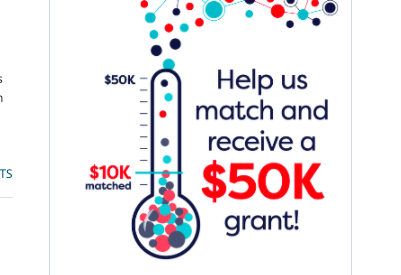
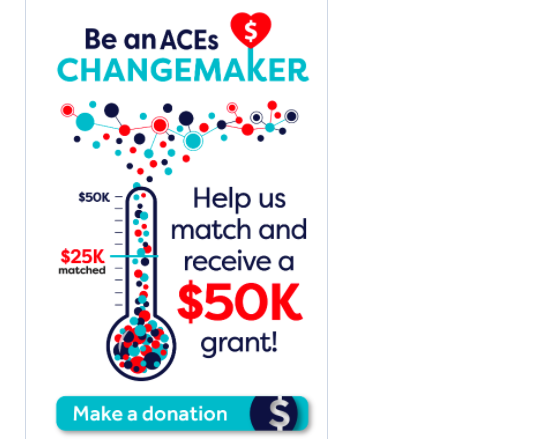
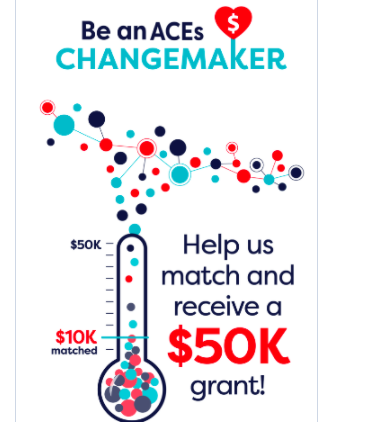
As a member of ACEs Connection, you’re invited to make a tax-deductible donation in any amount to our Changemakers Matching Grant campaign, and add your own “Why I Support ACEs Connection” essay here, on the main blog of ACEs Connection. Your essay will be identified as part of the campaign. If you believe the work of ACEs Connection has improved your life and the lives of people you care about, please join me in sharing a gift to help us raise $50,000 from our ACEs Connection community. That amount will be matched by a generous donor, who prefers to remain anonymous. The deadline for your tax deductible donation is December 31, 2020. Thank you in advance for your generous donation, your post, or both!
“This Giving Tuesday, and every day, we thank you for your support,” said members of the ACEs Connection staff on a recent “all staff Zoom.” L-R (top row) Laurie Udesky, Carey Sipp, Gail Kennedy, Lara Kain (second row) Cissy White, Rafael Maravilla, Donielle Prince, Jenna Quinn (third row) Ingrid Cockhren, (off camera) Alison Cebulla, Jane Stevens. Out that day, and grateful all the same, were Karen Clemmer, Dana Brown, Elizabeth Prewitt, Marianne Avari, and Samantha Sangenito
“We’re hoping December 1 — ‘Giving Tuesday’ — will help us show our supportive matching grant donor just how much our 48,000 members appreciate ACEs Connection. We know we are important to them in their work, their research, their personal or professional understanding of adverse childhood experiences (ACEs), their helping their communities take on their most intractable problems of racism and inequity in healthcare, education, housing, and more” said Jane Stevens, founder and publisher of ACEs Connection.
“As the Giving Tuesday campaign says, ‘Everyone has something to give and every act of generosity counts.’ We welcome gifts of any size. What is important is that we are supported, in some way, by as many member donations as possible,” she said.
So far ACEs Connection has raised just more than one-fifth — $11, 223 — of the amount needed to receive the $50,000 matching grant. The “challenge grant” offered in October by a generous donor who chooses to remain anonymous, will be given only if member donations meet the $50,000 mark, essentially turning member donations of $50,000 into a donation total of $100,000.
According to Stevens, this is the first time ACEs Connection has asked its members to support the network in its work of :
educating people about ACEs science
engaging them in the movement to prevent and heal ACEs, and build resilience
increasing the number of people who join ACEs Connection
helping communities launch and grow ACEs initiatives
providing tools to help communities measure their progress
acting as the information resource for the ACEs movement by telling its stories and providing resources.
“Front and center is our desire to understand and address the deeply ingrained problems of racism and inequity — especially economic inequity — and to work with others to tailor solutions that reflect our communities’ unique strengths, needs, and challenges,” Stevens added.
“For six years we have been fortunate to have remarkable support — financial as well as stalwart encouragement for our work — from the Robert Wood Johnson Foundation (RWJF),” said Stevens.
Funders also include The California Endowment, Blue Shield of California Foundation, Genentech, the Lisa Stone Pritzker Family Foundation, the George Sarlo Foundation, and the Cambia Health Foundation.
“Thanks to the generosity of our funders, we’ve been able to make ACEs Connection — with its vast storehouse of resources about ACEs science, the free websites for some 350 geographic communities, data tracking, reports and news — available for eight years.
“Over the next three years, we are transitioning from a combination of funding from several different foundations to a self-sustaining cooperative. By the end of that transition, we intend to derive most of our support from the ACEs Connection Cooperative of Communities. To start 2021 with an additional $100,000 would give us a significant boost toward that goal,” said Stevens of the ACEs Changemaker “challenge” grant campaign.
Going further, Stevens said, “I hope you can find it in your hearts to contribute. This support would help the organization amplify and accelerate this healing journey to replace policies, laws and practices based on blame, shame and punishment with understanding, nurturing and healing.”
“We know from the work of pioneers in the ACEs science movement that we can solve our most intractable problems in all our sectors,” Stevens said, offering examples of how the work is changing lives:
Patients and physicians can successfully manage addiction to opioids and other substances so that 100% of patients are no longer addicted and can hold down jobs.
Plymouth County, MA has an opioid death prevention program that combines law enforcement, rehab centers, and hospitals in a joint cross-sector program that has resulted in a 26% drop in opioid deaths v. an 84% increase in deaths in surrounding counties.
A stunning project in Atlanta, GA, provides a community and economic model that successfully combines for-profit trauma-informed low-income housing; health clinics that improve services for families; after-school programs in the housing project; and local gardens for families to grow their own food. Landlords make more money, kids become healthier and do better in school, schools become more successful, residents are more empowered and self-reliant, and communities become more resilient and stable.
“We have the opportunity to build on momentum to continue to report on data-driven successes, to add tools and guidelines requested by communities across the U.S., and to provide guidance to communities making substantial progress in integrating practices based on ACEs science in organizations, institutions, and systems,” said Stevens.
“We hope members will add their support, in any amount, to advance and accelerate this work,” Stevens concluded.
By Emma Dill, December 3, 2020, Wilmington Star News.
A new resiliency task force aims to make Pender County a stronger and more trauma-informed community.
The task force will focus on educating community members and local providers about the lasting impact of childhood traumas. It will also provide training that helps residents recognize and respond to signs of trauma.
Those instances of instability and stress can impact a child for the rest of their life, said Carrey Sipp, the southeastern regional community facilitator with the nonprofit ACEs Connection.
Adverse childhood experiences or ACEs affect people at every age, said Liz Peterson, the task force chair. Peterson works in 4-H development as an agent at the North Carolina Cooperative Extension in Burgaw.
For years, Black women and birthing people have been disproportionately dying during and after childbirth in a medical system that is rooted in racism. For almost as long as the disparities have existed, the problem has not received mainstream attention, sufficient philanthropic and research funding, or any corporate investment. Meanwhile, community organizers, birth activists, and others have been making a way out of no way to create and sustain community-centered solutions—from training and deploying doulas, to creating childbirth centers, reviving Black midwifery, and developing other community resources to help save Black women.
Now, at a watershed moment for racial injustice, and after an unprecedented media spotlight on this issue, which has been led by organizations such as the Black Mamas Matter Alliance (BMMA)—a national network of black women-led organizations and multi-disciplinary professionals who work to ensure that all Black Mamas have the rights, respect, and resources to thrive before, during, and after pregnancy—the issue of Black maternal mortality is finally top of mind. So are corporate interests.
(To read the rest of this post, please click here.)
By Erika D. Smith, Los Angeles Times, November 29, 2020
As a Black man and a nurse practitioner working at the U.S. Department of Veterans Affairs hospital in Long Beach, Walter Perez hears a lot of cringeworthy stuff from his Black patients.
Like how the forthcoming COVID-19 vaccines won’t be safe because Big Pharma is cutting corners to make more money. Or how the medical establishment wants to use Black people as guinea pigs to test those vaccines. Or how the vaccines could actually prove more harmful than getting COVID-19.
“We are grateful for your support,” said members of the ACEs Connection staff on a recent “all staff Zoom call”. L-R (top row) Laurie Udesky, Carey Sipp, Gail Kennedy, Lara Kain (second row) Cissy White, Rafael Maravilla, Donielle Prince, Jenna Quinn (third row) Ingrid Cockhren, (off camera) Alison Cebulla, Jane Stevens. Out that day, and grateful all the same, were Karen Clemmer, Dana Brown, Elizabeth Prewitt, Marianne Avari, and Samantha Sangenito
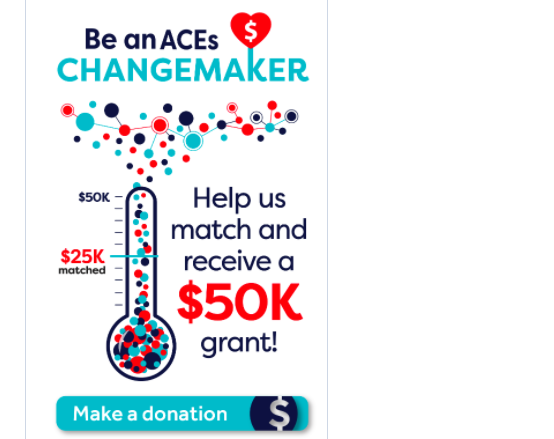
‘Tis the giving season, and as of mid-December ACEs Connection is at the halfway mark — $25,000 — toward our goal of raising $50,000 in donations to match the contribution of a generous funder. “We are thrilled that our community has responded so generously to our requests for donations,” said Jane Stevens, founder and publisher of ACEs Connection. “Your gift is important because If we raise $50,000 in member donations, a generous anonymous donor will match the amount, dollar for dollar, so your gift will be doubled.”
More than 110 members of ACEs Connection have used the online giving option to make their donation. Gifts have ranged in size from $1000 to $5. As Stevens says, “No gift is too small. Our matching gift donor is looking at this as another way to build community, in addition to our ability to raise the $50,000, so I want members to know that a gift in any amount is appreciated.”
While ACEs Connection staff will be taking a break during the holiday season — our Daily Digest and Weekly Roundup will go on hiatus until Jan. 4, 2021 — our online donation option remains active.
“We want to model what a trauma-informed organization looks like by truly taking some well-deserved time off during the holiday season,” said Stevens,
“This year proved beyond the shadow of a doubt that the science of adverse childhood experiences (ACEs) is at the nexus of the loss of life during the pandemic, the racism driving civil unrest, and the wrenching fear, poverty and despair experienced by millions due to the economic downturn,” said Stevens.
“We have been out front during this time. Our staff has been posting reports on the ACEs, resilience, the pandemic, racism, and poverty from every corner of our nation and the world. We’ve been gathering the stories from your communities; researching and reporting the data that show how being a person of color and living in poverty — both environmental ACEs — has disproportionately affected Black, Latinx and Indigenous people,” Stevens added.
In March, ACEs Connection responded to the popular question of “When will things get back to normal?” by saying “We need a better normal.” “The normal we had wasn’t working for most people in the U.S. So, we created ‘A Better Normal’ webinar series to shine a light on the problems being surfaced by the pandemic and the death of George Floyd so that we could share solutions, expertise from our vast community of members, and hope,” said Stevens.
“We hosted more than 65 webinars over the last nine months, in addition to several more on starting and growing ACEs initiatives, the Community Resiliency Model. Of those, 27 ‘Better Normals’ focused on re-imagining education in our ‘Education Upended’ series,” said Stevens.
In addition, the ACEs Connection “community of communities” has grown during the pandemic, now totaling 348 geographic communities and some 40 interest-based communities.
“In short, it has been a demanding year. We’ve grown our membership base to almost 49,000 members, and added to our followers on YouTube, Twitter, LinkedIn, FaceBook and Instagram.
We’ve worked hard on reporting about policy and advocacy, science and community successes. It’s time for us to practice what we preach and take a rest, and we encourage members to take time to rest and recover from the challenges this year brought, too, if possible.” said Stevens.
ACEs Connection will share its last Weekly Update for the year Wednesday, December 16, and its last Daily Digest on Friday, December 18.
“The website will be up and monitored. It is likely that members will continue to post, and that despite time off, some staff will be compelled to post updates as well,” said Stevens. Further, “The matching grant campaign will be extended to January 31, 2021, so we will start the new year with new videos and stories on why our supporters support us.”
For those of you who would like to mail a check, here is that information:
Please make the check out to TSNE (For Third Sector New England, our fiscal partner) and on the “for line” please note “for ACEs Connection.” The address to send the check is
Christine Carreiro ATTN: ACEs Connection TSNE MissionWorks 89 South Street Suite 700 Boston, MA, 02111
If you would like to post a two-to-three minute video about “Why I support ACEs Connection,” you are invited to do so. If you’d like to make a video, please use Zoom to record it, and email it to Carey Sipp at csipp@acesconnection.com, for review and posting after January 4, 2021. Please put “Why I Support” video in the subject line of the email.
Speaking on behalf of the ACEs Connection staff, Stevens said: “We wish all of you health, peace and happiness as 2020 draws to a close. We know that 2021 will be a better year.”
Southeastern ACEs Connection and national CTIPP leaders on the quarterly leader call welcomed guest speaker Rebecca Lewis-Pankratz (top left) for their quarterly call. Also among those present were (top row l-r) Carey Sipp, Jesse Kohler, Jesse Hardin, (second row, l-r) Patti Tiberi, Mebane Boyd, Jen Drake-Croft, Dan Press, (third row, l-r) Mimi Graham, Christopher Freeze, Margaret Stagmeier, (fourth row, l-r) Emily Marsh, Liz Peterson, Alyssa Koziarski and Janet Pozmantier. Also present was Caitlin LaVine. Dorothy Oppenheiser was among those calling in for the meeting.
Learning ways to help people walk out of the trauma of multi-generational poverty and abuse to create their own destinies and build new lives, representatives from 10 Southeastern states met last week to hear inspiring remarks from a formerly impoverished mom of three sons.
Participants on the ACEs Connection/CTIPP Southeastern Leaders call also updated the group about work being done in their states.
Rebecca Lewis-Pankratz, who transformed her own life and is now an educational and poverty consultant, was the educational speaker. Dan Press, general counsel for CTIPP (the Campaign for Trauma Informed Policy and Practice), said his “mind was blown” by Lewis-Pankratz’s story and methodology for helping people leave behind generational poverty and trauma.
“What you are saying is revolutionary,” he said. “All lobbyists in (Washington) D.C. will grit their teeth when they hear this. They say people whose brains are disabled by poverty aren’t going to be able to get out of poverty.”
Walking families out of poverty
Lewis-Pankratz’s story mesmerized those on the call, as they heard her explain the impact of trusting, stable relationships on her growth. She talked about living with three little boys in a $1,000 mobile home “that should have been condemned” as she struggled to complete a four-year degree and keep her kids in diapers.
“That trailer was what stood between me and homelessness. I’d been working nights as a bartender and had been in college almost a decade to get a degree and become a high school art teacher. I’d been clean and sober for about seven months, but bone-crushing poverty kept spinning me back,” she said.
Things started shifting when Lewis-Pankratz went to a church for some free diapers.
“A lady there took a shine to me. I told her I wanted to give back so other moms could get the same help. She pointed to a flyer about a class on getting out of poverty and I asked her what they could teach me that I was not already doing. But I figured this lady had been giving me free diapers so I had better sign up.
“When I bumped up against people working to get people out of generational poverty, my world changed. I got a position at that nonprofit,” she said. Later, she left to start a ministry of her own.
“In college I learned about the science of brain architecture – that by five your brain is set. Zero to five years was not good for me. And I had a strong history of using alcohol and drugs. But I got involved in this nonprofit that was really intentional about building relationships between people in poverty and middle-class people as a way of helping poor people get out of poverty.
“So I was surrounded by middle-class women supporting me. And I began to see a way forward, to feel less reactive, to be able to walk into large groups of people. I realized something was happening to my brain,” Lewis-Pankratz said.
She explained that in looking at the brain science of poverty and the brain science of trauma, “the pictures of the brains are the same. The brain doesn’t know whether it is in war or abuse, the brain is just stressed.”
Families in poverty “are always in toxic stress, always spending more time in survival,” she said.
“I have eight ACEs and my mom has nine,” Lewis-Pankratz said. “I was working with 35 families and all but one had high ACEs scores. When I fell into the science of resilience, I found my brain healing at the age of 37, and it was because of relationships people had created for me before they knew me. The science of resilience became my hope, as I learned it was all about relationships,” she said.
Over the last nine years, Lewis-Pankratz has helped teachers and administrators in hundreds of schools learn about ACEs and brain science. She has personally nurtured trusting relationships to help 90 families walk out of poverty.
Carey Sipp, Southeastern Community Facilitator for ACEs Connection, noted that there were two people on the call whose work is about stabilizing families by building trust and relationships. She connected Lewis-Pankratz in Kansas to Margaret Stagmeier, who started a revolutionary “edu-housing” program in Georgia, saying she looked forward to seeing what these two innovative thinkers can do together to provide traumatized people with opportunities to become stable, and improve the lives of their children and themselves.
“When people know stability and safety, when they are in relationship with people who have middle-class lives, who will help them gain confidence in themselves, we are preventing trauma, healing trauma, building resilience,” Sipp said. “I look forward to the day all communities are consciously doing this kind of work.”
State updates
Others on the call shared these updates from their states:
Alabama:
Emily Marsh, public and governmental affairs manager at the Alabama Department of Child Abuse and Neglect, reported that the state’s mental health grant in Alabama has been extended through 2021.
The Department of Mental Health funded training on trauma-informed care, ACEs science, strengthening families, and protective factors at home. she said. Her group did 22 trainings from June-September, and next year will target workers in mental health as well as teachers, law enforcement and counselors.
Marsh said the Department of Mental Health had been complimentary of the work done. “We will continue to partner with the Alabama Network of Family Resources, so this is good news.”
Florida:
Mimi Graham, Ph. D., director of The Center for Prevention and Early Intervention Policy at Florida State University, said that she and Andy Blanch, Ph.D, president and director of the Center for Religious Tolerance, will speak next May on CTIPP’s national call about a new tool, created in Florida, for trauma assessments.
“There are agencies that say they are trauma informed, but they are separating breastfeeding moms from babies, or children from parents. This new tool for trauma assessment of agencies (reviewing agencies in person in addition to other assessments) will help agencies become more trauma informed,” Graham said.
Georgia:
Resilient Georgia’s executive director Emily Anne Vall, Ph.D. was not on the call but she sent a report outlining highlights of work going on in the state. She said the eight Resilient Georgia regional grantees are doing fantastic work in their communities.
They are currently meeting with stakeholders from across the state to identify partners that can work together to create action plans for their next two rounds of grantees.
“The Resilient Georgia Trauma Informed Training Road Map is up and running, and available for all states to peruse. A copy of the survey they sent out that informed this work is on this webpage, too,” Vall wrote.
Margaret Stagmeier, founder and board chair of Star-C, a nonprofit working to stabilize rents and transiency in workforce housing communities, spoke briefly about her work with the residents at two of the blighted properties she bought, repaired and cleaned up. “When we started, we didn’t realize how traumatized these families are,” she said. “Since we began putting the lens of ACEs (adverse childhood experiences) over the community, I now understand what better to do. First get rid of crime. Then get an after-school program with social emotional learning,” she listed as a couple of the steps along the path of helping families, apartment complexes, and nearby schools become more stable.
Kentucky:
Carey Sipp, Southeastern Community Facilitator for ACEs Connection, shared that work to build a statewide structure in Kentucky is underway. Meetings with leaders from Kentucky Youth Advocates and other organizations are scheduled for the second week of January.
Mississippi:
Chris Freeze, a trauma-informed business consultant, will soon be working with statewide community manager Jackie Chatmon, System of Care project director at the Mississippi Department of Mental Health, to further activate the state.
North Carolina:
Mebane Boyd, executive director of the New Hanover Resiliency Task Force, said the Resilient North Carolina Collaborative is meeting with trauma-informed leaders throughout the state to coordinate advocacy efforts, to “find a way to align our advocacy and prioritize what might be best, so we are all asking for the same thing.” She said the group will be doing a training in early 2021 on how to do advocacy, who to contact, when and how to organize.
CTIPP general counsel Press said North Carolina’s Sen. Richard Burr will be either the chair of the Senate Health, Education, and Labor Committee or the ranking minority leader of that committee, depending on what happens in the upcoming Senate runoffs in Georgia. “Either way, he will be influential, and we need trauma-informed programs to educate him and his staffers,” Press said. There will be a call with North Carolina leaders the first week in January to put together a strategy to reach out to Burr.
South Carolina:
Alyssa Koziarsky, research and evaluation assistant at the Children’s Trust of South Carolina, said the Children’s Trust, which leads the South Carolina ACE initiative, is sharing its COVID-19 Impact on Children’s Well-Being Data Snapshot.
The report discusses disparities in housing, health care, and economic opportunities, and sheds light on the importance of protective factors. “We have been working on this for months,” she said. “Now we are providing advocacy steps for how to provide local supports. We are excited about this and will be sharing it out with legislators in January.’’
Tennessee:
Jennifer Drake Croft, director of child well-being at the Tennessee Commission on Children and Youth, said there is a new phase of strategic planning for the state’s signature Building Strong Brains Tennessee program. The goal is to establish Tennessee as a national model for how a state can promote culture change in early childhood, based on a philosophy that preventing and mitigating adverse childhood experiences, and their impact, is the most promising approach to helping Tennessee children lead productive, healthy lives and ensuring the future prosperity of the state.
The group is bracing for the possibility of major funding cuts. There are now some 1,252 diverse sector trainers for the Building Strong Brains program, representing all 95 counties in the state. The Department of Education has received approval for a second cohort of schools to become trauma-informed, the Department of Health has been through strategic planning and named ACEs as a priority, and the Building Strong Brains program will now be shared as part of training for foster parents.
Croft said Tennessee has been invited to the National Governors Association meeting to share a presentation on their work in adverse childhood experiences. She also said that East Tennessee State University has founded the Strong BRAIN (Building Resilience through ACEs Informed Networking) Institute, which is an ACEs Center of Excellence working with organizations to transform policies, procedures, and philosophies to promote resilience and mitigate the effects of ACEs.
The Commission on Children and Youth is executing a social media campaign following the success of last year’s campaign, which reached 500,000 people. The new campaign will raise awareness of the importance of brain development and preventing toxic stress. “We will be publishing a toolkit that people from other states can adopt for their use – this is coming,” Croft said.
Among updates from Nashville, Croft said that Ingrid Cockhren, ACEs Connection Community Facilitator for the Midwest and Tennessee, has been doing a community education series for parents, and that the ACE Nashville team, with some 400 members, is focusing on equity within the membership and the leadership team.
Texas:
Janet Pozmantier, nonprofit consultant and trainer, and Jullian Gaut, social worker, have been working with Sipp to create a survey that will live on the Texas ACEs Connection site. A link to the survey will be emailed to the more than 1,000 Texas members of ACEs Connection, to help leaders identify and connect with ACEs initiatives throughout the state.
Kohler said that there is a social media campaign to help CTIPP add to the number of people signing versions of the letter. “If you still want to sign on, just email me to be added,” he said. His email address is jesse@traumacampaign.org.
Press encouraged attendees to alert him if they know of any state legislators who are trauma informed, as he would like to invite them to join the CTIPP Community Action Network.
Federal funding update
Press urged the group to try to secure some of the money that states and communities soon will be getting through the resolution of opioid lawsuits.
“You should start looking into this,” he said. “Right now, most of the money will be spent on people who have already suffered. Some of this funding needs to be spent on preventing trauma, and on building resilience. You are encouraged to find out where the money is going and get in there and advocate for a portion to be used for prevention and for resilience building.”
Press also shared that CTIPP is exploring ways to finance trauma-informed programs that don’t rely on government funding, because governments are running out of money. “One of the things we need is evidence that trauma-informed programs save money,” he said. “We know schools implementing trauma-informed programs have fewer discipline issues and less teacher turnover, fewer security guards, and more kids in seats, so they receive more money because attendance is better.
“We are having trouble finding good hard data. If any of you have actual hard data, we think we have people ready to invest in trauma-informed programs that can be paid back over time.”
Monthly call schedule
Here are the upcoming calls, with educational topics, for the CTIPP Community Action Network (CAN). Calls are the third Wednesday of each month from 2-3:30 p.m. EST, except for January 2021, as that’s the day Joe Biden and Kamala Harris will be inaugurated.
Jan. 27 – East Tennessee State University and Southern Oregon University are becoming trauma informed; representatives from the two schools will share what they are doing to facilitate the transitions.
Feb. 17 – Delaware First Lady Tracey Quillen Carney will talk about Delaware’s becoming the first trauma-informed state in the U.S.
March 17 – A representative from England’s WAVE Trust will discuss the initiative working to reduce child abuse by 70 percent in 10 years, and how Great Britain and the U.S. can work together.
April 21 – Rebecca Lewis-Pankratz will elaborate on how she and her organization are helping some 235 families break out of the multi-generational cycle of poverty and trauma.
May 19 – Mimi Graham and Andy Blanch will share information about a new program involving in-person trauma assessments of agencies to help them become more trauma-informed.
Upcoming SE leader calls
The next ACEs Connection SE Leader quarterly call is scheduled for Tuesday, March 2. Subsequent calls will be on for June 15, September 21, and December 21. All calls are from 2:30-4 p.m. EST.
To learn more about CTIPP, Rebecca Lewis-Pankratz, or Margaret Stagmeier:
By Gene Nichol, The Charlotte Observer, December 28, 2020
It doesn’t happen as often as one might wish. But, on occasion, you can still be surprised by what someone says. For example, earlier this month, the Donald Trump-appointed Chair of the Federal Reserve, Jerome Powell, explained to the Senate Banking Committee:
“Disparate economic outcomes on the basis of race, have been with us for a very long time, they are a long-standing aspect of our economy, and there is a great risk that the pandemic is making them worse. Because the people who are most affected by the job losses are people in relatively low-paying parts of the service industries that happen to skew more to minorities and women, there is a real concern that if we don’t act as quickly as possible to support these people then we’ll leave behind an even more unequal situation. We need to do as much as we can to avoid exacerbating inequality.”
Seriously, the guy Bloomberg News calls “Wall Street’s Head of State” lectured the country on the challenges of economic justice. Man.
The traditional patterns of racial economic subordination Powell referenced have long dominated every component of life in North Carolina. Today, for example, twice as many African-American Tar Heels live in poverty as whites. The numbers are even worse for Black kids – nearly three times as many are poor as whites.
Racial income disparity is huge. But racial wealth disparity astonishes. Black households, on average, claim less than a tenth of the economic assets of white Tar Heel families. Racial minorities are dramatically more likely, in North Carolina, to be unemployed, uninsured, food insecure, housing insecure, and trapped in low wage work. Such defining disparities have existed throughout the entirety of our state’s history. Radical, systemic, disproportional racial economic impact, as Chairman Powell put it, has “been with us for a very long time.”
 Carey Sipp 9/22/207:58 PM
 ACEs Connection launched in January 2012, and over the last eight years, has become one of the leaders in the ACEs movement, thanks to the tens of thousands of people and hundreds of communities who’ve joined and accelerated the spread of knowledge about childhood adversity. People in this movement have also developed innovative approaches using ACEs science to help people turn despair into hope, hate into love, and inspired them to pass on that knowledge and wisdom.
 educating people about ACEs science