Calliope Holingue is researching the microbiome among kids with autism. She’s part of a growing field of research seeking to understand the gut-brain axis. Kennedy Krieger Institute
By Joanne Silberner, National Public Radio (NPR), July 8, 2023
Sixteen years ago, when Calliope Holingue was in high school, she had a problem. Two, actually. She developed gastrointestinal symptoms severe enough to force her to give up running, plus she had a long history of anxiety and obsessive-compulsive disorder.
“And I wondered if maybe there was a link between my mental health and the GI symptoms I was experiencing,” she recalls now.
Her doctors shrugged off her questions. “That led me to start reading a lot about the gut microbiome, the autonomic nervous system, and their connection with the brain and mental health,” she says.
(This is a review of what I believe is an important new resource for the PACEs [for positive and adverse childhood experiences] science movement. Opinions expressed are my own, and are shared as a parent, advocate, author, and longtime student of trauma, healing, and prevention. Thoughts are also shared through my lens as someone who believes, deeply, in the incredible importance of and value in building healthier, more compassionate communities to support and nurture pregnant and new mothers; new parents and caregivers; young families. Full disclosure: Deborah McNelis’s company, Brain Insights, will soon be listed as a PACEs Connection partner, and is donating to PACEs Connection 5% of the profits from the sale of materials sold to our members or member organizations.)
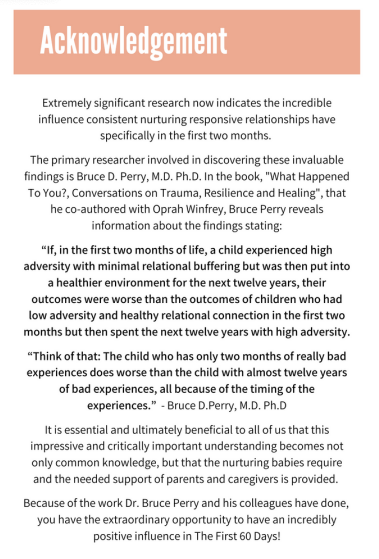
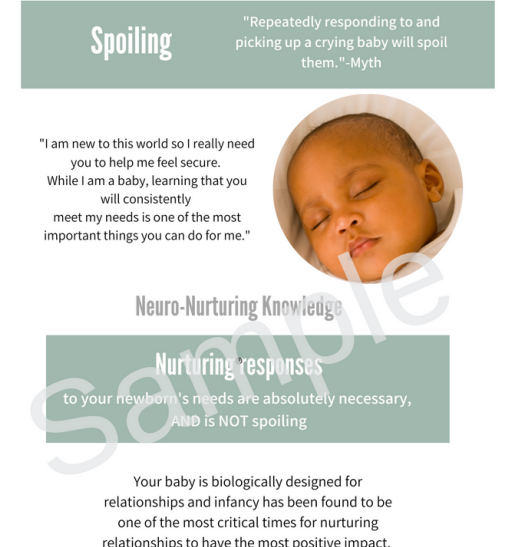
Deborah McNelis’s newest offering, “The First 60 Days,” booklet (link is to a 12-page sample) is her heartfelt response to groundbreaking research by Dr. Bruce Duncan Perry and colleagues showing the negative developmental impact of toxic stress the first two months of life, and the importance of practicing what she calls “Neuro-Nurturing ®” during this influential time in infant brain development.
Her booklet dispels 22 potentially harmful myths about caring for newborns, among them:
Repeatedly responding to and picking up a crying baby will spoil them.
Just like the heart is fully developed at birth, the brain is fully developed.
Babies are too young. They don’t know what is happening.
Rocking the baby creates a bad habit.
Your level of stress doesn’t matter to a baby.
If left alone babies will learn to self-regulate.
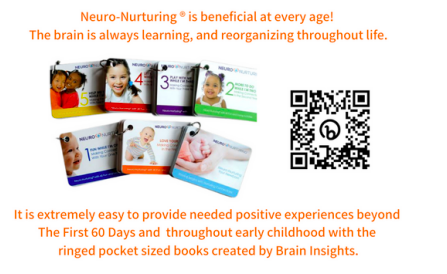
While it is not hefty, the booklet is packed with research-based recommendations, and is the capstone to McNelis’s decades of work with children and families. Over the course of some four decades in education, family support, and community building work, she created and introduced her “Neuro-Nurturing ® series of ringed, pocket-sized books, filled with loving and easy activities for caregivers to use with children at each age and stage, from newborn through age five. (These are books I definitely would have loved to have had when my children were young!)
What about those of us who didn’t necessarily have a Neuro-Nurturing ® start? Or children who may have experienced a lot of trauma? Or professionals who work with people who’ve experienced developmental trauma?
In their New York Times best-seller, Perry and Winfrey share ways to help heal Complex Post Traumatic Stress Disorder (C-PTSD) and Post Traumatic Stress Disorder (PTSD).
They also share causes of trauma as well as many ways we can help prevent it, including nurturing infants and children, building more compassionate communities, and being aware of the impact of racism and working to prevent it.
Those are parts of “What Happened to You?” that I loved most, so much so, in fact, that I have given away about twenty copies of it, reviewed it here on PACEs Connection, and last summer, with the help of partners including the Children’s Trust Fund Alliance and Prevent Child Abuse Georgia, helped drive a national book study of it, resulting in about 140 community-led book studies. That effort also resulted in a PACEs Connection webinar with Perry and PACEs Connection CEO Ingrid Cockhren and director of outreach and education Mathew Portell.
McNelis’s ringed books, though first published in 2008, show a mindfulness to racial diversity that was not often seen 15 years ago. The origin of the ringed books is quite dear, too.
“As a kindergarten teacher for 10 years, I was constantly asked by parents about what to do with their new babies and toddlers, the siblings of my students. So I created index cards of activities to promote bonding, fun, and love – by age and stage – and shared the cards to provide quick and easy answers. And that is how these popular ringed booklets came to be,” McNelis said.
We’d likely see a reduction in violence, child abuse, neglect, learning delays, school expulsions and suspensions, crime, domestic violence, poverty, racism and more.
Love begets love. Regulation begets regulation.
We have the resources to have a world influenced by Neuro-Nuturing ®, which could help babies receive the relational support science demonstrates helps promote healthy brain development and secure attachment.
A prediction?
I believe we’ll be hearing much more about the importance of the first two months of life from Oprah Winfrey, Perry’s co-author and friend of more than three decades, whose excitement in finding out about the adverse childhood experiences (ACEs) Study in 2018 is likely matched by her learning about Perry’s research on showing the importance of a baby’s first two months.
One of the key findings? An infant who has healthy relational connections the first two months of life and has high adversity the next 12 years will likely have a better outcome than the infant who has really bad experiences first two months of life and a healthy environment the next 12 years.
“Think of that,” Perry wrote in “What Happened to You?”.“The child who has only two months of really bad experiences does worse than the child with almost twelve years of bad experiences, all because of the timing of the experiences.
He continued, “This sounds discouraging, But we believe that poor outcomes are not inevitable; in fact, we believe that this is a perfect example of why we need developmentally informed, trauma-aware systems,” he said in the book.
Winfrey’s excitement about learning this information is palpable in the video clip below. In it Winfrey says she would be “so satisfied” if she could get the message out about the importance of the first two months of life.
As a society, we need to take our claims that we love our children and make them so!
If you are having a baby, have young children, or know people who’re having having a baby, consider these materials as a gift to yourself and your family, or as the perfect baby gift.
If you’re on a hospital board, or own a business having anything to do with children, consider buying the materials in bulkand customizing them with your logo. This also applies if you are part of an advocacy agency or organization, a medical practice, or community group. Or if you are a policymaker or work in city, county, or state government.
According to McNelis, “The materials are impressive promotional items that grab attention for your efforts, while contributing to a positive influence. State agencies, zoos, an Audubon Society chapter, health organizations, and more have bought these items as ‘premiums’ for new and expectant parents, as well as parents who needed parenting support. One state agency bought 47,000 sets and customized them with their logo.
“Visiting nurse organizations, a state representative who is also on a hospital board, judges and people in law enforcement are interested in the booklets for incarcerated mothers, foster parents, parents needing support,” she added.
Further, McNelis is donating five percent of the net profits from sales of the materials to PACEs Connection, when you mention PACEs Connection as the way you found out about her work.
For more information about ordering “The First 60 Days” booklets or the “Neuro-Nurturing ®” ringed books, please visit the Brain Insights website, or email McNelis at deb@braininsightsonline.com to receive your quantity order discount code.
By Steve Taylor, Image: Prachatai/from Flickr and Wikipedia, Psychology Today, July 26, 2023
After studying children brought up in orphanages and other institutions in the 1930s and 1940s, the British psychologist John Bowlby developed his maternal deprivation hypothesis. He suggested that if a young child’s attachment to a mother figure is broken, this is likely to severely damage their social, emotional, and intellectual development. A lack of attachment could result in what he called affectionless psychopathy, the inability to empathise with other people or to form meaningful relationships.
Certainly, as Bowlby’s theory predicts, a common theme of people with psychopathic traits is traumatic and emotionally deprived childhoods. In DisConnected, I refer to such people as hyper-disconnected. They are completely self-absorbed and detached from others, treating their fellow human beings as objects. I examined the childhood experiences of serial killers and fascist dictators and found a pattern of severe childhood trauma and neglect.
Serial killers such as David Berkowitz, Ted Bundy, and Joel Rifkin were rejected or abandoned by their mothers. The female serial killer Aileen Wuornos (portrayed by Charlize Theron in the film Monster) was abandoned by her mother at the age of 4 and raised by her grandfather, who abused her physically and sexually. A recent study found that 50 percent of serial killers experienced psychological abuse during childhood, while 36 percent experienced physical abuse, and 26 percent experienced sexual abuse.
By Daniel Amen, Image: Chelsea Victoria/Stocksy, mindbodygreen health, August 2, 2023
Your childhood upbringing plays a major role in your brain development. If you grow up in a happy, functional home, it supports the developing brain. However, when you experience childhood trauma—such as the death of a parent, neglect, sexual abuse, or other traumatic incidents—it negatively impacts the way your brain develops. Sadly, this can have lasting consequences on your mental health and cognitive function.
What are adverse childhood experiences?
Adverse childhood experiences, or ACEs, continue to affect people in adulthood. Many adults with emotional issues don’t realize that the traumatic experiences from their childhood are at the root of their problems. And they certainly don’t understand that those incidents changed the way their brain functions, which further contributes to their ongoing mental health issues.
The neurobiology of ACEs doesn’t get discussed enough, so I appreciate this article. That said, I have a different perspective than the author’s, which has more of a pathologizing tone that I like. My Western medicine training is based on the model that the patient I serve has pathology and that they need me to fix them, often with medications, surgeries, or injections. I have used my more recent trauma-informed approach with the PACEs science education I’ve had to recognize that the person who was exposed early in life to too much adversity without enough support has a brain that adaptively develops in a way to make their body really efficient at responding to potential threats/stressors. This adaptation makes sense, given that babies are born to be experience-dependent in our development. It also reframes the situation in a way that we now are appreciative of the body doing what it can to protect us, as opposed to “there’s something wrong with me”. A crucial additional point to make is that the traumatic world we all live in now is regularly triggering all of us, potentially more so in people whose brains are efficient at going into survival states.
As American returns to school, “History. Culture. Trauma.” podcast hosts Ingrid Cockhren, PACEs Connection CEO, and Mathew Portell, director of communities, continue with their series of education-related, back-to-school podcasts.
The second installment features an encore episode award-winning “relentless” school nurse, Robin Cogan, MEd, RN, NCSN, FNASN, FAAN.
“In recent years, COVID-19, school shootings, affirmation of the identity of LGBTQ students, institutional racism, critical race theory, teacher burnout and parent’s rights have transformed America’s schools into traumatizing places and cultural battlegrounds. As a result, students, teachers and administrators are experiencing poor mental health, traumatic stress and burnout,” said Cockhren.
To determine how our nation’s schools have come to this point and what can be done about it, Cockhren and Portell interview school professionals to discuss the school experience of educators, parents, students, staff and medical professionals from a trauma-informed perspective. Podcasts in this series focus on a variety of topics, including historical trauma.
Cogan is a Nationally Certified School Nurse (NCSN) in her 23rd year as a New Jersey school nurse in the Camden City School District. She has served as the New Jersey State School Nurses Association director to the National Association of School Nurses. She, Cockhren, and Portell discuss concerns and opportunities and the need for trauma-informed supports and solutions.
To listen to Thursday’s podcast at 1 p.m. PT, 4 p.m. ET, click here.
To hear prior episodes via your favorite podcast service, use the links below.
Longtime donor to and friend of PACEs Connection, Chris Freeze, who is also a former FBI Special Agent-in-Charge and current Ph.D. candidate at the University of Oklahoma, needs our help to complete an online survey on employee perceptions of leadership, hope, and well-being.
The survey is designed to identify ways in which leaders can help improve the well-being of employees by reducing burnout and increasing job satisfaction.
According to Freeze, who is studying under Chan Hellman, PhD, director of the Hope Research Center at Oklahoma State University, your perceptions will be very useful to this research.
Freeze invites you to share your experiences through the survey which can be accessed through the link or QR code below.
Further information about the research and your rights can be found in the online consent form as part of the survey.
Participation is voluntary.Participants will remain anonymous, no identifiable information is being collected, and no reports identifying any employee will be provided to any of the organization’s leaders.
Any information that is collected as part of your response will remain in a secure and safeguarded location.
The deadline to participate is August 31, 2023, but responding early would be most welcome.
To access the survey, please click this link or enter it into your web browser: https://bit.ly/43ISs8Sor scan this QR code with your mobile device:
By Robert Goldman, Photo: Unsplash, Psychology Today, August 20, 2023
“I am resilient, I went to medical school, don’t fix me, fix them.” This was recently stated to me at a resilience training for physicians. Similar words have been thought or stated by other employees tired of another wellness program they have been “asked” to attend. Under the great resignation, there has been an increased awareness and investment by companies on employee wellness programs. While well intentioned, they often miss the mark.
There has been much written and researched about individual resiliency, especially since COVID first appeared on the scene. The lines between individual resilience and a resilient workplace have become blurred. For that reason, it is necessary to differentiate between individual resilience and a resilient workplace.
Resiliency is the ability to bounce back and withstand life stressors. This ability has mostly been measured in terms of individual resilience. However, when it comes to teams and organizations such as sports, the term “resilience” also appears. For example, the story of the 1969 Mets and the 1980 USA Hockey “Miracle on Ice Team” are examples of how the respective teams defied the odds to “win it all.” But when it comes to work, much of the research and literature focuses on individual employee resilience as opposed to overall workplace resilience.
Photo above is of the PACEs Connection staff as we said goodbye to Jane Stevens, PACEs Connection founder and former CEO and publisher, on her transitioning to her new role as publisher ofACEsTooHigh, which was spun off from PACEs Connection on May 1. The eight staff members left in this photo curate and maintain the website, calendar, enewsletters, podcasts, webinars, maps, schedule of Creating Resilient Communities classes, membership profiles and more! They are, top row, l-r, Kahshanna Evans, director of Creating Resilient Communities; Carey Sipp, director of strategic partnerships; Jane Stevens, founder and former CEO, now retired; second row, l-r, Ingrid Cockhren, CEO; Rafael Maravilla, network manager, and Mathew Portell, director of education and outreach; third row, l-r, Jenna Quinn, program coordinator, environmental justice consultant; Porter Jennings McGarity, director of continuous quality improvement and community data, and Tawana Irvin, chief administrative officer.
“As long as I have worked here, I’ve only met two of my colleagues in person. There will always be a barrier that exists when the only way you are able to communicate with someone is through a screen.”
Did you know PACEs Connection …
Is a community of communities that’s raised awareness of the science of adverse childhood experiences (ACEs) for 11 years? In 2020, when we changed the name to PACEs Connection, we started cementing the importance of positive and adverse childhood experiences (PACEs) across all sectors, including journalism, policy and legislation, medicine, education and law enforcement, as well as the faith-based, parenting, LGBTQAI+ communities, and more. Our community of communities is now almost 60,000 strong!
Is home to 400 cross-sector (involving at least three sectors, such as education, healthcare, communities of faith, government) geographic, and 40 interest-based sub-communities. Tied together by our site, the communities help members find each other, promote their work on their respective free websites, leverage the network, use our social media tools, and more, to learn and share information.
Brings you the latest news on PACEs science viaour e-newsletters, the stories we write, the plethora of articles, videos, and resources we curate and post daily, and the monthly Research Corner, filled with the latest peer-reviewed scientific journal articles shared with us by Dr. Harise Stein, a medical doctor and Stanford University professor. We also create and share our ownwebinars andconferences, our History. Culture. Trauma. podcasts, our Historical Trauma in America series, plus the 25 Creating Resilient Communities (CRC) educational webinars staff members present each month. We also offer – again, at no charge – our Resource Center, modeled after those used in public libraries, and offering a wealth of free resources (many in Spanish and English) used by schools, parenting groups, community outreach programs, colleges, universities, physicians’ offices and more.
Connects members of our Cooperative of Communities for our coast-to-coast think tank, and gives members access to your posts, questions, conference and event promotions, comments, and more. It’s a platform we monitor closely to keep as a safe space for our members – including ourselves. It’s also a tool members use to calendar, market, and build businesses, promote themselves as subject matter experts, and promote podcasts, workshops, conferences, goods and services. We are delighted to have played a role in your success! With that thought in mind, this is also where we recently shared news of our own offerings in professional development and consulting, and invited you to reach out to Ingrid Cockhren, our CEO, for more information on our services, which started with diversity, equity, inclusion, and belonging work.
Is actually run by a lean and scrappy team of just eight dedicated individuals? That’s right. All of this work, and more, is done by just eight people!
Surprised?
We know this work is important to many of our almost 60,000 members, because you, too, share blog posts about your work, your events, your experiences.
We are your conveners, offering this home to post and process, to relate, to learn how to regulate, and reason, and to find membersin your own state – and possibly right down the street – who care about the same concerns you do!
Here, each month, there are more than 2.5 million page views!
Some of our members may well have been able to launch or sustain businesses in large part because PACEs Connection has helped them get the word out about trainings, podcasts, webinars, books, public speaking, recovery programs, and more.
Again, this is a service we have loved to provide – with no subscription or membership fee – since 2012.
It’s time, though, for us to make a special request of you. It’s not a heavy lift.
You see, we’d really like to meet each other in person! And we’re hoping you, our readers, members, frequent users, and friends, will support this request by making a tax-deductible contribution to PACEs Connection that will help us connect, in person, later this summer.
Half of us have never met another staff person! And most of us who have met each other haven’t seen each other in five years. Truth? We would deeply appreciate the time to meet each other, connect, work together on some important planning, and have some recreation and restoration time together. All so we can keep improving what we deliver to you, every day.
When asked why they are eager to have a staff retreat, comments included:
“Fresh ideas come when folks can hang out for some team building and fun. Spending time in 3-D is really important for developing trust and bonds with each other.”
“We’ve accomplished so much on a strictly virtual platform. We need to have some in-person bonding. The pandemic showed the world that having human interaction every now and then is necessary; this retreat will support that!”
“We need a work retreat to support healthy team collaborations, to have the opportunity to step away from our daily routines and stresses, and allow many of us to talk face-to-face for the first time ever, build understanding, and foster a stronger, more cohesive team culture.”
“Empirical evidence underscores the importance of investing in practices to foster healthy team building, especially in non profit organizations. Such activities help unite a team, which helps the team fulfill its mission.”
With your help, we’re hoping to raise about $20,000, enabling staff from California, Massachusetts, New York, North Carolina, and Tennessee, to travel and connect for three days of strategic planning, solution seeking, getting to know each other, and bonding.
Would you be willing to help us connect as we work to improve the work we do for you, our members and readers?
Your donation is tax deductible. You may donate online, or to mail your donation, please make your check payable to: TSNE (Third Sector New England, our fiscal sponsor) and write PACEs Connection Donation on the memo line.
Mail check to:
PACEs Connection, c/o TSNE, 89 South Street, Suite 700, Boston, MA 02111
To wire transfer funds, or if you have questions or comments, please email me, Carey Sipp, director of strategic partnerships, at csipp@pacesconnection.com, or email Ingrid Cockhren, our CEO, at icockhren@pacesconnection.com with the subject line: In-person staff meeting.
Thank you in advance for your support!
Your support of our work is greatly appreciated. Please click here to donate today.
By Linda Geddes, Illustration: Joel Burden/The Guardian, The Guardian, August 23, 2023
I’ve made a cup of coffee, written my to-do list and now I’m wiring up my ear to a device that will send an electrical message to my brainstem. If the testimonials are to believed, incorporating this stimulating habit into my daily routine could help to reduce stress and anxiety, curb inflammation and digestive issues, and perhaps improve my sleep and concentration by tapping into the “electrical superhighway” that is the vagus nerve.
From plunging your face into icy water, to piercing the small flap of cartilage in front of your ear, the internet is awash with tips for hacking this system that carries signals between the brain and chest and abdominal organs.
Manufacturers and retailers are also increasingly cashing in on this trend, with Amazon alone offering hundreds of vagus nerve products, ranging from books and vibrating pendants to electrical stimulators similar to the one I’ve been testing.
Cares volunteer Laurel Paltier, left, works with Baltimore residents looking for help with their electricity bills at the GEDCO building in Baltimore on Wednesday, August 23, 2023. Credit: Jessica Gallagher/The Baltimore Banner.
By Aman Azhar,Inside Climate News, September 11, 2023
Laurel Peltier fumed and half-muttered an expletive as she pondered the case of Teresa McFadden, 58, a Black woman who stood perplexed on the other side of the reception desk at Cares, a nonprofit helping low-income families meet their food and housing needs.
McFadden, behind on her bills, was on the verge of getting her electricity cut off, and, in addition to not knowing what to do, had just lost her job.
Bright sunlight flooded the charity’s office nestled inside the single-storied Community Hub building of the Govans Ecumenical Development Corporation in north Baltimore’s Govans neighborhood.
 Carey Sipp 7/11/233:00 PM
 Her booklet dispels 22 potentially harmful myths about caring for newborns, among them: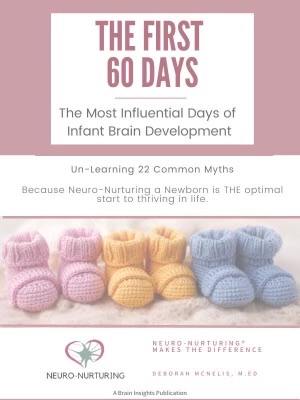
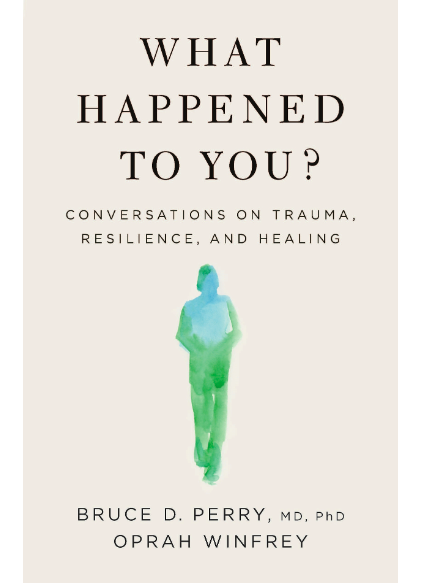 In their New York Times best-seller, Perry and Winfrey share ways to help heal Complex Post Traumatic Stress Disorder (C-PTSD) and Post Traumatic Stress Disorder (PTSD).