Tag Archives: education

“Lead with love, disrupt the system, and fight like hell!” Join Lara Kain, PACEs Connection Education Consultant, Thursday on History. Culture. Trauma.

Carey Sipp Carey Sipp 8/23/223:28 PM

“Sometimes we need to be reminded that we are a powerful movement, and collectively we are making a difference,” says Lara Kain, PACEs Connection education consultant. She joins this week’s History. Culture. Trauma. podcast with fellow educators and hosts, PACEs Connection CEO Ingrid Cockhren, and director of communities, Mathew Portell.

Screen Shot 2022-08-23 at 5.26.00 PMCockhren and Portell are focused on the start of the 2022-2023 school year, and welcome colleague Kain on Thursday, August 25 at 1 p.m. PT, 4 p.m. ET, when Kain will share her take on what can be done to ensure a better year than the last two.

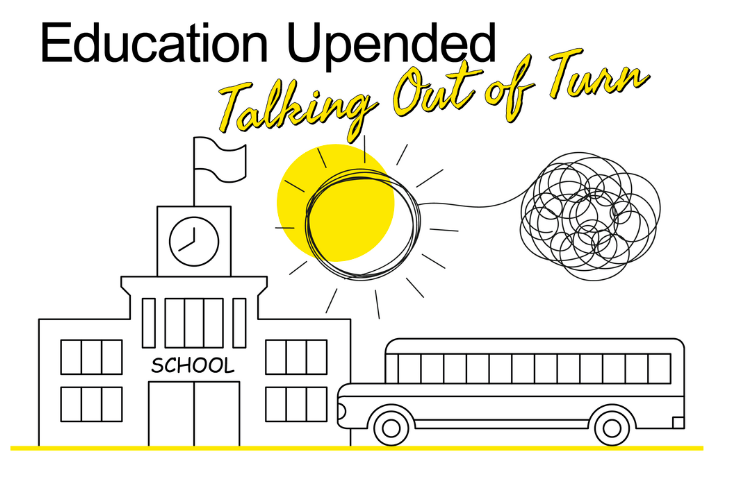
People who’ve attended Kain’s “Education Disrupted” webinar series know to expect forthright comments from Kain as she, Cockhren and Portell discuss topics including affirmation of LGBTQ students, institutional racism, critical race theory, teacher burnout, and parent’s rights, which have transformed America’s schools into cultural battlegrounds.

An unapologetic advocate for community schools, Kain will likely speak to why community schools are a great model when the objective is minimizing trauma.

“Schools are often the center of our lives, an integral part of a thriving and resilient community. As amplified by the pandemic, our society relies on schools to meet a myriad of basic needs for both students and their families,” says Kain. “Schools have become central in reducing food insecurity, providing access to basic mental health, and health care services, for example.
Screen Shot 2022-08-23 at 5.11.45 PM“But schools cannot do this on their own,” she continues. “They need community partners to achieve this reality. Community schools are a school design framework that I believe has the most promise for achieving equity and creating ecosystems where all children, families, and staff thrive.”

As Kain explains, “Community schools explicitly serve as the ‘hub’ of a community ecosystem. Carefully and purposefully integrating community supports to improve student outcomes (academic, health, and social-emotional) with a ‘whole child’ mindset, they form strategic and aligned partnerships with community organizations to serve the needs of children and families that are part of that school community. They are often open extended hours and on weekends, facilitating access to community services and extended learning opportunities. Community schools empower youth and families through authentic power-sharing as well as placing a high value on youth voice and community wisdom. This integrated focus not only improves student outcomes, it also contributes to building stronger families and healthier communities.”

Kain’s expertise in community schools comes from her work prior to joining PACEs Connection about four years ago.

“In my previous position, I supported the implementation of community schools in Los Angeles. It is a movement near and dear to my heart that align closely with the PACEsConnection values.”

  • Local Relevance. We believe people and their communities hold the solutions to prevent, address and heal adverse childhood experiences.
  • Equitable Partners. All levels of society in all sectors—individuals, organizations, communities, and systems—are equitable partners, essential to identifying and implementing solutions.

At the root of the need to focus on trauma-informed education comes the lack of equity experienced by students across the United States.

“We need to focus on equity-centered work, the importance of love and joy, the necessity of disruption, the need for solidarity, the importance of our community, a desire for more humanity in the work, the direct call to action, and the intense feeling of urgency,” Kain says.

“There are a lot of champions out there, and sometimes we need to be reminded that we are a powerful movement, and collectively we are making a difference. Lead with love, disrupt the system, and fight like hell,” she adds.
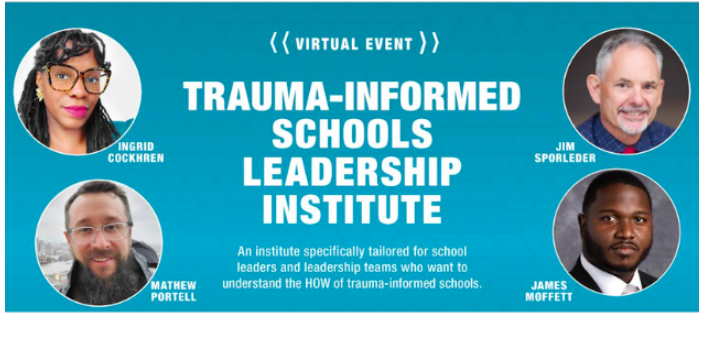
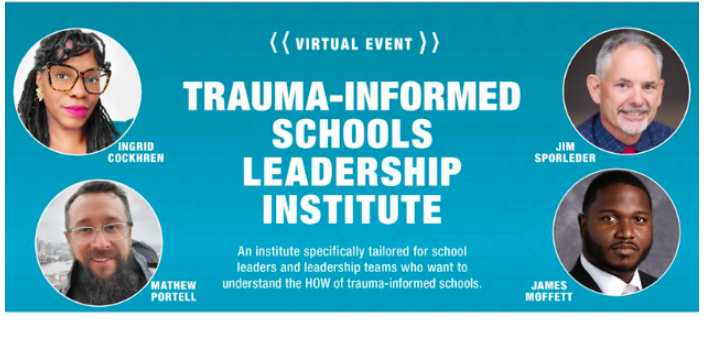
Screen Shot 2022-08-23 at 5.44.16 PM“Students, teachers, and administrators are experiencing poor mental health outcomes, secondary traumatic stress, and burnout,” says Cockhren. Kain will also discuss the recent Trauma Informed School Leadership Institute, now available as a self-paced study, during which she and other leaders in the trauma-informed education movement shared why trauma-informed education is imperative.

An experienced educator and consultant who speaks nationally on implementing trauma-informed practices in schools and building holistic, trauma-responsive systems, Kain brings over two decades of experience at the local, state, and national levels, including developing programs for integrating trauma-informed practices into community schools in Los Angeles.

Kain has also worked for the Wisconsin Department of Public Instruction as the state homeless coordinator and practiced her first love, teaching ‘at-risk’ youth.

Kain earned bachelor’s degree in education from the University of Wisconsin-Madison and a masters’ in public administration from The Evergreen State College. As an example of her understanding of the micro and the macro, Kain’s experience ranges from supporting individual teachers to designing a trauma-informed schools pilot implemented in 20 schools across the country.

As both a teacher and administrator, Kain has put the science of building resilience into practice. A trauma survivor, Kain was herself an ‘at-risk’ youth, and brings this perspective to her understanding of “what schools can and should look like to benefit ALL children.”

The mother of two adopted sons, Kain also brings an understanding of the effects of developmental trauma, and what it takes to overcome it.

Tune in Thursday here for Lara Kain, on the History. Culture. Trauma. podcast, or find the podcast on these carriers:

Show Links

Attachments

Hide

Images (3)

Screen Shot 2022-08-23 at 5.11.45 PM
Screen Shot 2022-08-23 at 5.26.00 PM
Screen Shot 2022-08-23 at 5.44.16 PM

Carey Smith Sipp

carey.pacescommunites@gmail.com

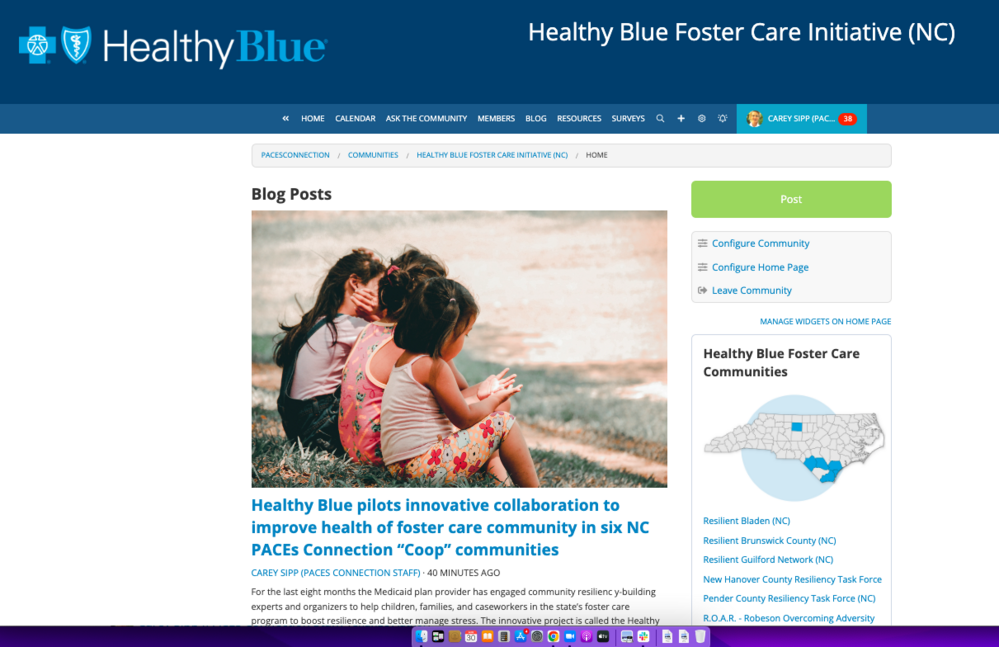
Healthy Blue pilots innovative collaboration to improve health of foster care community in six NC PACEs Connection “Coop” communities

Carey Sipp Carey Sipp 8/30/225:49 PM

For the last eight months the Medicaid plan provider has engaged community resiliency-building experts and organizers to help children, families, and caseworkers in the state’s foster care program to boost resilience and better manage stress. The innovative project is called the Healthy Blue Initiative.

Screen Shot 2022-08-30 at 3.48.11 PM

“We all know kids in foster care have higher rates of adverse childhood experiences (ACEs) than most children.

They are often in foster care due to loss of a parent from death, illness — including addiction — divorce, or incarceration,” says Amy Read, community trainer for Coastal Horizons, a large mental healthcare provider in Eastern Carolina.

Screen Shot 2022-08-30 at 3.52.25 PM

“Many foster children have experienced emotional and physical neglect, abuse, and/or sexual abuse. Most children in foster care have seen a lot of disruption, having been removed from their families and, if not placed with relatives, placed with a family or families they do not know,” she adds.

“There is intense loss of relationships, familiar surroundings, and often a school setting in which they at least had some routines,” says Read. With former social-emotional learning coach Kelly Purcell, she helps lead the initiative by working with six communities whose leadership includes a resilience initiative based on the science of positive and adverse childhood experiences — PACEs science.

Naimah Dye, Medicaid strategy growth and engagement director for Healthy Blue, says the organization is eager to see the outcomes of offering this support to the more than 2,000 children in these six counties. She is also glad to see that caseworkers and parents will be provided tools to build their own resilience to avoid being overwhelmed.

Screen Shot 2022-08-30 at 3.46.24 PM“The reason we looked to PACEs Connection for help in doing this is because they had the relationships with the different sectors in the communities—education, healthcare, child and family services, communities of faith, recreation, law enforcement, the arts, mental health—to bring a coordinated effort to the mission,” says Dye.

“PACEs Connection communities who are affiliates of the organization’s Cooperative of Communities have measurement tools that will help us see how the project is working,” she continues. “We won’t know overnight, and we know that; but over the course of the year we will be using PACEs Connection’s tools and their analysis to measure the communities’ progress. This ability to measure how many organizations are involved, the depth of their involvement, and ultimately how different sectors of the population are doing—in this case foster children—will help us get an idea of how effective the work is,” she says.


Screen Shot 2022-08-30 at 6.41.53 PM
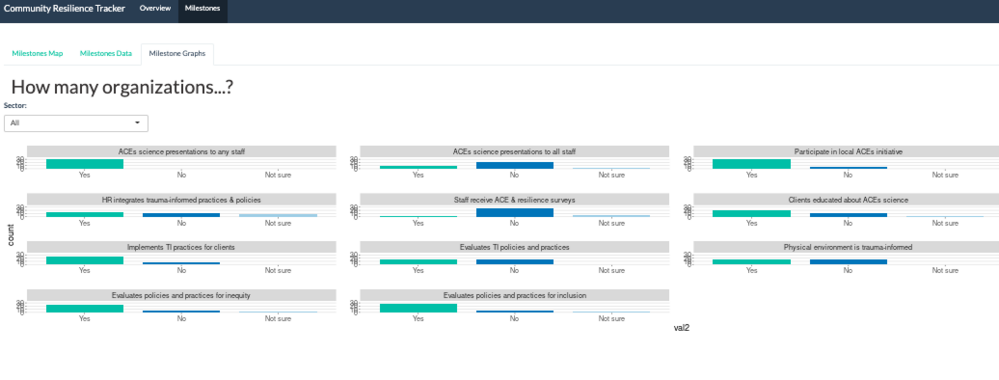
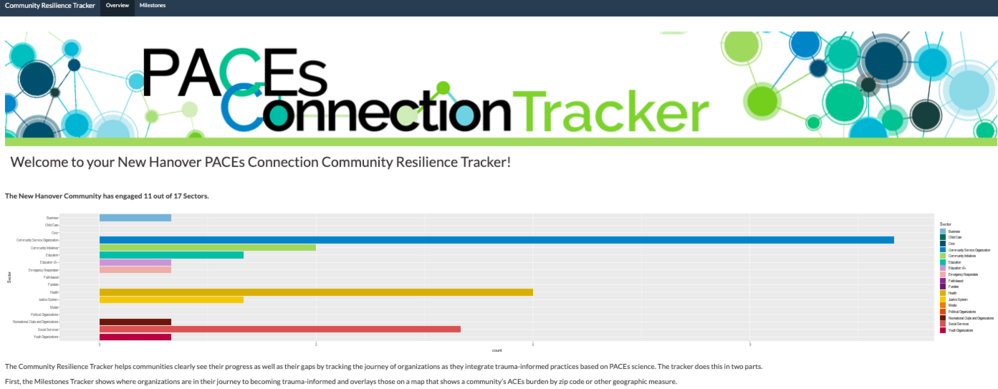
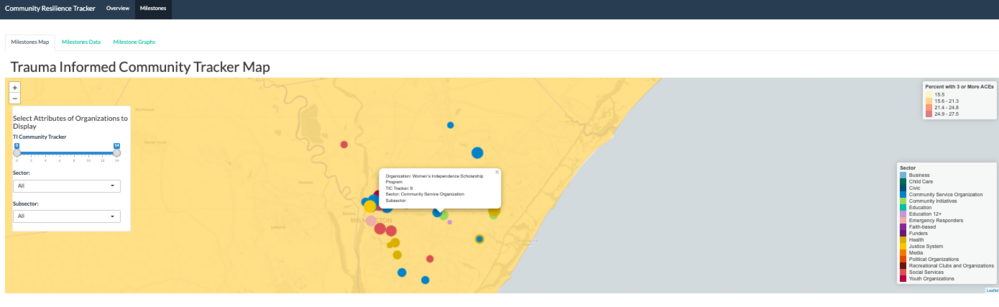
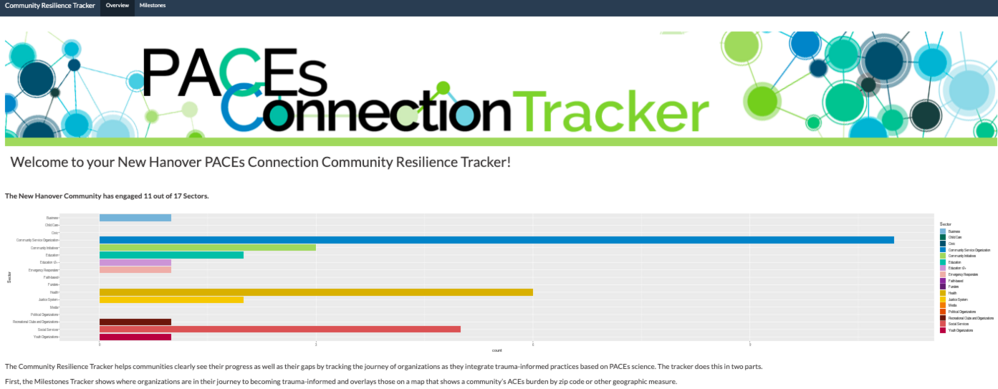
The Community Resiliency Tracker shows how many organizations have “signed on” to the work, what sectors they’re in, and, in another graph, how far along they are on the path to becoming trauma-informed.

Screen Shot 2022-08-30 at 6.43.50 PM

The Community Resiliency Tracker map also hows where organizations are, their names, how far along they are on the path to becoming trauma informed, and what sector the organization is in. This is a quick,  transparent gap analysis of where to work next!

What would have the greatest impact?
When the project’s leaders met with Department of Social Services employees, educators, and some foster parents before the work started, they were enthusiastic. “We wanted to start by asking what was needed and what, in the opinion of people working with foster children and within the system, would have the greatest impact on reducing stress and improving the health and well being of everyone from the social workers to the parents to the children themselves,” says Read.

Screen Shot 2022-08-30 at 4.04.48 PMOne of the foster parents on the fact-finding calls was Kristy Blackwell, a family youth partner with Coastal Horizons. The mother of four teenage boys, three of whom are foster children, Blackwell talked about the importance of to giving caregivers and children resiliency skills. One of her older foster children also shared thoughts about what was needed by the children.

The team listened to input from all corners and decided sharing resiliency skills with caregivers, and then families and children, made sense, so caregivers could use the skills to help care for themselves, and share the skills in their work with the families.

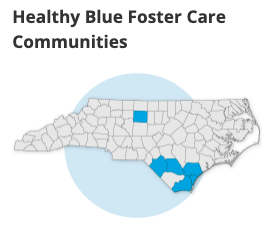
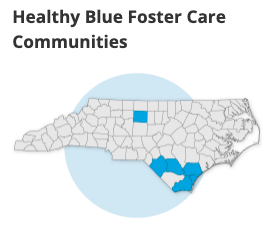
Screen Shot 2022-08-30 at 4.41.54 PMThe North Carolina communities involved are Resilient Bladen CountyResilient Brunswick County, the New Hanover Resiliency Task ForceResilient Guilford County, the Pender County Resiliency Task Force and Robeson Overcoming Adversity through Resilience (R.O.A.R.) for Robeson County.

“Resilient Guilford joined with the eastern counties in the project that involves ‘a lot of ‘dovetailing’—building on existing opportunities for connection—and community building to strengthen relationships among children, families and caregivers. In all six counties the work centers on providing proven tools for lowering stress, building resilience, and in bringing some positive childhood experiences to the children and their families,” says Read.

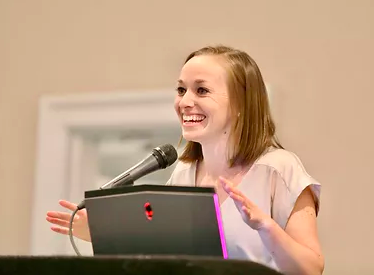
Screen Shot 2022-08-30 at 3.51.09 PMTying the six communities together and supporting their growth is Purcell, a former instructional coach with an emphasis on social emotional learning for the New Hanover County School System. A nationally-recognized trainer in the Community Resilience Model (CRM), Purcell has coordinated with the communities and caregivers to deliver CRM trainings. She is also working toward creating culturally appropriate,  community-led positive childhood experiences to buffer the impact of ACEs.

Purcell has attended most of the resiliency task force meetings in all six counties for the last eight months and says, “At the same time we are helping to strengthen children, families, and caregivers, we’ve been strengthening the overall community, so everyone from teachers and physicians to Sunday school leaders and coaches has heard about the project and can support it by using the same information about PACEs science and resilience tools.

“Emphasizing PACEs science education creates a shared mental model among the families, caregivers and community members, adding another level of support and resilience. Helping them learn about PACEs science reinforces why they want to do the work. The PACEs science presentation shows that the best way to have an impact is to keep going back to the science, the fact that adverse experiences affect health outcomes; positive experiences can be buffers, we can all play a role in supporting children and families” she says.

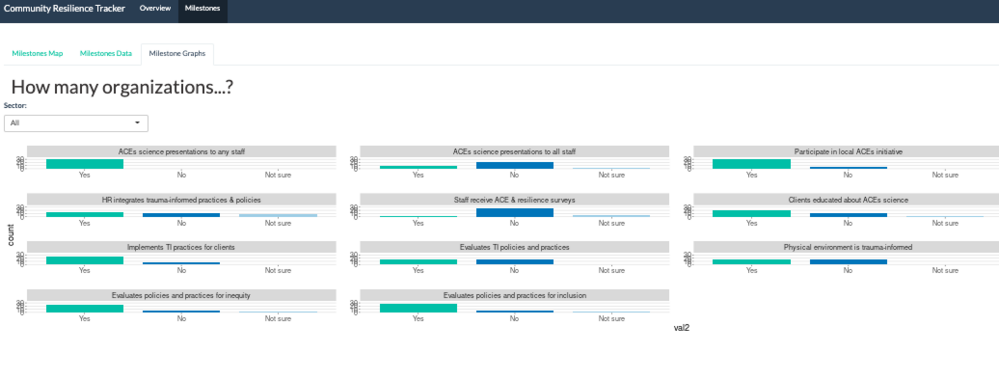
Screen Shot 2022-08-30 at 6.52.11 PMThe PACEs Connection Community Resiliency Tracker helps initiatives and member organizations gauge progress on the path to becoming “trauma informed”, which includes having staff members learn about PACEs science.

Creating Resilient Communities

Purcell has also made sure to share the free PACES Connection “Creating Resilient Communities” training information with initiative members at the meetings, in hopes of more and more community members learning the importance of following the PACEs Connection model of educating, aggregating (tracking), engaging, activating, and then celebrating the work to help the communities continue to grow.

“It’s great to see the collaborative effort of the communities, how members continue to connect and invite others to be part of the local effort. To create the healthy, compassionate communities that will be more supportive of foster families, we need to keep the work going, and growing, so people are hearing these messages at home, at work, in their faith communities, at their doctor’s office. That’s how we build sustainability” said Purcell.


The Healthy Blue Initiative website as a “real-time  report”

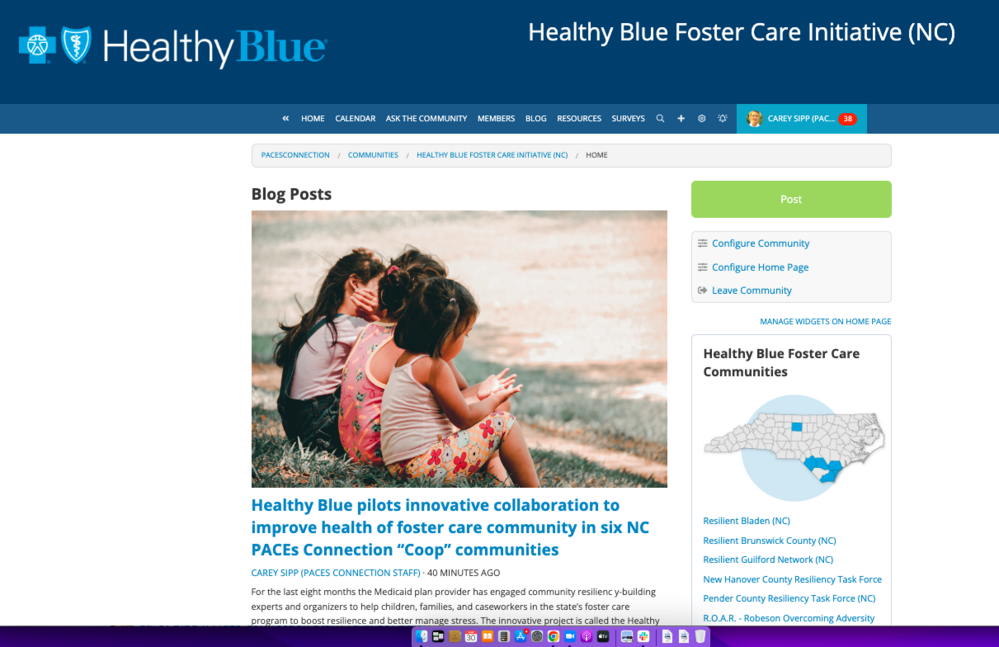
Purcell and Read have also used one of the most important tools available to the PACEs Connection communities—the free sites on PACEs Connection. They created and maintain a site for the Healthy Blue Initiative Foster Care Initiative, NC, which they’ve used to track, in near real-time, the presentations, projects, and progress of the entire initiative. Added to this, community managers from the communities have taken advantage of their memberships in the PACEs Connection Cooperative of Communities to attend the monthly meetings of Coop affiliates, as well as training sessions that are free to Coop members.

Screen Shot 2022-08-30 at 4.46.06 PM

Read is quick to compliment Purcell on her strategy and the way she’s done the work.

“Kelly is the perfect person to be working with children and leaders for this project,” says Read. “This includes the guardian ad litem volunteers she’s trained, North Carolina Department of Social Services leaders, and the children in a school where there are many children involved in the foster care system. She knows how important it is to help the community at large understand the impact of toxic childhood stress, and the healing potential of positive childhood experiences. She is a motivator, communicator and a connector, with the infectious enthusiasm to match her education, experience, training, and skills.”

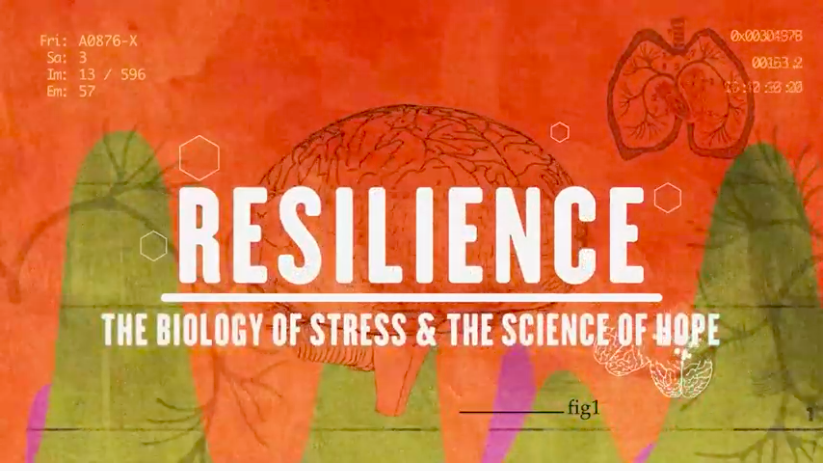
Part of Purcell’s responsibility has been to work with the different sectors in each community to find opportunities to connect with children and families in foster care. Once connecting points are identified, Purcell provides trainings and organizes events, such a three-county virtual viewing of the documentary “Resilience: The Biology of Stress & The Science of Hope”’ followed by a panel discussion.

Screen Shot 2022-08-30 at 4.01.09 PM“Some of the trainings have been in person,” notes Purcell. “Others, depending on the state of the pandemic and availability, have been and will continue to be online. We continue to look at bringing caseworkers, parents, and children together when and where appropriate to include positive childhood experiences. We’re exploring offerings that will involve arts and an outdoor activity.”

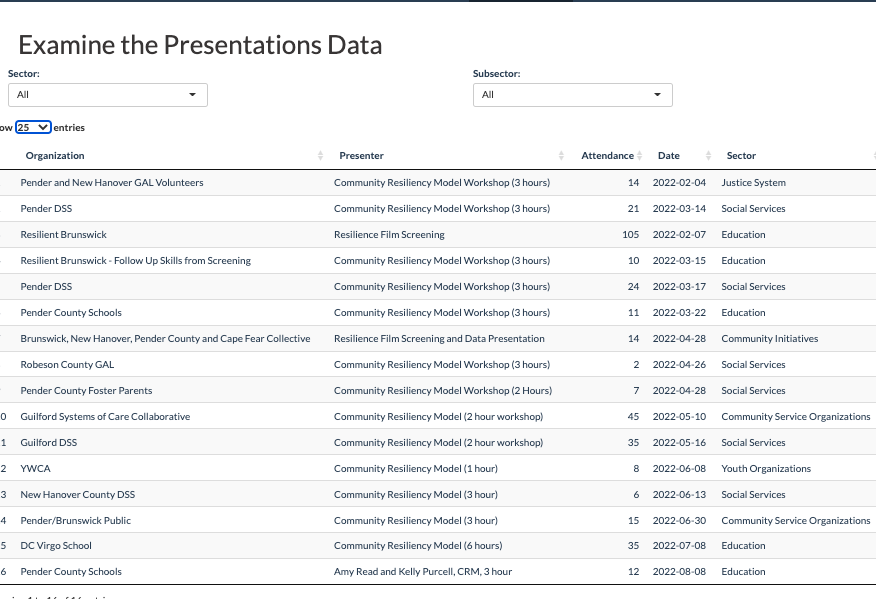
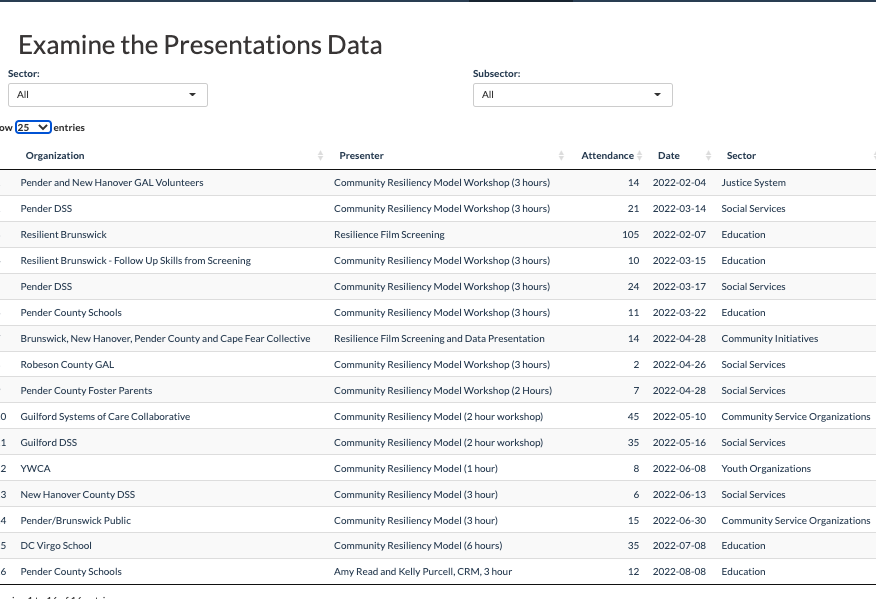
Presentations data goes into an easily-updated presentations tracker.

Screen Shot 2022-08-30 at 3.49.21 PM

“Building resiliency skills is a godsend”

Blackwell, the foster mother of teenager boys who also works with youth in foster care, had learned resiliency skills before the Healthy Blue Initiative started, and that was one of the reasons, during the planning phase of the program, she was so vocal about centering the work around sharing the skills.

“Building resiliency skills has been a godsend. Building resiliency skills in myself as a parent was especially helpful when we had a house fire in April (2021). It was such a blessing for us to know to notice who was there to support us, to remember things wouldn’t be bad forever, and that we could take the time to breathe,” she says.

“If more parents and caregivers had these skills, we would probably have more kids stay in their homes. That would reduce stress. The kids may need less medical attention because we’ve reduced the stress. My 15-year-old says it well. He talks about being in a foster home that wasn’t the greatest, and that maybe if they had all had some resiliency skills, it would have been a better fit,” she adds.

For more information about this program, contact Amy Read at aread@coastalhorizons.org; Kelly Purcell at resilientsenc@gmail.com

For more information about PACEs Connection, the Cooperative of Communities, and potential strategic alliances such as the Healthy Blue Initiative with PACEs Connection, contact Carey Sipp, PACEs Connection director of strategic partnerships, at csipp@pacesconnection.com

Attachments

Hide

Images (12)

Screen Shot 2022-08-30 at 3.48.11 PM
Screen Shot 2022-08-30 at 3.52.25 PM: Amy Read, Community Trainer for Coastal Horizons in Wilmington, NC
Screen Shot 2022-08-30 at 3.46.24 PM: Naimah Dye,Medicaid strategy growth and engagement director for Healthy Blue
Screen Shot 2022-08-30 at 4.04.48 PM: Kristy Blackwell,  foster mother and Family Youth Partner with Coastal Horizons
Screen Shot 2022-08-30 at 6.41.53 PM: The Community Resiliency Tracker shows how many organizations have "signed on" to the work, what sectors they're in, and how far along they are on the path to becoming trama-informed.
Screen Shot 2022-08-30 at 6.52.11 PM: The PACEs Connection Community Resiliency Tracker helps initiatives and member organizations gauge progress on the path to becoming "trauma informed", which includes having staff members learn about PACEs science
Screen Shot 2022-08-30 at 6.43.50 PM: The Community Resiliency Tracker map shows where organizations are, their names, how far along they are on the path to becoming trauma informed, and what sector the organization is in. This is a quick,  transparent gap analysis of where to work next!
Screen Shot 2022-08-30 at 3.51.09 PM: Kelly Purcell, nationally recognized trainer in the Community Resiliency Model
Screen Shot 2022-08-30 at 4.01.09 PM: Resilience: The Biology of Stress & The Science of Hope documentary
Screen Shot 2022-08-30 at 3.49.21 PM: Training events by the Healthy Blue Initiative as posted in the PACEs Connection Health Blue Initiative Presentations Tracker
Screen Shot 2022-08-30 at 4.41.54 PM: Artwork showing the six county initiatives that are part of the Healthy Blue Initiative
Screen Shot 2022-08-30 at 4.46.06 PM: The Healthy Blue Initiative uses its PACEs Connection website as a real-time "annual report" to update partners on events, reports, presentations. The site also links to the PACEs Connection website for each of the six HBI county initiatives.

Carey Smith Sipp

carey.pacescommunites@gmail.com
Tags: Pender CountyKelly PurcellGuilford CountyBladen CountyNew Hanover CountyCommunity Resiliency ModelHealth BlueRobeson CountyCarey SippBrunswick CountyNaimah DyeAmy Read

Views: 572

Add Comment

An urgent and important request for year-end giving from PACEs Connection

Carey Sipp Carey Sipp 10/18/222:42 PM

During this upcoming season of giving, we are making a special appeal. We are in deep financial straits. In a most un-trauma-informed move, a major foundation which had assured us that we would receive a second year of funding unexpectedly reversed course shortly before we were due to receive a $500,000 grant from them.

We’re fortunate to have a couple of funders who are providing support from January through December 2023. But we didn’t have enough funding remaining this year to take us through the end of this quarter, so we’ve cut our pay and time by 50%. If you’ve been through something like this, you know the hardship of making one paycheck last for two months. And almost all staff will be laid off for the month of December.

So, we’re modeling what we’ve written about for others for the last 11 years, quoting authority after authority about the need for people affected by trauma to “ask for help.”

We are asking you, our 57,300+ members, to make a donation, preferably, a monthly donation.

Because we’ve been funded by grants from generous donors over the last few years, we haven’t relied on donations. During a year-end funding campaign two years ago we received an unexpected matching gift of $50,000; you were kind enough to grow that to $105,000.

We are deeply grateful for that support, and for the $22,190 you donated over the last six months, since we began telling you of our situation. And now, as we enter the season of year-end giving, we ask for whatever you can give to assist PACEs Connection in its efforts to continue to solve our communities’ most intractable problems.

Given the current non-profit funding system, which tends to support organizations for only two or three years, we began planning six years ago to become self-supporting. That’s because we know that it will take communities 20 to 40 years to integrate policies and practices based on PACEs science. Earlier this year, we began accelerating those plans by diversifying our revenue streams.

  • We’re offering paid events (after doing more than 100 free webinars in 2020 and 2021), including a much-anticipated Collective Grief, Collective Healing conference.
  • We’re providing our expertise to create trauma-informed schools, trauma-informed workplaces that are anti-racist organizations, and helping local initiatives build partnerships to increase their funding and accelerate their growth.
  • We continue to recruit communities to join our Cooperative of Communities, which we launched in late 2019, only to see our progress delayed by COVID. The Coop offers unique and sophisticated tracking tools and other benefits to help community PACEs initiatives to accelerate growth, reduce ACEs and increase positive childhood experiences. Communities pay $5,000 a year for tools and benefits that would cost an individual community $80,000 to develop themselves.
  • Recruiting foundations to partner with us in our work. Besides the obvious consequence of losing much-needed funding, the loss of the $500,000 grant put us in the position of losing precious time to find another funder. Acquiring funding takes, on average, 18 months from first contact to money in the bank. Most funders won’t accept unsolicited requests for funding. You have to know someone who can provide an introduction.

Over the next couple of months, you won’t experience much of a difference in what you see from us. We’ll keep delivering the Daily Digest and Weekly Roundup, which we’ve provided for free for more than a decade. We’ll continue to provide support and training to the 440 or so cross-sector geographic communities and 40 or so interest-based communities that have free pages – their own mini-websites – on our site. We’ll keep offering our free Creating Resilient Communities trainings to the general public, and our Growing Resilient Communities trainings for managers of community initiatives.

We’ll be posting about our fundraising efforts, and asking some of you to post about what PACEs Connection has meant to you, your community, your growth and development as a human, parent, professional. If you’d like to share a video or a testimonial about the importance of our work, please do. We’d love to hear from you and ask that whether you post or not, to make a gift, preferably a monthly gift, to help us keep doing the work.

You can make your tax-deductible gift here. You can post a blog yourself (here are instructions for a blog.)

In the meantime, thank you for all you do in your life, your home, your community, your corner of the world, to help prevent and heal childhood trauma, to help build healthier, more resilient and compassionate communities.

Carey Sipp

Director of Strategic Partnerships

PACEs Connection

Attachments

Hide

Images (1)

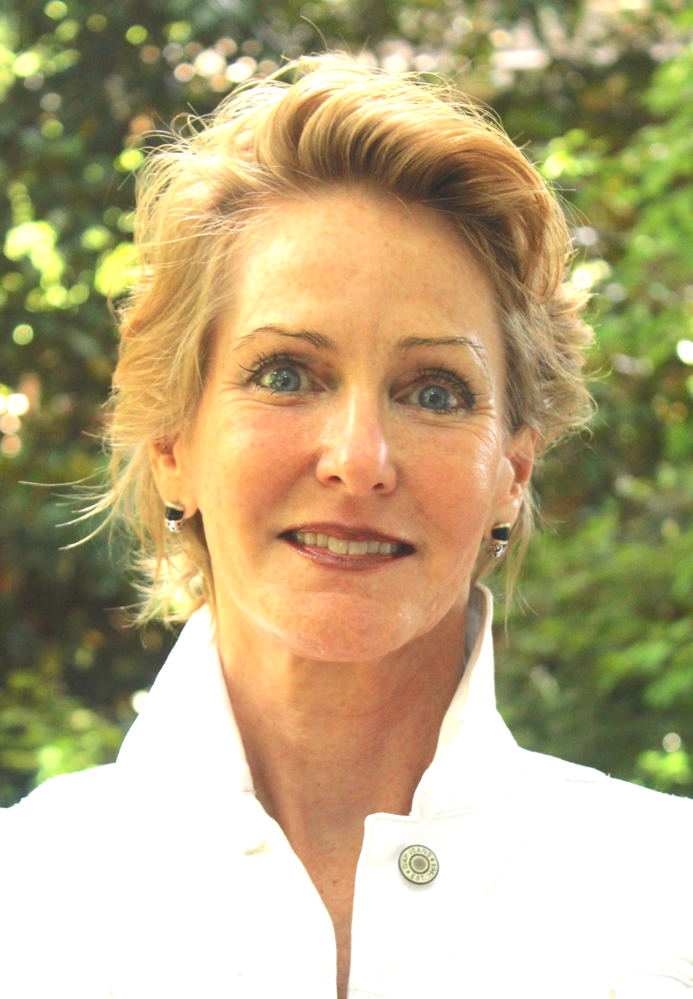
Carey Headshot 7.16.: Carey Sipp, Director of Strategic Partnerships

Carey Smith Sipp

carey.pacescommunites@gmail.com

Sofiya Asedrem supports PACEs Connection to help address root causes in her fast-growing Florida community & make mental health a human right.

Carey Sipp Carey Sipp 12/14/2210:30 AM

Note: PACEs Connection is in dire financial straits. We need you, our almost 58,000 members, to help cover the loss of foundation funding that was promised and did not come through. Unfortunately, staff pay and hours have had to be cut for December. The good news is that, since sounding the alarm this summer, we’ve raised more than $52,000. Thank you to all who’ve donated. To get a sense of who your fellow members are, who is donating, and why, please read and share this seventh in a series of donor profiles. Now that you know we need your help, please join Sofiya Asedrem and make a generous donationto PACEs Connection!

Sofiya Asedrem is busy. She manages the Creating a Resilient Community (CRC) Network convened out of the Peace and Justice Institute at Valencia College and the PACEs Connection Central Florida website that advances and reports on all the work. There’s also a CRC conference each spring that brings in people from all over the country, and myriad other educational events throughout the year.

Screen Shot 2022-12-12 at 3.23.18 PM

Deadly weather challenges and epic growth in her international community demand all of her skills. Her education—a bachelor’s degree in international affairs at the George Washington University where she was sponsored twice by the U.S. Department of State, and a master’s degree in political science from the University of Central Florida—is foundational to her success in community development. She also relies heavily on her expertise in mental health and trauma, women’s empowerment and gender issues, environmental sustainability, peace studies, and agricultural programs.

Another support in her work? The impact of PACEs Connection.

“PACEs Connection has been an immense factor in the growth of our group (the CRC Network),” she says. “We have been able to grow to over 500 members and 250 organizations in just three years.” The group is a cross-sector collective impact movement transforming the region into one of prevention, hope, healing and resilience for all, she continues. It provides space for information sharing as well as providing many opportunities for growth and networking/learning from other communities and experts around the nation.

I was motivated to become involved with PACEs Connection because I saw opportunities for growth both internally (as a mother, wife, daughter, sister, etc.) and externally–as a working professional looking to help my organization and community along the journey of becoming trauma-informed,” she says. “With its future-oriented initiatives and scientific and expertise-led approach, PACEs Connection is a go-to resource.”

Changing the world with PACEs science

How does Asedrem see PACEs science making a difference in the world?

“My local community is facing so many challenges that are a microcosm of the world’s challenges—from the pandemic, to recent hurricanes, to community violence and economic disparities,’ she says.

“I hope PACEs science will change my community and the world by providing an awareness of positive and adverse childhood experiences, teaching individuals how to heal from toxic stress, and welcoming others to approach fellow humans in a way that is more trauma-informed,” she says. “By learning about PACEs science, I think we will be able to realize the goal of making mental health a human right and public good. As a result, we will see greater social well-being—providing people with the opportunity to live healthy, meaningful lives and contribute to the greater good of our communities.”

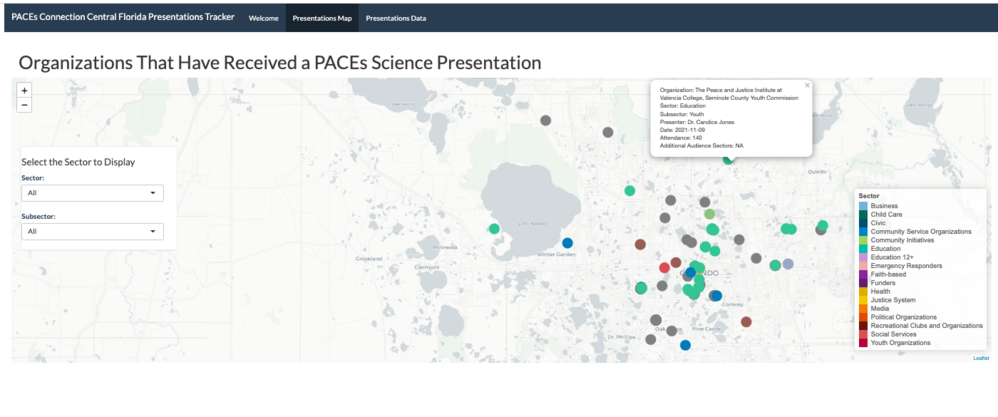
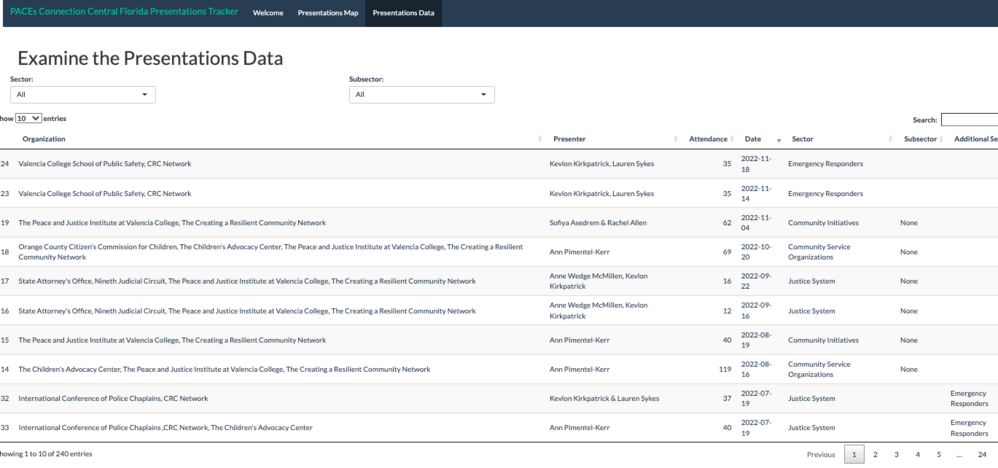
Asedrem is one of several members of the CRC Network to have given multiple PACEs science presentations in the community.  All told, members of the Network, led by Peace and Justice Institute director Rachel Allen, have made some 240 presentations over the last four years!

Screen Shot 2022-12-12 at 2.48.35 PM
Screen Shot 2022-12-12 at 3.31.38 PM

A paradigm shift to a trauma-informed culture.

Asedrem supports PACEs Connection because it is one of the organizations actively dedicated to creating a paradigm shift to create a culture founded on the science of positive and adverse childhood experiences, and whose policies and practices are expressed in trauma-informed ways.

“By investing in PACEs Connection, members of our community can help communities address the root causes of some of the deep challenges we all face,” she adds.

Asedrem leverages her PACE Connection website to get the word out about resources and events. Within a day of Hurricane Ian’s record destruction, Asedrem hadposted a blog on PACEs Connection full of resources for her community, and leveraged the ability to share her blog out on other social media in calling her fellow Central Floridians to “look for the helpers.”

Asedrem encourages fellow members of PACEs Connection to join her in making a generous, tax-deductible donation to PACEs Connection here.

If you’d prefer to mail your gift rather than give it online, here’s how…

mail iconMake check payable to:

TSNE (Third Sector New England, our fiscal sponsor) and write PACEs Connection Donation on the memo line.

Mail check to:

PACEs Connection, c/o TSNE, 89 South Street, Suite 700, Boston, MA 02111

information iconMaking a wire transfer or need Tax ID information?

Please contact Carey Sipp, Director of Strategic Partnerships, at

Sofiya Asedrem supports PACEs Connection to help address root causes in her fast-growing Florida community & make mental health a human right.

Carey Sipp Carey Sipp 12/14/2210:30 AM

Note: PACEs Connection is in dire financial straits. We need you, our almost 58,000 members, to help cover the loss of foundation funding that was promised and did not come through. Unfortunately, staff pay and hours have had to be cut for December. The good news is that, since sounding the alarm this summer, we’ve raised more than $52,000. Thank you to all who’ve donated. To get a sense of who your fellow members are, who is donating, and why, please read and share this seventh in a series of donor profiles. Now that you know we need your help, please join Sofiya Asedrem and make a generous donationto PACEs Connection!

Sofiya Asedrem is busy. She manages the Creating a Resilient Community (CRC) Network convened out of the Peace and Justice Institute at Valencia College and the PACEs Connection Central Florida website that advances and reports on all the work. There’s also a CRC conference each spring that brings in people from all over the country, and myriad other educational events throughout the year.

Screen Shot 2022-12-12 at 3.23.18 PM

Deadly weather challenges and epic growth in her international community demand all of her skills. Her education—a bachelor’s degree in international affairs at the George Washington University where she was sponsored twice by the U.S. Department of State, and a master’s degree in political science from the University of Central Florida—is foundational to her success in community development. She also relies heavily on her expertise in mental health and trauma, women’s empowerment and gender issues, environmental sustainability, peace studies, and agricultural programs.

Another support in her work? The impact of PACEs Connection.

“PACEs Connection has been an immense factor in the growth of our group (the CRC Network),” she says. “We have been able to grow to over 500 members and 250 organizations in just three years.” The group is a cross-sector collective impact movement transforming the region into one of prevention, hope, healing and resilience for all, she continues. It provides space for information sharing as well as providing many opportunities for growth and networking/learning from other communities and experts around the nation.

I was motivated to become involved with PACEs Connection because I saw opportunities for growth both internally (as a mother, wife, daughter, sister, etc.) and externally–as a working professional looking to help my organization and community along the journey of becoming trauma-informed,” she says. “With its future-oriented initiatives and scientific and expertise-led approach, PACEs Connection is a go-to resource.”

Changing the world with PACEs science

How does Asedrem see PACEs science making a difference in the world?

“My local community is facing so many challenges that are a microcosm of the world’s challenges—from the pandemic, to recent hurricanes, to community violence and economic disparities,’ she says.

“I hope PACEs science will change my community and the world by providing an awareness of positive and adverse childhood experiences, teaching individuals how to heal from toxic stress, and welcoming others to approach fellow humans in a way that is more trauma-informed,” she says. “By learning about PACEs science, I think we will be able to realize the goal of making mental health a human right and public good. As a result, we will see greater social well-being—providing people with the opportunity to live healthy, meaningful lives and contribute to the greater good of our communities.”

Asedrem is one of several members of the CRC Network to have given multiple PACEs science presentations in the community.  All told, members of the Network, led by Peace and Justice Institute director Rachel Allen, have made some 240 presentations over the last four years!

Screen Shot 2022-12-12 at 2.48.35 PM
Screen Shot 2022-12-12 at 3.31.38 PM

A paradigm shift to a trauma-informed culture.

Asedrem supports PACEs Connection because it is one of the organizations actively dedicated to creating a paradigm shift to create a culture founded on the science of positive and adverse childhood experiences, and whose policies and practices are expressed in trauma-informed ways.

“By investing in PACEs Connection, members of our community can help communities address the root causes of some of the deep challenges we all face,” she adds.

Asedrem leverages her PACE Connection website to get the word out about resources and events. Within a day of Hurricane Ian’s record destruction, Asedrem hadposted a blog on PACEs Connection full of resources for her community, and leveraged the ability to share her blog out on other social media in calling her fellow Central Floridians to “look for the helpers.”

Asedrem encourages fellow members of PACEs Connection to join her in making a generous, tax-deductible donation to PACEs Connection here.

If you’d prefer to mail your gift rather than give it online, here’s how…

mail iconMake check payable to:

TSNE (Third Sector New England, our fiscal sponsor) and write PACEs Connection Donation on the memo line.

Mail check to:

PACEs Connection, c/o TSNE, 89 South Street, Suite 700, Boston, MA 02111

information iconMaking a wire transfer or need Tax ID information?

Please contact Carey Sipp, Director of Strategic Partnerships, at

Sofiya Asedrem supports PACEs Connection to help address root causes in her fast-growing Florida community & make mental health a human right.

Carey Sipp Carey Sipp 12/14/2210:30 AM

Note: PACEs Connection is in dire financial straits. We need you, our almost 58,000 members, to help cover the loss of foundation funding that was promised and did not come through. Unfortunately, staff pay and hours have had to be cut for December. The good news is that, since sounding the alarm this summer, we’ve raised more than $52,000. Thank you to all who’ve donated. To get a sense of who your fellow members are, who is donating, and why, please read and share this seventh in a series of donor profiles. Now that you know we need your help, please join Sofiya Asedrem and make a generous donationto PACEs Connection!

Sofiya Asedrem is busy. She manages the Creating a Resilient Community (CRC) Network convened out of the Peace and Justice Institute at Valencia College and the PACEs Connection Central Florida website that advances and reports on all the work. There’s also a CRC conference each spring that brings in people from all over the country, and myriad other educational events throughout the year.

Screen Shot 2022-12-12 at 3.23.18 PM

Deadly weather challenges and epic growth in her international community demand all of her skills. Her education—a bachelor’s degree in international affairs at the George Washington University where she was sponsored twice by the U.S. Department of State, and a master’s degree in political science from the University of Central Florida—is foundational to her success in community development. She also relies heavily on her expertise in mental health and trauma, women’s empowerment and gender issues, environmental sustainability, peace studies, and agricultural programs.

Another support in her work? The impact of PACEs Connection.

“PACEs Connection has been an immense factor in the growth of our group (the CRC Network),” she says. “We have been able to grow to over 500 members and 250 organizations in just three years.” The group is a cross-sector collective impact movement transforming the region into one of prevention, hope, healing and resilience for all, she continues. It provides space for information sharing as well as providing many opportunities for growth and networking/learning from other communities and experts around the nation.

I was motivated to become involved with PACEs Connection because I saw opportunities for growth both internally (as a mother, wife, daughter, sister, etc.) and externally–as a working professional looking to help my organization and community along the journey of becoming trauma-informed,” she says. “With its future-oriented initiatives and scientific and expertise-led approach, PACEs Connection is a go-to resource.”

Changing the world with PACEs science

How does Asedrem see PACEs science making a difference in the world?

“My local community is facing so many challenges that are a microcosm of the world’s challenges—from the pandemic, to recent hurricanes, to community violence and economic disparities,’ she says.

“I hope PACEs science will change my community and the world by providing an awareness of positive and adverse childhood experiences, teaching individuals how to heal from toxic stress, and welcoming others to approach fellow humans in a way that is more trauma-informed,” she says. “By learning about PACEs science, I think we will be able to realize the goal of making mental health a human right and public good. As a result, we will see greater social well-being—providing people with the opportunity to live healthy, meaningful lives and contribute to the greater good of our communities.”

Asedrem is one of several members of the CRC Network to have given multiple PACEs science presentations in the community.  All told, members of the Network, led by Peace and Justice Institute director Rachel Allen, have made some 240 presentations over the last four years!

Screen Shot 2022-12-12 at 2.48.35 PM
Screen Shot 2022-12-12 at 3.31.38 PM

A paradigm shift to a trauma-informed culture.

Asedrem supports PACEs Connection because it is one of the organizations actively dedicated to creating a paradigm shift to create a culture founded on the science of positive and adverse childhood experiences, and whose policies and practices are expressed in trauma-informed ways.

“By investing in PACEs Connection, members of our community can help communities address the root causes of some of the deep challenges we all face,” she adds.

Asedrem leverages her PACE Connection website to get the word out about resources and events. Within a day of Hurricane Ian’s record destruction, Asedrem hadposted a blog on PACEs Connection full of resources for her community, and leveraged the ability to share her blog out on other social media in calling her fellow Central Floridians to “look for the helpers.”

Asedrem encourages fellow members of PACEs Connection to join her in making a generous, tax-deductible donation to PACEs Connection here.

If you’d prefer to mail your gift rather than give it online, here’s how…

mail iconMake check payable to:

TSNE (Third Sector New England, our fiscal sponsor) and write PACEs Connection Donation on the memo line.

Mail check to:

PACEs Connection, c/o TSNE, 89 South Street, Suite 700, Boston, MA 02111

information iconMaking a wire transfer or need Tax ID information?

Please contact Carey Sipp, Director of Strategic Partnerships, at

Year-end giving to PACEs Connection has become a family tradition for Lisa Hofmeister. ‘This work matches our family’s values.’

Carey Sipp Carey Sipp 12/22/2210:45 AM

A recent photo of Lisa Hofmeister (second from left) with her family.

Note: PACEs Connection is in dire financial straits. We need you, our almost 58,000 members, to help us cover the loss of foundation funding that was promised and did not come through. Unfortunately, staff pay and hours were cut for December.

The good news is that, since sounding the alarm this summer, we’ve raised more than $65,000 thanks to all of your who donated. To get a sense of who your fellow members are, who is donating, and why, please read and share this eighth in a series of donor profiles. Now that you know we need your help, please join Lisa Hofmeister—who, with her mother and brother has made a family gift to PACEsConnection for the last three years—and make a generous tax-deductible year-end donation.

Most people are stunned when they first learn about PACEs science. Lisa Hofmeister is no exception.

With a degree in psychology, a career in healthcare information technology, and a personal interest in equity and restorative justice, Hofmeister was surprised when she heard about the CDC-Kaiser Permanente Adverse Childhood Experiences Study.

“It seemed as though I should have known about this earlier,” she says of the ground-breaking research that was first published in 1998.

Since discovering ACEs Connection, now PACEs Connection, Hofmeister has been an avid follower and supporter of the organization and the PACEs science movement to prevent and heal childhood adversity, and to build healthier and more resilient families and communities.

“Our family chooses a charitable organization to support every year, so I was eager to suggest PACEs Connection, especially given our family’s interest in social justice and grassroots community organizing”, she continues. “I see PACEs Connection as the scaffolding behind a movement—perhaps the most important public health movement of our time. It allows passionate, talented people to collaborate, share inspiration, and innovate by imitating what works.”.

Q: What motivated you to become involved in PACEs Connection?

A: “In 2019 after a local trauma therapist’s presentation about ACEs, brain science, and resilience, I went from complete ignorance to near-obsession. I couldn’t stop thinking about it and couldn’t find enough people to marvel about this powerful ‘root cause’ discovery with me. So I was thrilled to learn that PACEs Connection was already on the case, thoughtfully creating a network and a platform for sharing new research and ideas.”

Q: How do you hope PACEs science will change the world?

A: “I do believe PACEs science can bring paradigm-shifting and compassionate change to a world that desperately needs it. My hope is that, together, we can promote it in a way that invites others to be curious and hopeful in this time of extreme polarization. It has great potential to heal and unite us.”

Q: Why should other members of PACEs Connection provide financial support to our organization?

A: “Sometimes I worry that the sheer volume of PACEs-related groups dilutes the good work that people are doing, and makes it confusing. I admire how PACEs Connection is clearly trying to avoid working in a silo, partnering with groups like CTIPP (Campaign forTrauma Informed Policy and Practice) and providing a platform to connect. This is an invaluable service.”

Q: What is your involvement in a PACEs community?

A: “I recently got connected with the Trauma-Informed Healthcare Education and Research (TIHCER) Community on PACEs Connection and am looking forward to hearing ideas about bringing trauma-informed care into the realm of the electronic health record. I’m also hoping to connect with Wisconsin-based groups focused on trauma-informed care in education.”

Hofmeister encourages fellow members of PACEs Connection to join her in making a generous, tax-deductible donation to PACEs Connection here.

If you’d prefer to mail your gift rather than give it online, here’s how…

Make check payable to:

TSNE (Third Sector New England, our fiscal sponsor) and write PACEs Connection Donation on the memo line.

Mail check to:

mail iconPACEs Connection,

c/o TSNE, 89 South Street

Suite 700

                        Boston, MA 02111

information iconMaking a wire transfer or need Tax ID information?

Please contact Carey Sipp, Director of Strategic Partnerships, at csipp@pacesconnection.com

Carey Smith Sipp

Year-end giving to PACEs Connection has become a family tradition for Lisa Hofmeister. ‘This work matches our family’s values.’

Carey Sipp Carey Sipp 12/22/2210:45 AM

A recent photo of Lisa Hofmeister (second from left) with her family.

Note: PACEs Connection is in dire financial straits. We need you, our almost 58,000 members, to help us cover the loss of foundation funding that was promised and did not come through. Unfortunately, staff pay and hours were cut for December.

The good news is that, since sounding the alarm this summer, we’ve raised more than $65,000 thanks to all of your who donated. To get a sense of who your fellow members are, who is donating, and why, please read and share this eighth in a series of donor profiles. Now that you know we need your help, please join Lisa Hofmeister—who, with her mother and brother has made a family gift to PACEsConnection for the last three years—and make a generous tax-deductible year-end donation.

Most people are stunned when they first learn about PACEs science. Lisa Hofmeister is no exception.

With a degree in psychology, a career in healthcare information technology, and a personal interest in equity and restorative justice, Hofmeister was surprised when she heard about the CDC-Kaiser Permanente Adverse Childhood Experiences Study.

“It seemed as though I should have known about this earlier,” she says of the ground-breaking research that was first published in 1998.

Since discovering ACEs Connection, now PACEs Connection, Hofmeister has been an avid follower and supporter of the organization and the PACEs science movement to prevent and heal childhood adversity, and to build healthier and more resilient families and communities.

“Our family chooses a charitable organization to support every year, so I was eager to suggest PACEs Connection, especially given our family’s interest in social justice and grassroots community organizing”, she continues. “I see PACEs Connection as the scaffolding behind a movement—perhaps the most important public health movement of our time. It allows passionate, talented people to collaborate, share inspiration, and innovate by imitating what works.”.

Q: What motivated you to become involved in PACEs Connection?

A: “In 2019 after a local trauma therapist’s presentation about ACEs, brain science, and resilience, I went from complete ignorance to near-obsession. I couldn’t stop thinking about it and couldn’t find enough people to marvel about this powerful ‘root cause’ discovery with me. So I was thrilled to learn that PACEs Connection was already on the case, thoughtfully creating a network and a platform for sharing new research and ideas.”

Q: How do you hope PACEs science will change the world?

A: “I do believe PACEs science can bring paradigm-shifting and compassionate change to a world that desperately needs it. My hope is that, together, we can promote it in a way that invites others to be curious and hopeful in this time of extreme polarization. It has great potential to heal and unite us.”

Q: Why should other members of PACEs Connection provide financial support to our organization?

A: “Sometimes I worry that the sheer volume of PACEs-related groups dilutes the good work that people are doing, and makes it confusing. I admire how PACEs Connection is clearly trying to avoid working in a silo, partnering with groups like CTIPP (Campaign forTrauma Informed Policy and Practice) and providing a platform to connect. This is an invaluable service.”

Q: What is your involvement in a PACEs community?

A: “I recently got connected with the Trauma-Informed Healthcare Education and Research (TIHCER) Community on PACEs Connection and am looking forward to hearing ideas about bringing trauma-informed care into the realm of the electronic health record. I’m also hoping to connect with Wisconsin-based groups focused on trauma-informed care in education.”

Hofmeister encourages fellow members of PACEs Connection to join her in making a generous, tax-deductible donation to PACEs Connection here.

If you’d prefer to mail your gift rather than give it online, here’s how…

Make check payable to:

TSNE (Third Sector New England, our fiscal sponsor) and write PACEs Connection Donation on the memo line.

Mail check to:

mail iconPACEs Connection,

c/o TSNE, 89 South Street

Suite 700

                        Boston, MA 02111

information iconMaking a wire transfer or need Tax ID information?

Please contact Carey Sipp, Director of Strategic Partnerships, at csipp@pacesconnection.com

Carey Smith Sipp

Does Trauma Informed “Workforce Development” Live Up to the Hype? Study respondents needed to see how some people turn learning about developmental adversity into transformative action!

Carey Sipp Carey Sipp 4/25/232:32 PM

By Krista Goldstine-Cole, EdD, co-principal investigator, Into the Black Box study of developmental adversity, Billings, Montana – April 25, 2023

A team of researchers at the University of Montana School of Public and Community Health Sciences has launched Into the Black Box, an extensive and ground-breaking study of how some adult learners turn information about developmental adversity—the traumas, adversities, and significant stressors that are sufficient to alter the brain, body, or developmental trajectory—into transformative action.

Screen Shot 2023-04-25 at 3.50.54 PMOver the past ten years, community organizations, philanthropy and government have called for workforce development or training as a first and necessary step to achieve trauma-informed practice as well as wholesale systems change. To date, no studies or evaluations have been published examining whether developmental adversity education works as imagined, and if so, for which learners, according to co-principal investigator Krista Goldstine-Cole.

The survey portion of this study is now open online, and researchers are seeking 1,000 respondents.

“It’s a big number,” Goldstine-Cole says. “But we are hoping to hear from the broadest possible group of people.  We want to capture variation in who learners are, how and why they are learning, and what they have been learning about—adverse childhood experiences (ACEs), neurobiology, epigenetics, ACEs, and resilience (NEAR) science, trauma-informed practice, toxic stress, and adjacent topics.

“We also want variation in how long people have been involved in developmental adversity education. We want to hear from people in a range of professions as well as those who are learning about developmental adversity (DA) in the context of community,” Goldstine-Cole added.

“The potential to generate greater momentum in the trauma-informed movement.”

Screen Shot 2023-04-25 at 4.24.23 PMJesse Kohler, executive director of the Campaign for Trauma Informed Policy and Practice (CTIPP) believes the study findings “have the potential to generate greater momentum in the trauma informed movement and build greater capacity to address the root causes of health and social issues throughout our society.”

“We want to understand “the spark” of DA education,” said co-principal investigator, Siwen Zhang Minero, EdD.

Screen Shot 2023-04-25 at 3.51.07 PM“Through interviews, we have found that some—but not all—learners really catch fire when they start to learn the science of developmental adversity. A few years ago, we did a video project where we asked innovators in the field how their thinking had changed over time. It taught me that learning about developmental adversity can be a source of personal and professional transformation.  We want to open up that black box and see how often this kind of transformation happens, for whom, and under what circumstances,” Minero said.

The confidential survey takes 30-40 minutes to complete and can be found at: https://umt.co1.qualtrics.com/…m/SV_3Cy41XUM3x4YQXs.

While the questionnaire can be completed on a small screen, using a tablet or computer will ensure greater access for participants who use screen readers or other accessibility tools.  Participation is limited to individuals over the age of 18, who have engaged in some form of developmental adversity learning, and who live or practice in the US.

“Developmental adversity education has grown hand-in-glove with the broader PACE movement,” Goldstine-Cole said.

“…there is an urgent need to equip our early learning and care providers, educators, and school personnel with foundational knowledge…”

Scientists at the US Centers for Disease Control, Kaiser Permanente, the Oregon Health Sciences Center and elsewhere have found that preventing developmental adversity and interrupting the progression of adversity over the life span holds the potential to reduce healthcare, social services, special education, incarceration, and other costs by over $100 billion.

DA education has increasingly been tied to crisis recovery as well.  For example, Dr. Diana Ramos, California’s newly appointed surgeon general notes on California.gov “As we begin to recover from the trauma of the pandemic, there is an urgent need to equip our early learning and care providers, educators, and school personnel with foundational knowledge of Adverse Childhood Experiences and trauma- informed principles.”

Goldstine-Cole and Minero met at the Harvard Graduate School of Education while earning doctorates in human development.  The two joined the University of Montana in January 2023, and with support from Susan Miller and ANSR and have formed the Developmental Adversity Resilience and Transformation (DART) lab with co-director, James Caringi, PhD.

Into the Black Box is DART’s first study.

Contact Info

Name: Krista Goldstine-Cole, EdD

Email: krista.goldstine-cole@umontana.edu

Org: University of Montana School of Public & Community Health Sciences

Developmental Adversity, Resilience & Transformation Lab

Address: 32 Campus Drive, Missoula, MT 59801

Phone: 360-584-6187

Attachments

Hide

Images (3)

Screen Shot 2023-04-25 at 3.50.54 PM: Krista Goldstine-Cole.
Screen Shot 2023-04-25 at 4.24.23 PM: Jesse Kohler, CTIPP
Screen Shot 2023-04-25 at 3.51.07 PM: Siwen Zhang Minero, EdD

Carey Smith Sipp

carey.pacescommunites@gmail.com
Early Brain Development Specialist Deb McNelis, M.Ed, Speaks Internationally; Offers Unique Guides on Loving Babies; Supports PACEs Connection Monthly

Carey Sipp Carey Sipp 5/23/231:31 PM

Deb McNelis, M.Ed, is an international speaker and author of materials supporting healthy infant and child brain development and the parent-child bond. She leads “The First Sixty Days” movement.

Twitter first made Deb McNelis aware of PACEs Connection. When she saw it pop up on her LinkedIn feed, she followed the links and was thrilled to find a community of “almost” like-minded people.

“We absolutely share the passion for preventing and healing childhood trauma; for building community,” said McNelis. But she says her work brings a sharper focus to the PACEs science movement, and a movement she herself is hoping to grow via PACEs Connection.

“I’ve been producing materials and speaking internationally for years about the importance of creating nurturing relationships with babies to establish that all-important   ‘secure attachment.’ But when Bruce Perry and fellow researchers produced the 2018 study on the importance of the timing of developmental adversity – and laid it out that the first two months are likely the most consequential two months in brain development for any child – I felt an even stronger passion for ensuring this essential and significant knowledge is understood by all adults.”

Click here  to see a brief clip of Dr. Bruce Perry with his co-author of “What Happened To You – Conversations on Trauma, Resilience, and Healing”, Oprah Winfrey.

“Essentially, Dr. Perry said the study shows that a child who has a horrible first two months – neglect or abuse, exposure to domestic violence, toxic stress – and a great next 12 years, is likely to have a worse life outcome than the child who has a nurturing, peaceful first two months and a horrible next 12 years! That should speak volumes to all of us, but especially expectant parents, employers who don’t offer paid parental leave, policymakers who don’t understand the need and the ultimate benefit of supporting families  – especially in the tender early years,” said McNelis.

She now works in earnest to promote “The First 60 Days” movement, educating parents, people working in parenting, home visiting, obstetrics and gynecology, pediatricians, educators, policymakers and everyone else she can think of, to make that first 60 days of life a sacred time of connection and secure attachment for mothers, parents, caregivers, and those precious newborns.

PACEs Connection CEO Ingrid Cockhren, herself the mother of a five-year-old and twins who are 18 months old, says she wishes more people would follow McNelis’s work, as she is beginning to do, and take McNelis’s lead in making monthly donations to PACEs Connection.

“We so appreciate Deb and the dozens of other people like Deb who are making small, steady, monthly donations. While we’re adding monthly donors, it would be good to see more of our almost 59,000 members – and literally millions of visitors – support our work to prevent and heal trauma,” said Cockhren.

Cockhren is asking members to sign on now to make a monthly donation to help fund the organization’s work to prevent and heal trauma, which includes supporting this anti-racist, equity-driven website, as well as our work with communities, and the newsletterspodcastsconferencesResource Center, and other free tools and guides offered by PACEs Connection.

“If just ten percent of our members made an automatic monthly donation of $10, you could help us cover a substantial portion of our costs,” said Cockhren.

Please consider following in the footsteps of early brain development specialist and the creator of the Neuro-Nurturing(R) materials from Brain Insights – proud PACEs Connection monthly donor Deb McNellis.

1. Name – Deborah McNelis, M.Ed

2. Occupation – I am an Early Brain Development Specialist who is the Founder of Brain Insights, LLC. In this role I am an international speaker, an author of numerous materials, the creator of Neuro-Nurturing® and the initiator of The First 60 Days Movement.

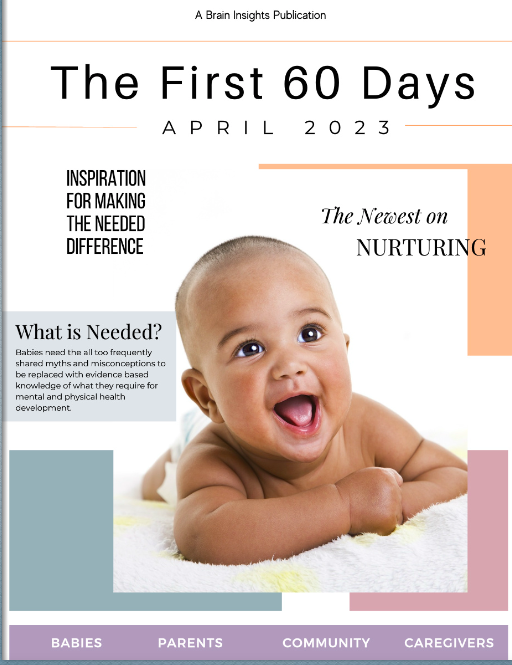
Screen Shot 2023-05-23 at 3.25.41 PM3. What is your connection to PACEs Connection/PACEs science? – The emphasis of my work and purpose of Brain Insights is entirely focused on prevention. This especially is the reason behind writing The First 60 DaysBooklet and initiating The First 60 Days Movement. Creating an awareness and understanding of the essential need for consistent nurturing responsiveness in the earliest days, weeks, and months makes an incredibly positive difference.

(Magazine shown above is free to download here.)

We in this movement need to make this common knowledge, so we can better support parents and caregivers. An awareness of early brain development — with the realization of the impact of relationship trauma, stress, and neglect and an understanding of the need for meeting physical needs, providing nurturing, security and play — ultimately benefits everyone of us. It is “preventive justice”, as it truly puts infants, babies, and children on a path to achieving their highest potential, by wiring their brains for connection, love, and healthy relationships, as opposed to distrust, disconnection, and the greater potential to seek out relationships and situations that reinforce  unworthiness, poor self-perception,  neglect, or danger.

Screen Shot 2023-05-23 at 3.30.02 PM4. Do you work in the field? – Yes, all of my work is based on child development and brain science with a focus primarily on the earliest months and years since that is the time the brain is most malleable, providing us with the most positive opportunity for well-being in life.

5. How did you find out about PACEs Connection? – Through LinkedIn and Twitter.

6. Were you surprised to find this resource? – I am not sure that surprised is the word, but I was definitely delighted.

7. What part of PACEs Connection do you like best? – It is not easy to choose a part that I would label as best. There is such a wealth of information and resources provided in various ways. It is all great. But if I would single out one aspect, I would say the Weekly RoundUp.

8. How do you use PACEs Connection? – I use it as a source of gaining awareness of what is being done in various locations and in various ways toward creating positive outcomes and increasing needed awareness. It is encouraging to see numerous efforts taking place.

9. Do you read the Weekly RoundUp? – Yes. It is helpful.

10. Do you share stories from the Weekly RoundUp? – Yes, I have.

11. Do you belong to a resiliency initiative? – I currently do not but would like to explore getting involved in this way.

12. What prompted you to support PACEs Connection with your gift? – I fully support providing financial help in hopes of reducing the number of children and families experiencing ACEs.

13. What keeps you giving as a monthly donor? – I want to continue to support the efforts of people who are leading the way toward significantly reducing the number of children whose brains are being developed in the midst of toxic stress. The science is there to show that it isn’t healthy for children to be in constant toxic stress. There are buffering effects as the result of positive childhood experiences – PCEs. It is essential that we get this message to everyone that has a direct or indirect influence on the development of children. Every child needs at least one nurturing relationship!

14. What would you tell others, to encourage them to support PACEs Connection on a monthly basis? – Something I say frequently is, EVERYONE needs to understand the impact experiences have on the developing brain, because when ALL children have the positive experiences they require from the start, we ALL benefit.

Screen Shot 2023-05-23 at 3.35.26 PM15. What is your greatest hope for what happens with PACEs science? That we end child abuse? Create equity? Eliminate racism? Do away with poverty?  Create a trauma-informed and healing-centered planet?  –  Every aspect listed here needs to happen. My greatest hope is that through sharing the understanding of early brain development and the importance of nurturing our babies and children, and each other, that the shared value of commonality and community can grow. We can create a  ripple effect of support and acceptance, instead of judgment and labels. It really does make a difference. There is great power in even just one caring adult positively interacting with a child. We can help people become that caring adult. We can help activate people to share the word about the importance of making the first 60 days of life a time of sacred connection and secure attachment that lays the foundation for physical and mental health, learning, positive behavior and self-perception, and the increased likelihood of overall well-being across the lifespan.

McNelis encourages fellow members of PACEs Connection to join her in making a monthly tax-deductible donation to PACEs Connection here.

One-time donations are encouraged as well!

If you’d prefer to mail your gift rather than give it online, here’s how…

Make check payable to:
TSNE (Third Sector New England, our fiscal sponsor) and write PACEs Connection Donation on the memo line.

Mail check to:
PACEs Connection, c/o TSNE, 89 South Street, Suite 700, Boston, MA 02111

Making a wire transfer or need Tax ID information?

Please contact Carey Sipp, Director of Strategic Partnerships, at csipp@pacesconnection.com

If you would like to be featured as a monthly donor, please send an email to Carey Sipp, director of strategic partnerships, with “Donor Spotlight” in the subject line to answer the 15 questions and let your fellow community members know more about you, how you use PACEs Connection, why you support the work.

Attachments

History of Juneteenth, how it’s celebrated, impact of trauma and enslavement today discussed on History. Culture. Trauma. encore with Brandon Jones Thursday

Carey Sipp Carey Sipp 6/13/233:10 PM

Juneteenth marks the day—June 19, 1865—when federal troops arrived in Galveston, Texas, led by Union Army general Gordon Granger. He announced General Order No. 3 that proclaimed freedom for all enslaved people in Texas, two years after President Abraham Lincoln issued the Emancipation Proclamation. The state was the last of the Confederacy that had institutional slavery.

Black communities began celebrating Juneteenth in Galveston in 1866, and since then the commemoration spread across the United States. On June 15, 2021, it was finally recognized by the U.S. government as a federal holiday.

Screen Shot 2023-06-13 at 5.07.09 PMThis This week’s “History. Culture. Trauma.” podcast examines trauma and resilience, not just at the individual level but at the systems and cultural level,” says Ingrid Cockhren, podcast co-host and CEO of PACEs Connection, who examines the questions, “How has the trauma of slavery and genocide impacted our current society? Why are the cultural manifestations of trauma, that is, community violence, school shootings, etc., so pervasive?

In this episode recognizing Juneteenth, Cockhren and guest Brandon Jones will discuss the historical and current context of Juneteenth, how it is recognized.

Jones, the executive director of the Minnesota Association for Children’s Mental Health (MACMH), has a consulting and training background in addressing adverse childhood experiences (ACEs), historical and intergenerational trauma, social/emotional Intelligence, leadership, and intercultural development inventory.

Jones holds a B.A. in sociology from the University of Minnesota, a master’s in community psychology from Metropolitan State University, and a master’s in psychotherapy from Adler Graduate School. He  is also a 2013 Bush Foundation Leadership Fellow. He provides “the MACMH staff and board with the leadership and vision necessary to keep MACMH at the forefront of mental health education and advocacy,” he explains.

Jones says he lives by the motto of, “Live life with purpose on purpose.”

To listen to History. Culture. Trauma. this Thursday at 1 p.m. PT, 4 p.m. ET, please click here.

Attachments

A special request from the staff at PACEs Connection

Carey Sipp Carey Sipp 8/22/2311:30 AM

Photo above is of the PACEs Connection staff as we said goodbye to Jane Stevens, PACEs Connection founder and former CEO and publisher, on her transitioning to her new role as publisher of ACEsTooHigh, which was spun off from PACEs Connection on May 1. The eight staff members left in this photo curate and maintain the website, calendar, enewsletters, podcasts, webinars, maps, schedule of Creating Resilient Communities classes, membership profiles and more! They are, top row, l-r, Kahshanna Evans, director of Creating Resilient Communities; Carey Sipp, director of strategic partnerships; Jane Stevens, founder and former CEO, now retired; second row, l-r, Ingrid Cockhren, CEO; Rafael Maravilla, network manager, and Mathew Portell, director of education and outreach; third row, l-r, Jenna Quinn, program coordinator, environmental justice consultant; Porter Jennings McGarity, director of continuous quality improvement and community data, and Tawana Irvin, chief administrative officer.

As long as I have worked here, I’ve only met two of my colleagues in person. There will always be a barrier that exists when the only way you are able to communicate with someone is through a screen.

Did you know PACEs Connection …

  • Is a community of communities that’s raised awareness of the science of adverse childhood experiences (ACEs) for 11 years? In 2020, when we changed the name to PACEs Connection, we started cementing the importance of positive and adverse childhood experiences (PACEs) across all sectors, including journalism, policy and legislation, medicine, education and law enforcement, as well as the faith-based, parenting, LGBTQAI+ communities, and more. Our community of communities is now almost 60,000 strong!
  • Is home to 400 cross-sector (involving at least three sectors, such as education, healthcare, communities of faith, government) geographic, and 40 interest-based sub-communities. Tied together by our site, the communities help members find each other, promote their work on their respective free websites, leverage the network, use our social media tools, and more, to learn and share information.
  • Brings you the latest news on PACEs science viaour e-newsletters, the stories we write, the plethora of articles, videos, and resources we curate and post daily, and the monthly Research Corner, filled with the latest peer-reviewed scientific journal articles shared with us by Dr. Harise Stein, a medical doctor and Stanford University professor. We also create and share our ownwebinars andconferences, our History. Culture. Trauma. podcasts, our Historical Trauma in America series, plus the 25 Creating Resilient Communities (CRC) educational webinars staff members present each month. We also offer  – again, at no charge – our Resource Center, modeled after those used in public libraries, and offering a wealth of free resources (many in Spanish and English) used by schools, parenting groups, community outreach programs, colleges, universities, physicians’ offices and more.
  • Connects members of our Cooperative of Communities for our coast-to-coast think tank, and gives members access to your posts, questions, conference and event promotions, comments, and more. It’s a platform we monitor closely to keep as a safe space for our members – including ourselves. It’s also a tool members use  to calendar, market,  and build businesses, promote themselves as subject matter experts, and promote podcasts, workshops, conferences, goods and services. We are delighted to have played a role in your success! With that thought in mind, this is also where we recently shared news of our own offerings in professional development and consulting, and invited you to reach out to Ingrid Cockhren, our CEO, for more information on our services, which started with diversity, equity, inclusion, and belonging work.
  • Is actually run by a lean and scrappy team of just eight dedicated individuals? That’s right. All of this work, and more, is done by just eight people!

Surprised?

We know this work is important to many of our almost 60,000 members, because you, too, share blog posts about your work, your events, your experiences.

We are your conveners, offering this home to post and process, to relate, to learn how to regulate, and reason, and to find members in your own state – and possibly right down the street – who care about the same concerns you do!

Here, each month, there are more than 2.5 million page views!

Some of our members may well have been able to launch or sustain businesses in large part because PACEs Connection has helped them get the word out about trainings, podcasts, webinars, books, public speaking, recovery programs, and more.

Again, this is a service we have loved to provide – with no subscription or membership fee – since 2012.

It’s time, though, for us to make a special request of you. It’s not a heavy lift.

You see, we’d really like to meet each other in person! And we’re hoping you, our readers, members, frequent users, and friends, will support this request by making a tax-deductible contribution to PACEs Connection that will help us connect, in person, later this summer.

Half of us have never met another staff person! And most of us who have met each other haven’t seen each other in five years. Truth? We would deeply appreciate the time to meet each other, connect, work together on some important planning, and have some recreation and restoration time together. All so we can keep improving what we deliver to you, every day.

When asked why they are eager to have a staff retreat, comments included:

“Fresh ideas come when folks can hang out for some team building and fun. Spending time in 3-D is really important for developing trust and bonds with each other.”

“We’ve accomplished so much on a strictly virtual platform. We need to have some in-person bonding. The pandemic showed the world that having human interaction every now and then is necessary; this retreat will support that!”

“We need a work retreat  to support healthy team collaborations, to have the opportunity to step away from our daily routines and stresses, and allow many of us to talk face-to-face for the first time ever, build understanding, and foster a stronger, more cohesive team culture.”

“Empirical evidence underscores the importance of investing in practices to foster healthy team building, especially in non profit organizations. Such activities help unite a team, which helps the team fulfill its mission.”

With your help, we’re hoping to raise about $20,000, enabling staff from California, Massachusetts, New York, North Carolina, and Tennessee, to travel and connect for three days of strategic planning, solution seeking, getting to know each other, and bonding.

Would you be willing to help us connect as we work to improve the work we do for you, our members and readers?

Your donation is tax deductible. You may donate online, or to mail your donation, please make your check payable to: TSNE (Third Sector New England, our fiscal sponsor) and write PACEs Connection Donation on the memo line.

Mail check to:

PACEs Connection, c/o TSNE, 89 South Street, Suite 700, Boston, MA 02111

To wire transfer funds, or if you have questions or comments, please email me, Carey Sipp, director of strategic partnerships, at csipp@pacesconnection.com, or email Ingrid Cockhren, our CEO, at icockhren@pacesconnection.com with the subject line: In-person staff meeting.

Thank you in advance for your support!

Your support of our work is greatly appreciated. Please click here to donate today.

Carey Smith Sipp

carey.pacescommunites@gmail.com