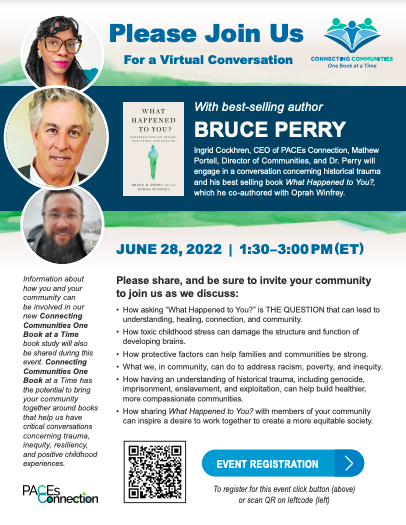
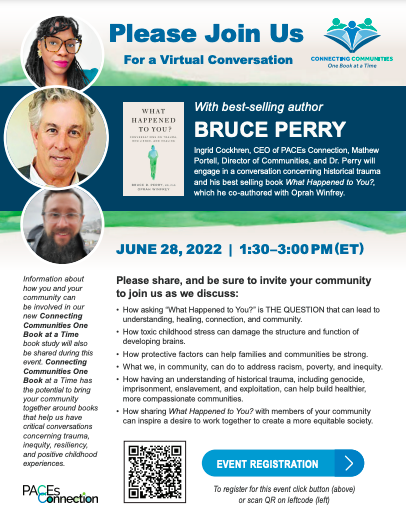
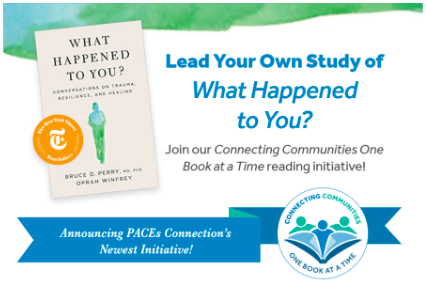
Please join us on June 28 from 1:30-3:00 p.m. ET for a virtual conversation with best-selling author Bruce Perry. Ingrid Cockhren, CEO of PACEs Connection; Mathew Portell, PACEs Connections’ director of communities, and Perry, a psychiatrist and neuroscientist, will engage in a conversation concerning historical trauma and Perry’s best-selling book “What Happened to You? Conversations on Trauma, Resilience and Healing,” which he co-authored with Oprah Winfrey.
Please share this blog post, and the attached flyer, and be sure to invite your community to join us as Perry and hosts address:
How asking “What Happened to You?” is THE QUESTION that can lead to understanding, healing, connection, and community.
How toxic childhood stress can damage the structure and function of developing brains.
How protective factors can help families and communities be strong.
What we, in community, can do to address racism, poverty, and inequity.
How having an understanding of historical trauma, including genocide, imprisonment, enslavement, and exploitation, can help build healthier, more compassionate communities.
How sharing “What Happened to You?” with members of your community can inspire a desire to work together to create a more equitable society.
Invite members of your community to this important event and learn how you and your community can be involved in our new Connecting Communities One Book at a Time book study.
Connecting Communities One Book at a Time has the potential to bring your community together around books that help us have critical conversations concerning trauma, inequity, resiliency, and positive childhood experiences.
Register now for the discussion with Perry on June 28, and watch for details of how your community can lead your local book study.
This opportunity is a new way PACEs Connection members and communities can connect, learn, heal, brainstorm and work together to improve the lives of children and families based on lessons learned from the book. The Connecting Communities project was inspired by the Georgia Reads book study of “What Happened to You?”, in which more than 40 Georgia groups discussed the book in the past year.
For more information, please contact Carey Sipp, director of strategic partnerships, at csipp@pacesconnection.com.
For more information about the book and a review tying it to PACEs Connection, please click the link below.
The horror of a child maltreatment case being mishandled or overlooked compelled this week’s guest on “History. Culture. Trauma.” to create a national, education-based solution.
Dr. Tyler Counsil is the director of Child Advocacy Studies (CAST), part of the Zero Abuse Project. He uses his passion for prevention, healing, education, and justice to the benefit of students at almost every level of education after high school.
“Today’s students in community colleges, technical schools and four-year colleges are eager to help prevent and heal child abuse and to bring justice for victims and survivors,” says Counsil. “Whether they are studying for a degree or certification in programs ranging from criminal justice to social work, they need to have a multidisciplinary understanding of how to respond to child maltreatment.”
According to Counsil, CAST courses are offered at 86 colleges, community colleges and universities across 29 states in the U.S. CAST learning focuses on developing students’ understanding of the factors that lead to child maltreatment as well as how various professionals, from law enforcement, social work, forensics and healthcare respond to abuse and neglect, so they can work more effectively.
On Thursday’s podcast with hosts Ingrid Cockhren, CEO of PACEs Connection, and Mathew Portell, director of communities, Counsil will share insights to advance listeners’ understanding of our country’s history and culture of child abuse.
“Work on a single child abuse case may involve multiple systems and institutions,” says Counsil. “With CAST programs being shared at education centers across the country, students learn about the various professional responses to child maltreatment and develop a multidisciplinary understanding of the most effective responses.”
Those who complete the CAST courses are will be better equipped to carry out the work of different agencies and systems (healthcare, criminal justice, social services) as they advocate on behalf of the needs of children as victims and survivors of child abuse.
According to the CAST website, “Universities seldom prepare students for the reality of child protection. Successful professional training will produce child maltreatment professionals who will be knowledgeable enough to competently manage child maltreatment cases.”
“Beginning in college, we must produce an army of frontline workers well equipped to organize all the players in their local communities for the benefit of children,” he says. “Each member of the CAST front line has experience recognizing abuse typologies, speaking with survivors and non-offending caregivers, conducting agency-appropriate investigations and testifying in court. While these experiences increase professional competency, the most compelling reason to provide this training is that it may prevent a child maltreatment case from being mishandled or overlooked.”
Counsil has worked over six years in the public and private laboratory sector, having been employed as a microbiologist, DNA specialist, quality assurance/quality control manager, and forensic scientist throughout the span of his laboratory career. His most recent venture involved working as a forensic scientist with the Indiana State Police Laboratory Division. He is a deputy coroner and death investigator for his county. Counsil has also been appointed as president-elect for the National Partnership to End Interpersonal Violence Across the Lifespan.
Counsil also has extensive experience working in post-secondary education. With over seven years of professional work experience at institutions of higher education, he has served as an associate professor for traditional and online learning platforms, with a combined five years of program development and directorial leadership experience for Child Advocacy Studies (CAST) criminal justice and forensic science programs.
Counsil has a B.A. in biology from Hanover College (Hanover, IN), a B.S. in criminal justice from Oakland City University (Oakland City, IN), and a M.S. and Ed.D. in biology from Ball State University (Muncie, IN).
Professional memberships:
American Academy of Forensic Sciences
Midwestern Association of Forensic Scientists
National Alliance on Mental Illness
National Partnership to End Interpersonal Violence
National Science Teachers Association
Indiana Academy of the Social Sciences
Tune into the “History. Culture. Trauma.” podcast on Thursday at 1 p.m. PT; 4 p.m. ET here.
For this and past episodes, connect with your podcast provider below:
“If you don’t understand history, you’re never going to understand trauma. And if you don’t understand trauma, you’re never going to understand history. And this is part of our problem as a field,” said Dr. Bruce Perry in a webinar interview last month, highlights of which will be shared in our “History. Culture.Trauma.” podcast this Thursday at 1 p.m. PT; 4 p.m. ET.
In the webinar, attended by more than 1200 registrants, Perry and hosts Ingrid Cockhren, CEO of PACEs Connection, and Mathew Portell, director of communities, discussed the intersecting fields of trauma and historical trauma and his best selling book, co-authored with Oprah Winfrey, “What Happened to You?”
“There are some really exciting and important things that are happening in the area of historical trauma,” said Perry. He addressed the history of colonialism, treatment of indigenous people, kidnapping and enslavement that are such a part of the history and historical trauma of the United States.
“You know, we are living in systems that are fundamentally colonial in construction,” he said. “And colonialism basically means I’m going to come into your space, your place, and I’m going to take your things and I’m going to make you feel privileged, if I give you a little bit of it back.”
Historical perspectives about trauma deserve “as much attention and funding and support” as is given to people studying the effects of a drug on post traumatic stress disorder (PTSD), or the effects of other treatments, he said.
The June webinar also launched the Connecting Communities One Book at a Time community book study initiative. The initiative begins with a study of “What Happened to You?” in PACEs Connection communities across the country. For more information about this initiative you can attend our book study leader training with our partner Children’s Trust Fund Alliance on July 27 or visit here. To sign up as a book study leader, please complete the form available here.
Perry is the principal of the Neurosequential Network, senior fellow of The Child Trauma Academy and adjunct professor in the Departments of Psychiatry and Behavioral Sciences at the Feinberg School of Medicine at Northwestern University in Chicago and the School of Allied Health, College of Science, Health and Engineering, La Trobe University, Melbourne, Victoria Australia.
According to his website, “Over the last thirty years, Dr. Perry has been an active teacher, clinician and researcher in children’s mental health and the neurosciences holding a variety of academic positions. His work on the impact of abuse, neglect and trauma on the developing brain has impacted clinical practice, programs and policy across the world. Dr. Perry is the author, with Maia Szalavitz, of “The Boy Who Was Raised As A Dog”, a bestselling book based on his work with maltreated children, and “Born For Love: Why Empathy is Essential and Endangered”.
Perry, a native of Bismarck, North Dakota, earned his undergraduate degree at Stanford University and Amherst College. He attended medical and graduate school at Northwestern University, receiving both M.D. and Ph.D. degrees, and completed a residency in general psychiatry at Yale University School of Medicine and a fellowship in Child and Adolescent Psychiatry at The University of Chicago.
To listen to Thursday’s podcast at 1 p.m. PT, 4 p.m. ET, click here.
To hear prior episodes via your favorite podcast service, use the links below.
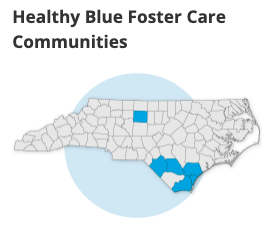
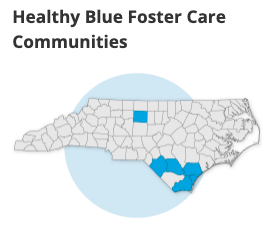
For the last eight months the Medicaid plan provider has engaged community resiliency-building experts and organizers to help children, families, and caseworkers in the state’s foster care program to boost resilience and better manage stress. The innovative project is called the Healthy Blue Initiative.
“We all know kids in foster care have higher rates of adverse childhood experiences (ACEs) than most children.
They are often in foster care due to loss of a parent from death, illness — including addiction — divorce, or incarceration,” says Amy Read, community trainer for Coastal Horizons, a large mental healthcare provider in Eastern Carolina.
“Many foster children have experienced emotional and physical neglect, abuse, and/or sexual abuse. Most children in foster care have seen a lot of disruption, having been removed from their families and, if not placed with relatives, placed with a family or families they do not know,” she adds.
“There is intense loss of relationships, familiar surroundings, and often a school setting in which they at least had some routines,” says Read. With former social-emotional learning coach Kelly Purcell, she helps lead the initiative by working with six communities whose leadership includes a resilience initiative based on the science of positive and adverse childhood experiences — PACEs science.
Naimah Dye, Medicaid strategy growth and engagement director for Healthy Blue, says the organization is eager to see the outcomes of offering this support to the more than 2,000 children in these six counties. She is also glad to see that caseworkers and parents will be provided tools to build their own resilience to avoid being overwhelmed.
“The reason we looked to PACEs Connection for help in doing this is because they had the relationships with the different sectors in the communities—education, healthcare, child and family services, communities of faith, recreation, law enforcement, the arts, mental health—to bring a coordinated effort to the mission,” says Dye.
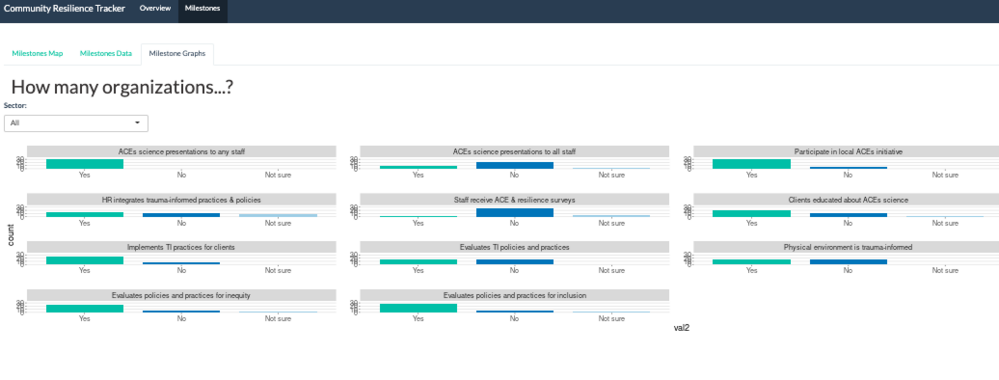
“PACEs Connection communities who are affiliates of the organization’s Cooperative of Communities have measurement tools that will help us see how the project is working,” she continues. “We won’t know overnight, and we know that; but over the course of the year we will be using PACEs Connection’s tools and their analysis to measure the communities’ progress. This ability to measure how many organizations are involved, the depth of their involvement, and ultimately how different sectors of the population are doing—in this case foster children—will help us get an idea of how effective the work is,” she says.
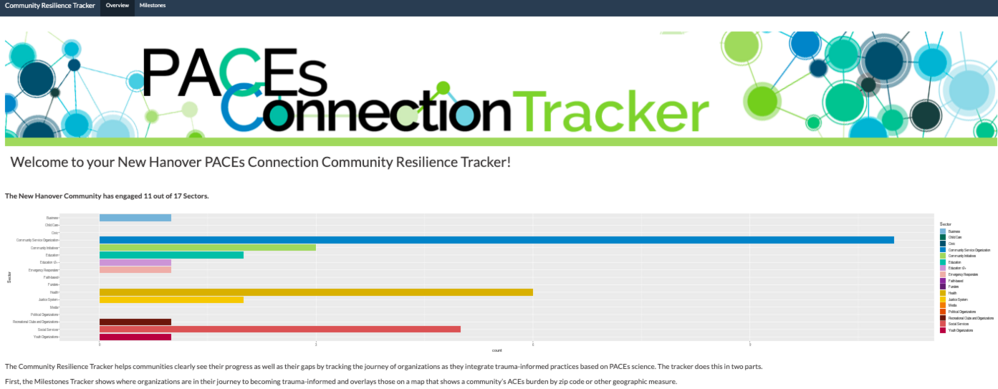
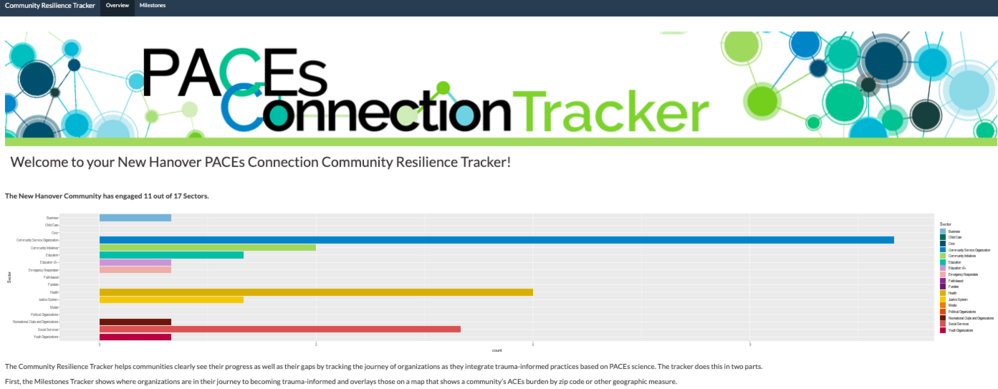
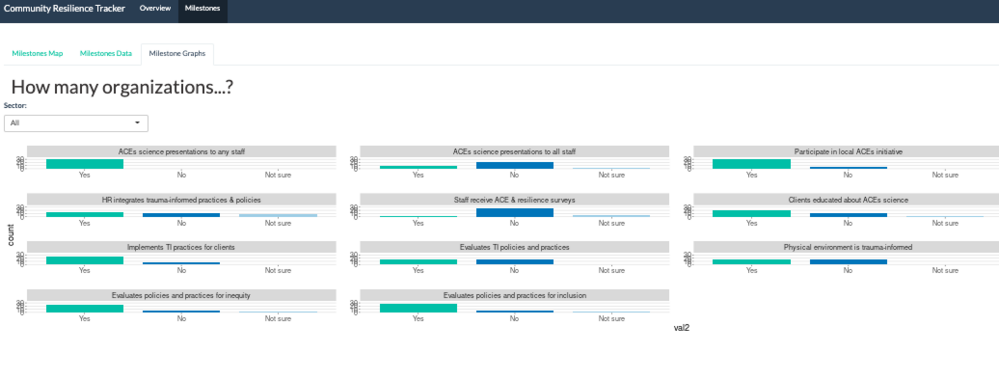
The Community Resiliency Tracker shows how many organizations have “signed on” to the work, what sectors they’re in, and, in another graph, how far along they are on the path to becoming trauma-informed.
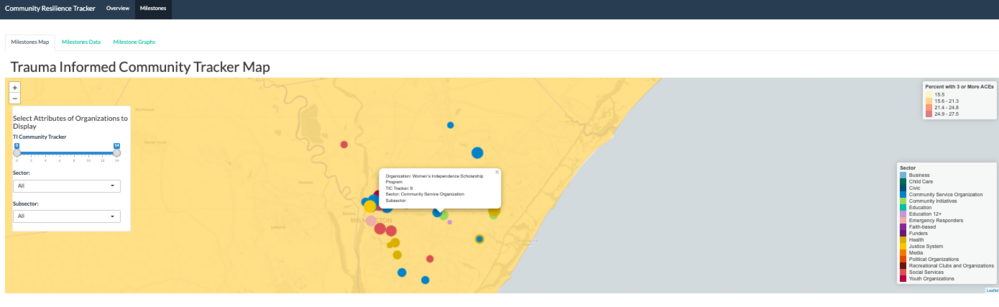
The Community Resiliency Tracker map also hows where organizations are, their names, how far along they are on the path to becoming trauma informed, and what sector the organization is in. This is a quick, transparent gap analysis of where to work next!
What would have the greatest impact? When the project’s leaders met with Department of Social Services employees, educators, and some foster parents before the work started, they were enthusiastic. “We wanted to start by asking what was needed and what, in the opinion of people working with foster children and within the system, would have the greatest impact on reducing stress and improving the health and well being of everyone from the social workers to the parents to the children themselves,” says Read.
One of the foster parents on the fact-finding calls was Kristy Blackwell, a family youth partner with Coastal Horizons. The mother of four teenage boys, three of whom are foster children, Blackwell talked about the importance of to giving caregivers and children resiliency skills. One of her older foster children also shared thoughts about what was needed by the children.
The team listened to input from all corners and decided sharing resiliency skills with caregivers, and then families and children, made sense, so caregivers could use the skills to help care for themselves, and share the skills in their work with the families.
“Resilient Guilford joined with the eastern counties in the project that involves ‘a lot of ‘dovetailing’—building on existing opportunities for connection—and community building to strengthen relationships among children, families and caregivers. In all six counties the work centers on providing proven tools for lowering stress, building resilience, and in bringing some positive childhood experiences to the children and their families,” says Read.
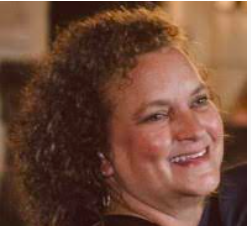
Tying the six communities together and supporting their growth is Purcell, a former instructional coach with an emphasis on social emotional learning for the New Hanover County School System. A nationally-recognized trainer in the Community Resilience Model (CRM), Purcell has coordinated with the communities and caregivers to deliver CRM trainings. She is also working toward creating culturally appropriate, community-led positive childhood experiences to buffer the impact of ACEs.
Purcell has attended most of the resiliency task force meetings in all six counties for the last eight months and says, “At the same time we are helping to strengthen children, families, and caregivers, we’ve been strengthening the overall community, so everyone from teachers and physicians to Sunday school leaders and coaches has heard about the project and can support it by using the same information about PACEs science and resilience tools.
“Emphasizing PACEs science education creates a shared mental model among the families, caregivers and community members, adding another level of support and resilience. Helping them learn about PACEs science reinforces why they want to do the work. The PACEs science presentation shows that the best way to have an impact is to keep going back to the science, the fact that adverse experiences affect health outcomes; positive experiences can be buffers, we can all play a role in supporting children and families” she says.
The PACEs Connection Community Resiliency Tracker helps initiatives and member organizations gauge progress on the path to becoming “trauma informed”, which includes having staff members learn about PACEs science.
Creating Resilient Communities
Purcell has also made sure to share the free PACES Connection “Creating Resilient Communities” training information with initiative members at the meetings, in hopes of more and more community members learning the importance of following the PACEs Connection model of educating, aggregating (tracking), engaging, activating, and then celebrating the work to help the communities continue to grow.
“It’s great to see the collaborative effort of the communities, how members continue to connect and invite others to be part of the local effort. To create the healthy, compassionate communities that will be more supportive of foster families, we need to keep the work going, and growing, so people are hearing these messages at home, at work, in their faith communities, at their doctor’s office. That’s how we build sustainability” said Purcell.
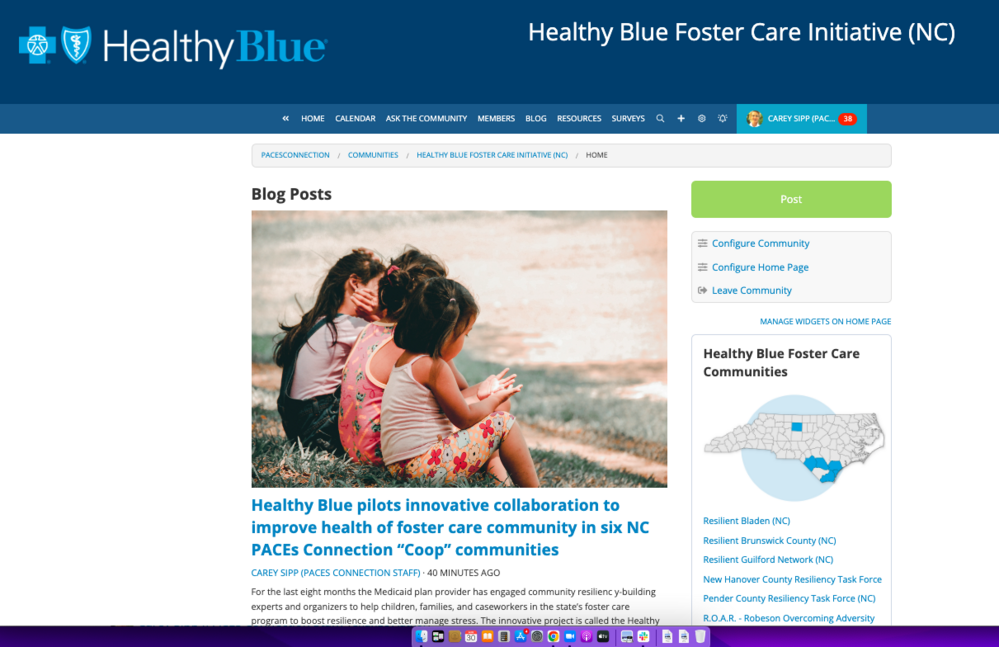
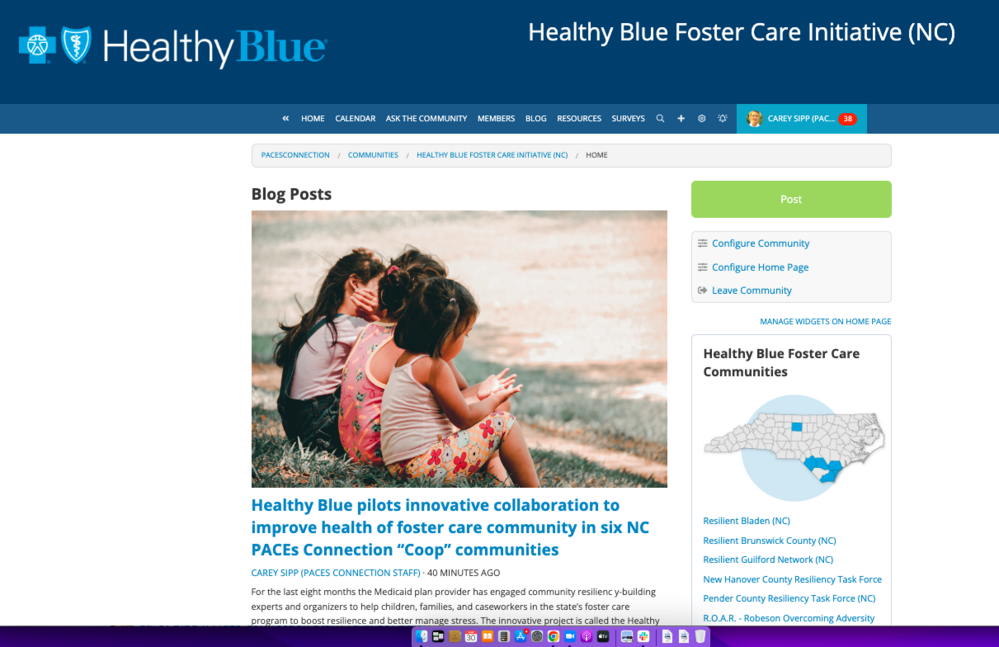
The Healthy Blue Initiative website as a “real-time report”
Purcell and Read have also used one of the most important tools available to the PACEs Connection communities—the free sites on PACEs Connection. They created and maintain a site for the Healthy Blue Initiative Foster Care Initiative, NC, which they’ve used to track, in near real-time, the presentations, projects, and progress of the entire initiative. Added to this, community managers from the communities have taken advantage of their memberships in the PACEs Connection Cooperative of Communities to attend the monthly meetings of Coop affiliates, as well as training sessions that are free to Coop members.
Read is quick to compliment Purcell on her strategy and the way she’s done the work.
“Kelly is the perfect person to be working with children and leaders for this project,” says Read. “This includes the guardian ad litem volunteers she’s trained, North Carolina Department of Social Services leaders, and the children in a school where there are many children involved in the foster care system. She knows how important it is to help the community at large understand the impact of toxic childhood stress, and the healing potential of positive childhood experiences. She is a motivator, communicator and a connector, with the infectious enthusiasm to match her education, experience, training, and skills.”
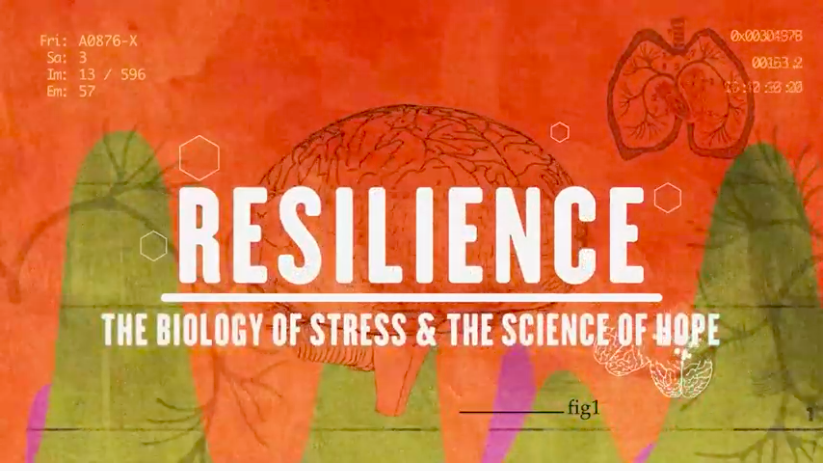
Part of Purcell’s responsibility has been to work with the different sectors in each community to find opportunities to connect with children and families in foster care. Once connecting points are identified, Purcell provides trainings and organizes events, such a three-county virtual viewing of the documentary “Resilience: The Biology of Stress & The Science of Hope”’ followed by a panel discussion.
“Some of the trainings have been in person,” notes Purcell. “Others, depending on the state of the pandemic and availability, have been and will continue to be online. We continue to look at bringing caseworkers, parents, and children together when and where appropriate to include positive childhood experiences. We’re exploring offerings that will involve arts and an outdoor activity.”
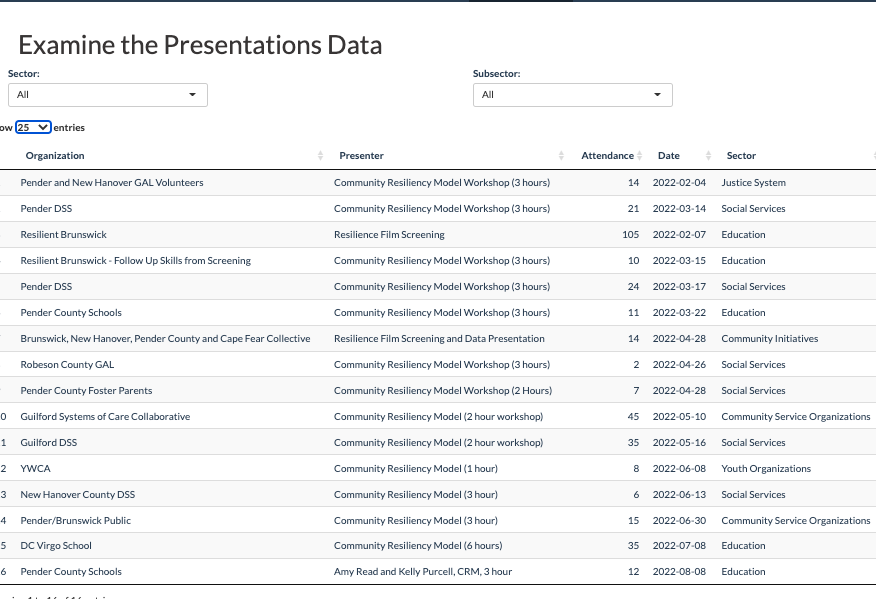
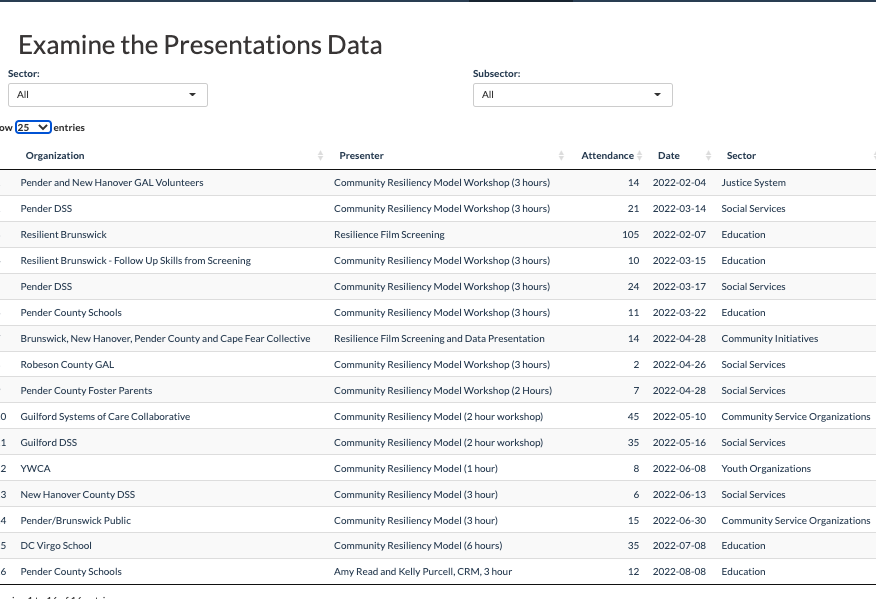
Presentations data goes into an easily-updated presentations tracker.
“Building resiliency skills is a godsend”
Blackwell, the foster mother of teenager boys who also works with youth in foster care, had learned resiliency skills before the Healthy Blue Initiative started, and that was one of the reasons, during the planning phase of the program, she was so vocal about centering the work around sharing the skills.
“Building resiliency skills has been a godsend. Building resiliency skills in myself as a parent was especially helpful when we had a house fire in April (2021). It was such a blessing for us to know to notice who was there to support us, to remember things wouldn’t be bad forever, and that we could take the time to breathe,” she says.
“If more parents and caregivers had these skills, we would probably have more kids stay in their homes. That would reduce stress. The kids may need less medical attention because we’ve reduced the stress. My 15-year-old says it well. He talks about being in a foster home that wasn’t the greatest, and that maybe if they had all had some resiliency skills, it would have been a better fit,” she adds.
For more information about PACEs Connection, the Cooperative of Communities, and potential strategic alliances such as the Healthy Blue Initiative with PACEs Connection, contact Carey Sipp, PACEs Connection director of strategic partnerships, at csipp@pacesconnection.com
Note: This funding opportunity is being posted as it appeared on theSubstance Abuse and Mental Health Services Administration (SAMSHA) Website.
Short Title
ReCAST
Initial AnnouncementNotice of Funding Opportunity (NOFO)
NOFO Number
SM-22-019
Posted on Grants.gov
Thursday, September 1, 2022
Application Due Date
Monday, October 17, 2022
Catalog of Federal Domestic Assistance (CFDA) Number
93.243
Intergovernmental Review (E.O. 12372)
Applicants must comply with E.O. 12372 if their state(s) participates. Review process recommendations from the State Single Point of Contact (SPOC) are due no later than 60 days after application deadline.
Public Health System Impact Statement (PHSIS) / Single State Agency Coordination
Applicants must send the PHSIS to appropriate State and local health agencies by application deadline. Comments from Single State Agency are due no later than 60 days after application deadline.Description
The purpose of this program is to promote resilience, trauma-informed approaches, and equity in communities that have recently faced civil unrest, community violence, and/or collective trauma within the past 24 months; and assist high-risk youth and families through the implementation of evidence-based violence prevention, and community youth engagement programs. SAMHSA expects ReCAST to be guided by a community-based coalition of residents, non-profit organizations, and other entities (e.g., health and human service providers, schools, institutions of higher education, faith-based organizations, businesses, state and local government, law enforcement, and employment, housing, and transportation services agencies).Eligibility
Eligible entities are States, political subdivisions of States, local municipalities (e.g., counties, cities, and local governments), public or private non-profit community-based organizations, Indian tribes, or tribal organizations (as defined in section 5304 of title 25), that have faced civil unrest, community violence and/or collective trauma.Award Information
Funding Mechanism
Grant
Anticipated Total Available Funding
$10,000,000
Anticipated Number of Awards
10
Anticipated Award Amount
$1,000,000 per year
Length of Project
Up to 4 years
Cost Sharing/Match Required?
No
Proposed budgets cannot exceed $1,000,000 in total costs (direct and indirect) in any year of the proposed project. Annual continuation awards will depend on the availability of funds, grantee progress in meeting project goals and objectives, timely submission of required data and reports, and compliance with all terms and conditions of award.
This program is being funded from the Bipartisan Safer Communities Act. SAMHSA has shortened the application submission period to less than 60 days to ensure the awards are issued consistent with the funding provisions within the law.Contact InformationProgram Issues
Jennifer Treger Center for Mental Health Services Substance Abuse and Mental Health Services Administration RECASTNOFOMHPB@samhsa.hhs.govGrants Management and Budget Issues
Office of Financial Resources, Division of Grants Management Substance Abuse and Mental Health Services Administration (240) 276-1400 FOACMHS@samhsa.hhs.gov
By Elaine Miller-Karas MSW, LCSW Building Resiliency to Trauma Psychology Today, September 30, 2022 Mental health can suffer after extreme climate events.
KEY POINTS
Mental health conditions exacerbated by natural disasters include post-traumatic stress disorder, depression, and anxiety.
After a disaster, the number of people needing assistance from the mental health systems strains or exceeds community capacity.
There are simple strategies helpers can use to help survivors restore well-being after climate events.
In September 2022, Puerto Rico, Cuba, and Florida are experiencing devastation from hurricanes. Extreme weather events — floods, hurricanes, and natural disasters like wildfires — are linked to a broad range of adverse mental health outcomes. The most reported mental health conditions in the aftermath of extreme weather events and natural disasters are post-traumatic stress disorder (PTSD) along with depression, anxiety, suicide, and substance abuse disorders (Cianconi et al., 2020).
Mental Health Systems Are Strained After Wide-Scale Disasters
Those impacted by the recent climate events are just beginning their journey. Emergency response mental health workers will be present in the initial days. However, the lasting impact for a community devastated by natural disasters lingers for weeks, months, or years. There is a strain on mental health systems as the number of people needing assistance exceeds a community’s capacity.
Suggestions for Helpers
For those assisting individuals during and after a disaster, the following suggestions reflect lessons learned by the Trauma Resource Institute as we have been invited to help communities after human-made and natural disasters:
1. Be careful not to interrupt the work of emergency response workers. Rescuing survivors and stabilizing infrastructure, such as restoring electricity, are priorities.
2. Help identify where survivors can acquire concrete services: water, food, shelter, hygiene products, and bathrooms. Direct survivors to where governmental groups like FEMA have established temporary locations. The elderly may need assistance with completing documents to receive benefits. As a result of the destruction, people with disabilities may have difficulty maneuvering to sites to receive services. Organizations like the Red Cross, local disaster response units, FEMA, Save the Children, and faith-based groups can help network support for community members.
3. Communication systems may be down because of power outages. There can be increased anxiety in not knowing the well-being of family members, friends, and pets and whether homes are still standing. Try to provide as much information about when providers may restore communication systems.
4. You may assume that people need to talk about what happened during the disaster to heal. We have found that this is not necessarily true for every person. Inviting choices to share or not to share about what happened is essential. Questions like, “I am here to provide support. If you would like, we can talk about what happened if that would be helpful. You can share with me as little or as much of what happened to you as you would like.”
Ask Strength-Based Questions to Remind Survivors of Encouraging Elements of Their Experience
5. Questions highlighting strengths can help survivors remember what else may be true now. Often when asking questions in this way, it broadens the perspective of the trauma to include other elements of the experience that were more positive. Questions can include:
“When did help first arrive?’
“When did you know you and your family were going to get to a safer place?”
“What or who is helping you the most right now?
If a person is agitated or sad, ask respectfully, “When challenging events have happened to you in the past, and what or who helped you get through?
Help Now! Strategies Can Be Simple and Effective Ways to Help
6. Another way to help calm a person who is distressed are the “Help Now!” strategies from the Community Resiliency Model set of wellness skills. They may appear simple, yet they can help people calm down and feel more like themselves. The following invitations can help children and adults experience a greater sense of well-being:
Would it be helpful to go for a walk together?
Sometimes, it helps to get the energy of anxiousness out by pushing against the wall with our hands or our back against it. Do you want to do it with me?
Can I get you a drink of water?
If I am anxious, sometimes it helps me to count down from 20. Would you like to try it with me?
If I am feeling a lot of tension in a part of my body, I try to find a part of my body that is less tense. Then, I bring my attention to the parts that feel better. Do you want to try doing this?
I found this app called iChill, and I listen to it when I am down or too anxious. You might want to consider using it when you are stressed or down.
Identify Community Mental Health Clinics and Alcohol and Drug Treatment Programs
7. It is a complex process to lose one’s home, livelihood, and surrounding community. The journey of recovering and rebuilding can exacerbate mental health conditions and also lead to increases in alcohol and drug use. Helping survivors identify community mental health clinics and drug and alcohol treatment programs can lead them to essential safety nets.
How to Learn More
To help to gain more information about how to build more resilient communities to prepare your community for climate events, contact the International Transformational Resilience Coalition (ITRC), inspired by the work of climate change advocate Bob Doppelt. The ITRC elaborates upon how society can invest in effective responses that can address the mental health challenges that invariably will result from climate events. The coalition has a wide range of experienced professionals working on a dynamic steering committee to guide its projects, policies, and advocacy, including representatives from the National Association of Social Workers, the American Psychiatric Association, the American Psychological Association, the American Public Health Association, the Alliance of Nurses for Healthy Environments, and more. As a founding member, my organization, the Trauma Resource Institute, has worked in collaboration with the ITRC to help communities prepare and respond to climate events.
References
Cianconi, P., Betro, S., & Janiri, L. (2020), The Impact of Climate Change on Mental Health: A Systematic Descriptive Review, Frontiers in Psychiatry, March 6, 2020, | https://doi.org/10.3389/fpsyt.2020.00074
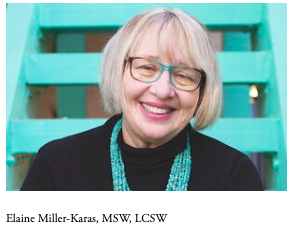
Elaine Miller-Karas, LCSW, is an author, lecturer, consultant, radio show host, trauma therapist, and social entrepreneur. She is a co-founder and the Director of Innovation of the Trauma Resource Institute and a founding member of the International Transformational Resilience Coalition. She is the author of Building Resiliency to Trauma: The Trauma and Community Resiliency Models® (2015). Her models have been introduced in over 75 countries. She has presented at the Skoll World Forum, Resiliency 2020 and 2021, and the United Nations. Her book was selected by the United Nations and Taylor and Francis’ curated online library as one of the innovations helping to meet the United Nations’ Sustainable Development Goals. She is also a Senior Consultant to Emory University’s SEE Learning program, inspired, and launched by His Holiness the Dalai Lama, and she is consulting with the Medgar and Myrlie Evers Foundation to help create a virtual curriculum of the U.S. Civil Rights Movement. Her radio talk show, Resiliency Within: Building Resiliency during Unprecedented Times, is on VoiceAmerica.
Yunetta Smith, one of the few African American EMDR-certified therapists in the nation, will talk this week with History. Culture. Trauma. podcast hosts Ingrid Cockhren, CEO of PACEs Connection, and Mathew Portell, director of communities. The podcast airs on Thursday, Oct. 6, at 1 p.m. PT; 4 p.m. ET.
Smith describes herself as “a thriving therapreneur—a therapist + entrepreneur. She is the CEO and founder of Spring Forth Counseling and Ground Breakers Coaching and Consulting of Clarkesville, Tennessee. She specializes in helping Black and Brown clients navigate childhood trauma.
EMDR, which stands for “eye motion desensitization and reprocessing”, is a psychotherapy treatment that was originally designed to alleviate the distress associated with traumatic memories, according to the EMDR Institute. It is a well-studied and highly effective treatment for those who have experienced trauma or have been diagnosed with post traumatic stress disorder.
Smith is a Licensed Professional Clinical Counselor (LPCC) in three states— Tennessee, Kentucky and Indiana. She is also a nationally certified counselor, clinical trauma professional, and EMDR therapist/approved consultant.
She specializes in helping people work through childhood trauma that manifests in adulthood. Her clientele comprises public figures, professionals, pastors, and practitioners. She also works to raise awareness about childhood trauma and the effectiveness of EMDR as a healing modality through various media platforms including the weekly “Talk it out Tuesday” segment on the Rickey Smiley Morning Show, co-hosting the Deeper than the Diet Podcast, and self-publishing her self-care workbook, “Take the Struggle out of Self Care”.
Calling herself a groundbreaker, a stigma breaker, and a cycle breaker, Smith says she “cultivates spaces for healing, wholeness, compassion, and change,” in hopes that her clients will be better able to “stand in their truth.”
This week’s episode airs on Thursday, October 6 at 1 p.m. PT; 4 p.m. ET, and can be heard at by clicking this link.
To hear prior episodes via your favorite podcast service, use the links below.
Yunetta Smith, one of the few African American EMDR-certified therapists in the nation, will talk this week with History. Culture. Trauma. podcast hosts Ingrid Cockhren, CEO of PACEs Connection, and Mathew Portell, director of communities. The podcast airs on Thursday, Oct. 6, at 1 p.m. PT; 4 p.m. ET.
Smith describes herself as “a thriving therapreneur—a therapist + entrepreneur. She is the CEO and founder of Spring Forth Counseling and Ground Breakers Coaching and Consulting of Clarkesville, Tennessee. She specializes in helping Black and Brown clients navigate childhood trauma.
EMDR, which stands for “eye motion desensitization and reprocessing”, is a psychotherapy treatment that was originally designed to alleviate the distress associated with traumatic memories, according to the EMDR Institute. It is a well-studied and highly effective treatment for those who have experienced trauma or have been diagnosed with post traumatic stress disorder.
Smith is a Licensed Professional Clinical Counselor (LPCC) in three states— Tennessee, Kentucky and Indiana. She is also a nationally certified counselor, clinical trauma professional, and EMDR therapist/approved consultant.
She specializes in helping people work through childhood trauma that manifests in adulthood. Her clientele comprises public figures, professionals, pastors, and practitioners. She also works to raise awareness about childhood trauma and the effectiveness of EMDR as a healing modality through various media platforms including the weekly “Talk it out Tuesday” segment on the Rickey Smiley Morning Show, co-hosting the Deeper than the Diet Podcast, and self-publishing her self-care workbook, “Take the Struggle out of Self Care”.
Calling herself a groundbreaker, a stigma breaker, and a cycle breaker, Smith says she “cultivates spaces for healing, wholeness, compassion, and change,” in hopes that her clients will be better able to “stand in their truth.”
This week’s episode airs on Thursday, October 6 at 1 p.m. PT; 4 p.m. ET, and can be heard at by clicking this link.
To hear prior episodes via your favorite podcast service, use the links below.
Note – We’re reposting this PACEs Science Champion feature by Laurie Udesky, from November 16, 2021, to share more about the life and work of Dan Press, who died yesterday. He was our remarkable friend and partner in preventing and healing adverse childhood experiences (ACEs) and promoting healthier, more compassionate, more resilient communities. Please see this post by Jesse Kohler for more information about Press, his life and legacy.
In 1964, Dan Press was in his first year of law school and was not liking it; he wanted a way out. He applied for a volunteer spot with AmeriCorps VISTA, the domestic version of the Peace Corps, and was intrigued by a position on an Indian reservation.
Dan Press
“I knew nothing about Indians, but it sounded like a good opportunity,” says Press, who was raised in Flushing, in the Queens borough of New York City. “So, I signed up and the next thing I knew I was on a plane to Montana,” he says.
It was a move that changed the course of his life.
Press, an attorney and now 78 years old, has spent his entire working life fighting on behalf of Indian tribes. He helped found the Tribal Employment Rights Office in 1977, which now has 300 offices around the country. His first legal battles involved pushing for enforcement of laws passed a half a century earlier to give Native Americans preference in hiring for employment on Indian lands brought by outside agencies and firms, but until Press challenged practices and won, those laws were largely ignored.
During his long legal career from working for The Navajo-Hopi Legal Services Program for the Navajo Nation in Arizona to his work at Van Ness Feldman, a law firm in Washington, D.C., he’s also counseled Indian tribes in advancing legislation that’s resulted in hundreds of millions of dollars in land settlements and the procurement of new health facilities. He helped found the first intertribal bank in the nation. Press has also been a champion of promoting trauma-informed initiatives, which in 2018 earned him a Public Advocacy award from the International Society for Traumatic Stress Studies for “Outstanding and Fundamental Contributions to Advancing the Social Understanding of Trauma.” In addition, he is the author of “A How-To Handbook on Creating Comprehensive, Integrated Trauma-Informed Initiatives in Native American Communities.”
Press is the general and legislative counsel for the Campaign for Trauma-Informed Policy and Practice (CTIPP), which helps local, county and state initiatives advocate for legislation to expand trauma-informed practices across the country. He also served as general counsel for The Roundtable on Native American Trauma-informed Initiatives. Both organizations are pro bono clients of his law firm. He has taught classes on tribal government at Columbia University, including “The Holocaust and Genocide in America”, in which students looked at common themes that arose in the genocides of Native Americans and of Jews.
On his first foray into Indian land in Montana, Press tutored children and coached basketball on the Crow Indian Reservation in the southern part of the state. While there, he was approached by Joseph Medicine Crow, the last living war chief of the Crow tribe, an oral historian and writer, who chronicled the living stories of the Crow. Medicine Crow asked Press to translate Crow treaties with the federal government into everyday language. (Medicine Crow, who won a Presidential Medal of Freedom for his war time service during WW II and for his work chronicling Crow history, died in 2016). The project was a turning point for Press. “It made me interested in Indian law,” he recalls.
Fortuitously, a couple he met in Montana who had just graduated from Yale Law School, which had coursework focused on law and society, helped him transfer from Columbia Law School to Yale, where he finished law school two years later in 1968. He then headed to the Navajo Indian Reservation in Window Rock, Arizona to take a job with The Navajo-Hopi Legal Services Program. He shed his urban roots enough to buy a horse, help friends herd cattle in his spare time, and he also attended native ceremonies.
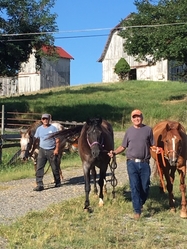
strolling with horses
That experience with the legal services program gave Press a window into the lives of the people he was representing. “We knew there was a lot of beauty out there; there were a lot of beautiful traditions and wonderful people who weren’t reaching their full potential,” he says. Press got involved in employment law, “because I thought if people had jobs, that would help them overcome some of the problems like alcoholism and suicide and other major problems that people suffered on the reservation.”
That employment work, pushing for Indians to have preference in employment over non-Indians for jobs brought into the reservation, led to the establishment of the first Tribal Employment Rights Office in Window Rock. Although there were laws to give that preference, explains Press, “nobody every enforced them.”
When Press moved to Washington, eventually taking a job at the law firm Van Ness Feldman where he spent more than three decades, he continued to fight for Indian preference in employment.
“We had battles with federal agencies who said, ‘You can’t tell our federal contractors or grantees what to do.’ Now we had to show that tribal sovereign authority was stronger than any of those federal regulations. And that tribes could tell federal contractors they have to comply with Indian preference requirements of the tribe. So, a lot of it was fighting to assert tribal sovereignty, which at that point, was still a very new concept.”
As a result of Press’s efforts to push and maintain enforcement of Indian preference law, some 300 Tribal Employment Rights Offices have sprung up around the country.
Despite these victories, Press was beginning to understand that improving employment rights among native people did not mean—as he had hoped—that the societal problems on Indian reservations would go away.
“By around 2010, I started getting very disillusioned. I noticed that 40 years after I’d left the Navajo reservation, the problems that I thought would gradually dissipate were still as bad as ever—the alcoholism and the suicide and all of the other health and social problems that the tribes lead the country in,” he recalls.
He took the problem to his Columbia University students in the first course he taught on Indian tribal government.
“The issue I put before the students is how do we explain all of this dysfunctionality that we see on reservations? Why haven’t those problems decreased? We’ve seen an increase in college graduates, we’ve seen an increase in economic status, but we still have huge unemployment problems, huge substance use problems, huge suicide problems, high school dropout problems,” he says.
It was his students, says Press, who first introduced him to the concept of intergenerational and historical trauma in 2011. They had worked with professors in the university’s psychology department who were investigating how trauma from stress caused changes in genes in mice that were passed down from one generation to the next. (For an example of research around generational trauma and epigenetics, see this study. For research on Holocaust survivors and epigenetics, see this study.)
“It was after that class that I became persuaded that historical trauma was by far the most viable explanation for all for a lot of the problems that you see on reservations,” Press says.
Around the same time as the class, Press’ wife emailed him a study that she thought he should read. It was the landmark Centers for Disease Control and Prevention/Kaiser Permanente Adverse Childhood Experience Study (ACE Study) that tied 10 types of childhood trauma, such as living with a family member who’s addicted to alcohol or is depressed, with chronic disease in adulthood. The ACE Study and subsequent research also showed links between childhood trauma and alcohol and drug abuse in adulthood.
“So, I read it and thought, ‘It really connects the dots between historical trauma and these other forms of trauma’,” says Press. “I began studying more about it and I became a convert, and thought it was one of the most important studies out there.”
In 2014, a phone call with a former client would send Press on his current path. The call was with Native American psychologist, Dr. Tami DeCoteau, whom he describes as his “guru on trauma,” who called Press up one day and said, “I never mentioned it, but I used to babysit for Senator Heidi Heitkamp from North Dakota, and she just called me and said: ‘Let’s have coffee. I want to just pick your brain on what issues I should be dealing with.’”
Press suggested that DeCoteau ask Heitkamp to hold a roundtable discussion on historical trauma in Indian country. Heitkamp, who said it was consistent with her interest in issues affecting children, agreed.
Press and DeCoteau brought together about 25 people in 2014 to speak, including PACEs Connection’s Elizabeth Prewitt, who described the ACE Study. DeCoteau spoke about the experience of trauma on Indian reservations, and representatives from the Menominee tribe in Wisconsin talked about their cross-sector work in implementing trauma-informed practices. (See this PACEs Connection storyfor more on this meeting.)
Heitkamp stayed put for a full hour of the three-hour roundtable, recalls Press. “Getting a senator to sit the whole hour was amazing… But as she walked out, she said, ‘I’ve walked out of this hearing room for the Senate Committee on Indian Affairs depressed so many times because of all the problems people have described. This is the first time I’m walking out optimistic that maybe we have a solution!’”
That meeting gave rise to The Roundtable on Native American Trauma-informed Initiatives in 2016. While the group, led by leaders volunteering their time, including Press, is no longer active, it held meetings to inform government officials about the merits of trauma-informed programs. It also organized conferences for Native Americans, including one entitled: Calling Upon the Warrior Spirit to Heal Historical Trauma Conference and Ceremony in 2018.
In 2017, Heitkamp, along with Illinois Senator Dick Durbin, introduced the Trauma-Informed Care for Children and Families Act of 2017. Provisions of the legislation were later included in legislation signed into law in 2018 to address the nation’s burgeoning opioid epidemic. Until she lost her reelection bid to the Senate in 2019, Press says that Heitkamp remained a staunch supporter of legislation to advance trauma-informed policy.
Around the same time, Press was introduced to Dr. Sandra Bloom, a psychiatrist who was among a group of clinicians who developed a trauma-informed practices protocol known as the Sanctuary model, which has been widely disseminated around the country in schools and organizations, and Dr. Andrea Blanch, the president and director of the Center for Religious Tolerance, who trains service agencies and communities in trauma-informed practices. The two told Press of their interest in forming a national organization with leaders from across sectors to spread the word about trauma-informed practices. They just needed a place large enough to hold the meeting. Press offered up a room at his law firm.
That conversation sparked the formation of the Campaign for Trauma-Informed Policy and Practice, and Press, who was winding down his legal practice, jumped in. CTIPP focuses on advocating for legislation that incorporates the science of positive and adverse childhood experiences (PACEs science) into federal programs and serves as a forum for trauma-informed coalitions to share ideas and resources. In February 2020, just before the COVID-19 pandemic took hold, CTIPP launched the National Trauma Campaign, which is focused on recruiting advocates for trauma-informed legislation in every Congressional district. (See the attached slide deck to learn more about the work of CTIPP.)
That effort has already produced results. “When we first started, there was really just Senator Durbin and Senator Heitkamp. Now there are probably a half dozen senators who have introduced trauma-informed legislation,” says Press. In June, Senators Durbin and Shelley Capito of West Virginia, and others introduced the Rise from Trauma Act, which would infuse trauma-informed policies into federal programs. The bill would also provide funding for community-level work on trauma-informed practices. That bill hasn’t moved yet, says Press. But he has hopes about the reconciliation bill (a.k.a. Build Back Better, click here for PACEs Connection story), which is before the House of Representatives for a vote, and includes $2.5 billion in funding, which could go towards trauma-informed community coalitions.
If that happens, he says, “we’ll achieve one of our most important goals, which is to get funding to these local coalitions because they’re springing up all over the country and you see them on PACEs Connection. But the thing they all struggle with is funding. We have a lot of great volunteers, but we don’t have funding to hire full-time staff. So as the reconciliation bill passes with the Senate for the first time, there’ll be a funding source for local trauma-informed coalitions, and that would be a huge, huge, huge win.”
Press points to the appropriations bill report that just came out of the U.S. House of Representatives as another sign of progress. It included 30 different items in which funding was provided for trauma-informed related programs.
Reflecting next steps, Press says, it’s really all about education. “We know how to help people who have suffered trauma. We know how to prevent trauma. It’s really the education piece that is the biggest barrier. If we get in front of every state legislator, every congressperson, every governor for a half an hour, and go through the [positive and adverse childhood experiences] science, I think all of the barriers would just fall like crazy.”
Note: PACEs Connection is in dire financial straits. A funder who’d promised $500,000 reversed course and we are asking for help, from you, our 57,400+ members, to help cover the loss. Pay and hours have been cut for our staff – most of us will be laid-off for the month of December. Since sounding the alarm this summer,we’ve raised about $22,000. To get a sense of who your fellow members are, who is donating, and why, please enjoy our first in a series of donor profiles, and be like Lois: Now that you know we need your help, pleasemake a generous donationto PACEs Connection!
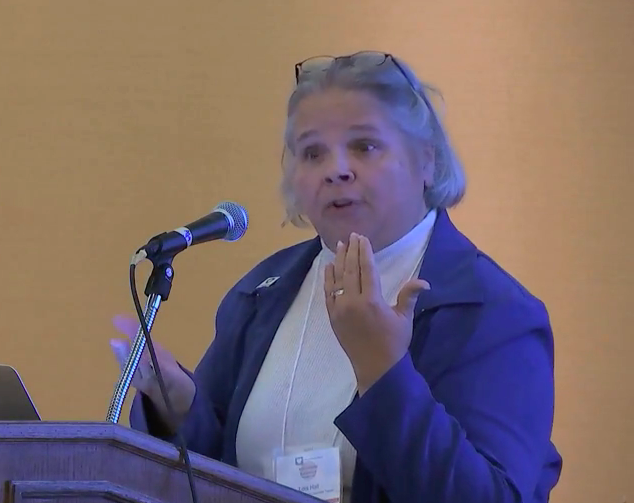
“I love PACEs Connection—and the thought that it might go away was not only frightening—but sad. Where else would I find the things I get from PACES Connection, all in one place?”—Lois Hall, grief recovery specialist
When Lois Hall first learned about the science of adverse childhood experiences (ACEs) in 1998, it made complete sense. “That study, and all the ensuing research and analysis proves that grief/change/loss—in the broadest terms—is indeed the root of almost all (if not all) of our ills as individuals, communities and… our world,” she says.
She would know as well as anyone. Hall, past executive director of the Ohio Public Health Association, has been doing Grief Recovery Method programs and training for more than two decades. She’s been in the field of public health for more than 40 years.
“I took my Grief Recovery Method (GRM) training in 1998 and saw the important role of grief/loss/change in the basics of all we do in public health. I remember in my training thinking, ‘We have a program and brochure for all of these topics—but they’re not working.’ In public health we weren’t getting to ‘the heart’ of those topics—obesity, smoking, alcoholism, abuse, drug use, suicide, violence, etc.,” she says.
“Bingo! All the pieces came together,” she recalls. “I literally sat in that staff meeting and cried, because it is indeed those things that happen to us in childhood that impact us throughout our lives—till death.”
As an “early adopter,” Hall began referencing the ACE Study into her work as national trainer and technical assistance consultant at the Grief Recovery Institute.
“I look to PACES Connection for proof of where hope is brought in communities…”
“When I do Grief Recovery Method training for the Grief Recovery Institute,” she explains, I always conclude by telling the new trainees that while they came to become Grief Recovery Method specialists, I’m sending them out as that AND as ‘hope-bringers’ to a pretty hopeless-seeming world.
She gives PACEs Connection much credit for the hope she has.
“I look to PACES Connection for proof of where hope is brought in communities, data that proves the impact of PACEs and interventions that can help bring that hope, in addition to our programs, of course.
“I love PACEs Connection—and the thought that it might go away was not only frightening—but sad. Where else would I find the things I get from PACES Connection, all in one place? I just didn’t want to imagine not having it,” she says.
Hall counts on PACEs Connection for what’s in the name of the organization: Connection. “Working for a small company there’s no ‘chatting around the water fountain’ about what we’ve heard or seen in journals or other articles,” she explains. “I count on PACES Connection for that.”
Hall relies on the resources, information, and the Weekly Roundup as among her primary sources of continued learning and staying current on PACE research and practice. “For me to stay informed and current, PACEs Connection is my ‘community of like-minded professionals and advocates,” she says.
“And ‘being involved’ also means I have chosen to make a financial donation,” Hall points out, adding, “Why should other members of PACES Connection provide financial support? If not us, then who?”
Note: PACEs Connection is in dire financial straits. We are asking for support, from you, our57,505 members, to help cover the loss of foundation funding that was promised and didnot come through. Pay and hours have been cut for our staff—most of us will be laid off for the month ofDecember. Another grant will pick up in January. Since sounding the alarm this summer,we’ve raisedabout $24,000. To geta sense of who your fellow members are, who is donating and why, please enjoy and share this secondpost in a series of donor profiles, and be likeRobin:Pleasemake a generous donationto PACEs Connection!
“PACEs Connection has been my north star for credible information about the science, research, and lived expertise that is centered on healing our most intractable problems,” says Robin Cogan, a nationally certified school nurse (NCSN) in an elementary school clinic in Camden, New Jersey.
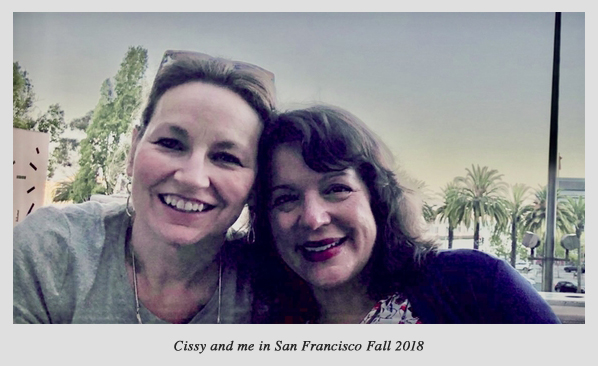
Cogan and former PACEs Connection employee and current blogger Cissy White met in person at the 2018 ACEs Conference in San Francisco after connecting on (then) ACEs Connection and Twitter!
She found PACEs Connection following the death of her father.
“He was a complex man who died from a hemorrhagic stroke, directly linked to the trauma he suffered as a 12-year-old boy witnessing the death of his entire family,’’ she explains. “He was buried on the 60th anniversary of the murders. I was on a quest to understand the life and death of my father, and found it through the research provided in the treasure trove of information available on PACEs Connection.”
Generational trauma
Cogan’s family has experienced the trauma of two mass shootings with both survivors and victims. A niece of Cogan’s was involved in a school shooting several years ago, and survived in the same way her grandfather survived in the mass shooting of his family seven decades earlier: She hid in a closet.
“Generational trauma was my original reason for digging deeper into the science of ACEs,” Cogan says. “It is my goal to do everything in my capacity as a school nurse and family-member survivor to end gun violence through public health measures which drive me to share this work. PACEs science holds the key by reducing and working to eliminate childhood adversity, especially exposure to violence. That will change the world.”
Headaches and stomach aches
As a clinical coordinator in the school nurse specialty program where she teaches at the Rutgers School of Nursing in Camden, Cogan has shared her passion and expertise in school nursing with hundreds of college students who follow in her footsteps to be, oftentimes, the one person who understands what’s happening when a child shows up at a school clinic with the fifth headache of the month; the third stomach ache of the week. She knows trauma is likely the root cause of many of those headaches and stomach aches.
Her work on the faculty in the School Nurse Certificate Program at Rutgers University-Camden School of Nursing earned her the 2018 Rutgers University – Camden Chancellor’s Teaching Excellence Award for Part-time Faculty.
“The Relentless School Nurse”
Cogan is also a prolific writer. Her weekly “Relentless School Nurse” posts were named “Top Nursing Blog” in 2020 on her website by the same name. Cogan also authors a monthly column in “My American Nurse”, the official journal of the American Nurses Association, and is the recipient of multiple awards for her work in school nursing and population health, including the 2019 and 2020 National Association of School Nurses President’s Award and the New Jersey Department of Health 2017 Population Health Hero Award. She was also named the 2018 National Certified School Nurse (NCSN) School Nurse of the Year, and the 2017 Johnson & Johnson School Nurse of the Year.
“Our gifts back…will bring more light..”
As for her generous support of PACEs Connection, Cogan says, “For so long the content of PACEs Connection has been open-access and I am sure that will continue. But answering this call for support is the least that we can provide for all that has been given by the organization.
“When you look at the structure behind PACEs Connection, you realize how few devoted people are providing so much content, research, opportunities for community building, and space to exhale in this complex world. I have given over the years, but realize that if each of us gave even a small amount, the collective impact would be a game-changer for PACEs Connection,” she adds.
”I appreciate that PACEs Connection lifts up community-inspired solutions by engaging grassroots groups working to heal their communities,” she says. “It has been a focal hub for learning, growing, and amplifying the science of positive and adverse childhood experiences. Our gifts back will be used to bring more light into this world in great need of healing.”
Cogan encourages fellow members of PACEs Connection to join her in making a generous, tax-deductible donation to PACEs Connection here.
If you’d prefer to mail your gift rather than give it online, here’s how…
Make check payable to: TSNE (Third Sector New England, our fiscal sponsor) and write PACEs Connection Donation on the memo line.
Mail check to: PACEs Connection, c/o TSNE, 89 South Street, Suite 700, Boston, MA 02111
Making a wire transfer or need Tax ID information?
 Carey Sipp 6/23/2210:45 PM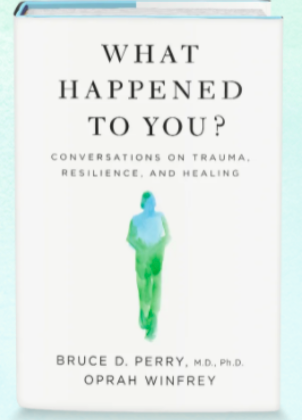
 This opportunity is a new way PACEs Connection members and communities can connect, learn, heal, brainstorm and work together to improve the lives of children and families based on lessons learned from the book. The Connecting Communities project was inspired by the Georgia Reads book study of “What Happened to You?”, in which more than 40 Georgia groups discussed the book in the past year.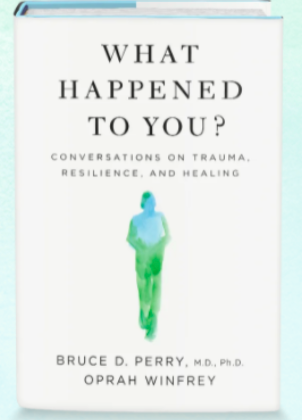







 By Elaine Miller-Karas MSW, LCSW Building Resiliency to Trauma Psychology Today, September 30, 2022 Mental health can suffer after extreme climate events.
 ACEs Connection, and Mathew Portell, director of communities. The podcast airs on Thursday, Oct. 6, at 1 p.m. PT; 4 p.m. ET.

 If you’d prefer to mail your gift rather than give it online, here’s how…
 Making a wire transfer or need Tax ID information?
